Uncategorized
Lemon Juice Won’t Beat a U.S. Hair Drug Test That Covers 90 Days
Oct
No, lemon juice does not reliably make you pass a hair follicle drug test. Topical acids only touch the outer surface of the hair shaft, while drug metabolites bond chemically inside the keratin structure where surface treatments cannot reach, according to peer-reviewed research. Abstinence and new hair growth remain the only guaranteed path to a clean result.
TL;DR:
- Standard hair samples cover roughly 1.5 inches nearest the scalp, or about 90 days; 30 days of abstinence will not clear metabolites already incorporated.
- Bleaching reduced concentrations by up to 90% for cocaine and about 60% for THC, but effects vary by substance and labs can flag treated hair.
- Laboratories wash every sample before extraction, may test the wash for outside contamination, and confirm positive screens with mass spectrometry.
- Before testing, confirm the panel and window, document prescriptions for medical review, consider a lab preview, and ask whether an alternate specimen is permitted.
Table of Contents
Table of Contents
- How Hair Follicle Tests Detect Drug Use Over 90 Days
- Why Lemon Juice and Other Surface Rinses Don’t Work
- Which Chemical Hair Treatments Actually Change Test Results
- What the Research Says About Vinegar, Baking Soda, and Multi-Step Kits
- How Labs Catch Tampered or Altered Hair Samples
- What to Do If You Have a Hair Test Coming Up
- The Chemistry Behind Lemon Juice and Hair Metabolites
- Common Myths About Lemon Juice and Hair Detox
- How Lemon Juice Compares to Other Detox Methods
- Can Lemon Juice Damage Your Hair?
- How People Typically Apply Lemon Juice in Detox Attempts
- Why Liquid Rinses Can’t Reach the Hair Cortex
- A Straight Answer on Why Myths Like This Persist
- PassHairDrugTest.com: Product and Resource Options
- FAQ
- Sources
- Primary Sources and Further Reading
How Hair Follicle Tests Detect Drug Use Over 90 Days
Hair follicle testing works differently from urine or saliva screening because it looks at what got absorbed into the hair as it grew, not what is currently in your system. When you use a substance, metabolites travel through your bloodstream and get incorporated into the hair follicle during the anagen, or active growth, phase. Once that segment of hair pushes above the scalp, the drug traces are locked inside the cortex.
Standard collection takes about 1.5 inches of hair closest to the scalp, which corresponds to roughly a 90 day detection window, based on average hair growth rates according to the Society of Hair Testing consensus. That window is why hair testing is favored for pre-employment and safety-sensitive screening: it captures a pattern of use rather than a single recent event.
Labs follow a standardized workflow before they report a result:
- Wash and decontaminate the sample to strip external residue from sweat, oils, or environmental exposure.
- Pulverize or homogenize the hair so the extraction solvent reaches the internal matrix evenly.
- Extract the metabolites using validated solvents suited to the specific drug class being tested.
- Confirm any positive screen with gas chromatography mass spectrometry, or GC-MS, which identifies exact molecular signatures.
Testing sensitivity now reaches the picogram-per-milligram range, according to the SoHT consensus, meaning labs can detect vanishingly small concentrations of a substance even after a sample has been washed or lightly altered. That sensitivity is part of why attempts to mask results at home carry so much risk: the margin for error a DIY method would need to clear is extremely thin.
Why Lemon Juice and Other Surface Rinses Don’t Work
The science on this is fairly settled. A 2023 study published in Drug Testing and Analysis found that lemon juice has no scientific efficacy for passing a hair follicle drug test. Researchers tested it directly against the biology of how hair stores drug metabolites and found no meaningful reduction in detectable concentrations.
The reason comes down to where the drug actually sits. Hair has an outer cuticle, an inner cortex, and in some hair types a central medulla. Drug metabolites that enter through the bloodstream during growth get trapped in the cortex, bound to the keratin protein itself. A topical rinse like lemon juice, no matter how acidic, interacts only with the cuticle surface. It cannot reach, let alone dissolve, metabolites that are chemically incorporated several layers deeper.
Even if a surface rinse could strip away some residue, it would not matter in practice. Laboratories wash every hair sample with solvents as a routine pre-analytical step before extraction even begins, according to the same peer-reviewed analysis. That means:
- Any surface residue lemon juice might have loosened gets removed by the lab’s own decontamination wash anyway.
- The wash solution itself can be analyzed separately to check whether external contamination, rather than ingestion, explains a result.
- Only the internal, post-wash extraction determines the final reported concentration, not whatever sat on the hair’s surface beforehand.
A 2023 peer-reviewed study found lemon juice produced no measurable reduction in hair drug metabolite concentrations, according to Drug Testing and Analysis. That single data point undercuts most of the home-remedy advice circulating online, because it tested the claim directly rather than relying on anecdote.
Which Chemical Hair Treatments Actually Change Test Results
Not every treatment is equally useless. Oxidative processes like bleaching and dyeing can chemically break down some drug metabolites sitting inside the hair shaft, unlike a surface rinse. The same 2023 study in Drug Testing and Analysis measured this directly and found the effect varies sharply by substance.
The reduction ranged up to roughly 90% for cocaine but only about 60% for THC under the treatment conditions tested, according to the same research. That gap matters: a treatment that happens to crush one drug’s signal might barely dent another’s, which makes bleaching an unreliable strategy for anyone unsure exactly what a panel is screening for.
| Treatment type | Mechanism | Reported effect |
|---|---|---|
| Lemon juice rinse | Surface-only acid contact | No measurable reduction |
| Oxidative bleaching | Breaks down metabolites inside cortex | Up to 90% reduction for cocaine, around 60% for THC |
| Dyeing | Chemical penetration similar to bleach | Inconsistent, substance-dependent |
Even where bleaching lowers concentrations, it is not a controlled or predictable process. Hair condition, treatment duration, and the specific drug class all change the outcome, and heavy bleaching can visibly damage the hair, which itself raises questions during collection.
Labs are not blind to this tactic either. Researchers have identified specific metabolite biomarkers, including compounds like PTCA and PTeCA, that signal a sample has been chemically treated, according to untargeted hair metabolomics research. A separate validated method using liquid chromatography-tandem mass spectrometry can similarly distinguish treated hair from untreated hair by analyzing amino acid damage patterns, according to this analytical chemistry study. In practice, that means:
- A heavily bleached or dyed sample can trigger a closer look or a request for an alternate specimen.
- Biomarker evidence of cosmetic alteration can accompany a report, undermining any claim that a negative result reflects abstinence.
- The unpredictability of the effect means some users see no change at all despite the damage to their hair.
What the Research Says About Vinegar, Baking Soda, and Multi-Step Kits
Lemon juice is not the only home remedy tested in the literature. The 2023 study in Drug Testing and Analysis evaluated three multi-step protocols beyond simple rinses, giving a clearer picture of how these DIY approaches actually perform under controlled conditions.
The study tested several protocols:
- A combination of baking soda, a salicylic acid moisturizer, and bleach.
- Bleaching paired with dyeing in sequence.
- A vinegar rinse combined with a moisturizer, a cleansing wash, and dyeing.
Protocols that included an oxidative step, bleach or dye, showed the concentration reductions described earlier for certain drug classes. Protocols built only around vinegar, baking soda, or moisturizers without bleach showed far weaker effects, consistent with the finding that non-oxidative, surface-level treatments struggle to reach bound metabolites regardless of how many steps are stacked together.
This distinction matters because it separates genuine chemistry from marketing claims. A multi-step kit sounds more rigorous than a single rinse, but if none of its steps involve oxidation, the added steps mostly add moisturizer and cleanser without changing the core problem: metabolites stay locked inside the cortex. Commercial detox shampoos marketed online vary widely in formulation, and user reports on their effectiveness are inconsistent, partly because lab confirmation methods differ in sensitivity and because individual hair chemistry, thickness, and drug history all affect outcomes.
How Labs Catch Tampered or Altered Hair Samples
Laboratories do not simply trust a sample at face value. The Society of Hair Testing’s 2021 consensus lays out a structured pre-analytical process specifically designed to catch contamination and alteration before a result is ever reported, according to the SoHT consensus document.
That process includes:
- Documenting visible hair condition and treatment history at collection, since cosmetic alteration is often apparent on inspection.
- Washing every sample with validated organic solvents or aqueous solutions before extraction, a step that also removes most surface tampering attempts.
- Analyzing the wash solution itself in some cases, which can reveal whether a positive result came from external contamination versus actual ingestion.
- Using pulverization for samples with low drug concentrations, which exposes more surface area to extraction and makes it harder for a thin surface treatment to hide internal content.
Beyond the wash protocol, biomarker science adds another layer of scrutiny. Metabolomic studies have identified chemical signatures left behind by oxidative treatments, giving labs a way to flag samples that look clean on a basic panel but show signs of cosmetic alteration, according to RSC Publishing research.
Pro Tip: If you’re worried about how a past treatment might look to a lab, assume any bleaching or dyeing done close to the test date could be noticed and plan around disclosure rather than concealment.
The practical consequence is straightforward: evidence of tampering does not just risk an inconclusive result, it can prompt a lab to request a repeat collection or push an employer toward an alternate specimen entirely.
What to Do If You Have a Hair Test Coming Up
If a hair test is scheduled and you cannot change the timeline, the honest starting point is understanding what is actually achievable. Abstinence and new hair growth remain the only guaranteed method, according to the SoHT consensus, and even that takes time since new growth has to replace the tested segment, roughly matching the 90 day window the test itself covers.
With that reality in mind, here is a realistic sequence of steps:
- Confirm the testing window and panel with whoever is requesting the test, since detection periods and substances screened can vary by employer or program.
- Consider a lab-grade preview test first, which gives you an evidence-based read on where you stand rather than guessing.
- Document any legitimate prescriptions ahead of time, since a Medical Review Officer (MRO) typically reviews positive results for medical explanations before they are finalized.
- Ask whether an alternate specimen, such as urine or oral fluid, is an option, since federal workplace testing guidelines recommend collecting an alternate authorized specimen alongside hair testing and note that a positive hair result alone may be vulnerable to legal challenge without corroborating evidence.
- If hair length allows and the policy permits it, ask about segment testing options rather than assuming nothing can be clarified.
A few additional points worth keeping in mind:
- Routine washing and normal hair hygiene are safe and will not trigger tampering flags the way heavy bleaching might.
- Preview testing is a legitimate way to reduce uncertainty without attempting to alter the sample itself.
- Trimming hair short is sometimes suggested, but only pursue this if your specific testing policy explicitly allows it, since refusing to provide a sample of adequate length can itself be treated as a failure to test.
You can read more about how hair drug test accuracy works and how it compares to other detection windows if you want a fuller picture before your test date.
The Chemistry Behind Lemon Juice and Hair Metabolites
Lemon juice is acidic, with a pH typically well below 3, and acids do interact with hair in measurable ways. They can temporarily raise the cuticle scales on the outer hair shaft and strip some surface oils and residue, which is part of why lemon juice shows up in folk remedies for hair shine or dandruff.
That surface interaction, though, is categorically different from what would be needed to affect a drug test. Drug metabolites that enter hair during growth are not sitting loosely on top of the strand. They become chemically associated with the melanin and keratin structures inside the cortex, the dense inner layer that makes up most of the hair’s mass. An acid rinse applied externally changes the outer cuticle’s texture and openness, but acids at the concentration found in lemon juice do not break the internal protein bonds holding metabolites in place.
This is consistent with the direct finding that lemon juice showed no measurable effect on detectable concentrations in controlled testing, according to Drug Testing and Analysis. The acid simply never reaches the compartment where the evidence actually lives.
Common Myths About Lemon Juice and Hair Detox
A lot of the advice circulating about lemon juice traces back to general folk beliefs about acids “cleaning” or “stripping” things, applied to hair testing without any real basis. A few of the most common claims do not hold up.
One myth is that lemon juice “opens” the hair shaft enough to flush out drug residue, similar to how it is sometimes used to lighten hair color. Mild cuticle lifting is real, but lifting the outer cuticle is not the same as reaching compounds bound deep in the cortex.
Another common claim is that combining lemon juice with heat, like a hot shower or hair dryer, somehow accelerates the detox effect. There is no scientific support for this; heat may enhance the mild cuticle effect, but it does not change the fundamental chemistry of where metabolites are stored.
A third myth suggests that frequent lemon juice washes over several days can gradually “flush” the hair. Repetition does not change what the 2023 peer-reviewed study found: lemon juice showed no measurable efficacy at all, regardless of how it was applied, according to Drug Testing and Analysis.
How Lemon Juice Compares to Other Detox Methods
Lining lemon juice up against other approaches readers commonly hear about makes the gap clear. Lemon juice itself produced no measurable reduction in hair drug concentrations in controlled research, according to Drug Testing and Analysis, putting it in the same ineffective category as plain vinegar rinses or baking soda pastes used alone.
That inconsistency, combined with visible hair damage, makes bleaching an unpredictable strategy rather than a reliable one.
Multi-step protocols that combined an oxidative step with cleansers or moisturizers performed closer to bleaching alone, while protocols without any oxidative component performed closer to lemon juice: largely ineffective. The pattern across all of this research points the same direction. Surface-level acids and simple rinses do not reach internally bound metabolites, while chemical treatments that alter the cortex can shift results somewhat but carry damage and detectability tradeoffs of their own.
Can Lemon Juice Damage Your Hair?
Even setting aside whether lemon juice affects test results, it is worth knowing what repeated use does to your hair. Citric acid at the concentration found in lemon juice is a mild to moderate irritant when left on the scalp or applied frequently, and it can dry out both hair and scalp skin with regular use.
The acidity can also make hair more porous and prone to breakage over time, particularly for hair that is already chemically treated, color-treated, or naturally dry. Because lemon juice temporarily lifts the cuticle, repeated applications followed by sun exposure can also accelerate color fading in dyed hair.
None of this is dangerous in the way a harsh chemical treatment might be, but it is worth weighing against the fact that the practice does not improve your odds on a hair test at all.
How People Typically Apply Lemon Juice in Detox Attempts
For context, the typical home method looks something like this: fresh lemon juice, sometimes diluted with water, is massaged into wet or dry hair and left on for anywhere from a few minutes to over an hour, often repeated daily in the days leading up to a test. Some versions call for combining it with baking soda to form a paste, or following it with a standard shampoo rinse.
The underlying theory behind this routine is that the acid will “open” the hair and allow trapped substances to wash out, sometimes paired with claims about heat or steam boosting the effect. As the chemistry above shows, this theory does not match how metabolites are actually stored inside the hair cortex, and the 2023 controlled study confirmed there was no measurable reduction in detectable drug concentrations from this kind of application, according to Drug Testing and Analysis.
If you are weighing whether to spend the days before a test on this kind of routine, the research suggests the time would be better spent understanding your actual detection window and legitimate options instead.
Why Liquid Rinses Can’t Reach the Hair Cortex
The core reason lemon juice and similar liquid treatments fail comes down to hair structure itself. Hair has an outer cuticle, an inner cortex containing keratin and melanin, and in some hair types a central medulla.
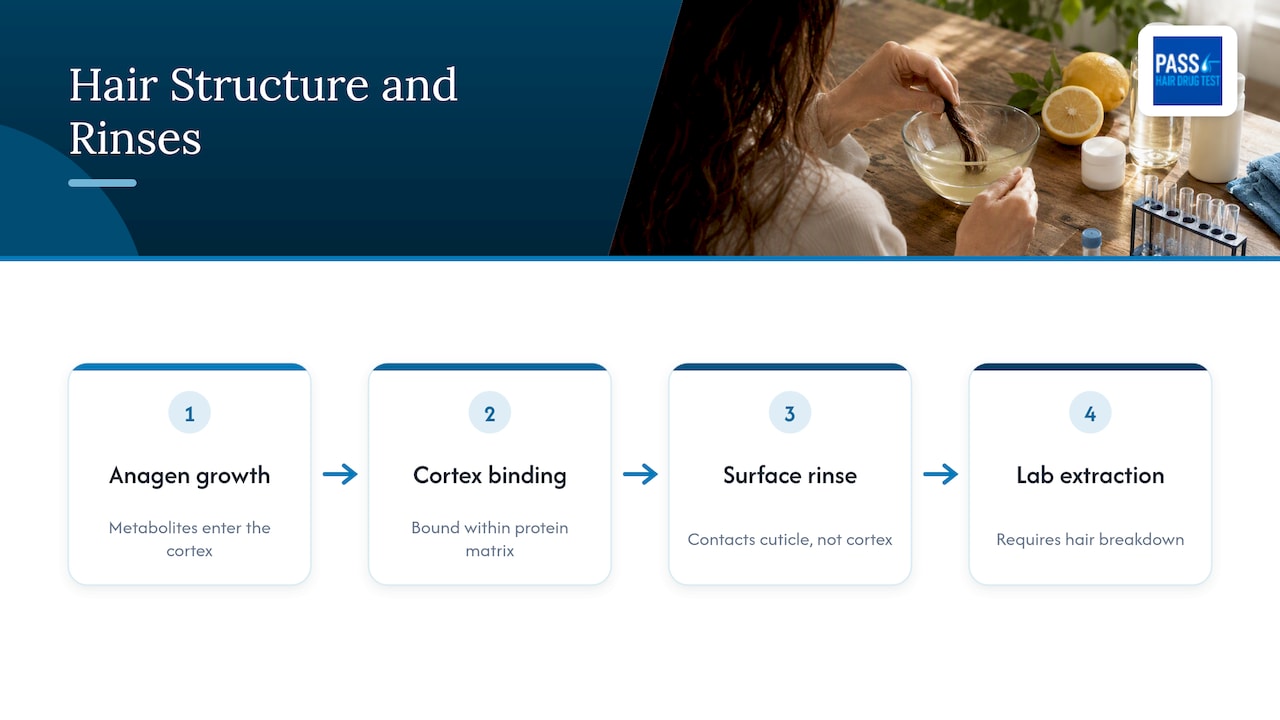
Drug metabolites enter the cortex through the bloodstream during the anagen growth phase and become chemically bound to those internal structures as the hair forms. By the time hair has grown out and been cut for testing, those metabolites are not loose or sitting in a cavity, they are incorporated into the solid protein matrix.
A liquid rinse, regardless of its acidity, interacts primarily with the cuticle layer on contact. Even when an acid temporarily lifts the cuticle scales, the liquid does not have the chemical capacity to dissolve or extract compounds bonded within the cortex’s keratin structure. This is a structural limitation, not a matter of using more lemon juice or leaving it on longer. It is also precisely why laboratory extraction requires pulverizing or digesting the hair before analysis, according to the SoHT consensus: reaching the cortex requires breaking down the hair’s physical structure, not simply rinsing its surface.
A Straight Answer on Why Myths Like This Persist
The lemon juice myth persists because it sounds plausible. Acids do visibly change hair, and “detox” framing borrows credibility from legitimate uses of citrus in skincare and cleaning. But plausible is not the same as tested, and when researchers actually tested the claim, it produced no measurable effect.
What strikes us most about this topic is how much of the home-remedy advice online treats “the hair test” as a single obstacle, when in reality it is a layered system: growth biology, lab washing, extraction chemistry, and confirmatory mass spectrometry. A method has to defeat all four to matter, and a kitchen ingredient defeats none of them. The treatments that do measurably shift results, oxidative bleaching and dyeing, work precisely because they alter the cortex chemically, not because they are stronger versions of a rinse.
The more useful mental shift for most readers is abandoning the idea of “beating” a hair test and replacing it with understanding the actual detection window and what legitimate, transparent options exist if a test is coming up faster than that window allows.
— MIchael
PassHairDrugTest.com: Product and Resource Options
We built our catalog around understanding where home remedies fall short and what may require a structured approach. Our site offers preview testing options and detailed product information so you can evaluate your situation with real information rather than guesswork from a forum post.
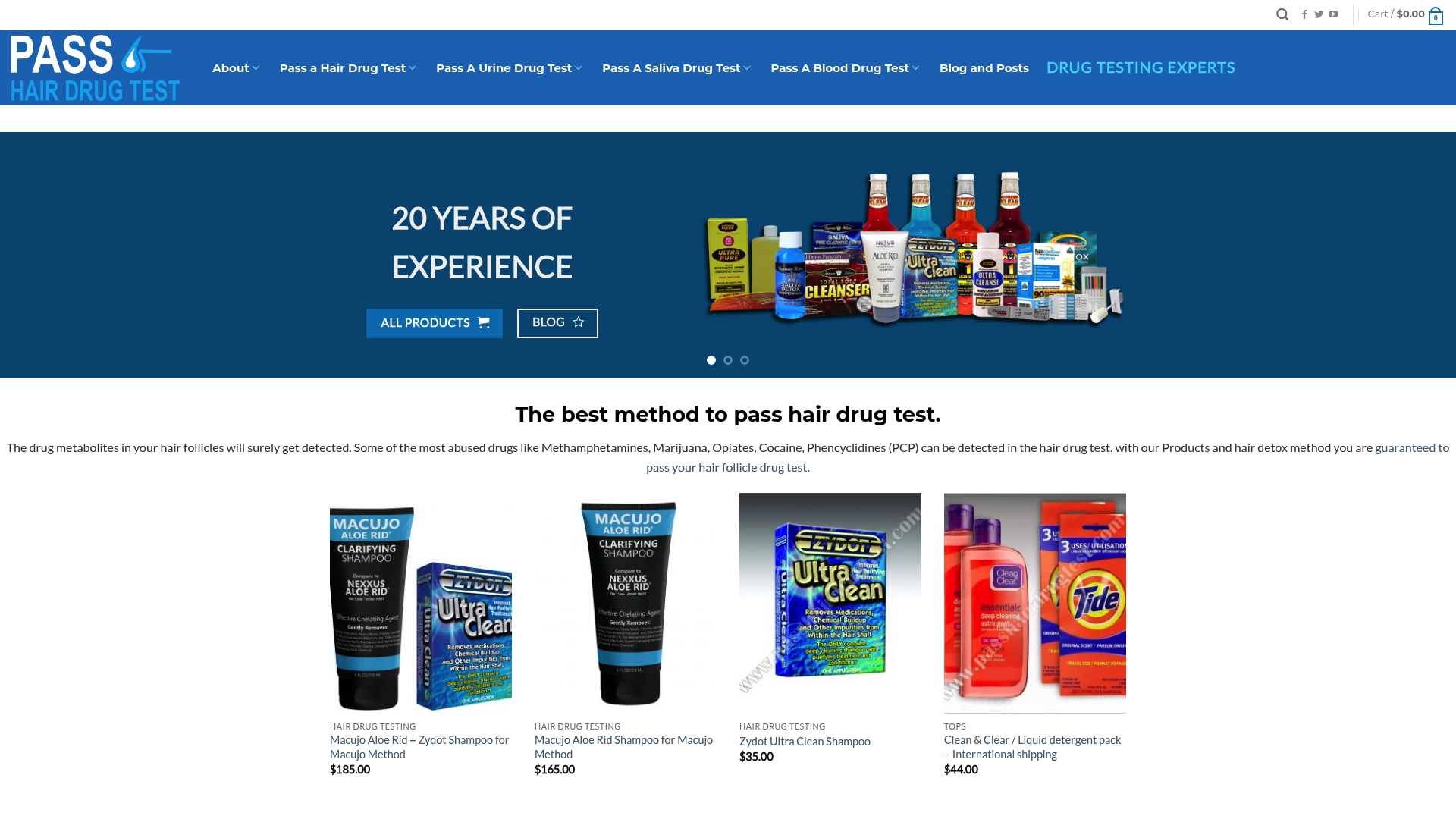
What we offer includes:
- Hair follicle shampoo kits built around multi-step protocols rather than single-ingredient rinses.
- Individual shampoo products for readers who want a standalone option.
- A range of hair testing shampoo kits.
- Supporting hair drug test information pages that walk through preparation in detail.
No product changes the biology covered above, and we think that’s worth saying plainly. What our resources can do is give you a structured, transparent process to evaluate instead of relying on kitchen-ingredient myths. Visit our product pages to see the full lineup and find the option that fits your timeline.
FAQ
Does lemon juice help pass a drug test?
No, lemon juice does not reliably make you pass a hair follicle drug test. Topical acids only touch the outer surface of the hair shaft, while drug metabolites bond chemically inside the keratin structure where surface treatments cannot reach, according to peer-reviewed research. Abstinence and new hair growth remain the only guaranteed path to a clean result.
What’s the best way to pass a hair follicle test?
Abstinence combined with new hair growth is the only guaranteed method, since the tested segment has to be free of the substance from the start, according to the SoHT consensus. Where abstinence isn’t possible before a scheduled test, requesting an alternate specimen through the testing program, where federal guidelines support this option, is a more realistic path than a home remedy.
Can you pass a hair follicle test in 30 days?
It depends heavily on usage history, hair growth rate, and the specific substance involved, since standard hair tests typically cover roughly a 90 day window based on about 1.5 inches of hair, according to the SoHT consensus. Thirty days of abstinence alone will not clear hair that already incorporated metabolites during that window.
What can cause a false positive on a hair follicle test?
External contamination from environmental exposure to a substance is one documented concern, which is why labs analyze wash solutions separately from the internal hair extract, according to the SoHT consensus. Cosmetic treatments like heavy bleaching can also complicate results, and labs use biomarker analysis to flag samples that show signs of chemical alteration.
Is it safe to use lemon juice on your hair before a drug test?
Lemon juice itself is not dangerous in small amounts, but frequent or undiluted use can dry out hair and scalp skin and increase breakage over time. Since it has no measurable effect on test outcomes, using it mainly adds a hair care downside without any corresponding benefit for the test itself.
Sources
- Analyticalsciencejournals
- Participants in the discussion: Alain Verstraete, Brice Appenzeller, Carmen Jurado, Donata Favretto, Donna Cave, Elena Lendoiro, Frank Sporkert, Gisela Skopp, Jochen Beyer, José Manuel Matey, Lolita Tsanaclis, Maria Antonia Martinez, Maria del Mar Ramirez, Mario Barroso, Maristela Andraus, Markus Baumgartner, Michael Uhl, Michel Yegles, Robert Kronstrand, Ronald Agius, Sabina Strano Rossi, Salah Breidi, Teresa Soriano, Tina Binz, Vincent Cirimele. The present consensus deals with DoA only, whereas general aspects of hair testing covering collection and storage, decontamination, segmentation, extraction, analytical techniques, general interpretation, quality assurance and quality controls, will be revised and presented in the future. The consensus was finalized and agreed during the SoHT board meeting on the 16 th November, 2021 1. Sample preparation 1.1 The preparation of hair samples involves a number of steps including washing/decontamination, segmentation (optional) and obtaining a representative sample from the material available. 2. Pre-analytical steps 2.1 Before extraction, hair samples must be homogenized by pulverization or digestion, or cut in small pieces. 2.2 A decontamination step is necessary. 2.3 Organic solvents and/or aqueous solutions can be used. Any wash protocol will require validation by the laboratory to assess its efficacy. 2.4 For drug or metabolites that are present at low levels, pulverization is recommended 3. Extraction 3.1 Hair analysis involves an initial pre-treatment step to release the drugs from within the hair matrix. The resulting extract can be analyzed directly or will require further clean-up 3.2 Method efficiency is compromised significantly through use of unsuitable extraction procedures not targeted to specific drugs. 3.3 It is important to consider the potential deleterious effect on the drugs in question when choosing the extraction solutions. In vitro hydrolysis of labile compounds such as cocaine and heroin has been rep
- Federal Register
::
Mandatory Guidelines for Federal Workplace Drug Testing Programs - Cheating on forensic hair testing? Detection of potential biomarkers for cosmetically altered hair samples using untargeted hair metabolomics – Analyst (RSC Publishing)
Primary Sources and Further Reading
- Mandatory Guidelines for Federal Workplace Drug Testing Programs
- Method for analysis of hair amino acids and damage biomarkers, LC-MS/MS
Recommended
- How Can I Pass a Hair Drug Test?
- How to pass hair drug test
- 90 Day Risk: Can an Occasional Smoker Fail a Hair Test?
- 90 Day Ketamine Hair Test: What U.S. Labs Check and Why Shampoos Fail
