No products in the cart.
Uncategorized
Can a Lab Detect Detox Shampoo in Your Hair?
04
Nov
Nov
Short answer: no. Current laboratory methods cannot detect that you used a cleansing shampoo or washed your hair extensively. What labs can and do spot is a different thing: chemical treatments such as dye, which are usually caught by looking at the sample. If you have a hair follicle test coming up and you are researching shampoo-based preparation, that distinction shapes everything you do next.
This guide explains how a US hair test works, what a lab can and cannot see on a hair strand, what the published research says about shampoos and THC, and how to prepare sensibly.
Table of Contents
TL;DR
- A 2023 review in Analytical and Bioanalytical Chemistry states that cleansing shampoos and extensive washing cannot be detected at all by current laboratory methods.
- Labs do check for cosmetic treatments such as dye, which is typically spotted by visual inspection, so keep your hair routine simple and avoid stacking treatments.
- A standard test reads about 1.5 inches of hair from the scalp, which reflects roughly 90 days, so timing and hair length matter as much as the shampoo.
- Follow the instructions of whatever product you use, check its expiration, and give yourself time before the collection date.
Table of Contents
- How a hair follicle test actually works
- Can a lab tell you used a detox shampoo?
- What labs do look for in hair
- What research says about shampoo and THC in hair
- Timing: the 90-day window and your hair length
- Our perspective
- How to prepare sensibly
- Our hair cleansing products
- FAQ
- Sources
How a hair follicle test actually works
A hair test does not look at your scalp. It looks at the strand. According to Quest Diagnostics, a SAMHSA-certified laboratory, the follicles under the skin are surrounded by a dense network of capillaries, and drugs in your bloodstream can bind to the growing hair.
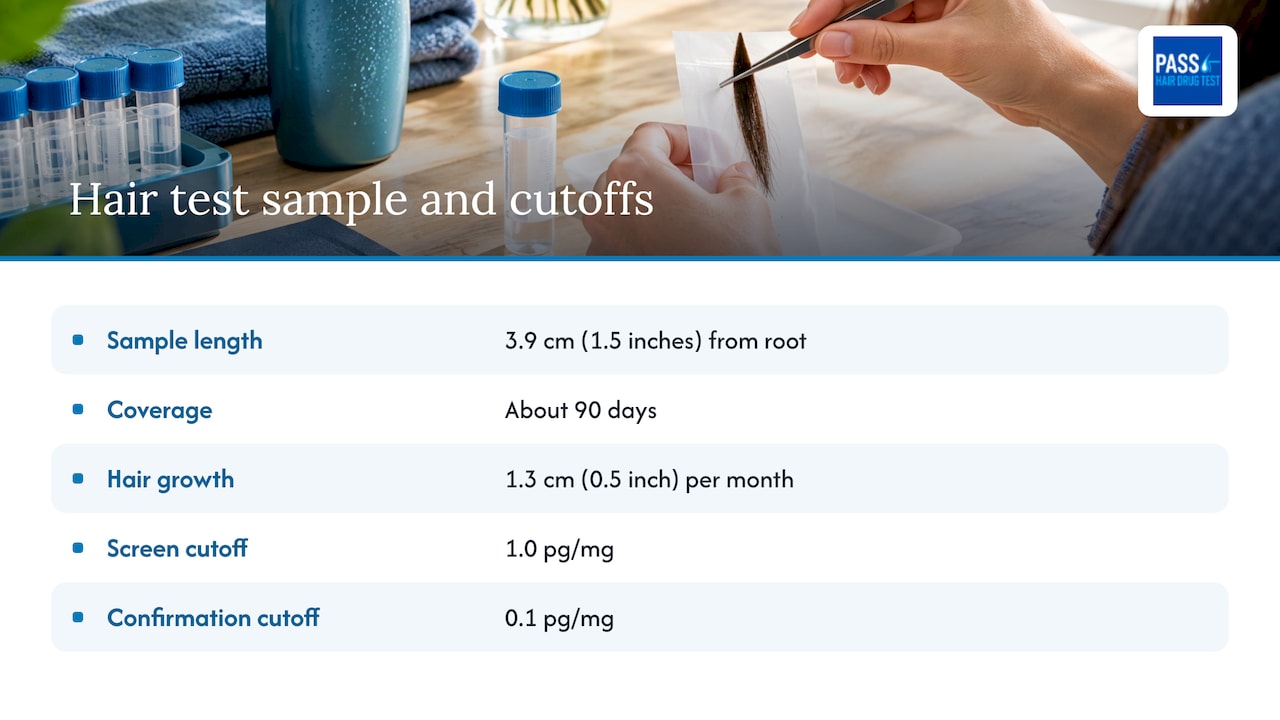
The collector usually cuts a small sample close to the scalp. Quest says the standard length tested is the first 3.9 cm (1.5 inches) from the root end. Head hair grows about 1.3 cm (0.5 inch) per month, so that segment covers about 90 days and shows a pattern of repeated use over that period rather than a single event.
For marijuana, the same Quest document lists a screening cutoff of 1.0 pg/mg and a confirmation cutoff of 0.1 pg/mg for the THC carboxylic acid metabolite. If you want a deeper look at what those numbers mean, see our page on hair test cutoff levels.
Why this matters for shampoo
Some of the drug material reaches the hair from inside the body. Some arrives from outside. The National Institute of Justice notes that drugs can enter hair through blood, sweat, or contact with the external environment, and that decontamination procedures are not standardized. The 2025 review by Hubbard adds that THC-COOH, the preferred marker to confirm THC ingestion, is found in the sweat and sebum that bathe the hair, so it ends up throughout the hair matrix. That is the reason people look at what washing can do to the outer part of a strand.
Can a lab tell you used a detox shampoo?
No routine method does. The 2023 review by Wissenbach, Binz and Steuer says that up to now there is no standardized, routine workflow to objectively screen for cosmetic treatments or extensive hair washing. It says cleansing shampoos and extensive washing cannot be detected at all by current laboratory methods, unlike hair dyeing, which is typically inspected visually.
In practical terms:
- The collector sees your hair when taking the sample, and the lab sees the cut strand.
- A shampoo leaves no visible mark and no routine chemical marker.
- A lab report for a standard workplace test reports the concentration it measures. It does not come with a note saying “shampooed.”
That is the answer to the question behind the keyword. The risk people worry about is not a lab flagging the shampoo. It is the hair itself looking or testing as though it had been chemically altered.
What labs do look for in hair
The same review explains that hair dyeing is typically spotted by eye, and that researchers have proposed a marker called PTCA (1H-pyrrole-2,3,5-tricarboxylic acid) to screen for oxidative hair treatments such as bleaching. It can be added to routine procedures, but it has limits: it is also present in native hair and depends on the melanin content, meaning hair color.
So the things worth avoiding in the weeks before a test are the ones a lab can actually notice:
- Fresh bleach or color. Visible changes to the sample are the most likely thing to draw attention.
- Layering many treatments at once. The review cites Baeck et al., who found that ten repeated washes produced similar hair damage, and similarly lower amphetamine and methamphetamine concentrations, as one hair dye. Treat your hair gently and do not improvise a stack of harsh products.
- Unusual sample issues. If you have very short hair, body hair may be collected instead. Ask the collection site or your employer about their policy.
A clean, ordinary-looking head of hair with a routine you can describe in one sentence is the least eventful sample a collector sees.
What research says about shampoo and THC in hair
A 2022 peer-reviewed study by Bertges et al. analyzed 54 THC-positive hair samples with LC-MS/MS. Zydot shampoo produced a mean 52% reduction in THC hair concentrations. In 14 of the 54 cases, treatment brought concentrations below 0.02 ng/mg, which would have been reported negative under planned German guidelines. Note that this was a German study using German thresholds, not US cutoffs, and individual results varied from sample to sample.
That variation is the key point. Hair is not uniform. Dark, porous or previously treated hair holds onto compounds differently, and heavier use leaves more material in the strand. A single mean figure cannot tell you what your own result will be. That is why we focus on process, repeat contact with the product as directed, and timing rather than a one-wash expectation.
Two more findings are worth knowing if you read about this topic:
- A 2015 study by Moosmann et al. found THC-COOH in older hair segments that grew before oral THC intake, and in sebum and sweat. It also found cannabinoids can be present in the hair of non-consumers through transfer from consumers’ hands, sweat or cannabis smoke. The authors concluded THC findings in hair cannot be regarded as proof of cannabis consumption.
- The MSD Manual’s drug testing chapter notes that hair offers the longest detection window, at least 100 days for some drugs, but that the clinical relevance of quantitative hair assays is unknown.
If you want our broader read on effectiveness, we cover it in Do Detox Shampoos Work for Hair Follicle Tests?.
Timing: the 90-day window and your hair length
Because hair grows about half an inch a month, the 1.5 inch segment closest to your scalp is the one that counts. Here is how that plays out:
| Factor | What it means for your test |
|---|---|
| Standard sample length | First 1.5 inches (3.9 cm) from the scalp |
| Time covered | Roughly 90 days of use |
| Growth rate | About 0.5 inch (1.3 cm) per month |
| Arrival above the scalp | Hubbard’s review says at least a couple of days, and up to 10 days |
The last row matters if your use was recent. Drugs reach the hair bulb in as little as 30 minutes, according to Hubbard’s review, but they will not be detected in hair above the scalp for at least a couple of days, and possibly up to 10. In other words, a hair test is a look back, and the oldest part of the window falls off as hair grows and is cut.
Our perspective
After more than 20 years in the drug-testing and detox-product business, the question we hear most is not “does it work?” It is “will they know I did something?” The research gives a clear, reassuring answer to that second one: current lab methods cannot detect cleansing shampoos or extensive washing.
That is why our hair line is built around a routine rather than a single bottle. We sell Macujo Aloe Rid Shampoo and Zydot Ultra Clean Shampoo, and we offer the multi-step Mike’s Macujo Method for people who want a full process with detailed instructions. Our approach is designed for both light and heavy users, and our phone support is there so you are not guessing at step three on a Sunday night.
What we tell every customer: start early, keep your hair free of fresh dye or bleach, follow the directions exactly, and check your product’s expiration before you begin. A calm, planned routine does more for you than a panicked one.
MIchael
How to prepare sensibly
Here is the order we suggest for a scheduled test.
- Find your date and work backward. Get the collection date from your employer or the testing site. The more days you have, the more rounds of your routine you can complete as directed.
- Leave your hair alone chemically. No new dye, bleach or perm. Those are the changes a collector or lab can notice.
- Check your product. Look at the date and storage condition. Our guide to detox shampoo expiration lists seven checks.
- Follow the directions as written. Contact time, rinsing and repetition are part of how a product is meant to be used. Our walkthrough on how to use detox shampoo covers the usual sequence.
- Keep conditioning simple. There is no proven hair test effect from conditioner after shampoo, as we explain in our conditioner page. Use it only if your product’s instructions call for it.
- Know your fallback. If your hair is very short or you have a shaved head, ask whether body hair will be collected, and read our hair follicle test information.
Detox or clarifying shampoo?
People often ask whether a store-bought clarifying shampoo does the same job as a product made for hair testing. We compare them side by side in detox vs clarifying shampoo. If you are comparing products, our best hair detox shampoo page walks through what to look at.
A note on how these products are marketed
A 2017 review by Marrinan et al. observed that many products are sold online as hair cleansers, cleansing systems or hair detoxifiers. The takeaway for you is practical: buy from a seller that gives you real instructions, real contact details and a person you can call, and read the directions before you start rather than the night of the test.
Our hair cleansing products
If you have decided on a routine, our store carries the Macujo Aloe Rid Shampoo, the Zydot Ultra Clean Shampoo and the multi-step Mike’s Macujo Method, along with test kits for urine, saliva and blood. You can browse the full range on our products page, or start with our guide on how to pass a hair drug test to see how the pieces fit together.
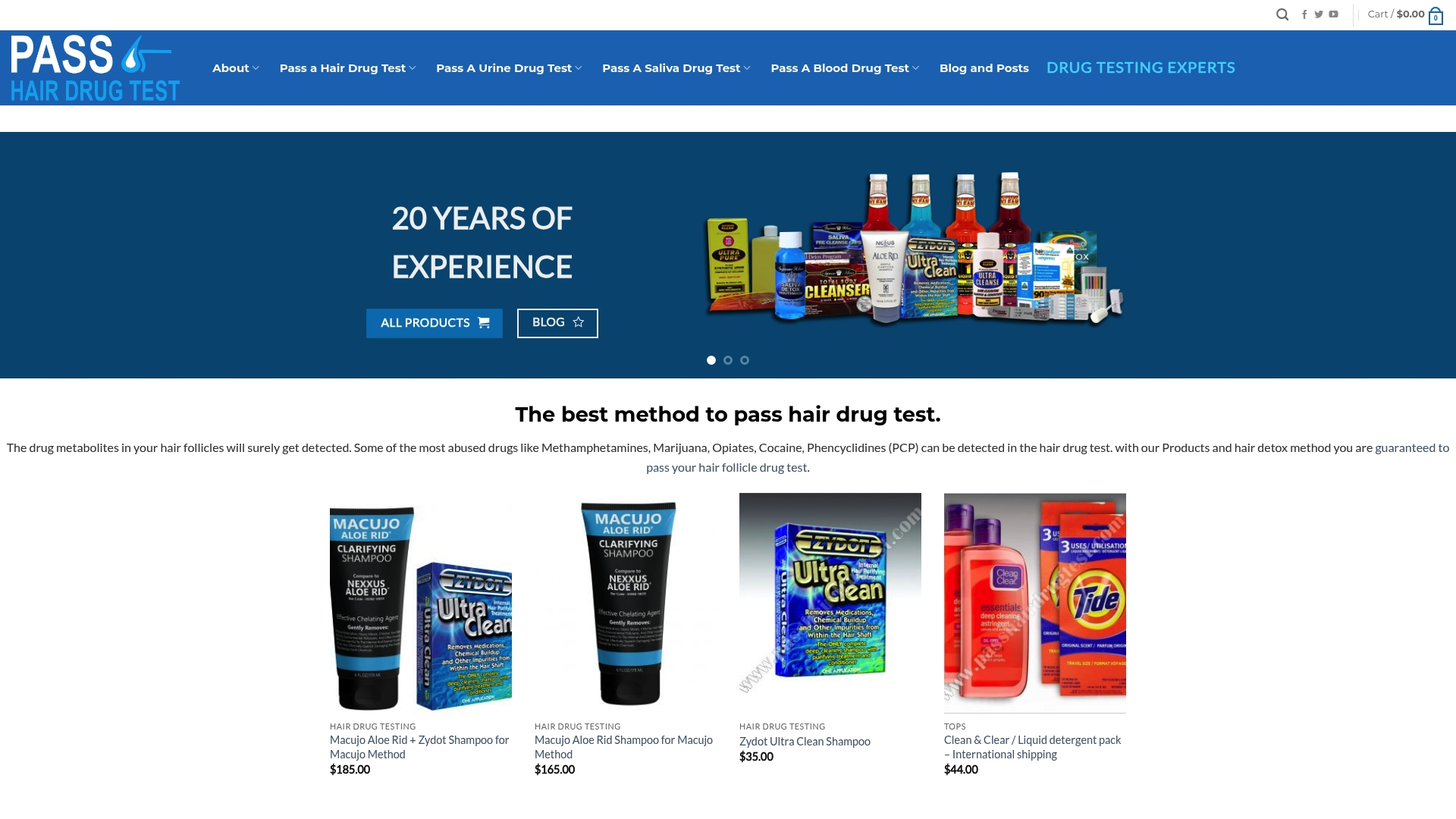
If you have questions about which option fits your hair length, use history and timeline, call us. Phone support is part of what we offer.
FAQ
Can a hair drug test lab detect that I used detox shampoo?
Not with current routine methods. A 2023 review states that cleansing shampoos and extensive washing cannot be detected by current laboratory methods. Labs do check for dyed or bleached hair, which is usually spotted visually, so avoid new chemical treatments before your test.
How far back does a THC hair test go?
A standard sample is the first 1.5 inches of hair from the scalp. Because head hair grows about half an inch per month, that reflects roughly 90 days of use, according to Quest Diagnostics. Very recent use may not show up yet, since drugs take at least a couple of days to appear in hair above the scalp.
Does ordinary shampoo do the same thing as a detox shampoo?
The research on this is mixed and depends on the product and the hair. A 2022 study found Zydot shampoo produced a mean 52% reduction in THC concentrations in German samples. We compare detox and clarifying options on our detox vs clarifying shampoo page.
Will a hair test prove I used cannabis?
Hair findings can be harder to interpret than people expect. A 2015 study found cannabinoids in the hair of non-consumers through contact with users’ hands, sweat or smoke, and concluded THC findings in hair cannot be regarded as proof of consumption. If a result is disputed, ask the testing program about its review process for donors.
Sources
- Advances in testing for sample manipulation in clinical and forensic toxicology (2023)
- Quest Diagnostics, Hair testing FAQ
- National Institute of Justice, Detecting Drugs in Hair
- Review on Toxicology Testing in Hair, Journal of Applied Laboratory Medicine (2025)
- Manipulation of THC Hair Concentrations by Commercially Available Products (2022)
- Finding cannabinoids in hair does not prove cannabis consumption (2015)
- MSD Manual Professional Edition, Drug Testing
- Hair analysis for the detection of drug use (2017)
Recommended
- How to Use Detox Shampoo for a Hair Drug Test
- Best Hair Detox Shampoo for Hair Follicle Drug Tests
- Detox vs Clarifying Shampoo for Hair Drug Test Prep
- Do Detox Shampoos Work for Hair Follicle Tests?
