No products in the cart.
Uncategorized
Employee Drug Testing Rights: What U.S. Employers Can Do

24
Nov
In most of the U.S., a private employer can require a drug test and can act on a positive THC result, and the rules that limit them depend mostly on your state and your job. If a hair follicle test is coming, the practical question is not only what your rights are but what you can do before the collection date. This guide covers the rights first, then the preparation that puts you in control of the outcome.
Table of Contents
TL;DR
- Federal law does not require most private employers to test, but it does not stop them from testing for illegal drugs either, and the ADA gives no protection for current illegal drug use.
- Applicants, current employees and safety-sensitive workers face different rules. Federally regulated transportation jobs have the strictest ones.
- Some states limit THC testing or firing over a positive result. Others, like Louisiana, treat any THC detection as a violation.
- Refusing a test is usually treated as a failed test, especially in DOT-regulated jobs.
- Hair tests look back about 90 days, so the time to act is before the collection, not after the result.
Table of Contents
- What federal law actually says
- Applicants, employees and safety-sensitive jobs
- How state THC laws change the picture
- Your rights around a hair follicle test
- Can you refuse a test?
- If the result comes back positive
- Why the preparation window matters most
- Getting ready for a hair test with our products
- Our perspective
- FAQ
- Sources
What federal law actually says
There is no single federal law that gives private-sector workers a general right to avoid drug testing. According to SAMHSA’s page on federal drug testing laws (updated July 31, 2024), most private employers are not required to run a drug-free workplace program. The exceptions are federal contractors and grantees, and safety- and security-sensitive industries and positions.
That means two things for you. First, many employers test because they choose to, through a written policy. Second, the policy is the document that governs your situation, so read it before you sign anything.
The Americans with Disabilities Act (ADA) is the law people most often assume protects them. It is narrower than that. SAMHSA explains that employers with more than 15 employees cannot fire, refuse to hire or refuse to promote someone solely because of a history of substance use or enrollment in a rehabilitation program. But the ADA gives no special protection to people who are currently using illegal drugs. The U.S. Commission on Civil Rights ADA chapter on drug testing adds that testing for illegal drug use is not an ADA violation, and that an employer may refuse to hire or may discipline someone based on a positive result even if the person says they recently stopped.
Marijuana is still illegal under federal law, which is why state legalization does not automatically protect a job.
Applicants, employees and safety-sensitive jobs
The same test can mean different things depending on where you are in the hiring process.
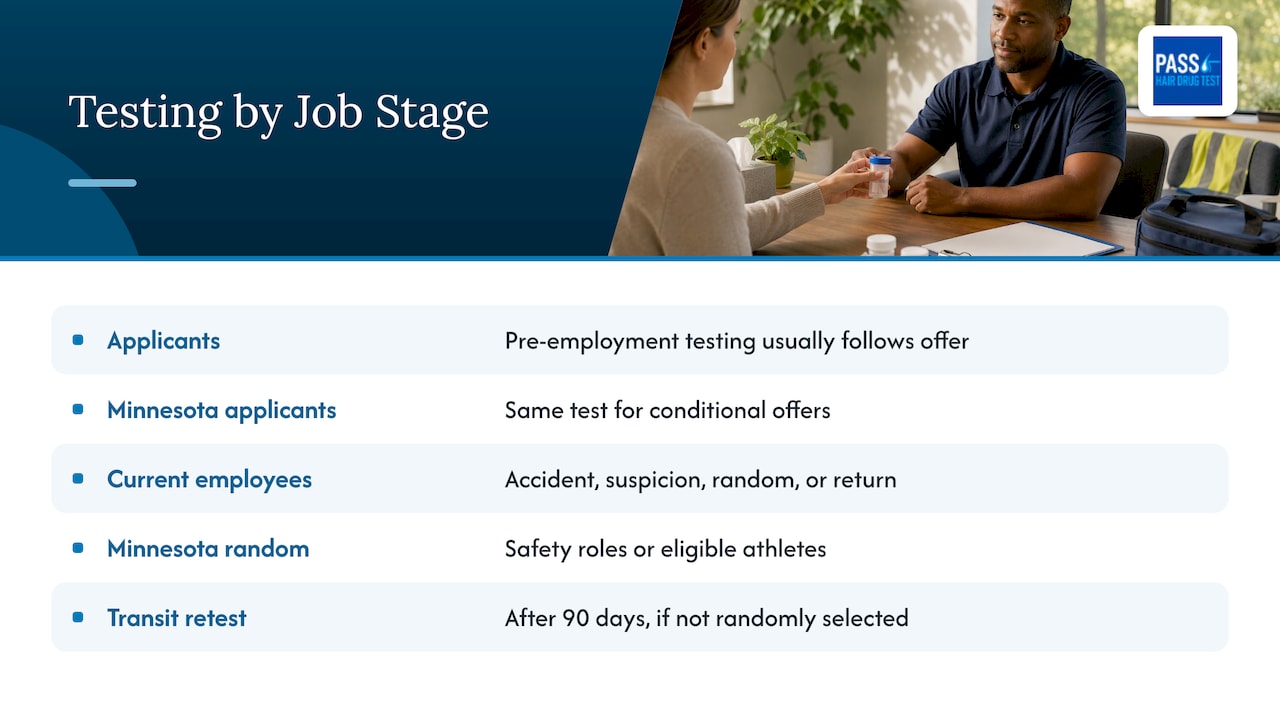
Job applicants. Pre-employment testing is the most common form, and it is usually tied to a job offer. Many states allow it freely. A few set conditions. Minnesota, for example, limits applicant tests to after a job offer and requires the same test for everyone conditionally offered that position, under Minnesota Statutes section 181.951.
Current employees. Employers typically test after an accident, on reasonable suspicion, at random, or when returning from a leave or treatment program. Whether random testing is allowed is a state question. Minnesota permits it only for safety-sensitive employees or eligible professional athletes under a collective bargaining agreement.
Safety-sensitive and federally regulated jobs. These carry the heaviest obligations. Under 49 CFR 655.41, a transit employer must make sure a covered applicant or employee has a verified negative pre-employment drug test before first performing a safety-sensitive function. A re-test is required if the employee has not performed one for 90 consecutive calendar days and was not in the random selection pool. Under 49 CFR 655.43, an employer must test when it has reasonable suspicion based on specific, contemporaneous, articulable observations of appearance, behavior, speech or body odors, made by a trained supervisor.
The Department of Transportation also keeps changing its testing procedures. A final rule published in the Federal Register on May 11, 2026 and effective June 10, 2026 requires directly observed urine collection where oral fluid tests are required but unavailable, because no HHS-certified oral fluid laboratories exist yet. If you hold a commercial license or a transit job, your employer’s DOT program, not general state law, sets your rights.
How state THC laws change the picture
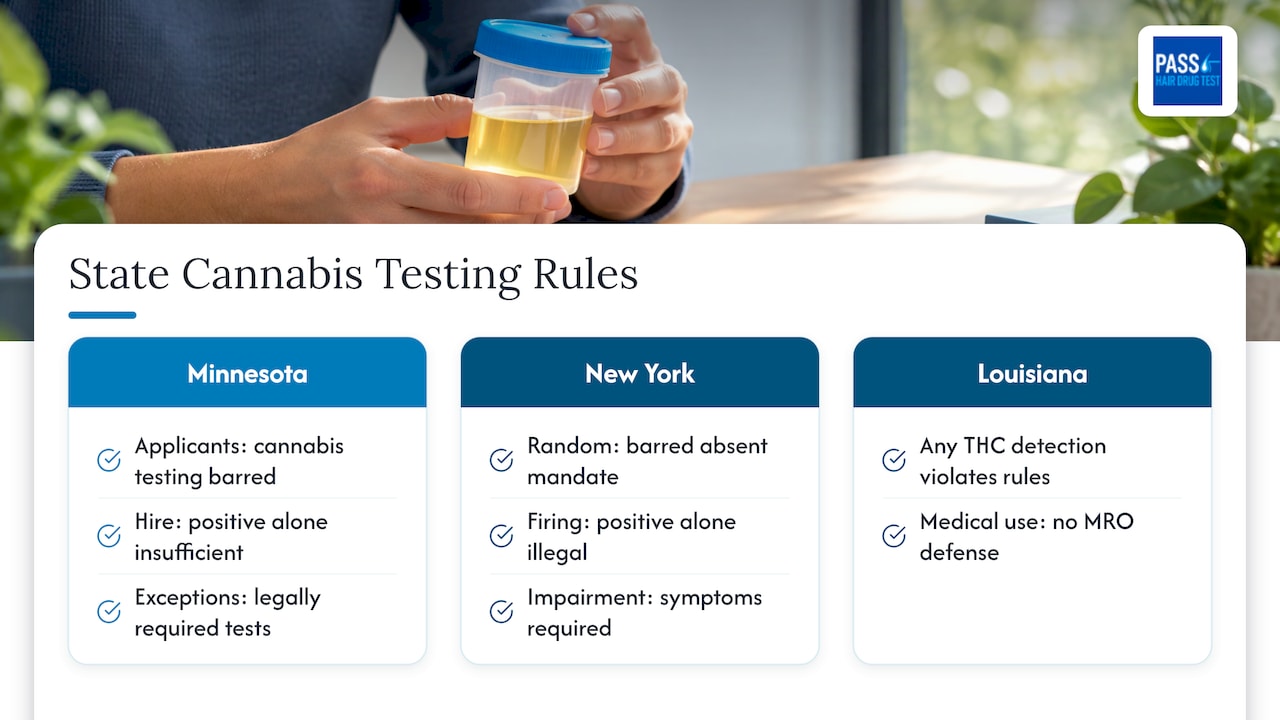
This is where your location matters most. Three examples show the range.
Minnesota bars cannabis testing of applicants as a condition of employment, and bars refusing to hire solely over a cannabis-positive test, unless state or federal law requires it. The statute still treats cannabis as a drug for safety-sensitive roles, peace officers, firefighters, certain face-to-face care jobs, CDL and motor-vehicle positions, federal-grant-funded work and other legally required testing. It also requires a written policy and bars arbitrary and capricious testing. The details are in section 181.951.
New York is described by Cornell’s ILR School in its guide to cannabis drug testing in the workplace. Employers may not randomly test for cannabis unless a law or mandate requires it, and firing someone only because of a positive marijuana test is illegal. The smell of marijuana alone is not enough to show impairment; articulable symptoms are required. Employers can still act where state or federal rules require it (DOT and FAA mandates, for example), where they would lose a federal contract or funding, or where specific symptoms of impairment interfere with a safe workplace. They can still test for other drugs.
Louisiana goes the other direction. Its drug-free workplace regulation says any detection of marijuana or THC is a violation regardless of source, including physician-recommended or legally purchased products, because THC remains Schedule I federally. Marijuana use is not a valid medical explanation for a medical review officer (MRO), the physician who reviews lab results before they reach the employer.
The lesson: “legal in my state” and “protected at work” are different statements. Check your own state’s employment statute, not just its cannabis law.
For a closer look at hair testing rules specifically, see our guide to hair drug testing laws in the U.S..
Your rights around a hair follicle test
Hair testing is less regulated than urine testing in most states, which makes the few clear rules worth knowing. Maryland offers a detailed example in Health-General section 17-214:
- Hair specimens may be used for job-related controlled-substance testing only for pre-employment purposes.
- The specimen is limited to no more than 1.5 inches from the body, and cannot be used for any other purpose.
- The lab must be permitted or approved, and it must give you its name and address if you ask.
- After a confirmed positive, the employer must give you the result, the written policy and any notice of intended action, plus information about independent testing, within 30 days from the test date.
- You may request verification of the same sample at your own cost.
- Labs and physicians generally may not tell the employer about nonprescription or legally prescribed drug use.
Most states do not have a statute this detailed, so the protections above are a model of what to ask for, not a promise that applies everywhere. In any state, you can ask for the written policy, the name of the lab and the process for contesting a result.
If you take prescription medication, the MRO step matters. Our page on proving prescription meds to an MRO walks through what documentation to have ready. For applicants specifically, what job applicants need to know about the pre-employment hair test covers the process from the first notice.
Can you refuse a test?
You can say no, but the consequences are usually the same as a failed test or worse.
In transit jobs, 49 CFR 655.15(h) requires the employer’s policy to say that employees who refuse a test are immediately removed from safety-sensitive functions and evaluated by a substance abuse professional. The same applies to a verified positive. Under 49 CFR Part 382, drivers may not refuse a required pre-employment, post-accident, random, reasonable-suspicion, return-to-duty or follow-up test, and employers may not let a refusing driver keep performing safety-sensitive work. A refusal includes failing to appear within a reasonable time for a test (other than a pre-employment test), and a verified adulterated or substituted result also counts. Railroad workers who refuse a required specimen must be withdrawn from regulated service for nine months under 49 CFR Part 219.
For a private-sector applicant, refusing typically ends the application. For an at-will employee, refusing a test required by a lawful written policy can be grounds for discipline or termination, subject to your state’s rules. If you believe a test is arbitrary or discriminatory, that is a question for an employment attorney in your state, and it is worth asking before you refuse rather than after.
If the result comes back positive
What the employer may do next depends on the job:
- DOT-regulated roles: immediate removal from safety-sensitive duties and referral to a substance abuse professional.
- State-protected roles: in states like Minnesota or New York, a positive THC result alone may not be enough to fire you, but impairment symptoms or a federal requirement can change that.
- Everywhere else: the employer can usually withdraw an offer or discipline an employee under its written policy, and the ADA will not help if the result reflects current illegal drug use.
If you get a positive, ask for the lab report, the written policy and the process for requesting re-verification of the same sample. Some states set deadlines and give you the right to independent verification, at your own cost.
An unusual outcome is not always a positive. A sample can also come back invalid. Our explainer on the invalid drug test result and hair tests covers what that means and what usually follows.
Why the preparation window matters most
Every right above operates after the fact: after notice, after the sample, after the result. Rights to challenge a result are narrow and slow, and in many states they do not exist at all. The strongest position for a THC user facing a hair test is to be ready before the collection.
Hair is different from urine in one key way. THC metabolites get into the hair shaft and are not flushed out in days. The standard hair test looks back roughly 90 days, which is why the timeline for a hair test is long and the window for acting is short once you get notice. Our page on the science behind the hair drug test explains how that works.
It also helps to know what else can show up. Products you assume are harmless may carry trace THC, a point we cover in how CBD products can trigger a positive hair test. Employers set the cutoffs, so “I only used a little” is not a defense on its own.
Getting ready for a hair test with our products
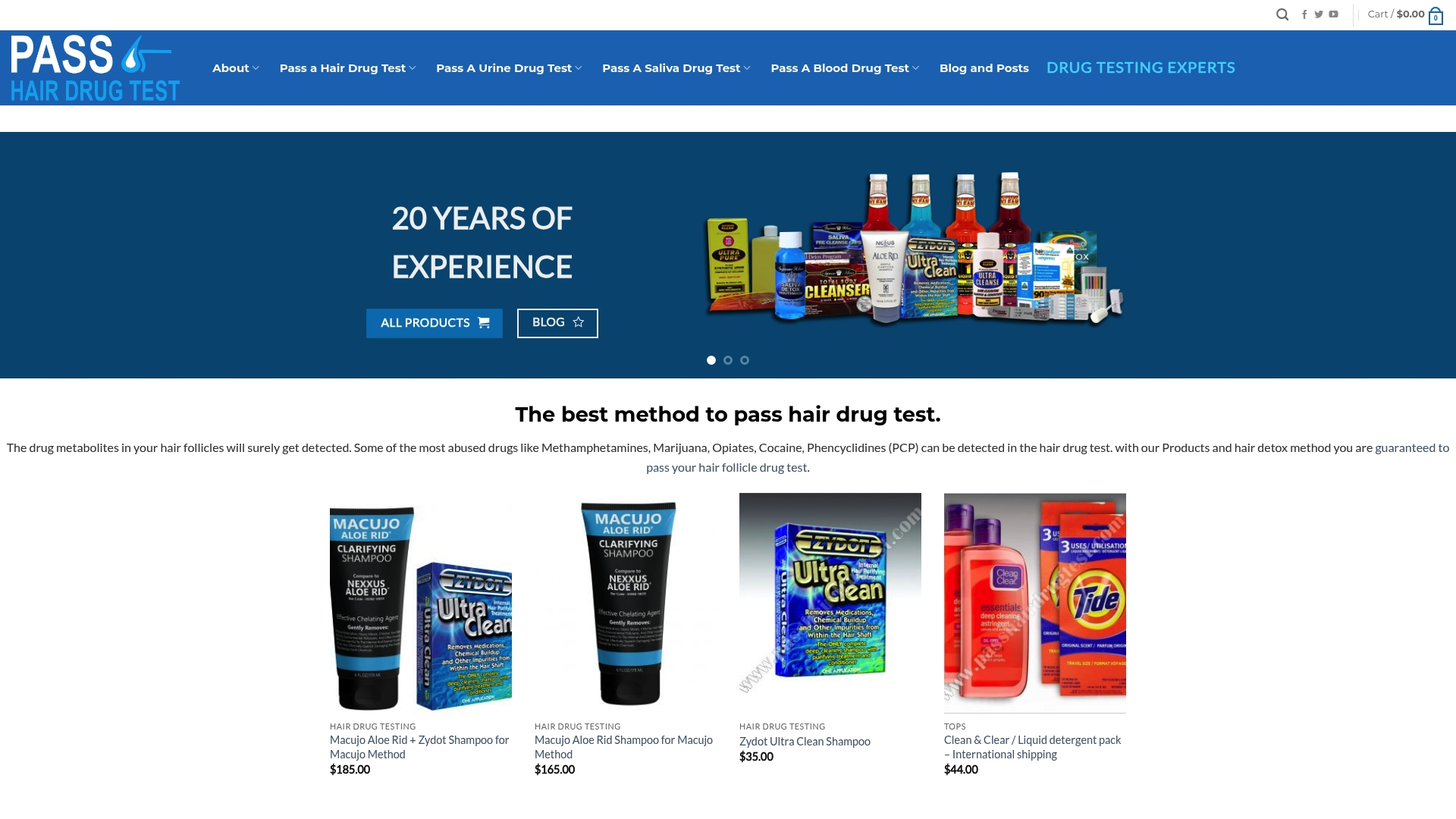
We’ve worked in the drug-testing and detox-product industry for more than 20 years, and hair cleansing is the center of what we sell. Our approach is built around Mike’s Macujo Method, a multi-step routine that uses Macujo Aloe Rid Shampoo and Zydot Ultra Clean Shampoo. We provide detailed instructions with the method and phone support for customers who have questions about the routine.
If you are comparing options, start with the Macujo Aloe Rid Shampoo guide or go straight to the shampoo and method page. If you want to see everything we carry for hair, urine, saliva and blood testing, the full product catalog lists it.
We also keep a longer piece on workplace hair testing and defensible steps for readers who want the employer’s side of the process.
Our perspective
Most people who write to us are not trying to argue with their employer. They have a date, a policy they did not write and a result that will decide a job. In that position, a legal right to “appeal” is cold comfort, because the appeal comes after the damage.
That is why we built our work around preparation. Our Macujo Method is a multi-step routine, and we believe a multi-step routine, followed carefully with the right shampoos, gives hair test takers a real plan instead of a hope. We have spent more than 20 years in this industry, and we stand behind our products and our phone support.
Know your rights, read your policy, and give yourself the time to follow the routine properly. Start early, follow every step, and call us if you have questions.
MIchael
FAQ
Can my employer drug test me without telling me?
It depends on your state and your employer’s policy. Many states require a written policy, and some, like Minnesota, require one by statute and bar arbitrary and capricious testing. Ask for the written policy before any collection.
Can I say no to a random drug test?
You can, but the consequence is typically treated like a failed test. In DOT-regulated jobs, a refusal means immediate removal from safety-sensitive work and evaluation by a substance abuse professional. In some states, random testing for non-safety-sensitive jobs is restricted, so check your state’s rule.
Does a legal marijuana state protect me from being fired?
Not automatically. Marijuana is still illegal under federal law, and the ADA does not protect current illegal drug use. Some states, such as Minnesota and New York, add job protections with exceptions. Others, such as Louisiana, treat any THC detection as a violation.
How far back does a hair test look?
Standard hair tests look back about 90 days, which is why preparation has to start as soon as you get notice. Maryland’s statute, for one, limits the hair specimen to no more than 1.5 inches from the body.
Can I challenge a positive result?
Sometimes. Maryland, for example, lets you request verification of the same sample at your own cost, and requires the employer to give you the result and policy within 30 days. Other states offer less, so ask the employer for the lab report and the dispute process in writing.
Sources
- SAMHSA: Employer Resources, Drug Testing Federal Laws
- U.S. Commission on Civil Rights: ADA, Chapter 4
- eCFR: 49 CFR Part 655 Subpart E, Types of Testing
- Federal Register: Procedures for Transportation Workplace Drug and Alcohol Testing Programs, May 11, 2026
- govinfo: 49 CFR Part 655 (2025)
- eCFR: 49 CFR Part 382
- govinfo: 49 CFR Part 219 (2024)
- Minnesota Statutes 2026, Section 181.951
- Cornell ILR School: Cannabis Drug Testing in the Workplace
- Louisiana Administrative Code, Title 22, Section I-207
- Maryland Health-General Section 17-214
Recommended
- Which Labs U.S. Employers Use for Hair Follicle Drug Tests
- Hair Drug Testing Laws in the U.S.: What Applies to You
- Pre-Employment Hair Test: What Job Applicants Need to Know
- 20 Years’ Evidence: U.S. Workplace Hair Testing and Defensible Steps
