No products in the cart.
Uncategorized
Cocaine Hair Detection Time: How Far Back a Test Looks
20
Nov
Nov
A standard hair drug test looks back about 90 days, so cocaine use in roughly the last three months can show up. The test does not read the days of the week. It reads a 1.5-inch piece of hair cut at the scalp, and that piece holds about three months of history. If you have a hair follicle test coming, the window, the 5 to 10 day delay before use shows up, and the cutoff the lab applies are the three facts that decide how to plan. When you want to cleanse your hair before the test, we built our hair cleansing products and instructions around exactly that timeline.
Table of Contents
TL;DR
- A standard hair test covers about 90 days, because the lab takes the first 1.5 inches (3.9 cm) of hair closest to the scalp.
- Cocaine does not show on the first day. Hair that carries a drug takes roughly 5 to 10 days to grow out to where it can be cut.
- Labs commonly use a 500 pg/mg cutoff for cocaine and its confirmed markers, so the question is how much is in the hair, not just whether any is.
- Hair length, hair color, grooming habits and how fast your hair grows all change what the sample represents.
- Urine, blood and saliva windows are measured in hours and days. Hair is the one measured in months, which is why people prepare for it differently.
Table of Contents
- How long cocaine stays detectable in hair
- Why the window is 90 days and not “since last use”
- What the lab actually measures
- What changes your personal detection window
- Hair compared with urine, blood and saliva
- How long do you have to be clean for a hair test?
- Preparing for a hair test: what we recommend
- Promo: the products for your hair test
- What a positive does and does not tell the lab
- FAQ
- Sources
How long cocaine stays detectable in hair
The working number is 90 days. Quest Diagnostics states that its standard head-hair analysis uses the first 3.9 cm (1.5 inches) of hair from the root, that this covers approximately 90 days, and that it detects a pattern of repetitive drug use over that period.
You will see longer numbers online, up to six months. Those come from longer hair. If a lab is handed a sample longer than 1.5 inches, the cut it analyzes is still counted from the scalp, but the hair you have is a record that keeps going. A person with shoulder-length hair carries a much longer history than a person with a short crop, yet the standard test only reads the part nearest the root.
So the honest answer to “how long” depends on three things: how long your hair is, how the lab cuts it, and how often and how much you used. A single use is far less likely to clear a cutoff than regular use across weeks.
Why the window is 90 days and not “since last use”
Hair is a slow record. Head hair grows about half an inch (1.3 cm) a month, according to the same Quest FAQ. Multiply that by three months and you get the 1.5-inch segment the lab cuts.
There is a built-in lag as well. Quest states that drug-containing hair takes approximately 5 to 10 days to reach the scalp surface where it can be collected. A 2025 review in the Journal of Applied Laboratory Medicine describes the same delay: drugs enter the hair bulb within as little as 30 minutes, but are not detectable in the hair shaft above the scalp for at least a couple of days and up to 10 days after ingestion.
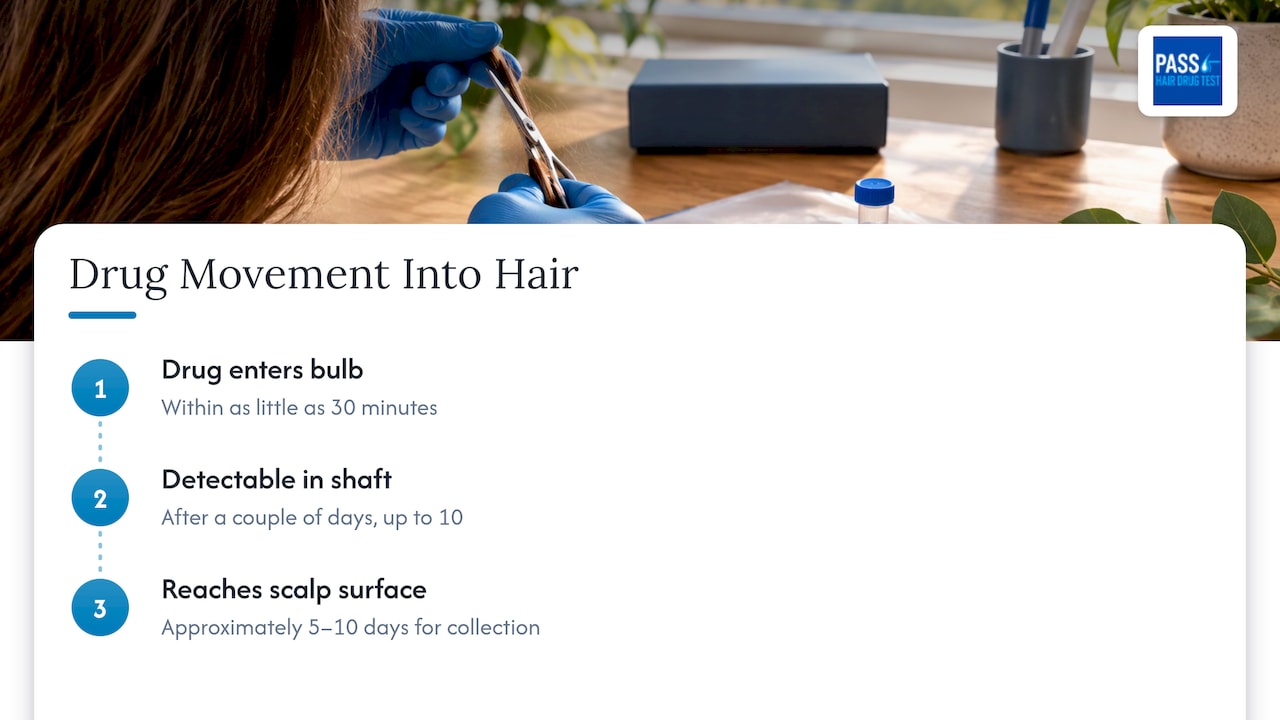
That lag has a practical meaning. If your last use was three days ago, the hair that took it in is still under the skin. It will not be in the cut sample yet. This is why many people are surprised that a test taken within the first week after use can come back negative while a test two weeks later can be positive, even with no new use in between.
What happens inside the hair
A peer-reviewed review of cocaine hair testing explains that cocaine and its metabolites (the substances the body turns it into) enter the hair as it forms and stay for the rest of that strand’s life. The review reports a first trace 6 to 8 hours after exposure, likely through sweat, and that after one to two weeks at least two-thirds of the drug is detectable in hair as the deposited portion grows beyond the scalp.
That is why showering, washing and time alone do not simply erase it. The drug is part of the hair, not only on it.
What the lab actually measures
A hair test is not a yes or no on whether cocaine ever touched your hair. It is a concentration check against a cutoff.
According to the Quest FAQ, the process runs like this:
- Hair is collected under direct supervision.
- The lab washes the sample to remove external contamination.
- The drug is extracted from the hair.
- The extract is analyzed by mass spectrometry (GC-MS, GC-MS/MS or LC-MS/MS), a method that identifies specific molecules.
- Presumptive positives are confirmed, and a second portion of the hair is tested.
Quest lists a screening cutoff of 500 pg/mg for cocaine and its metabolite, and confirmatory cutoffs of 500 pg/mg for cocaine, cocaethylene, norcocaine and benzoylecgonine. A picogram per milligram is a trillionth of a gram per thousandth of a gram of hair, so the numbers are tiny, but they are the line between a reported positive and a negative.
Federal guidance on hair testing is more specific about what counts as a positive. SAMHSA’s summary document, which describes its 2004 proposed rule, sets a cocaine cutoff of 500 pg/mg plus either a benzoylecgonine-to-cocaine ratio of at least 5% or cocaethylene of at least 50 pg/mg. Cocaethylene forms only when alcohol is consumed with cocaine. The 2022 SAMHSA material also notes that cocaine is a poor standalone marker, which is why labs look for a second analyte alongside it.
If you want the longer version of what these numbers mean for your preparation, we wrote it up in what the 500 pg/mg cutoff means for cocaine hair detox.
What changes your personal detection window
Two people with the same use history can get different results. The 2025 JALM review lists the main reasons: hair growth rate, melanin content (the pigment that gives hair its color), the properties of the drug, grooming habits, how the sample is collected, diffusion of sweat and sebum, and external contamination.
Here is what each means for you.
| Factor | What it does |
|---|---|
| Hair length | Only the first 1.5 inches from the scalp is cut for a standard test, so length beyond that does not extend the standard window. |
| Growth rate | Faster growth means each inch holds fewer days. Slower growth means the 1.5 inches reaches further back. Quest notes growth is not constant between or within people. |
| Melanin | Dark hair binds some drugs more readily than light hair, so two people with equal use can show different concentrations. |
| Frequency of use | A pattern of repeat use puts more drug in more segments than a single occasion. |
| Grooming | Coloring, bleaching, perming and frequent washing change the hair, and the review lists grooming habits among the interpretation factors. |
| Body hair | When head hair is too short, labs can use body hair, which grows on a different cycle. Ask the collection site or employer what they will accept. |
Because growth speed varies, Quest cautions that segment-by-segment analysis should not be used to pin down exact intervals of use. That means you cannot read “I used in week 6” from the hair with confidence. The lab reports whether the sample, as a whole, clears the cutoff.
Hair compared with urine, blood and saliva
If you have taken urine tests before, the hair window will feel very different. Labcorp states that drugs may be detectable for approximately 90 days in hair, generally one to seven days or longer in chronic users in urine, and five to 48 hours in oral fluid.
| Test | Typical window stated by Labcorp |
|---|---|
| Hair | About 90 days |
| Urine | Generally 1 to 7 days, longer in chronic users |
| Oral fluid (saliva) | 5 to 48 hours |
Quest states that hair testing is the only method giving up to a 90-day history of repeated use, and that it tends to produce more positives than urine because of that longer window. It is also generally used for pre-employment and random testing, not after an accident or on reasonable suspicion, where urine or oral fluid is preferred.
For you the takeaway is simple. Stopping use two or three days before a urine test is a plan. Stopping two or three days before a hair test does very little, because the hair already holds the previous three months.
How long do you have to be clean for a hair test?
Counting from the cutoff, the sample represents about 90 days. For the most recent cocaine exposure to leave the 1.5-inch segment through growth alone, you would need roughly three months of hair to grow past the cut point, and the cut is taken at the scalp, so the new hair that grows in is clean. Waiting is the only approach that comes with no preparation, but most people with a test date in two or three weeks do not have three months.
If you are in that position, the useful questions are:
- When is the test, and how long is my hair? Short hair means a short wait before the older segments are no longer in the sample.
- What did the employer or lab say about the sample? Head hair, body hair, and the length of the cut can all differ.
- Was the use occasional or repeated? Concentration relative to the 500 pg/mg cutoff matters more than a yes or no.
Our guide, Cocaine hair test detox in U.S. labs, explains why a large reduction in drug content is not the same thing as clearing a cutoff, which is the number to understand before you set a plan. For a plain-language overview of the testing itself, see our page on how long coke stays in your hair.
Preparing for a hair test: what we recommend
People arrive at a hair test with very different histories. Some used once at a party. Some used regularly through a stretch. What they share is a date and a result that matters for a job.
We built our hair program around the idea that one wash does not make a plan. Our products for hair preparation are centered on Macujo Aloe Rid Shampoo, Zydot Ultra Clean Shampoo and the multi-step Mike’s Macujo Method, which combines several steps rather than relying on one product. We state that we have more than 20 years of experience in the drug-testing and detox-product industry, and we offer unlimited phone support.
You can read how the shampoo step is done in our Macujo Aloe Rid Shampoo guide, or go through the broader hair follicle drug test guide first if you want the testing basics before you decide.
Promo: the products for your hair test
If your test is coming up, you can see the hair-cleansing products, including the Macujo and Zydot shampoos, on our products page. The instructions go with the method, and our phone support is there when you want to talk through your timeline.
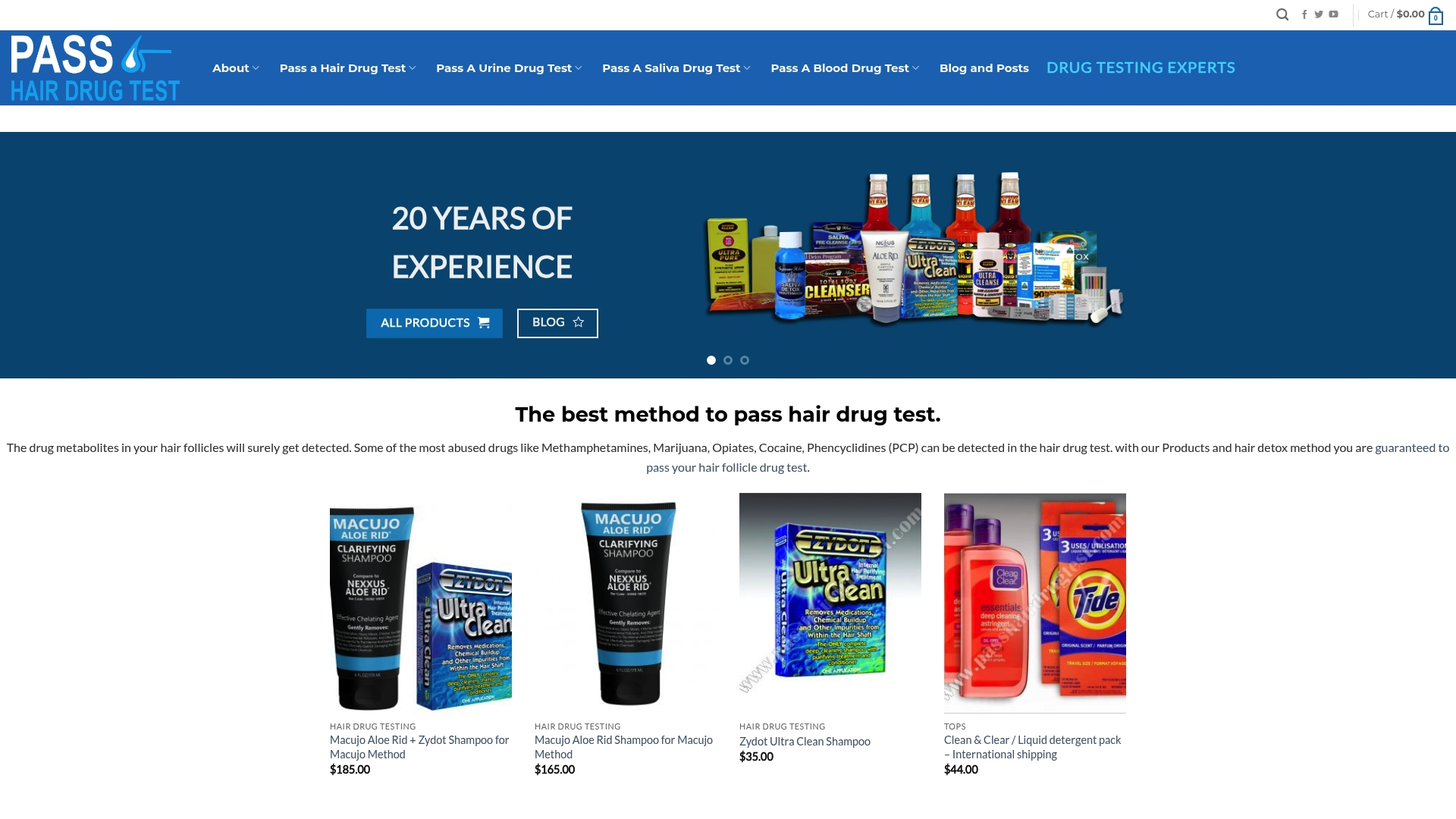
If you want to start with a specific product, the Macujo Aloe Rid + Zydot shampoo set for the Macujo Method is the one that fits the multi-step approach.
What a positive does and does not tell the lab
It helps to know the limits of the test, because they shape what happens after a result. The National Institute of Justice notes that hair tests cannot reveal how much of a drug was consumed. Labs look at concentration against a cutoff, not at an amount taken.
The 2014 cocaine review adds that cocaine can convert to benzoylecgonine on its own, which is one reason confirmation uses more than a single marker. And the JALM review reports wide variation between people in the ratio of metabolite to parent drug, so interpretation depends on the whole pattern.
In practice, that is why a lab runs the confirmation steps in the Quest process, verifies identity and tests a second portion. If you receive a result you want to understand, the medical review officer (the physician who reviews lab results for the employer) is the person to ask about the report. If you have a legal question about a workplace test, speak with an employment attorney in your state.
Perspective: why timing beats guesswork
We have spent more than 20 years around hair testing, and the question we hear most is not “how long does cocaine stay in hair.” It is “what do I do with the time I have.”
The 90-day window, the 5 to 10 day lag and the 500 pg/mg cutoff are the facts that matter. Once you know them, the plan gets simple: count back from the test date, know your hair length, and decide how much preparation fits.
That is the reason our approach is a method and not a single bottle. Mike’s Macujo Method is a multi-step routine, built around Macujo Aloe Rid Shampoo and Zydot Ultra Clean Shampoo, designed for people who need to prepare their hair for a test. We include detailed instructions with it, and you can reach us by phone with questions as you go.
Start early, follow the steps in order, and keep your test date in front of you.
MIchael
FAQ
How long does cocaine show on a hair follicle test?
A standard test covers about 90 days, based on a 1.5-inch (3.9 cm) cut of head hair. Use in the days right before the test may not appear yet, because hair takes around 5 to 10 days to grow to where it can be collected.
Can a single use show up in a hair test?
Drugs can be detected in hair after a single exposure in research settings, and the first traces can appear within hours. Whether a result is reported depends on whether the concentration clears the lab’s cutoff, which for cocaine is commonly 500 pg/mg. Hair type and growth rate affect that concentration.
Is a hair test the same as a urine test for cocaine?
No. Urine commonly covers a few days, while hair covers about three months, according to Labcorp’s published windows. That is why a hair test can come back positive when a recent urine test did not.
Does hair length change the detection window?
For a standard test, the lab cuts the first 1.5 inches from the scalp, so extra length does not extend the standard window. Shorter hair or a different growth rate can change how far back that cut reaches, and labs may use body hair when head hair is too short.
Sources
- Quest Diagnostics, Hair testing FAQ (PDF)
- Quest Diagnostics, Hair drug screening facts
- Labcorp, Hair follicle drug testing
- The Journal of Applied Laboratory Medicine, Review on Toxicology Testing in Hair (2025)
- A Review of Methodology for Testing Hair for Cocaine (2014)
- SAMHSA, Summary of Hydroxy Cocaine and Cocaine Ratios in Hair
- National Institute of Justice, Detecting Drugs in Hair
Recommended
- Do You Need a Cocaine Hair Test? Here’s How Long Coke Stays in Your Hair
- Cocaine Hair Detox: What the 500 pg/mg Cutoff Means
- 90% Reductions Don’t Guarantee a Pass: Cocaine Hair Detox in U.S. Labs
- Hair Drug Test Information
