No products in the cart.
Uncategorized
Sweat and Hair Drug Tests: How They Differ and How to Prepare
23
Nov
A sweat test and a hair test are not interchangeable. A sweat patch is worn on the skin for a few days and picks up recent use. A hair test looks back about 90 days. If your employer has ordered a hair follicle test, the sweat patch is not your concern: your hair is, and the time to prepare it is before the collector picks up the scissors. We built our hair follicle drug test guidance and our hair-cleansing products for exactly that situation.
Table of Contents
TL;DR
- A sweat patch is an FDA-approved device worn 3 to 7 days. It detects use shortly before it goes on and while it is worn.
- A hair test reflects roughly the past 90 days for a standard scalp sample, and it does not show use from the last 7 to 10 days.
- Hair is the test that creates the preparation window for THC users: it is a long-memory test, so the steps you take in the weeks before collection matter.
- Our multi-step Mike’s Macujo Method and hair-cleansing shampoos are made for people preparing for a hair follicle test.
Table of Contents
- What a sweat test actually is
- What a hair test actually is
- Sweat patch vs. hair test side by side
- Why hair is the one that needs a plan
- Preparing your hair for a follicle test
- What a hair test can and cannot tell a lab
- When the question is really about a sweat test
- Our perspective
- Ready to start your routine
- FAQ
- Sources
What a sweat test actually is
When people say “sweat test,” they usually mean the sweat patch: an adhesive pad with an absorbent section that is stuck to the skin and removed after a set time. According to SAMHSA’s Clinical Drug Testing in Primary Care, it is the only sweat-collection device approved by the FDA, it should be worn at least 3 days and no longer than 7, and most drugs will have been excreted within the first 48 hours. That means the patch captures use shortly before application and use during wear.
A few practical points about the patch:
- It collects mainly the parent drug. Sweat contains mostly the drug itself, plus some metabolites, according to the same SAMHSA publication.
- It cannot date a use event. A Montana drug court technical guide explains that a positive means use occurred, but not the exact date or time, and a high level cannot separate many small doses from one large dose.
- It is a monitoring tool. Probation and treatment programs use it because it covers a continuous stretch of days without repeated urine collections. A 2016 peer-reviewed review notes it is currently available only for the SAMHSA-5 panel, the five drug classes federal workplace programs have long screened for, marijuana among them.
The patch is rarely what an employer orders for a job offer or a safety-sensitive position. It is what a court or a treatment program uses to keep watch from week to week.
What a hair test actually is
A hair follicle test works on a completely different principle. Drugs and their metabolites (the substances your body makes as it breaks a drug down) travel in your bloodstream. SAMHSA explains that hair follicles absorb them from the blood and from scalp sweat and oil gland secretions, and they become trapped in the hair as it grows at about 1 cm a month.
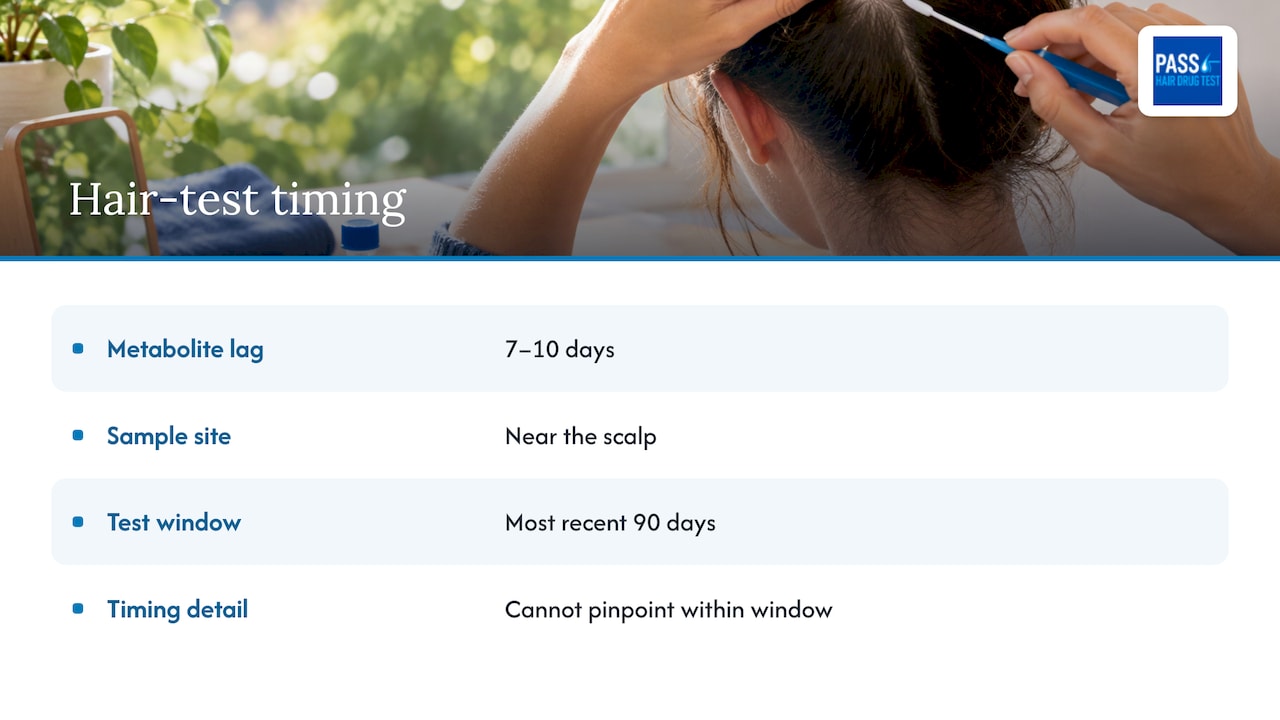
Because the hair holds that record as it grows out of the scalp, it works like a calendar. Metabolites appear in the hair shaft roughly 7 to 10 days after use, which is why hair reflects the past 90 days or so but not last week.
How the sample is collected
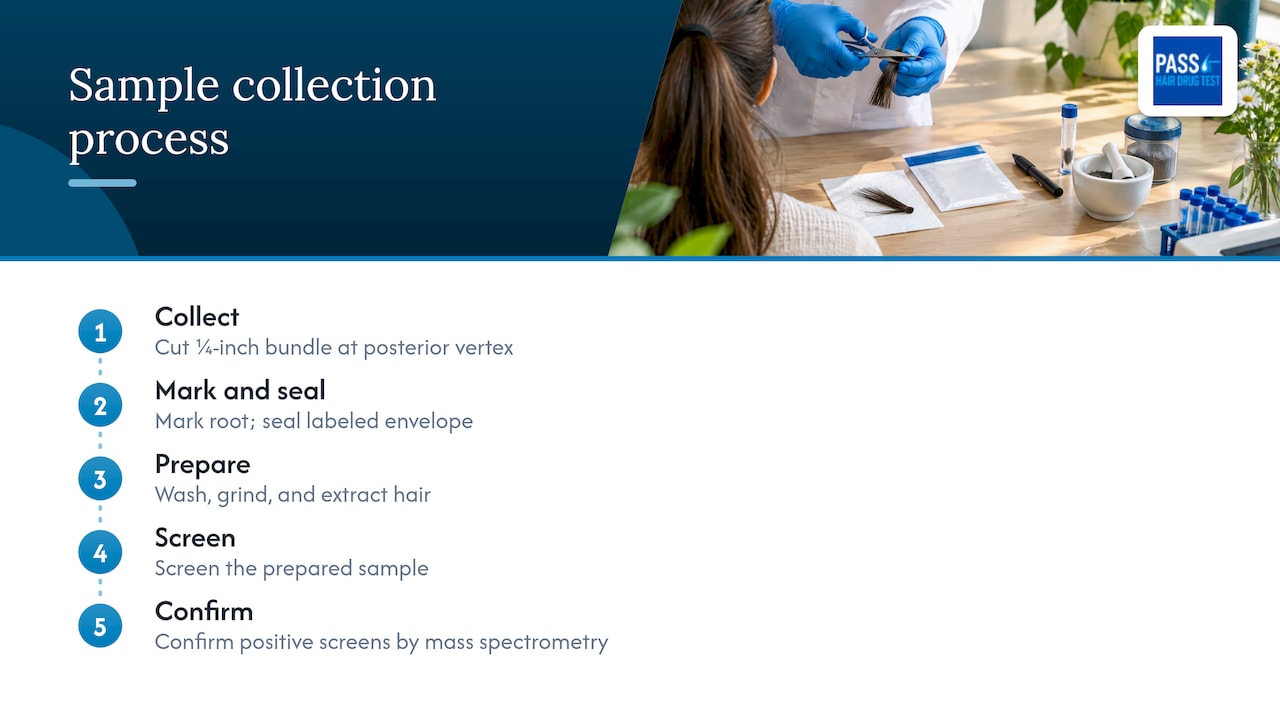
The Journal of Applied Laboratory Medicine review (2025) describes the standard procedure: a bundle about ¼ inch in diameter is cut as close to the scalp as possible from the posterior vertex, the spot at the back of the crown. That site is preferred because growth rate varies least there and it has the largest share of actively growing follicles. The root end is marked and the bundle sealed in a labeled envelope.
The lab then washes the hair, grinds and extracts it, and screens it, with positives confirmed by mass spectrometry. The Society of Hair Testing’s 2022 consensus states that every presumptive positive screen must be confirmed this way. Some labs segment the hair at about 1 cm intervals to build a timeline.
If you do not have enough scalp hair, collectors can take body hair. Cleveland Clinic notes that body hair has a window of up to 12 months, because it grows more slowly than scalp hair.
Sweat patch vs. hair test side by side
| Sweat patch | Hair follicle test | |
|---|---|---|
| How it is collected | Adhesive patch worn on skin for 3 to 7 days | About ¼ inch bundle of hair cut at the scalp |
| What it reflects | Use shortly before application and during wear | Use over roughly 90 days for a standard scalp sample |
| What it mostly finds | Parent drug, some metabolites | Drugs and metabolites trapped in the hair |
| Typical setting | Probation, treatment monitoring | Pre-employment and workplace screening |
| Blind spot | Cannot date the use | Not designed to show use in the last 7 to 10 days |
The UNODC’s testing guidelines put the same contrast in broader terms: detection windows of weeks for sweat patches, and months or longer for hair, against hours to days for blood, urine and oral fluid.
Why hair is the one that needs a plan
A sweat patch window is short enough that what matters is the few days around it. A hair test is different: it is a record, and a record cannot be changed by abstaining for a weekend. The American Academy of Pediatrics explains in its 2014 policy statement that hair cannot detect use in the previous 7 to 10 days, the first 3 cm of scalp hair covers about 90 days, and the results can be affected by hair structure, growth rate, melanin, hygiene, cosmetic treatment, shampoos, bleaches and dyes.
Two details matter to THC users in particular:
- THC is the hard one to find in hair. SAMHSA reports that cannabinoids deposit less readily in hair than basic drugs, and that hair testing is most reliable for frequent, heavy use. Labs look for a THC metabolite, tetrahydrocannabinol carboxylic acid.
- Environmental exposure is on the lab’s radar. The AAP notes that volatile drugs like marijuana can adhere to hair from the environment, which is one reason labs wash samples before analysis.
The practical takeaway is that how you care for your hair in the weeks before collection is part of your preparation. Hair color, how recently you treated it, and how you wash it all show up in that AAP list of factors.
The timing most people get wrong
Because metabolites take 7 to 10 days to reach the shaft, there is a built-in lag, and because the standard sample is cut near the scalp, the most recent 90 days of growth are the ones tested. NYU’s School of Global Public Health notes that hair generally reflects use within the past 90 days but cannot readily pin down when within that window drugs were used. So the question is not “when did I last use?” but “what does the last three months of my hair look like to a lab?” Plan from that.
Preparing your hair for a follicle test
If you have a test coming, here is a routine that fits what the evidence says about how hair tests work. Where our products come in, we say so.
Step 1: Find out exactly which test you are getting
Ask the employer or the collection site whether it is a head hair test, and whether body hair is acceptable if you have little scalp hair. Ask how soon you must report. A hair test is not a point-of-care test: the AAP notes that no point-of-care hair tests exist, and laboratory hair testing is costly and slow to return results. So you will usually have a scheduled appointment, not a surprise cup in the hallway. That gives you time to get started.
Step 2: Start immediately and plan for the whole window
Hair carries a long record, so every wash between now and collection counts. Do not wait for the night before. Our guide to passing a hair follicle test lays out how to build your schedule backward from the collection date.
Step 3: Use a cleansing routine made for hair testing
This is where we put our experience to work. We have more than 20 years in the drug-testing and detox-product industry, and our hair-cleansing line is built around our multi-step Mike’s Macujo Method, along with Macujo Aloe Rid Shampoo and Zydot Ultra Clean Shampoo. Our method is designed for both light and heavy users and comes with detailed instructions, so you are not guessing at order, timing or frequency. Our phone support is unlimited, which is useful at step three, when most people have questions about their own hair. You can see the full routine on our how to pass a hair drug test page.
Step 4: Follow the instructions in full, every time
A multi-step routine only works as a routine. Skipping a wash, changing the order, or stopping early undoes the point of having a plan. Keep the products and the instructions together and stick to the schedule you set in step two.
Step 5: Do not add chemistry you cannot account for
Bleaches, dyes and other cosmetic treatments are on the AAP’s list of things that can alter hair-test results. Changing your hair treatment right before collection adds an unknown, so keep your routine consistent with the instructions you are following.
Step 6: Handle collection day calmly
The collector takes a small bundle from the back of the crown. Arrive with your hair as you normally wear it and follow the collector’s directions. If you have dreadlocks or a particular style, read our page on what to say at a 90-day hair drug test before you go.
A note on safety and health: hair-cleansing products are for external use on hair and scalp. If you have a scalp condition, allergies or broken skin, ask a doctor or pharmacist before using any new product on your scalp.
What a hair test can and cannot tell a lab
One reason people worry is how much weight a single result carries. Here is what the science says in plain terms:
- It is built for pattern, not a single moment. The PMC review describes hair as useful for detecting chronic use and periods of abstinence, but not sporadic use, and says use often must be relatively heavy to be detected.
- Individual factors matter. The same review lists shaving, sweat-driven migration of metabolites up the shaft and melanin-related differences in dark hair as limitations on interpretation.
- Interpretation takes experience. The UNODC guidelines say hair results should be interpreted only by specifically experienced personnel who consider case history, collection site, growth-rate variability and drug pharmacology.
- Screening is followed by confirmation. A 2004 overview in PubMed describes a screening test followed by a confirmatory test if positive, and gives hair the largest detection window among common matrices, from 7 to over 100 days.
The point for you: the lab process is layered and the result is based on the hair you bring. That is why preparing the hair itself is the sensible place to put your effort.
When the question is really about a sweat test
If your situation is probation, a treatment program or a court order that uses a patch, the test is a different one and the timeline is days, not months. Keep the patch on for the full period, do not tamper with it, and follow your supervising officer’s instructions. Your attorney or probation officer is the right person for questions about your specific order. If you are also facing a urine, saliva or blood screen, we carry products for those too: browse all our drug testing products.
Our perspective
We hear from people who read about the sweat patch and the hair test in the same breath and assume they work alike. They do not. A patch is a window of days. A hair sample is a record of months.
That is exactly why we put the most effort into the hair side of our business. When the lab is going to read a strand of hair that has been growing for 90 days, you need a method, not a single product and a hope. Our multi-step Mike’s Macujo Method exists for that reason: it gives you an order of steps, a schedule and instructions you can follow.
After more than 20 years in this industry, our view is simple. Start early, follow the routine in full, and call us when something about your hair or your schedule does not fit the instructions. Our phone support is unlimited for a reason.
MIchael
Ready to start your routine
If a hair follicle test is on your calendar, our hair-cleansing shampoos and the multi-step Mike’s Macujo Method are made for exactly this situation, and our instructions walk you through the routine from the first wash to collection day.
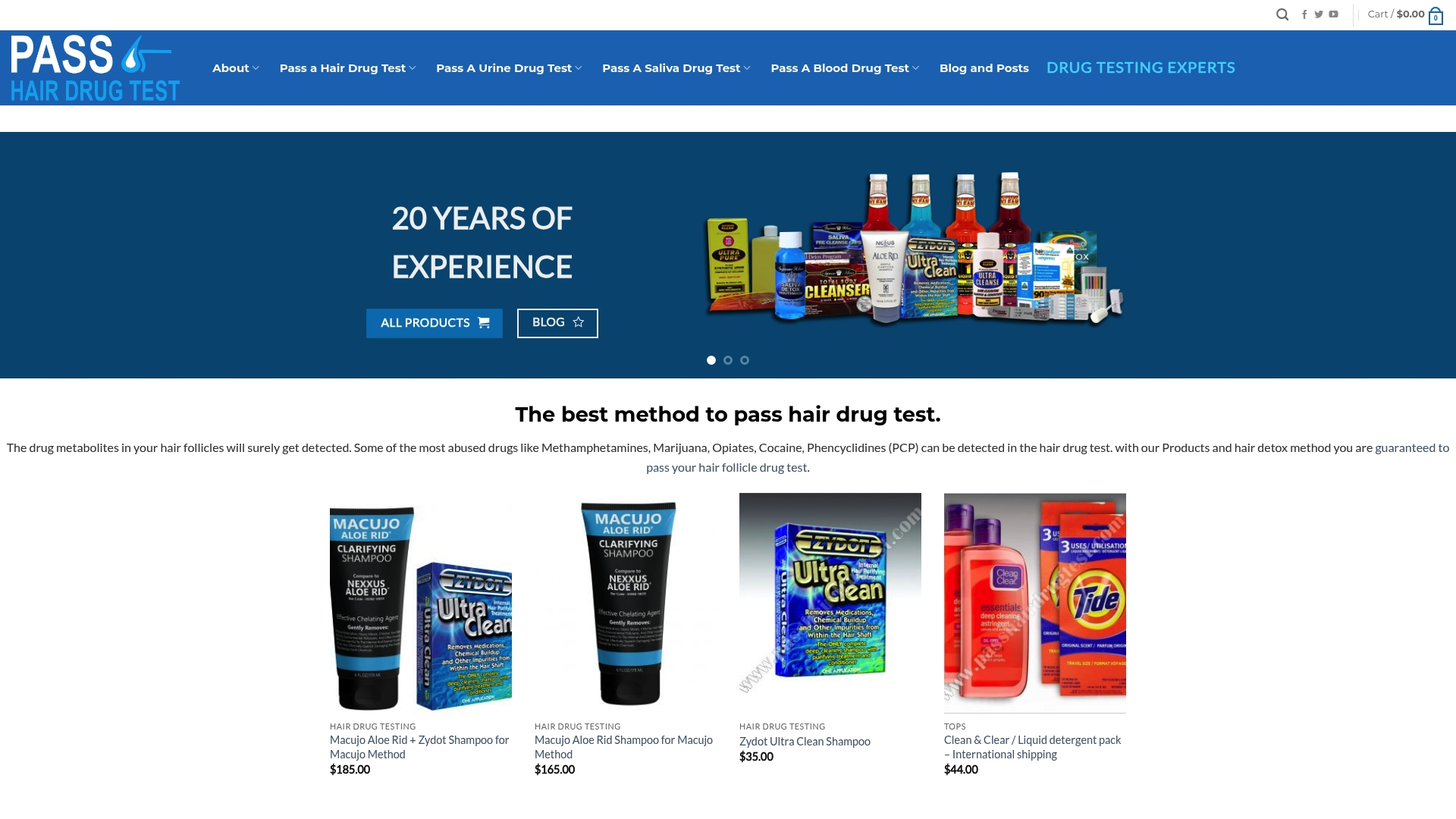
See the full lineup on our hair follicle drug test page, or head to the products page to choose your kit.
FAQ
How long does a sweat patch stay on?
SAMHSA says a sweat patch should be worn at least 3 days and no longer than 7. It picks up drugs that were in your system shortly before it was applied, plus anything excreted while you wear it. Most drugs are gone from sweat within the first 48 hours after use.
How far back does a hair follicle test go?
A standard 1.5-inch scalp sample covers about the past 90 days. Hair does not reflect use from the most recent 7 to 10 days, because metabolites take that long to reach the part of the hair above the scalp. Body hair grows more slowly and can cover up to 12 months, according to Cleveland Clinic.
Can a hair test show exactly when I used THC?
Not precisely. NYU’s School of Global Public Health notes that hair generally reflects use in the past 90 days but cannot readily delineate when within that window drugs were used. Labs can segment hair at about 1 cm to estimate a rough timeline, which is based on an average growth rate.
Does the lab wash my hair before testing?
Yes. Labs wash hair samples to remove external substances before analysis, then screen and confirm positives with mass spectrometry. That is why your own preparation should focus on the hair itself well before collection day, using a routine built for hair testing.
Where can I get a hair-cleansing routine for a follicle test?
We sell hair-cleansing shampoos and the multi-step Mike’s Macujo Method, with detailed instructions and unlimited phone support. Start with our hair drug test information page, then choose a kit on the products page.
Sources
- Clinical Drug Testing in Primary Care, SAMHSA (2012)
- Technical Guide, Montana drug court conference
- Objective Testing: Urine and Other Drug Tests, PMC (2016)
- Review on Toxicology Testing in Hair, Journal of Applied Laboratory Medicine (2025)
- General Consensus on Hair Testing, Society of Hair Testing (2022)
- Cleveland Clinic: Drug Test overview
- UNODC guidelines on hair, sweat and oral fluid testing
- Testing for Drugs of Abuse in Children and Adolescents, AAP Pediatrics
- Drug & Alcohol Testing, NYU School of Global Public Health
- An overview of the use of urine, hair, sweat and saliva, PubMed (2004)
Recommended
- How to Prepare for a Hair Test the Right Way
- Body Hair vs Head Hair: What Drug Test Labs Really Use
- Body Hair Drug Test: What You Need to Know
- Hair Washes Before a Hair Drug Test: What Actually Matters
