No products in the cart.
Uncategorized
Abstinence Before a Hair Test: How Long It Takes and What It Misses
22
Nov
Stopping THC is the first step before a hair follicle test, but it does not clear the hair you have already grown. A lab reads roughly the last 90 days of your hair, so the days you abstain only help once that new hair has grown out. If your test is sooner than that, the hair already on your head is what gets analyzed, and that is where a cleansing routine such as the Mike’s Macujo Method, which we sell, comes in.
This guide explains how the window works, what abstinence does and does not change, and how to plan the weeks you have.
Table of Contents
TL;DR
- A standard hair test analyzes about 1½ inches of scalp hair from the root, which Quest Diagnostics says covers approximately 90 days.
- Abstinence stops new THC from entering your hair. It does not remove what is already in the 1½ inches nearest your scalp.
- Use in the last 5 to 10 days usually has not reached the scalp surface yet, so the part of the window that matters most is the older stretch.
- If your test falls inside 90 days of your last use, plan for abstinence plus a hair-cleansing routine, not abstinence alone.
- Our Macujo Aloe Rid and Zydot Ultra Clean shampoos and the multi-step Mike’s Macujo Method are built for exactly this situation.
Table of Contents
- How the 90-day window actually works
- What abstinence does for a hair test
- Why a single clean month is not a clean result
- Secondhand smoke and contamination
- Things that can shift how hair reads
- Putting it together: abstinence plus cleansing
- What to expect on test day
- Promo: start your hair plan today
- Our perspective
- FAQ
- Sources
How the 90-day window actually works
Your hair grows from the follicle, and anything circulating in your blood can be taken up into the growing strand. As the strand lengthens, that record moves away from your scalp, like a timeline printed on a ribbon.
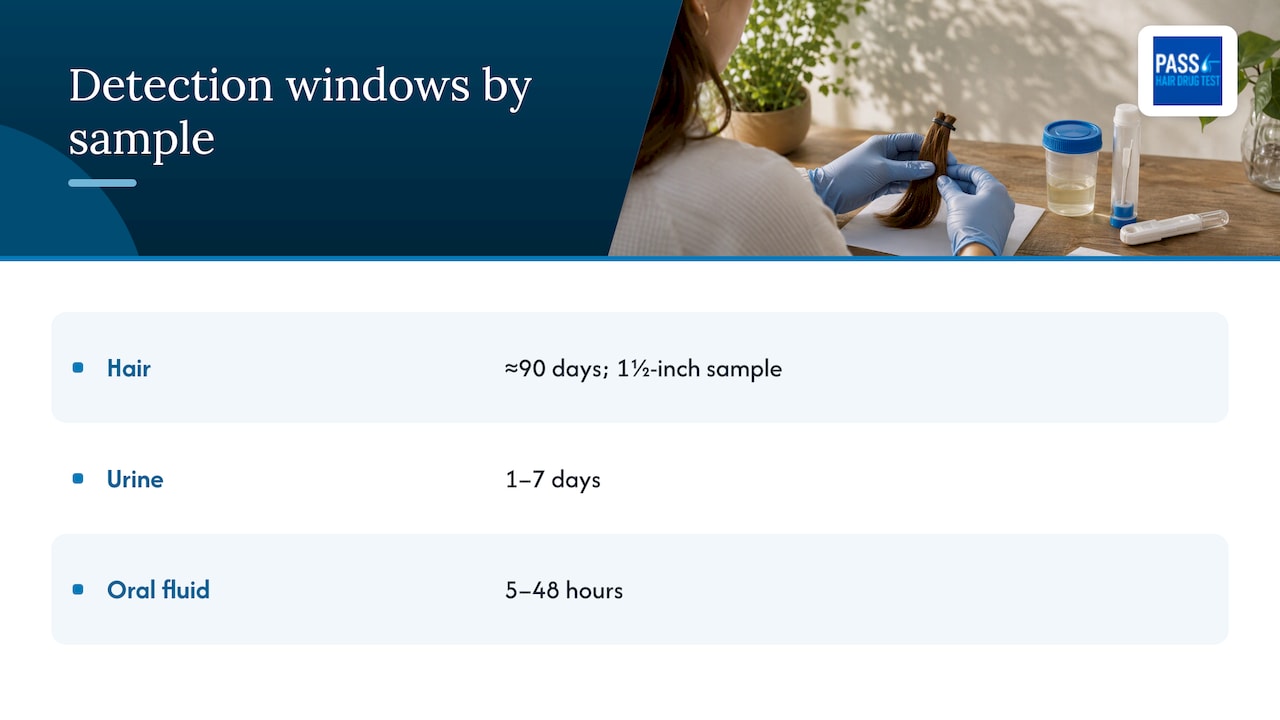
Quest says head hair grows about ½ inch (1.3 cm) per month, and the lab usually cuts the first 1½ inches (3.9 cm) closest to the scalp. That length covers approximately 90 days. Labcorp gives the same figure, and contrasts it with urine, which looks back one to seven days, and oral fluid, which looks back five to 48 hours.
The Society of Hair Testing notes that growth rate varies from person to person, and that roughly 1.0 cm per month is generally accepted. So 90 days is a working figure, not a stopwatch. If you want more on what labs measure with different hair lengths, see our page on long hair and drug tests.
The lag at the front of the window
Hair that has just taken up a substance has to grow out of the skin before it can be cut. Quest puts that at about 5 to 10 days. A 2025 review in the Journal of Applied Laboratory Medicine says drugs will not be detectable in hair above the scalp for at least a couple of days after ingestion, and up to 10 days.
That is why a hair test is not a test of last night. It is a test of the previous weeks and months, with a short blind spot at the end. For the same lag on other substances, see our opioid detection time guide.
What abstinence does for a hair test
Abstinence does one very useful thing: it stops adding THC metabolite to new hair. Every week you stay clean, the newest growth at the root is clean growth. That matters because labs look at the pattern across the sample, and because it is the foundation of any plan.
But it does not erase the older record. The Iowa Department of Health and Human Services guidelines state that hair is not significantly affected by brief periods of abstinence, and that 1½ inches of hair corresponds to a 90-day window. The United Nations Office on Drugs and Crime says hair analysis can find traces of drugs in people who claim months of abstinence.
In plain terms: if you stopped 3 weeks ago and the lab cuts 1½ inches, about two months of your earlier use is still sitting in that sample.
A simple way to read your own timeline
- Count back from your test date to your last use. That is your clean stretch, in days.
- Subtract it from 90. The remainder is how many days of earlier use may still be in the sample.
- If the remainder is zero or less, the full window is behind you and abstinence has done the work.
- If it is above zero, that remainder is the hair you need a plan for.
Worked example: your test is in 45 days and you quit today. Roughly 45 days of the 90-day window will cover the time you were still using. Waiting alone does not close that gap. A plan that adds cleansing to your abstinence does.
Why a single clean month is not a clean result
People often ask whether 30 days is enough. The window above shows why it usually is not for a 1½-inch sample: two thirds of that sample reflects the time before you quit.
There is also a detail on how much shows up. SAMHSA’s primary care guide says hair testing is most reliable for prior frequent, heavy use and is difficult for low-level use such as a single episode. It also notes that cannabinoids deposit less readily in hair than some other drugs. So lighter or occasional users are not in the same position as daily users, but you cannot count on that without knowing your own pattern and your lab’s cutoffs.
Those cutoffs are tiny. Quest lists its marijuana cutoffs as 1.0 pg/mg for screening and 0.1 pg/mg for confirmation, measured as the THC carboxylic acid metabolite (THC-COOH). A picogram is a trillionth of a gram, which is why a small amount of residue matters.
Secondhand smoke and contamination
If you are abstaining, you want to stay out of smoke too. Labs know environmental exposure is possible. The Iowa guidelines note that positive hair results can come from environmental exposure as well as ingestion, and that better labs wash the sample to tell the difference.
The Journal of Applied Laboratory Medicine review describes how this works: the lab washes the hair and analyzes the wash solution. If a drug is found in the hair but not the wash, outside contamination can be ruled out. It also describes a wash criterion that subtracts a multiple of the last wash from the hair result before comparing it to the cutoff.
Labs also look for the metabolite, because it is made by the body. SAMHSA’s literature summary says THC-COOH in hair is widely accepted as confirming use, while another compound is examined as a marker of sidestream smoke. For you, the practical rule is simple: during your abstinence period, avoid rooms and cars where others are smoking, and keep your hair away from smoke.
Things that can shift how hair reads
Several factors change how a sample behaves. The Society of Hair Testing consensus says hair concentrations can be affected by bleaching, dyeing, perming, straightening and UV exposure, as well as by outside contamination. Hair color also plays a part: SAMHSA notes that dark hair can bind more of some drugs because of melanin.
The same review says a THC metabolite can be found in hair outside the segments that match the time of use, probably because it spreads from sweat and sebum through the hair. For you, this means your hair’s surface and care routine matter, and it is the reason we focus on the hair itself rather than on counting days alone.
If you have dreadlocks, the sampling question is different; our guide on what to say at a 90-day test with dreadlocks covers it.
Putting it together: abstinence plus cleansing
Here is the plan we recommend to a reader whose test falls inside the 90-day window.
- Stop use now and stay out of smoke. Every clean day grows clean hair at the root and removes new exposure.
- Work out your gap with the 90-day count above.
- Start a hair-cleansing routine right away, not the night before. Our Mike’s Macujo Method is a multi-step routine built around Macujo Aloe Rid Shampoo and Zydot Ultra Clean Shampoo. You can read the details on our hair-cleansing guide and on the Macujo Aloe Rid Shampoo guide.
- Follow the instructions in full. The method comes with detailed instructions, and we offer unlimited phone support if you have questions along the way.
- Keep your hair care simple around the test and avoid new treatments that you cannot predict.
We have more than 20 years of experience in the drug-testing and detox-product industry, and the method is the product of that work. We describe it as a way for both light and heavy users to approach a hair test, and our site presents a guarantee with it.
Where abstinence plus the method beats abstinence alone
Abstinence works on the future: it keeps new hair clean. The method is aimed at the hair you already have. Used together, they cover both halves of the sample. If your test is 10 days out or 60 days out, the plan is the same shape: stay clean, and start the routine as soon as you can so you can follow every step.
If you are comparing hair with other tests you may face, our page on hair versus urine testing explains who each test catches, and the full hair follicle test guide gives more background.
What to expect on test day
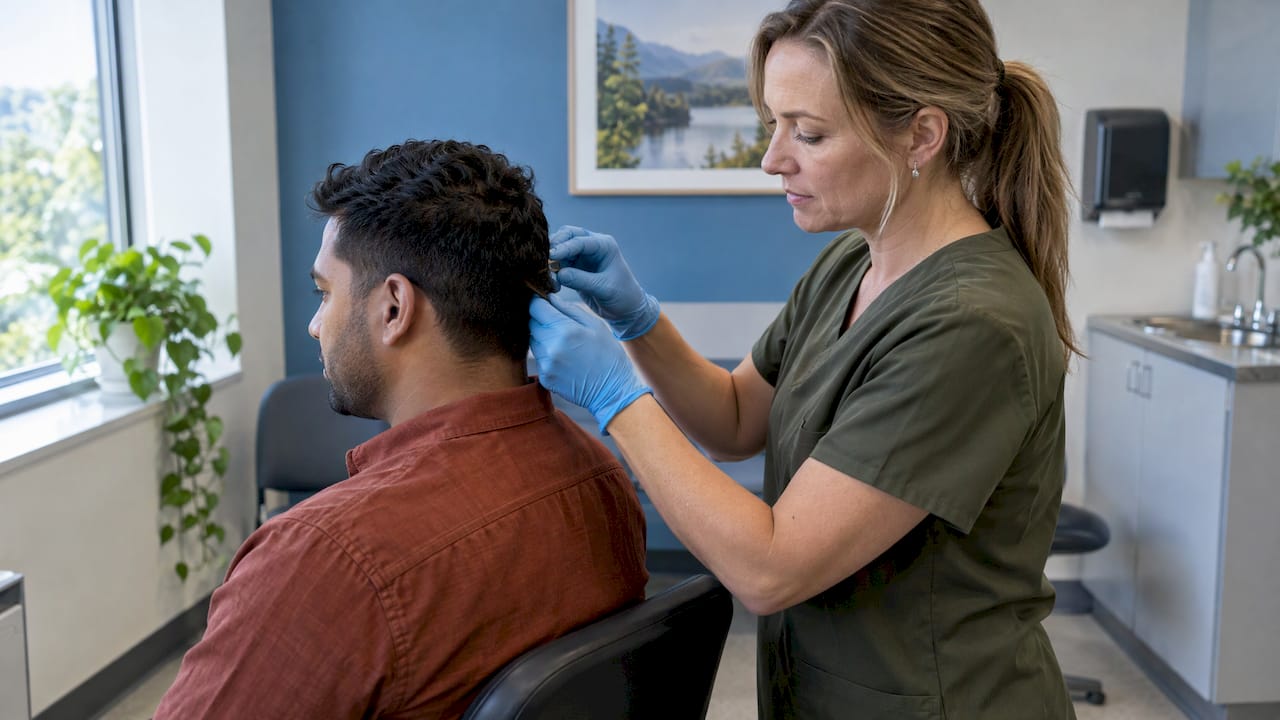
The collection itself is quick. The UNODC manual recommends taking a lock of hair about the thickness of a pencil from the back of the head, at the posterior vertex, where growth rate varies least. The root end is aligned and marked, and the sample is stored dry and dark.
At the lab, the sample is washed, extracted and screened. The Society of Hair Testing advises that all presumptive positives be confirmed by mass spectrometry, so a result goes through more than one step. Quest explains that it uses wash correction in some confirmatory assays and requires the metabolite before reporting a positive (Quest FAQ).
Hair testing is also a pre-employment and random-testing tool. Quest explains it gives a 90-day history of repetitive use, which is why employers choose it for screening applicants. If you are applying for a job, expect it to be done once, early in the process.
Promo: start your hair plan today
If your test falls inside the 90-day window, the best use of your time is to begin the routine now. Our hair detox shampoos and the multi-step Mike’s Macujo Method are in our store, along with the instructions that go with them.
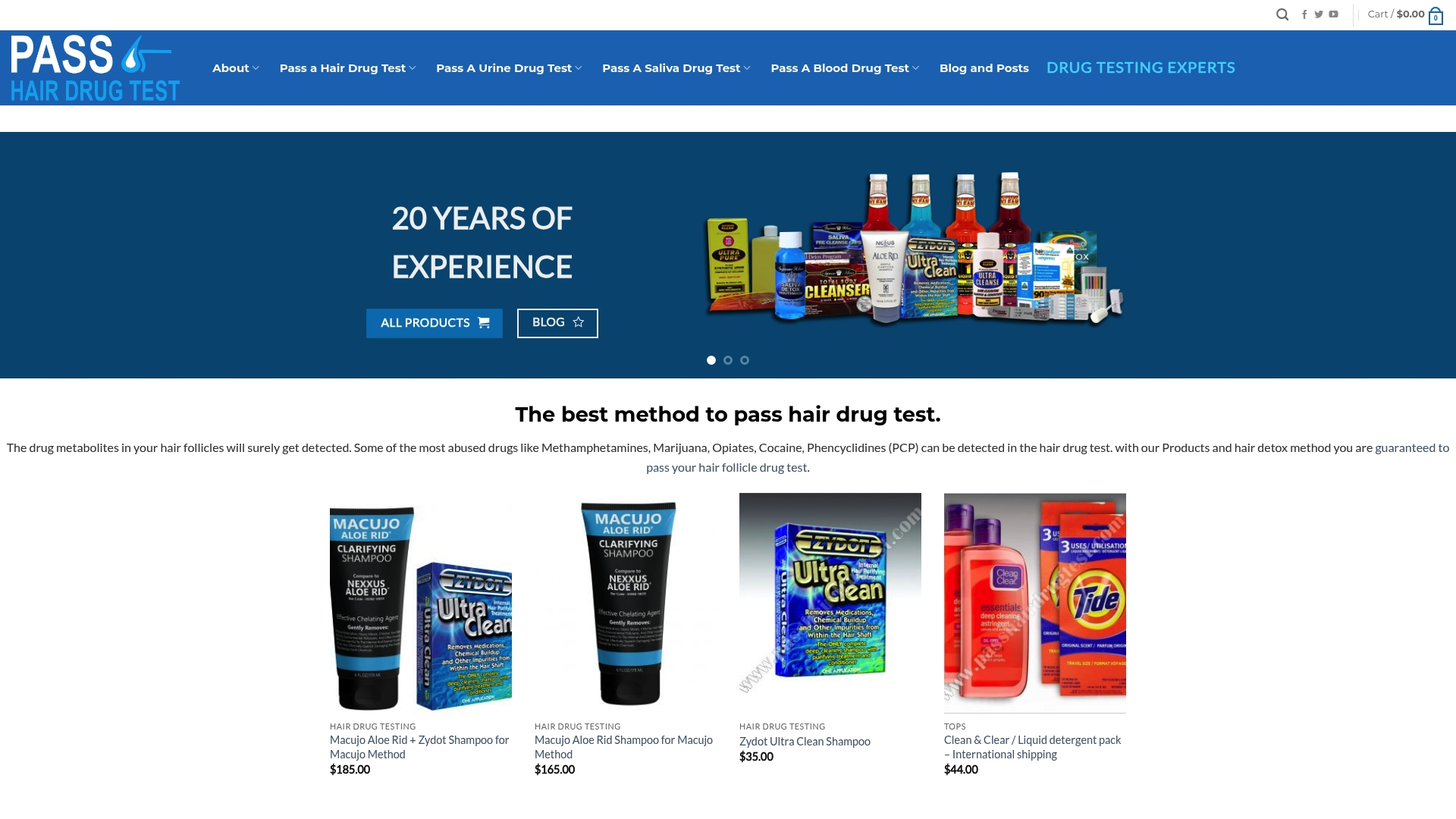
See the full range on our hair drug testing products page, or read how the routine works on our hair-cleansing guide.
Our perspective
Most people who come to us ask the same thing: if I just stop, will that be enough? The honest answer depends on the calendar. A hair test looks back about 90 days, so stopping protects the hair you grow from here on, and that is a good habit to start today.
What it cannot do alone is change the hair that already grew while you were using. That is the problem we built our work around. Over more than 20 years in this industry, we have focused on products for the hair itself: Macujo Aloe Rid Shampoo, Zydot Ultra Clean Shampoo, and the multi-step Mike’s Macujo Method, which we regard as the way to go about it.
Our advice is to treat the two as a pair. Abstain, avoid smoke, and start the method early enough to follow each step without rushing. If you have a question at any stage, our unlimited phone support is there for that.
MIchael
FAQ
How long should I abstain before a hair follicle test?
A standard sample covers about 90 days, so a full 90 days of abstinence puts the whole sample after your last use. If your test is sooner, abstinence on its own leaves part of the window uncovered, which is why we pair it with the Mike’s Macujo Method.
Does quitting a week before the test help?
It helps with the newest hair, but the lab usually cuts the first 1½ inches from the scalp, and use in the last 5 to 10 days may not have grown out yet. The weeks and months before that are still in the sample, so a short break is best combined with a cleansing routine.
Can a hair test detect one-time or occasional use?
SAMHSA states hair testing is difficult for detecting low-level use such as a single episode and is better at picking up frequent, heavy use. Your result depends on your pattern of use and on the lab’s cutoffs, so plan around your own timeline rather than assuming.
Can secondhand smoke cause a positive hair test?
Environmental exposure is recognized, and labs wash samples and look for the THC metabolite to separate it from use. During your abstinence period, stay out of smoke-filled rooms and vehicles to avoid any question.
Where should I start if my test is coming up?
Stop use, count your days against the 90-day window, and begin your hair-cleansing routine right away. You can browse our hair drug testing products and call us with any questions.
Sources
- Quest Diagnostics: Hair testing FAQ
- Labcorp: Hair drugs of abuse testing FAQ
- Society of Hair Testing: General Consensus on Hair Testing, 2022
- Journal of Applied Laboratory Medicine: Review on Toxicology Testing in Hair
- Iowa HHS: RC-0090 Drug Testing Guidelines
- UNODC: Guidelines for testing drugs under international control in hair, sweat and oral fluid
- SAMHSA: Clinical Drug Testing in Primary Care
- SAMHSA: The science of hair testing, literature summary
Recommended
- Why the 5–14 Day Lag Makes Hair Tests Miss One Time Use
- Your Last Week Before a Hair Test: What You Can Still Do
- How to Prepare for a Hair Test the Right Way
- Hair Washes Before a Hair Drug Test: What Actually Matters
