No products in the cart.
Uncategorized
Hair Drug Test Accuracy: What the Science Actually Shows

11
Aug
Aug
Hair drug tests are generally reliable for confirming past drug exposure, but they are not perfectly accurate, cannot measure dose, and cannot prove intent.
What you need to know immediately:
- Confirmatory testing by GC-MS or LC-MS/MS is required before any forensic or employment decision. A screening result alone is not proof.
- Environmental contamination (cocaine powder, secondhand smoke, surface contact) can produce a positive result in someone who never ingested a drug.
- Hair tests miss very recent use. Drugs typically take 5–7 days to appear above the scalp, so anything consumed in the past week is likely invisible.
- Accuracy varies by drug class. Cannabis and street opioids show higher concordance with self-reported use than cocaine or prescribed opioids.
- A 2026 systematic review concluded that hair testing reliably indicates exposure but cannot accurately quantify dose or distinguish intentional ingestion from passive contamination.
Table of Contents
Key Takeaways
Hair drug tests reliably confirm past exposure but cannot measure dose, prove intent, or detect use from the past week, making confirmatory GC-MS or LC-MS/MS testing and chain-of-custody documentation non-negotiable for any high-stakes result.
| Point | Details |
|---|---|
| Accuracy varies by drug class | Cannabis concordance reaches 93%; cocaine drops to 61%, making drug type a critical variable. |
| Confirmatory testing is required | Immunoassay screens alone lack forensic validity; GC-MS or LC-MS/MS confirmation is the standard. |
| Contamination can cause false positives | Cocaine and methamphetamine deposit on hair externally; metabolite testing distinguishes ingestion from exposure. |
| Hair misses very recent use | The 5–7 day lag before drugs appear above the scalp means anything used in the past week is likely undetected. |
| Challenge rights exist | You can request split-sample reanalysis, chain-of-custody records, and MRO review before any adverse action. |
Table of Contents
- How does hair drug testing actually work?
- How accurate are hair drug tests? Sensitivity, specificity, and what those numbers mean
- What raises or lowers hair drug test accuracy?
- How does the lab process work, from screening to confirmation?
- What causes false positives and false negatives in hair tests?
- What should you do if you get a positive or negative hair test result?
- How does hair testing compare with urine and blood testing?
- What does the research actually show about hair test reliability?
- The role of hair testing deserves more honest scrutiny
- Sources
How does hair drug testing actually work?
Drugs enter hair through two main routes: the bloodstream during active hair shaft formation, and external deposition via sweat, sebum, and surface contact. Both pathways matter because they create a long detection window but also introduce contamination risk that no lab can fully eliminate.
Hair growth and the detection window
Hair grows at roughly 0.6–1.4 cm per month. The standard collection protocol takes 1.5 inches (approximately 3.8 cm) of hair cut close to the scalp, which maps to roughly 90 days of history. That 90-day window is why hair testing is the preferred matrix for detecting chronic or repeated use rather than a single recent episode.
There is a critical blind spot, though. Drugs take 5–7 days to emerge above the scalp surface after use, so hair growth rate variability and that lag make precise timing within the 90-day window unreliable. Segmental analysis (dividing the shaft into monthly segments) can show a trend over time, but it cannot pinpoint exact dates of use.
Sample collection basics
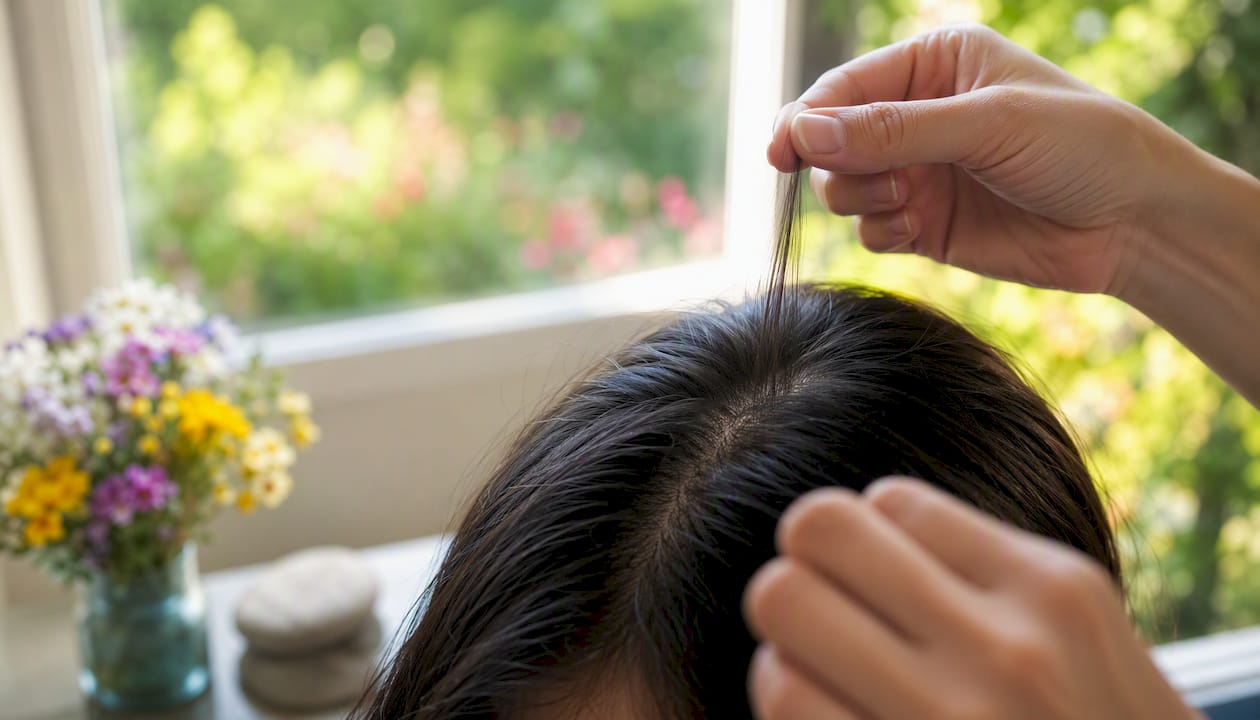
Labs require a minimum amount of hair, typically collected as a pencil-width bundle from the crown of the scalp. Scalp hair is preferred because its growth rate is better characterized. Body hair (chest, leg, underarm) grows more slowly and erratically, so the same 1.5-inch segment does not map cleanly to 90 days. When scalp hair is unavailable, body hair can substitute, but the time window it represents becomes less precise, and labs should note this in their report.
| Hair source | Approximate growth rate | Detection window for standard sample | Timing precision |
|---|---|---|---|
| Scalp | 0.6–1.4 cm/month | ~90 days | Moderate (segmental analysis possible) |
| Body (chest, leg) | Slower, more variable | Longer but less defined | Low (timing unreliable) |
| Facial | Variable | Undefined for standard protocol | Not recommended for segmental use |
Pro Tip: If a lab uses body hair because scalp hair is unavailable, ask specifically what detection window they are reporting. A blanket “90-day” claim applied to body hair is not scientifically defensible, and a reputable lab will acknowledge that limitation in writing.
How accurate are hair drug tests? Sensitivity, specificity, and what those numbers mean
Sensitivity measures how often a test correctly identifies someone who actually used a drug. Specificity measures how often it correctly clears someone who did not. PPV (positive predictive value) tells you how likely a positive result is real given the population being tested. NPV (negative predictive value) tells you how likely a negative result is real. All four numbers matter, and none of them alone tells the full story.
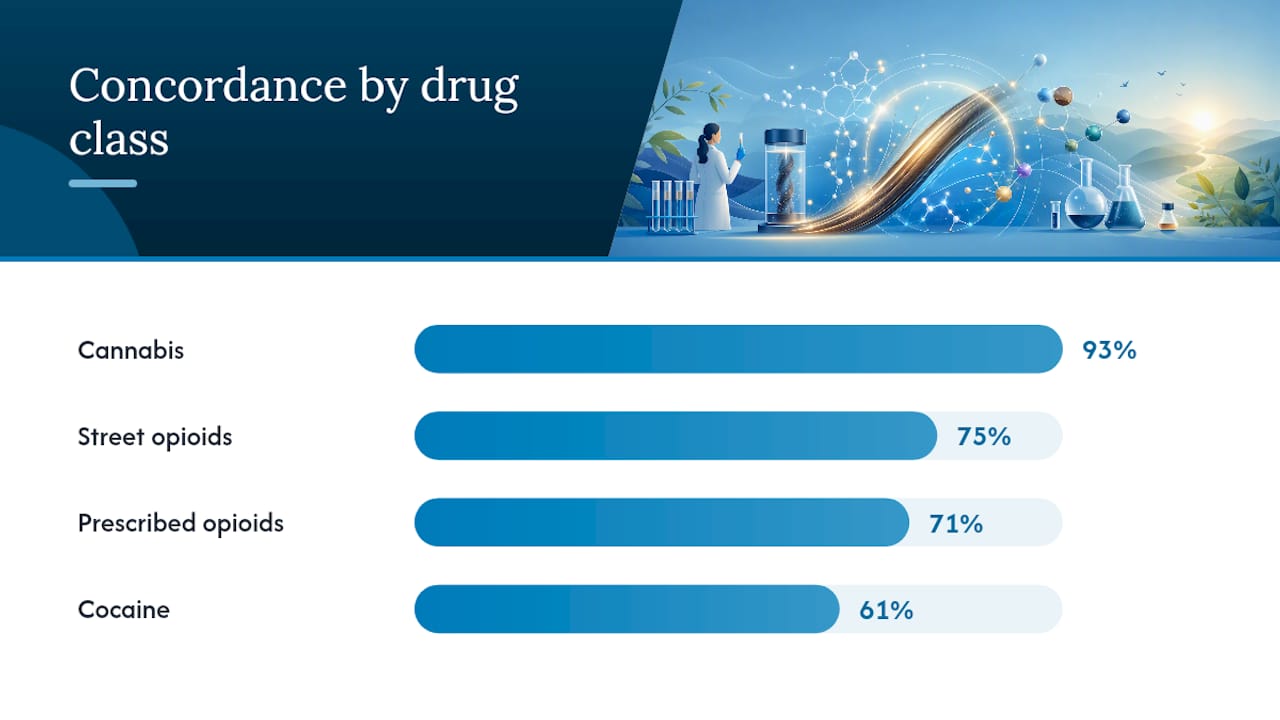
A study comparing hair analysis with self-reported drug use found concordance of 93% for cannabis and 75% for street opioids, but only 61% for cocaine and 71% for prescribed opioids, illustrating that drug-class variability in sensitivity and specificity is substantial.
When labs optimize their immunoassay screening cutoffs against Society of Hair Testing (SoHT) confirmation thresholds and confirm positives by UPLC/MS-MS, AUC values above 0.95 and sensitivity/specificity above 90% are achievable for multiple drug classes. That is a strong diagnostic performance, but it depends entirely on the lab following those optimized protocols.
Why prevalence changes everything
PPV is not fixed. In a forensic investigation where prior evidence already suggests drug use, the same test’s PPV climbs sharply. This is not a flaw in the test — it is basic probability. Knowing the population being tested is as important as knowing the test’s published accuracy figures.
What raises or lowers hair drug test accuracy?
Multiple non-drug variables materially change measured drug concentrations in hair. The main ones are melanin content, hair color and texture, cosmetic treatments, environmental contamination, and hair growth rate. Ignoring any of them risks misinterpreting a result.
Factors that affect hair test results:
- Melanin and pigmentation: Darker hair binds certain drugs, particularly cocaine and amphetamines, more readily than lighter hair. This means a dark-haired person and a blonde person with identical drug exposure may show different hair concentrations, which complicates threshold-based cutoffs.
- Hair texture and ethnicity: Incorporation pathways, melanin content, cosmetic treatments, and ethnicity significantly influence results, and no single correction factor has been universally validated.
- Cosmetic treatments: Bleaching, permanent dyeing, and chemical straightening degrade drug concentrations in hair, sometimes dramatically. A person who bleached their hair six weeks ago may test negative despite prior use, while someone who has never treated their hair may show higher concentrations from the same exposure.
- Environmental contamination: Cocaine and methamphetamine are especially prone to surface deposition from airborne powder, handling, or secondhand smoke. Without proper decontamination washes and metabolite testing, a person who handled cash or was in a room where cocaine was used could test positive.
- Hair growth rate: Faster-growing hair dilutes drug concentration per centimeter; slower-growing hair concentrates it. Labs rarely account for individual growth rate variation.
- Sample site: As noted above, body hair introduces timing uncertainty that scalp hair does not.
What contamination looks like in segmental analysis
External contamination tends to distribute relatively evenly along the hair shaft or concentrate in the outermost (oldest) segment, because the hair has been exposed to the environment for longer. Drug ingestion, by contrast, typically shows a concentration peak in the segment corresponding to the period of use, then tapers. A spike in the outermost segment with no corresponding elevation in newer growth is a red flag for contamination rather than ingestion, though it is not definitive on its own.
Pro Tip: Before accepting any positive result, ask the lab whether they performed standard decontamination washes (typically methanol or dichloromethane) and whether they tested for drug metabolites rather than just parent compounds. A positive for cocaine parent compound without a corresponding benzoylecgonine result is a strong indicator of external contamination, not ingestion.
How does the lab process work, from screening to confirmation?
A screening result alone is not forensic proof. Confirmation by mass spectrometry is required for any result that will be used in an employment, legal, or clinical decision. This is not optional best practice — it is the standard the field operates on.
The laboratory workflow follows three stages:
- Decontamination wash: Hair is washed with organic solvents to remove surface contamination before analysis begins. The wash solution itself is sometimes analyzed to estimate external exposure.
- Immunoassay (IA) screening: A rapid antibody-based test flags samples above a set cutoff concentration. Fast and inexpensive, but prone to cross-reactivity with structurally similar compounds. A positive screen is a presumptive result only.
- Confirmatory testing: Positive screens are re-analyzed by gas chromatography-mass spectrometry (GC-MS) or liquid chromatography-tandem mass spectrometry (LC-MS/MS). These methods identify compounds by molecular structure, not just antibody binding, and can detect specific metabolites that prove ingestion rather than contamination.
Key terms:
- Immunoassay (IA): Antibody-based screening test; fast but not specific enough for forensic use alone.
- GC-MS: Gold-standard confirmatory method using gas chromatography paired with mass spectrometry.
- LC-MS/MS: Liquid chromatography tandem mass spectrometry; preferred for polar compounds and metabolites.
- Cutoff: The minimum concentration at which a sample is reported positive. Different from the limit of detection (the lowest concentration the instrument can detect) or limit of quantitation (the lowest concentration it can reliably measure).
The Society of Hair Testing (SoHT) publishes recommended confirmation cutoffs and metabolite criteria for each drug class. Labs that follow SoHT guidance on metabolite testing and validated cutoffs produce results with stronger forensic standing than those using in-house thresholds. When a lab’s protocol is not publicly stated, that is worth asking about before accepting a result.
Immunoassay screening alone should not be the basis for any legal or employment decision. Positive screens require confirmation by mass spectrometry for forensic validity, and any lab that reports a final positive without that step is not meeting the standard the field expects.
What causes false positives and false negatives in hair tests?
Both false positives and false negatives occur in hair drug testing. The causes differ by drug class, and some scenarios are more likely to produce errors than others.
Common causes of false positives:
- Surface cocaine or methamphetamine contamination without metabolite confirmation
- Immunoassay cross-reactivity (e.g., certain antihistamines triggering amphetamine screens)
- Inadequate decontamination wash before analysis
- Chain-of-custody errors leading to sample mix-up or mislabeling
- Lab protocol variability, since identical samples sent to different accredited labs can yield different qualitative results based on the protocols used
Common causes of false negatives:
- Bleaching or aggressive chemical treatment degrading drug residues below the cutoff
- Very recent use (within 5–7 days of collection)
- Low-level or infrequent use that never reaches the detection cutoff
- Faster-than-average hair growth diluting concentration per centimeter
- Cutoff set too high relative to the drug class being tested
That gap reflects both the contamination problem for cocaine and the legitimate-prescription ambiguity for opioids. For cannabis, the main false-negative risk is infrequent use or recent-only use that falls within the 5–7 day blind spot.
Lab and chain-of-custody errors are harder to quantify but real. A sample that is mislabeled, stored improperly, or processed without documented chain of custody can produce a result that is legally and scientifically indefensible regardless of what the instrument actually measured.
What should you do if you get a positive or negative hair test result?
Request confirmatory testing immediately. If a positive result has not been confirmed by GC-MS or LC-MS/MS, it is a presumptive screen result, not a final determination. You have the right to ask for that confirmation before any adverse action is taken.
Step-by-step checklist:
- Ask for the confirmatory test report. Request the GC-MS or LC-MS/MS result in writing, including the specific compounds detected and the concentrations reported.
- Request chain-of-custody documentation. Every step from collection to result should be documented. Gaps in the chain of custody are grounds to challenge the result’s admissibility.
- Ask about the lab’s decontamination protocol and metabolite testing. For cocaine especially, a positive for the parent compound without benzoylecgonine is a contamination flag.
- Request a split-sample reanalysis. Many collection protocols preserve a portion of the sample. Ask whether a split sample exists and request that it be sent to an independent accredited laboratory for reanalysis.
- Contact the Medical Review Officer (MRO). In federally regulated workplace testing, an MRO reviews positive results and can consider legitimate medical explanations. Request a conversation with the MRO before any employment decision is finalized.
- Note the timing. Requests for reanalysis typically need to be made within a short window after the result is reported. Ask the lab or MRO what the deadline is and act before it passes.
- Seek legal or union support if the stakes are high. In employment or legal proceedings, an attorney familiar with drug testing law can review whether proper procedures were followed.
For federally regulated testing (DOT-covered positions, federal contractors), the procedures above are codified. For private employers, the rules vary by state, but the documentation and confirmation steps remain your strongest practical tools.
Pro Tip: If you plan to request an independent reanalysis, ask the original lab to preserve the remaining sample in writing as soon as possible. Some labs have short retention windows, and once a sample is discarded, independent testing is no longer an option.
For more background on hair follicle testing procedures and what to expect, Passhairdrugtest provides detailed guidance on the collection and laboratory process.
How does hair testing compare with urine and blood testing?
Hair tests are best for detecting medium-to-long-term use history. Urine is better for recent use. Blood is the right matrix when immediate impairment is the question. No single matrix does everything well.
Key differences at a glance:
- Detection window: Hair covers roughly 90 days; urine covers 3–30 days depending on drug and frequency of use; blood covers hours to a few days.
- Susceptibility to adulteration: Urine is the easiest to adulterate (dilution, substitution, additives). Hair is harder to adulterate but vulnerable to cosmetic treatment. Blood is collected under observation and essentially tamper-proof.
- Invasiveness: Blood collection is the most invasive. Hair collection is minimally invasive but requires a visible sample. Urine collection requires observed or monitored conditions for forensic validity.
- Recent use detection: Blood and urine are far superior for detecting use within the past 24–72 hours. Hair cannot reliably detect anything from the past week.
- Chronic use detection: Hair is the strongest matrix for establishing a pattern of repeated use over months.
| Scenario | Preferred matrix | Reason |
|---|---|---|
| Pre-employment screening for chronic use | Hair | 90-day window captures repeated exposure |
| Suspicion of immediate impairment | Blood | Detects active drug presence in hours |
| Post-accident workplace testing | Urine or blood | Captures recent use; faster turnaround |
| Probation or treatment compliance monitoring | Urine (frequent) or hair (periodic) | Urine for recent; hair for longer-term pattern |
| Forensic investigation of historical use | Hair | Segmental analysis shows use trends over months |
From an occupational health perspective, combining urine for recent use and hair for chronic use often gives the most complete picture of substance-use patterns. Neither matrix alone captures the full picture.
For a broader overview of drug testing matrices and their comparative use cases, Passhairdrugtest covers the key differences in plain language.
What does the research actually show about hair test reliability?
Systematic reviews and controlled studies generally agree on one core finding: hair testing reliably confirms exposure but is inconsistent for dose estimation or precise timing. The evidence base is solid enough to support qualitative exposure conclusions, but not strong enough to support claims about how much someone used or exactly when.
Key studies and what they found:
- The 2026 systematic review in Science & Justice concluded that correlations between drug dose and hair concentration are inconsistent across most illicit drugs and that hair should be treated as a qualitative exposure marker, not a quantitative measure.
- The Gryczynski et al. study in primary care patients found concordance of 93% for cannabis and 75% for street opioids, with lower rates for cocaine (61%) and prescribed opioids (71%), confirming that drug-class variability is a consistent finding across the literature.
- An applied forensic study showed that optimized immunoassay cutoffs confirmed by UPLC/MS-MS produce AUC values above 0.95 and sensitivity/specificity above 90% for multiple drug classes, demonstrating that high diagnostic performance is achievable when protocols are rigorous.
- Forensic toxicology reviews consistently flag that incorporation pathways, melanin content, cosmetic treatments, and lab protocol variability significantly affect results, and that standardized interpretation procedures are still needed across the field.
What the literature cannot yet answer:
- Controlled administration studies are limited for ethical reasons, so many dose-concentration relationships rely on observational or forensic samples, which introduces variability that cannot be fully corrected for.
- There is no universally adopted standard for decontamination washes, cutoffs, or reporting. Identical samples sent to different accredited labs can yield different qualitative results.
- Segmental analysis can show trends but cannot reliably assign drug use to specific dates within the detection window.
Remaining research gaps:
- Validated correction factors for melanin content and cosmetic treatment effects
- Standardized decontamination protocols adopted across accredited labs
- Larger controlled studies on body hair detection windows
- Clearer guidance on how to handle borderline concentrations near the cutoff
The role of hair testing deserves more honest scrutiny
Hair testing occupies an unusual position in forensic toxicology. The science behind it is real and the detection window is genuinely useful. But the gap between what the test can reliably show (exposure occurred) and what it is often asked to prove (this person used drugs on these dates, in these amounts, intentionally) is wider than most employers, courts, or even some labs acknowledge.
The most defensible use of hair testing is as one piece of a larger picture, not as a standalone verdict. A positive hair result confirmed by GC-MS, supported by chain-of-custody documentation, and interpreted by a qualified MRO or forensic toxicologist is meaningful evidence. The same result from a lab that skipped metabolite testing, used non-standard cutoffs, or cannot produce a complete chain-of-custody record is not.
The fairness concern is real. People with darker hair, people who use cosmetic treatments, and people who work in environments where drug residues are present face a structurally higher risk of a misleading result. That is not a reason to dismiss hair testing, but it is a reason to demand confirmatory protocols and to push back on any result that was not produced under rigorous conditions. Informed consent in employment testing should include a plain-language explanation of these limitations, not just a signature on a collection form.
Sources
The claims in this article draw primarily from peer-reviewed forensic toxicology literature and systematic reviews. The sources below are the most directly relevant for readers who want to verify findings or read deeper.
- The forensic limits of hair drug testing: a critical assessment of drug intake and hair concentration relationships
- Hair Drug Testing Results and Self-reported Drug Use among Primary Care Patients with Moderate-risk Illicit Drug Use
- Variability associated with interpreting drugs within forensic hair analysis: A three-stage interpretation
The hair drug test information resource at Passhairdrugtest provides accessible summaries of testing procedures, detection windows, and preparation options for readers navigating a test in the near term.
Recommended
- Hair Drug Test Information – Pass Hair Drug Test
- Body Hair Drug Test: What You Need to Know
- The Science Behind the Hair Drug Test – Pass Hair Drug Test
- Hair Follicle Drug Test Information – Pass Hair Drug Test
