No products in the cart.
Uncategorized
At-Home Saliva Test Kits: How They Work and What to Expect
02
Nov
Nov
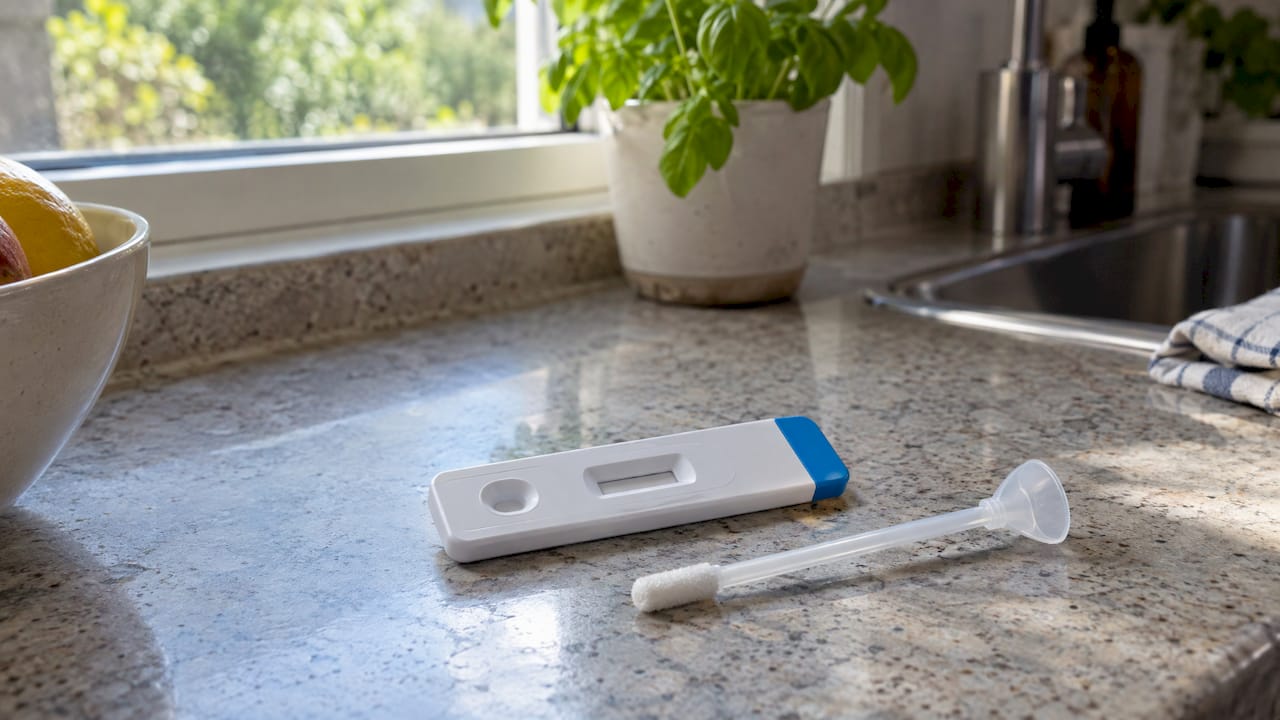
An at-home saliva test kit lets you collect a small oral fluid sample yourself and read a result in minutes (for drug screens) or send it to a lab (for hormone and DNA kits). If you landed here because a job, probation office or employer has mentioned an oral swab, you are almost certainly looking at a saliva drug screen. It looks for recent use of drugs such as THC, and it works very differently from a hair follicle test.
Table of Contents
TL;DR
- An at-home saliva drug test is a self-administered oral swab that checks for specified drugs or their metabolites, and it is built to show recent use, not use from months ago.
- Many 10-panel oral kits include THC, but panels vary by manufacturer, so read the box before you buy.
- Follow the insert exactly: no food, drink, smoking or tobacco for about 10 minutes beforehand, then wait the stated time before reading the result.
- A positive at-home result usually needs laboratory confirmation, and a screen shows presence, not impairment.
- Hair testing covers a far longer window than saliva, so the right preparation depends on which test you actually face.
Table of Contents
- Which kind of saliva kit do you need?
- What an at-home saliva drug test detects
- How to collect a saliva sample correctly
- Reading your result
- How long does THC stay detectable in saliva?
- How accurate are at-home saliva tests?
- Saliva test vs. hair follicle test
- Choosing a kit: a short checklist
- Our perspective
- Get the right test or prep for your situation
- FAQ
- Sources
Which kind of saliva kit do you need?
Search for this phrase and you will see very different products side by side: hormone kits that track cortisol or testosterone, DNA collection tubes, and rapid drug screens. They all use saliva, but they are built for different jobs.
- Hormone kits are mailed to a lab. You collect one or several samples over a day, ship them back and get a report later. Prices on the pages that rank run in the low hundreds of dollars, which is a different category from a drug screen.
- DNA kits stabilize a sample for genetic analysis. They are irrelevant to drug testing.
- Oral drug screens are single-use devices with a collection pad and a test strip. You read the result at home within minutes.
This guide covers the third type, because that is the one people use to check themselves before an employer, court or program does. If you need a hormone panel, the process of spitting into a tube and mailing it is simple, and the kit’s own instructions cover it.
What an at-home saliva drug test detects
Cleveland Clinic describes an oral drug test as a way to detect specified drugs or their metabolites in saliva, including alcohol, marijuana (THC), cocaine and opioids. An at-home kit is the self-administered version of that same test.
Which drugs are on a given kit is up to the manufacturer. The Maine Department of Public Safety notes that oral-fluid devices are commonly designed to detect THC, cocaine, amphetamine, methamphetamine, benzodiazepines and opiates, and that the exact panel depends on the device.
Does a 10-panel oral test include THC?
Usually, yes. A typical 10-panel oral screen covers amphetamine, barbiturates, benzodiazepines, cocaine, methamphetamine, methadone, opiates, oxycodone, PCP and marijuana/THC. But “10-panel” is not a standard. One kit may swap benzodiazepines for MDMA, another may use a different cutoff concentration. The panel list and the cutoffs are printed on the package or insert, and that printed list is the only reliable guide.
If your concern is THC specifically, confirm that the kit lists THC or marijuana as a tested drug before you pay for it. You can browse the saliva drug testing products we carry and see which panels each device covers.
How to collect a saliva sample correctly
Most bad results at home come from bad collection, not bad tests. The steps below reflect common manufacturer inserts and general medical guidance. Your kit’s own instructions always win if they differ.
- Wait before you swab. Inserts typically ask you not to eat, drink, smoke or use tobacco for at least 10 minutes first. Food and drink residue in the mouth can interfere with the result, and Cleveland Clinic lists food or drink in saliva among the factors that affect accuracy.
- Open the device only when you are ready. Check the expiration date and the pouch seal first.
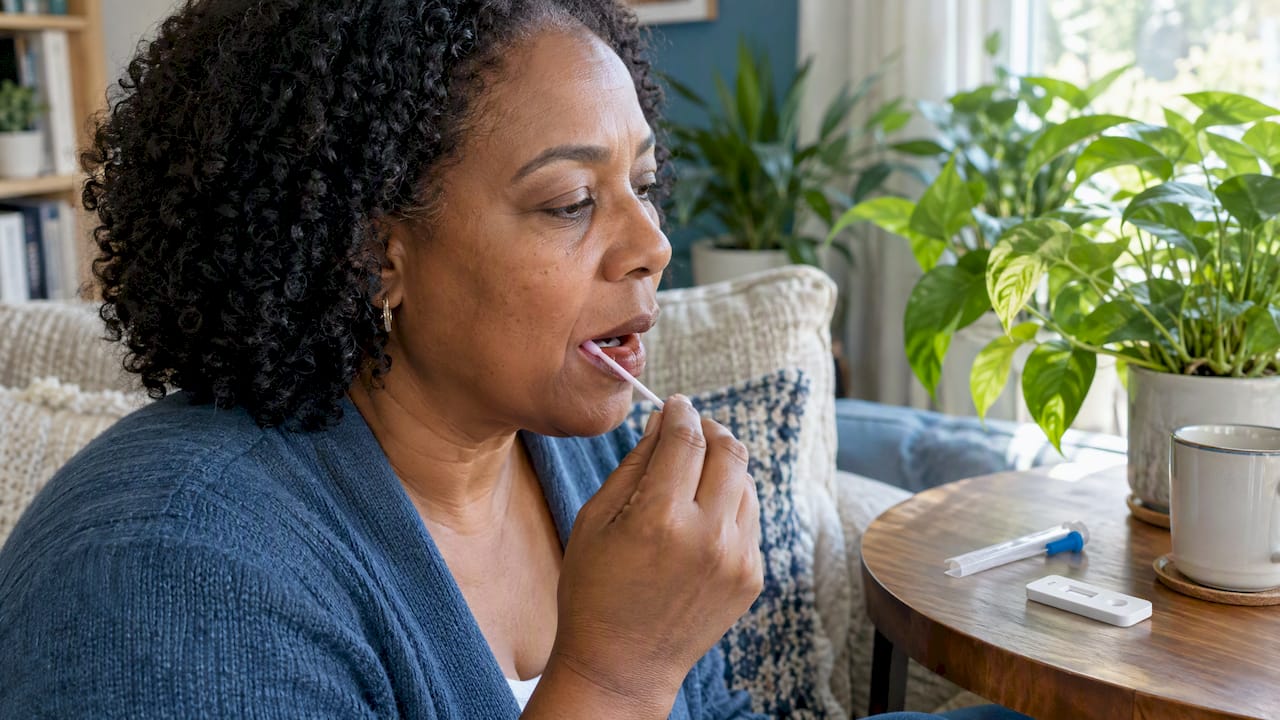
- Collect the sample. Some devices have you rub the pad on the inside of each cheek and then place it under the tongue. MedlinePlus describes a general method of rolling the swab around the mouth or holding it under the tongue for about two minutes until it is saturated.
- Watch the saturation indicator. Many pads include an indicator that changes when enough fluid has been collected. Do not pull the pad early.
- Start the timer when the insert says to. Different devices use different read times, so use the one printed on yours.
- Record the result. Take a photo of the device in good light if you want a record.
What if you cannot produce enough saliva?
A dry mouth is common when you are nervous. Do not chew gum or drink right before collection to force it, since that can contaminate the sample and break the waiting rule. Instead, wait out the full pre-test period, relax, and let the mouth fill naturally. Mentally picturing a lemon or gently moving the tongue against the cheeks helps some people. If the saturation indicator has not moved after the time given in the insert, treat the collection as failed, discard the device and start over with a new one. A swab that never saturated tells you nothing.
Reading your result
Rapid oral tests are designed for speed. Cleveland Clinic says point-of-collection oral tests give results within minutes, while laboratory results usually take 24 to 48 hours.
A few reading rules apply to nearly every strip-style device:
- A control line must appear. If it does not, the test is invalid. Discard it and repeat with a new device.
- A line in a drug’s window usually means negative for that drug, and no line means a presumptive positive. This reversed logic confuses many first-time users, so check the insert diagram.
- Respect the read window. Manufacturers generally specify a time to read and a time after which the result no longer counts. A faint line seen 30 minutes later is not a valid reading.
- A result shows presence, not amount. Cleveland Clinic notes that oral tests show whether a substance is present, not how much.
One more point matters if you are worried about how a result could be used. The Maine Department of Public Safety stresses that a positive oral-fluid screen is not proof of impairment. It indicates that a drug was present at or above the device’s cutoff.
How long does THC stay detectable in saliva?
Saliva is a short-window specimen. Healthline’s consumer guide says saliva tests may detect marijuana for up to 24 hours, and cocaine, morphine or heroin for up to 36 hours. Those are approximate examples, not guarantees. Some employer-testing resources describe THC remaining detectable for longer in regular users, up to a few days.
Why such a range? Several things shift the window:
- How recently you used
- How often you use (regular use tends to extend detection)
- How you consumed it, since smoking and vaping can leave residue in the mouth
- Your metabolism
- The cutoff concentration of the specific device
A peer-reviewed review of oral fluid testing explains that oral fluid is more closely related to blood concentrations and is useful for recent exposure, while hair is more useful when a longer exposure timeframe is sought. That one sentence explains why employers choose one method over another: saliva answers “has this person used lately?” and hair answers “has this person used during the last few months?”
How accurate are at-home saliva tests?
Cleveland Clinic says the best oral-fluid tests can be around 97% accurate, and that accuracy depends on the test type and substance, last use, metabolism, frequency of use, test sensitivity and quality, and food or drink in saliva.
The phrase “the best” matters. The Maine Department of Public Safety warns that there are no industry-wide standards for oral-test accuracy or sensitivity, and that both false positives and false negatives occur. So two kits with similar boxes can behave differently.
Practical takeaways:
- Buy from a seller that shows the panel, cutoffs and manufacturer information.
- Treat an at-home result as a screen. MedlinePlus advises that a positive home result should receive follow-up laboratory testing, and suggests checking before purchase whether the kit includes materials for sending a sample to a lab.
- If a result surprises you, repeat with a fresh device from a different lot rather than relying on one strip.
Saliva test vs. hair follicle test
These two tests answer different questions, and mixing them up is the most common mistake we see.
| Saliva (oral fluid) | Hair follicle | |
|---|---|---|
| What is collected | Oral fluid on a pad | A small cut of hair close to the scalp |
| Time to result | Minutes on-site, or 24 to 48 hours at a lab | Lab analysis |
| What it reflects | Very recent use | A much longer history of use |
| Usual reason it is chosen | Same-day or post-incident checks | Pre-employment screening |
The collection difference is easy to see in Labcorp’s U.S. comparison: oral-fluid testing uses a pad under the tongue, while hair testing takes about 100 scalp hairs cut close to the scalp.
If you are not sure which test your employer will use, ask the HR contact or read the offer paperwork. For a deeper look at how hair and urine differ, see our hair drug test vs. urine comparison. Hair also has a delay before use shows up, which we cover in why the 5 to 14 day lag makes hair tests miss one-time use.
Choosing a kit: a short checklist
Before you buy any at-home saliva drug test, run through this list:
- Panel: Does it list THC/marijuana, plus any other substance you are concerned about?
- Cutoffs: Are the concentrations (ng/mL) printed? Lower cutoffs catch smaller amounts.
- Expiration date: Expired devices can fail.
- Instructions: Are the collection and read times clear and in English?
- Support: Can you reach a person if the control line does not appear?
- Lab option: Does the seller offer a way to confirm a positive?
Our saliva swab drug testing guide walks through these points with the devices we sell, and our pass a saliva drug test page covers what to do ahead of a scheduled oral screen.
Our perspective
Most people who contact us do not ask about saliva first. They ask about hair, because a hair follicle test is the one that worries them. But a lot of them are also told, in the same breath, that a saliva or urine screen may come before or after. That is why we carry all four test types in one place.
Here is how we think about it. A saliva swab is a snapshot of the last day or so. A hair test is a record of months. Preparing for one does not prepare you for the other, and guessing wrong is expensive. So the first thing we do is help people confirm what kind of test they face and when.
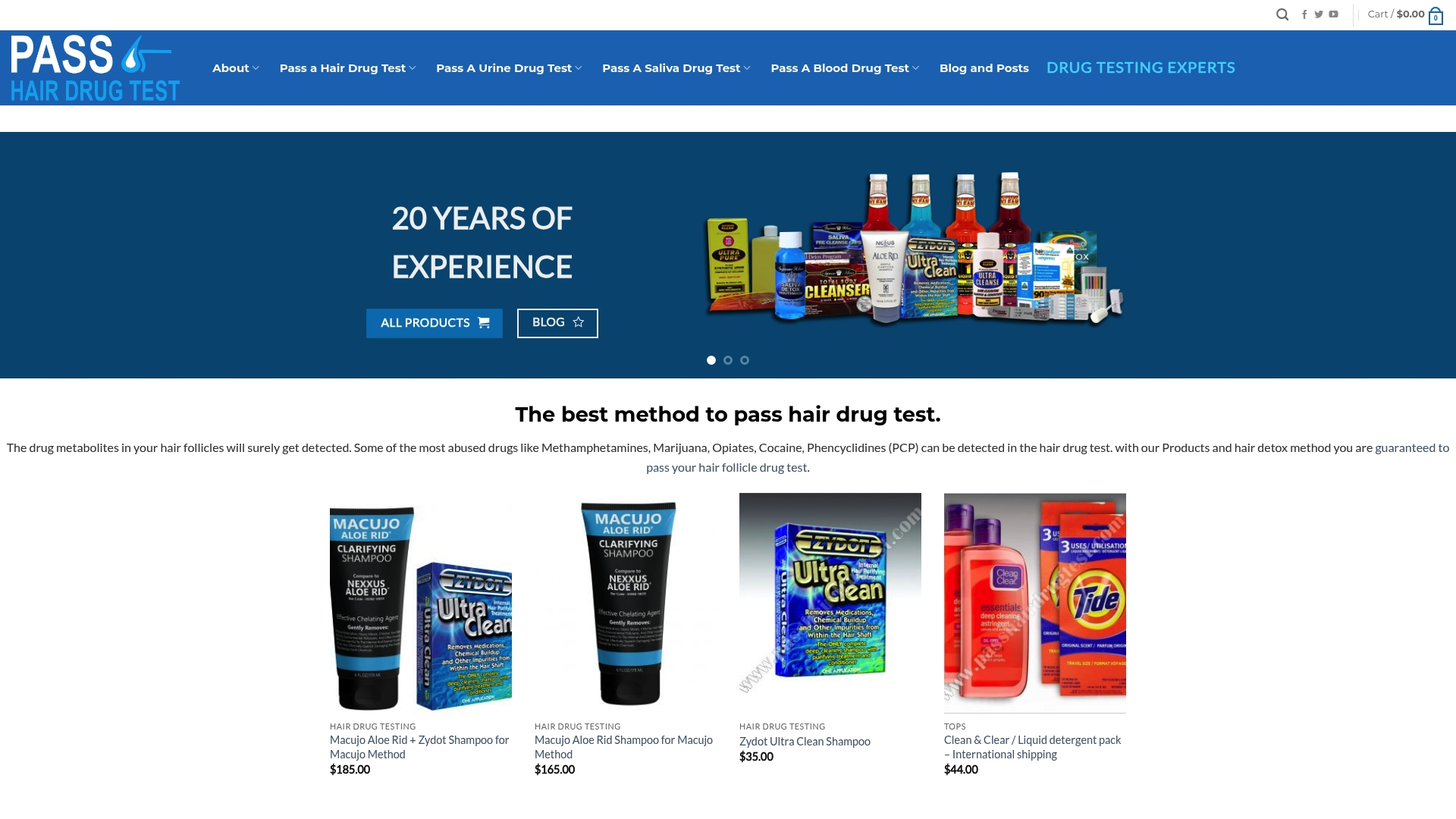
For hair, our approach is built around Macujo Aloe Rid Shampoo, Zydot Ultra Clean Shampoo and the multi-step Mike’s Macujo Method, with instructions and phone support from a team with more than 20 years in the drug-testing and detox-product industry. For saliva, a home test kit is the practical way to know where you stand before the official collection, so you are not surprised.
Use the instructions, check the panel, and call us if you are unsure which product fits your situation.
MIchael
Get the right test or prep for your situation
If you want to check yourself before an oral screen, we sell at-home saliva drug test kits alongside urine and blood products, so you can match the device to the substances you are concerned about. If a hair follicle test is what you actually face, our hair cleansing line is built for that, with step-by-step instructions and phone support.
Browse all drug testing products, or go straight to our hair follicle drug test preparation page if hair is your concern.
FAQ
Can I buy an at-home saliva drug test without a prescription?
Yes. Rapid oral drug screens for home use are sold directly to consumers online and in some pharmacies. Check the panel and cutoffs, and look at the expiration date before you buy. If you need a result that will hold up for legal or employment purposes, plan on laboratory confirmation.
How soon after use will a saliva test show THC?
Oral fluid reflects recent exposure. THC can appear within minutes of use, and general consumer guidance puts the window for marijuana at up to about 24 hours. Regular use, the product and the device cutoff can all change that, so treat any number as an estimate.
Is a positive at-home saliva result final?
No. At-home kits are screening tools. MedlinePlus advises follow-up laboratory testing after a positive home result, and the Maine Department of Public Safety notes that false positives and false negatives do occur. A positive also shows presence of a drug, not impairment.
What if the control line does not show up?
The test is invalid. Throw the device away, wait the recommended time, and repeat with a new kit, following the insert step by step. Do not interpret any other line on a device that failed its control.
Does a saliva test replace a hair test?
No, they measure different periods. Saliva shows very recent use, hair shows a much longer history. If your employer has told you to expect a hair follicle test, a saliva kit will not tell you what that test will find.
Sources
- Oral Drug Test (Mouth Swab), Cleveland Clinic
- Oral Fluid Drug Tests: Concerns and Recommendations, Maine Department of Public Safety
- Drug Testing, MedlinePlus
- At-Home Drug Tests: What They Are and How They Work, Healthline
- Drug Testing in Oral Fluid, PMC
- Drug Testing Options Summary, Labcorp
Recommended
- Pass A Saliva Drug Test
- Pass Saliva Swab Drug Test
- Saliva Swab Drug Testing – Best Saliva Test Guide
- Passing Any Saliva Test
