No products in the cart.
Uncategorized
Product Buildup and Hair Drug Tests: What Really Matters
25
Oct
Oct
Product buildup on your hair does not hide drug use from a hair test, and a lab does not read residue as a drug. Labs wash every sample before analysis precisely to strip away products, sweat and oils, so the question that matters is less “is my hair coated?” and more “what is inside the hair shaft, and what has my hair been through?” Below we explain what buildup is, how a lab handles it, what research says about shampoos and other treatments, and how to prepare sensibly if you have a hair follicle test coming.
Table of Contents
TL;DR
- Product buildup is sticky residue from serums, sprays, oils and dry shampoo on the strand and scalp. It is a surface issue, and labs wash it off before testing.
- Drugs that matter in a hair test are incorporated inside the hair as it grows. Hair tests typically cover up to about 90 days, so a single clarifying wash does not rewrite that window.
- Peer-reviewed work shows shampoos and other treatments can lower measured THC, but unevenly and unpredictably, and labs know hair treatments can affect results.
- A sensible prep means removing real buildup, avoiding damage, and following a structured routine rather than stacking harsh treatments.
Table of Contents
- What product buildup is, and how to spot it
- What a hair drug test actually measures
- How labs deal with buildup
- Can products change your result?
- What to do about buildup before a test
- Our perspective
- Where to start if you are ready to prep
- Special cases
- FAQ
- Sources
What product buildup is, and how to spot it
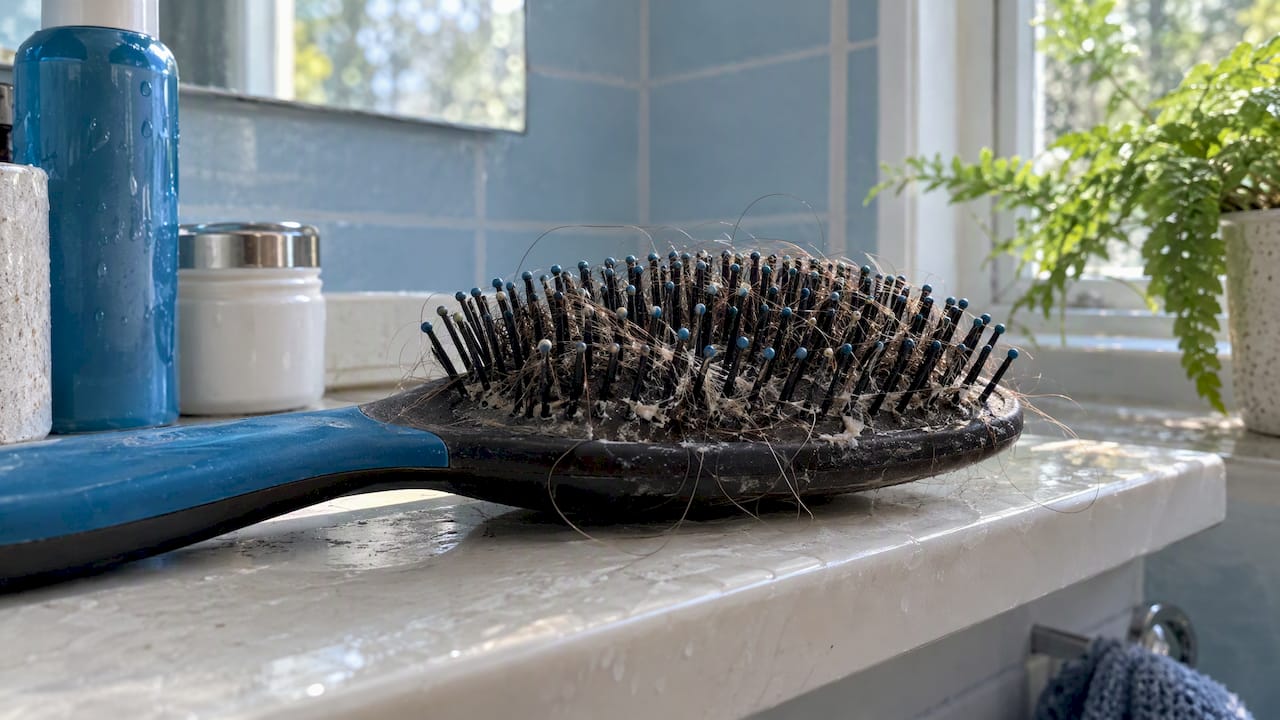
Buildup is what is left on hair when products do not fully rinse away. Serums, sprays, creams, oils and dry shampoo can leave a sticky, non-soluble film that accumulates over days or weeks on the strands and scalp, as described in the research we reviewed on hair care. On the scalp, Medical News Today explains that buildup can combine sebum, sweat, hair products and dead skin cells, sometimes with itchiness, oily or crusty skin, scaly patches, and redness.
The usual signs:
- Hair looks dull and flat, even right after washing.
- It feels coated, sticky or heavy, and loses volume.
- It can be greasy at the roots yet dry and brittle at the ends.
- Flakes appear. Head & Shoulders notes that buildup flakes tend to be similar in size, sticky, and cling to the hair when you shake it, while dandruff flakes are more irregular and may float off.
If your hair has these signs and a test is on the calendar, buildup is worth fixing. Just fix it for the right reason: clean, undamaged hair is easier to sample and you control your routine. It is not because residue is what a lab detects.
What a hair drug test actually measures
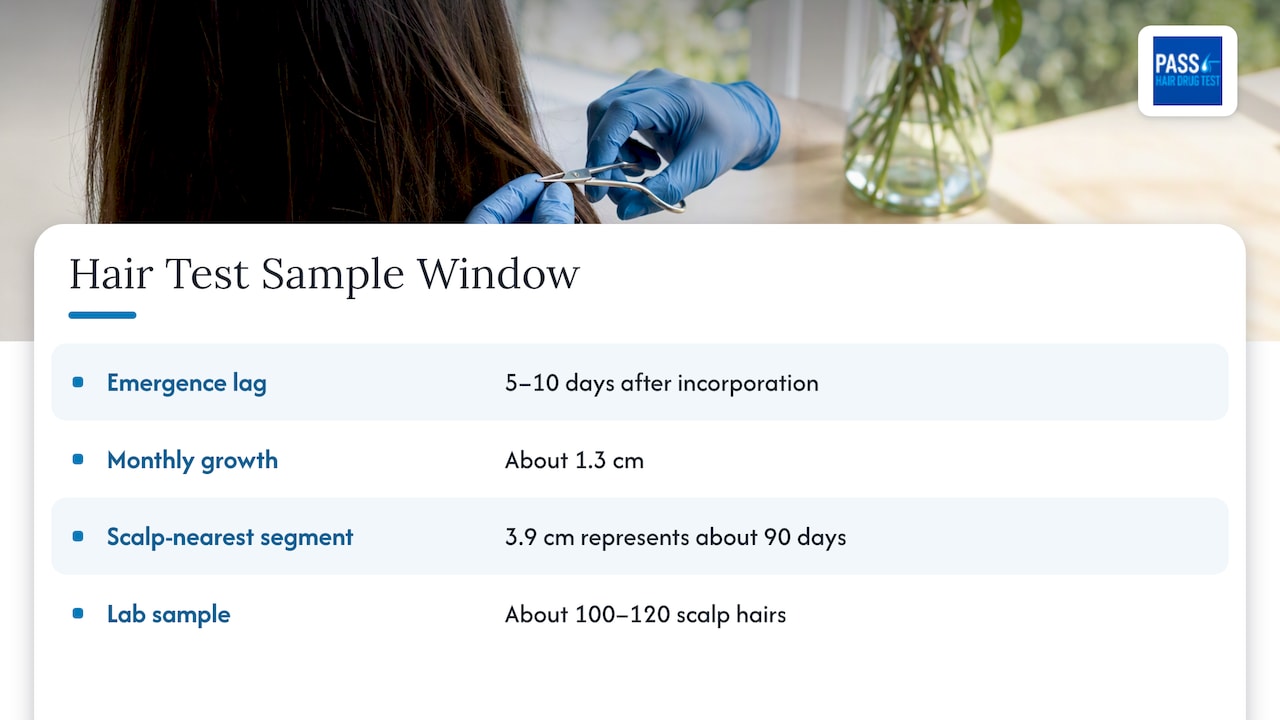
A hair test looks for drugs and their metabolites carried into the hair. According to Quest Diagnostics, hair testing provides up to a 90-day history of drug use, and about 100 to 120 scalp hairs are needed for the laboratory. Its U.S. hair testing FAQ adds the mechanics: head hair reaches the scalp surface about 5 to 10 days after drugs are incorporated, grows roughly 1.3 cm (half an inch) a month, and the standard 3.9 cm (1.5 inch) segment nearest the scalp represents about 90 days.
That is why a hair test is a different animal from a urine test. If you want the comparison, we cover it in hair drug test vs urine.
How drugs get into hair matters here. SAMHSA’s literature summary states that drugs may enter hair through the blood, through sweat and sebum, or from the external environment, and that the wash steps are critical. Buildup sits on the outside, in that third category. It is exactly what the wash is designed to deal with.
How many hairs, and from where
Quest describes a collection of about 100 mg from the first 1.5 inches of hair; when hair is longer than 4 inches, that is roughly 120 strands, about the circumference of a pencil or a flat bundle around 1 cm wide. The Society of Hair Testing consensus recommends cutting head hair close to the skin from the posterior vertex, the crown area at the back of the head, and documenting the root end and any hair treatments.
How labs deal with buildup
Before analysis, samples are washed. The same consensus says the wash removes hair-care products, sweat, sebum, surface material and possible external contamination. A 2025 review in the Journal of Applied Laboratory Medicine describes washing as essential to remove interfering products and contaminants while preserving the drugs incorporated within the hair structure.
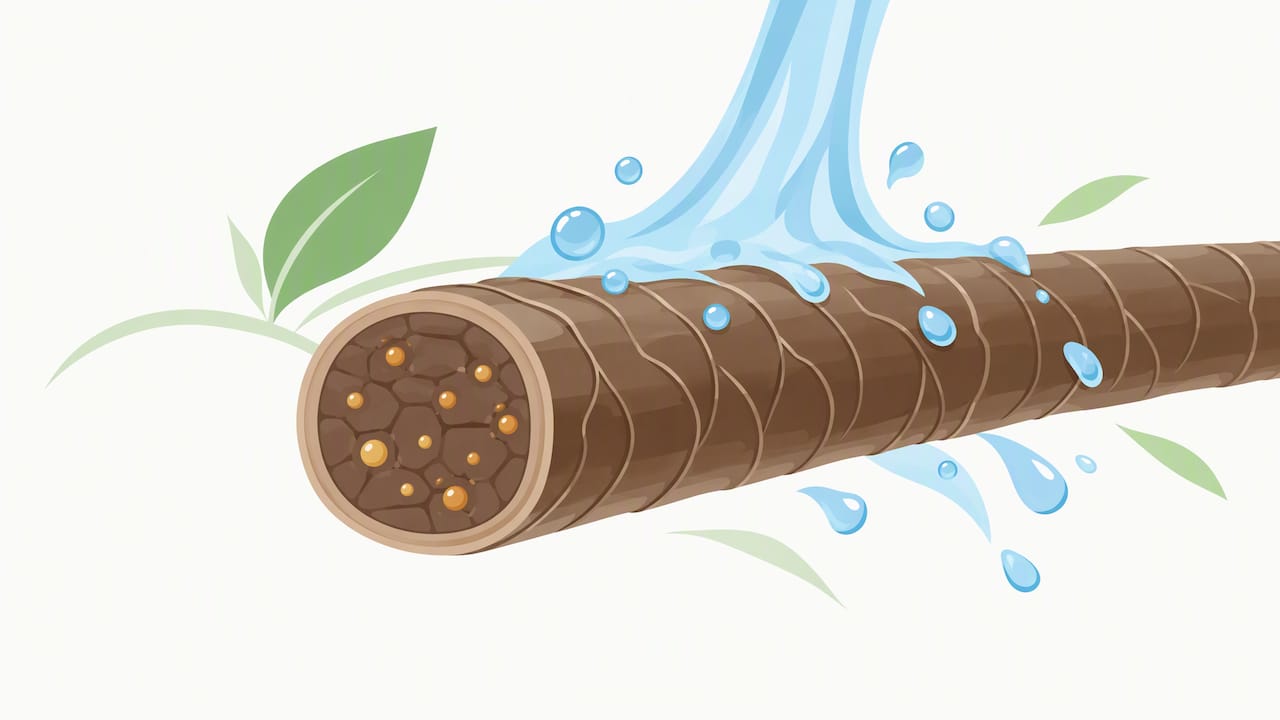
After washing, the sample is homogenized (pulverized, digested or cut fine) and analyzed with chromatography combined with mass spectrometry. Presumptive positive screens must be confirmed by mass spectrometry, per the consensus. In plain terms: a layer of gel, wax or dry shampoo is not what the instrument is looking for, and it is not what gets confirmed.
Two more points that matter to you:
- Treatments are documented. The consensus says topical, chemical and physical treatments can affect drug concentrations and should be recorded and considered when results are interpreted. Labs know about dyes, bleach and heavy styling.
- Labs can tell some contamination from use. The National Institute of Justice reports that analyzing conjugated phase II metabolites may help separate real drug use from environmental exposure. We explain this in more depth in how labs use phase II metabolites.
Can products change your result?
Here the honest answer has layers. Quest reports that in its worst-case testing, shampoos, sprays and gels applied to cut samples had little or no effect, and that ordinary bleaching or dyeing typically did not change the reporting category. That is one laboratory’s finding, and it does not close the broader scientific debate about damaged or contaminated hair.
The academic literature shows a different side:
- A peer-reviewed German study on THC tested 54 THC-positive hair samples. Mean THC concentrations dropped 52% with Zydot shampoo and 52% with Head & Shoulders. Vodka, hair tonic and disinfectant produced mean reductions of 58%, 63% and 65%. In some samples, everyday products pushed concentrations below detection. The authors cautioned against over-interpreting quantitative THC hair levels.
- A 2023 toxicology review says extensive washing and cleansing shampoos can pull drugs out of hair, while chemical or thermal treatments can damage the hair matrix and affect how drugs are held or released. It also notes that no standardized routine workflow yet objectively detects cleansing-shampoo treatment or extensive washing, though labs may look for oxidative treatment with biomarkers and microscopy.
- Residue can also work the other way. One peer-reviewed study found that some water- and humectant-containing hair products raised cocaine and methamphetamine uptake into hair by up to 100-fold compared with purely oil-based products, a potential external-contamination concern.
Take the pattern, not the numbers, as the lesson. Results varied sample to sample, the average reduction was roughly half, and some samples barely moved. Nobody can promise what happens to your hair. That is also why the researchers say a lower result does not reliably prove abstinence.
| Factor | What it does | Why it matters for your prep |
|---|---|---|
| Product buildup (oils, serums, dry shampoo) | Coats the outside of the strand | Removed in the lab wash; worth clearing for hair health and clean sampling |
| Cleansing or detox shampoo | Can lower measured THC in studies, unevenly | Results vary; routine and hair condition matter |
| Bleach, dye, heat | Can damage the hair matrix | Labs document treatments; see how bleach and dye change hair tests |
| Some humectant-rich products | May increase uptake of certain external contaminants | Avoid layering new products right before collection |
What to do about buildup before a test
If you have a test on the horizon, a practical order of operations looks like this.
1. Check your timeline
Hair grows about half an inch a month, so what is in the first 1.5 inches near your scalp reflects roughly the last three months. Washing cannot change that history. It can only affect what is measured in the sample. Be realistic about what a shampoo can and cannot do.
2. Stop adding residue
Cut back on heavy oils, waxy pomades, sprays, creams and dry shampoo. Simple, water-rinsable products are easier on your hair and avoid stacking new layers right before collection. Skip anything new you have not used before.
3. Clear existing buildup the gentle way
A basic clarifying shampoo removes surface film. We explain the differences between the two types in detox vs clarifying shampoo. Rinse thoroughly, because unrinsed shampoo is itself buildup. If your scalp is red, crusty or very itchy, see a dermatologist rather than treating it yourself, since that can be a skin condition and not simply residue.
4. Avoid damage
Harsh stacked treatments, repeated bleaching and high heat can damage hair, and the 2023 review linked chemical and thermal treatment to changes in how hair holds drugs. Damaged hair is also more likely to be flagged in the lab’s documentation of treatments. Our piece on detox shampoo damage goes through the trade-offs.
5. Follow a structured routine
If you are using a detox product, follow the label and a full method rather than improvising with kitchen items. For the full process, see our guide on how to pass a hair drug test. If you want to understand whether any of this works at all, read do detox shampoos work first.
Our perspective
After two decades in the drug-testing and detox-product business, here is what we tell people who write to us worried about buildup.
First, buildup is rarely the problem people think it is. Labs wash samples, so a coated strand is not going to produce a false positive on its own, and clearing it will not erase months of history by itself. We would rather you understand that than buy something on a hunch.
Second, the research is mixed, and we say so. Shampoos lower measured THC on average in the published work, but not evenly, and heavy users should expect less predictable results than light users. We have built our hair line around Macujo Aloe Rid Shampoo, Zydot Ultra Clean Shampoo and the multi-step Mike’s Macujo Method because a structured, repeatable routine beats improvised washing. We think the method is the strongest option we know, and the support behind it matters: customers can reach us by phone with questions about timing and steps.
Third, hair condition counts. Aggressive routines can leave hair brittle, and a lab notes treatments. Start early, be gentle where you can, and do not stack new products in the last days.
— MIchael
Where to start if you are ready to prep
If you have decided to prepare, our hair drug testing products page lists the shampoos and the multi-step method kit, along with the instructions. If you are comparing options first, our detox shampoo comparison covers what separates them, and our hair follicle test guide walks through the test itself. Check the product pages for current pricing.
Special cases
Gray or white hair. Color does not decide whether drugs are present. See our article on gray hair drug testing.
Short hair or no head hair. Collectors may take body hair when scalp hair is not available. Details are in body hair drug test.
Textured or product-heavy routines. The humectant study above is a reminder that moisturizing products can matter for outside contamination. If you use many leave-ins, simplify in the weeks beforehand.
Accuracy questions. If you are wondering how reliable the whole process is, our hair drug test accuracy article covers what the science shows.
FAQ
Can product buildup cause a false positive on a hair drug test?
Buildup itself is not a drug, and labs wash samples to remove products, sweat and sebum. The documented exception is external contamination, where drug present in the environment or in a product can stick to hair. Labs use methods such as phase II metabolite analysis to help tell contamination from use.
How can I tell if my hair has product buildup?
Look for dull, flat or heavy-feeling hair that stays dull after washing, greasy roots with dry ends, and sticky flakes that stay on the hair when you shake it. An itchy, red or crusty scalp can point to a skin condition, so see a dermatologist if it persists.
How many hairs do they take for a hair drug test?
Quest Diagnostics describes about 100 mg from the first 1.5 inches of hair, roughly 120 strands if your hair is longer than 4 inches. That looks like a bundle about the circumference of a pencil, typically cut close to the scalp at the back of the head.
Can a hair test detect one-time THC use?
Unlikely. One review says a single use is most often insufficient for a positive hair result, and for cannabis even daily use does not guarantee a positive. Results depend on the lab, cutoffs and your hair, so no one can promise an outcome either way.
Sources
- Scalp build up: Definition, causes, and how to get rid of it (Medical News Today)
- Dandruff vs. Product Build-Up (Head & Shoulders)
- Hair Drug Testing & Screening (Quest Diagnostics)
- Hair testing FAQ (Quest Diagnostics)
- The science of hair testing, literature summary (SAMHSA)
- General Consensus on Hair Testing (Society of Hair Testing, 2022)
- Review on Toxicology Testing in Hair (Journal of Applied Laboratory Medicine)
- Detecting Drugs in Hair: Is It Drug Use or Environmental Contamination? (National Institute of Justice)
- Manipulation of THC Hair Concentrations by Commercially Available Products
- Advances in testing for sample manipulation in clinical and forensic toxicology
- Ethnic hair care products may increase false positives in hair testing
- Using biological samples in epidemiological research on drug use
Recommended
- How to pass hair drug test
- How to Prepare for a Hair Test the Right Way
- The Science Behind the Hair Drug Test
- Hair Drug Test Information
