Uncategorized
Hair Drug Test vs Urine: Which Detects Use When
Aug
A urine test catches what happened in the last few hours to a few days. A hair test catches a pattern going back roughly 90 days. That single difference decides which one an employer, court, or clinic reaches for, and it’s the reason so many drug-testing programs now run both instead of picking one.
A systematic review of forensic populations found hair testing generally turns up more positives for chronic or concealed use, while urine wins for catching something used in the past day or two. Lab data from Quest Diagnostics backs this up directly: hair testing covers roughly 90 days of history and finds close to twice as many positives as urine, mainly because it’s looking at a much longer window.
Here’s the quick version before you get into the weeds:
- Choose urine if you need to know about use in the last few hours to a few days, like after a workplace accident or a reasonable-suspicion check.
- Choose hair if you need a longer look back, like pre-employment screening or random testing meant to catch repeat use.
- Combine both when a program wants recency AND history, which is increasingly common in probation and safety-sensitive industries.
Table of Contents
Key Takeaways
Urine testing catches recent drug use within hours to days, while hair testing reveals patterns of use going back roughly 90 days, and the two are best chosen based on whether recency or history matters more.
| Point | Details |
|---|---|
| Detection window gap | Urine covers hours to a few days; hair covers about 90 days but misses the most recent 5 to 7 days. |
| Hair finds more chronic use | Comparative lab data shows hair testing detects nearly twice as many positives as urine, largely due to the longer window. |
| Tampering resistance differs | Hair testing is harder to manipulate than urine, which is vulnerable to dilution and substitution without observed collection. |
| Confirmation matters | Every legally valid result, hair or urine, requires GC-MS or LC-MS confirmation after an initial immunoassay screen. |
| Programs increasingly combine both | Pairing hair and urine testing catches gaps that either matrix leaves open on its own. |
| Preparation resources exist | Passhairdrugtest offers Macujo Method kits, Zydot Ultra Clean Shampoo, and at-home test kits for people preparing for a hair test. |
Table of Contents
- Hair Drug Test vs Urine Test: Detection Windows Compared
- What the Research Says About Accuracy and Positivity Rates
- How Hair and Urine Samples Are Collected and Confirmed
- The Real Trade-Offs With Hair Testing
- The Real Trade-Offs With Urine Testing
- Tampering Risks and Why Hair Is Harder to Beat
- Which Test Fits Your Situation: A Decision Guide
- What Hair and Urine Testing Cost, and How Long Results Take
- Limitations Both Tests Share, and Where They Diverge
- What the Strongest Studies Actually Conclude
- Where the Testing Debate Misses the Point
- If You’re Preparing for a Hair Test: What Your Options Actually Are
- Frequently Asked Questions
- Sources
Hair Drug Test vs Urine Test: Detection Windows Compared
The gap between these two tests isn’t small, and it isn’t the same across every drug class either. Urine detection generally runs from a few hours after use up to a few days, though heavy, chronic cannabis users can test positive for several weeks because THC metabolites accumulate in fat tissue. Hair, by contrast, holds a record of roughly 90 days for a standard 1.5 inch (3 cm) sample cut close to the scalp, since that’s about how much hair grows in that time.
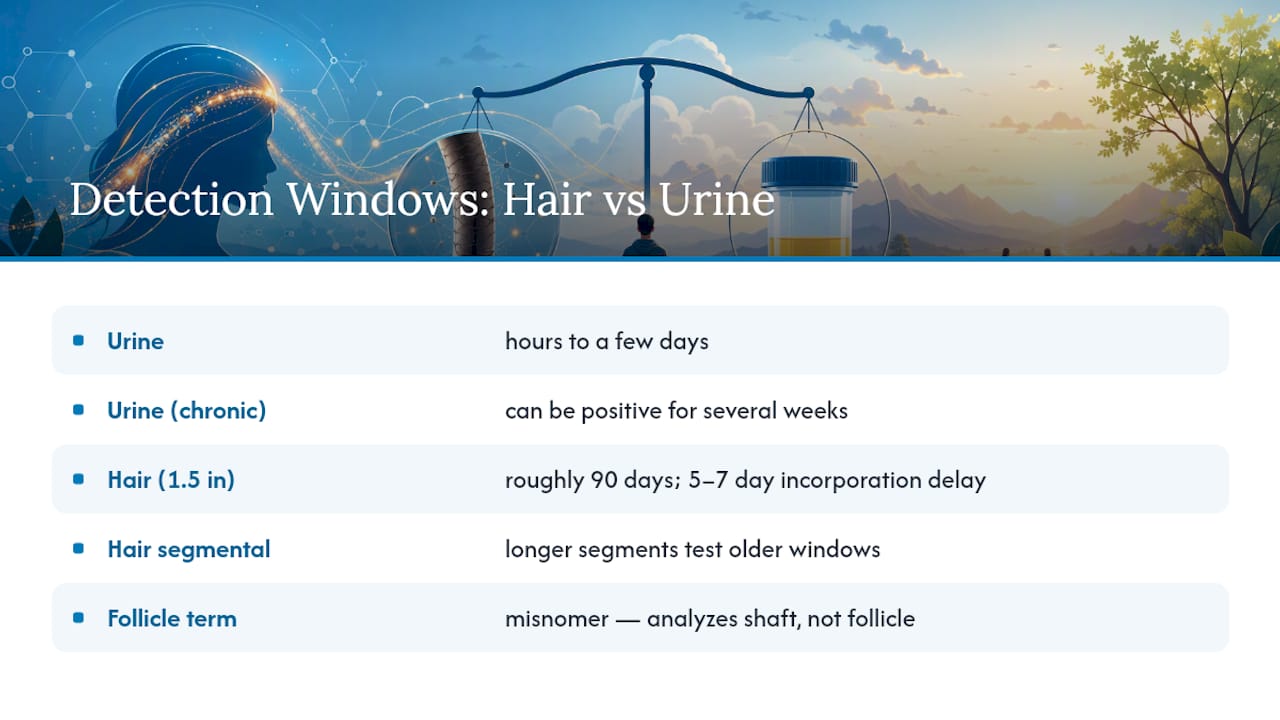
There’s a catch on the hair side that trips a lot of people up: a new hair test won’t catch drug use from yesterday. Drugs need time to travel through the bloodstream and get incorporated into the hair shaft as it grows above the scalp, a process that typically takes 5 to 7 days. Test someone the day after they used, and hair testing may miss it entirely, even though urine would likely catch it.
Pro Tip: Hair segment length maps directly to time. A 1.5 inch sample from the scalp roughly covers the most recent 90 days, but labs can cut longer segments or test further down the shaft to look at older windows, which is how segmental hair analysis can pin down drug exposure to specific months, including by trimester in prenatal cases.
This is also why the phrase “hair follicle drug test” is a bit of a misnomer worth clearing up early. The test doesn’t actually analyze the follicle itself, it analyzes the hair shaft that’s already grown out of it. That distinction matters when you’re trying to understand what the test can and can’t see.
What the Research Says About Accuracy and Positivity Rates
The clearest evidence on urine vs hair testing accuracy comes from studies that ran both tests on the same people at the same time. When researchers do that, hair testing consistently surfaces more positives for chronic or concealed drug use, especially for cocaine, opioids, and stimulants, while urine holds its ground for catching very recent, isolated use.
Hair testing detects nearly twice as many positives as urine testing in comparative lab data, according to Quest Diagnostics, largely because hair’s 90-day window catches patterns that a single urine sample simply can’t see.
One study that gets cited often in this space looked at young adult opioid users and found that adding hair testing to a urine-only protocol increased detection of both self-reported and unreported drug use in the same cohort, per Palamar et al.. In other words, some people who denied use, or who used infrequently enough that urine missed it, still showed up positive on hair. That’s a meaningful gap for any program relying on a single matrix.
Large matched-sample studies in occupational and transportation-industry testing have found similarly stark differences, with hair detection rates running several times higher than urine for drugs like cocaine and methamphetamine in the same worker populations. The systematic review covering studies from 2010 through 2025 (12 studies met its inclusion criteria) reached the same broad conclusion: hair wins on chronic and concealed use, urine wins on recency.
None of this means one test is simply “better.” A few things complicate direct comparisons between studies:
- Cutoff levels vary by lab and by drug class, so a positive on one panel might be a negative on another using a stricter threshold.
- Nonconcurrent sampling in some studies, where hair and urine weren’t collected on exactly the same day, can skew results in either direction.
- Program selection bias matters too. A cohort of people already flagged for chronic use will naturally show a bigger hair advantage than a general population sample would.
The honest takeaway is that hair testing’s edge in positivity rates is real and well documented, but the size of that edge depends heavily on who’s being tested and what they’re being tested for. A systematic review flags exactly this kind of heterogeneity as a reason to interpret headline positivity comparisons with some caution, even while the overall direction of the finding holds up study after study.
How Hair and Urine Samples Are Collected and Confirmed
Collection looks nothing alike between the two tests, and that difference is part of why they behave so differently in practice.
For hair testing, a technician typically cuts 100 to 120 strands from the crown of the head, as close to the scalp as possible, about the thickness of a shoelace tip. If head hair isn’t available, labs can sometimes use body hair, though that changes the detection window since body hair grows more slowly.

Urine collection works differently and comes in two flavors: observed and unobserved. Unobserved collection is far more common and far more vulnerable to manipulation, which is why labs run checks for temperature, specific gravity, creatinine levels, and known adulterants before a sample is even screened for drugs.
Both matrices follow the same basic lab workflow after collection:
- An initial immunoassay screen flags samples that appear positive.
- Confirmatory testing via GC-MS or LC-MS verifies any presumptive positive before it’s reported.
- Labs test for metabolites, not just the parent drug, which helps rule out external contamination in hair samples.
- Decontamination washes are run on hair samples before testing to remove surface residue that isn’t from actual ingestion.
Pro Tip: If you’re ever handed a same-day rapid urine cup test, know that it’s only the immunoassay screen. A “positive” result on that first pass still has to clear GC-MS confirmation before it counts as an official result in most employment and legal contexts.
The Real Trade-Offs With Hair Testing
Hair testing’s biggest strength is also its biggest limitation: it’s built for the long view, not the immediate one.
On the plus side, hair testing gives you roughly 90 days of history in a single sample, and its physical nature makes it far harder to cheat than a cup of urine handed over in a bathroom stall. Segmental analysis is another advantage unique to hair. Labs can test different sections of the same strand to build a rough timeline of use, which is genuinely useful in perinatal cases where a trimester-specific profile matters.
The downsides are just as real. Hair testing can’t see the last 5 to 7 days because of the incorporation lag, so it’s the wrong tool if recency is the whole point. It also tends to cost more than urine testing, and cosmetic factors like hair color, bleaching, and chemical treatments can affect how certain drugs bind to the hair shaft, something labs try to control for with metabolite-based testing and decontamination steps rather than just eyeballing the sample.
Hair testing tends to be the preferred option in a few specific situations:
- Pre-employment screening, where employers want a longer look at behavior patterns.
- Random workplace testing programs aimed at catching repeat use rather than one-off incidents.
- Forensic and legal cases, including child custody or perinatal drug exposure evaluations, where a longer historical record carries more weight than a single moment in time.
The Real Trade-Offs With Urine Testing
Urine testing earns its place as the industry default for one simple reason: it’s cheap, fast, and good at exactly what most testing programs actually need day to day.
Turnaround is the standout advantage. A point-of-care urine screen can deliver results the same day, and the equipment needed to collect a sample is available in nearly every clinic, urgent care, and workplace testing site in the country. It’s also the more sensitive option for catching use within the last few hours to a few days, which makes it the obvious choice when timing is the whole question.
The trade-off is that short window cuts both ways. A urine test can only see what happened recently, which means it can completely miss chronic, lower-frequency use if the timing doesn’t line up. Unobserved collection also opens the door to dilution, substitution, or other tampering that a physical hair sample simply doesn’t allow.
Urine testing shows up most often in these settings:
- Post-accident testing, where the question is “was this person impaired right now.”
- Reasonable-suspicion testing triggered by an immediate workplace concern.
- Clinical settings, including the kind of routine urinalysis Mayo Clinic describes as standard practice for detecting recent drug exposure alongside other health markers.
- Point-of-care workplace screens where speed and low cost matter more than a long historical record.
Tampering Risks and Why Hair Is Harder to Beat
Urine is the matrix people try to cheat, and there’s a whole industry built around it. Dilution, substituted samples, temperature manipulation, and chemical adulterants are the four tricks labs see most often, which is exactly why unobserved urine collection comes with so many built-in checks.
Labs counter this by screening for creatinine levels, specific gravity, and sample temperature immediately after collection, and by running adulterant panels that catch common masking agents. Still, a donor with enough preparation time and the wrong incentive has more room to maneuver with a cup than with a physical sample cut directly from their scalp.
Hair testing is widely considered more resistant to tampering precisely because collection is observed by default, the sample can’t be diluted or substituted the way liquid can, and lab decontamination washes combined with metabolite-specific testing filter out most external contamination concerns before a result is ever reported.
Pro Tip: If a testing program’s real goal is minimizing evasion, the strongest setup is observed urine collection paired with hair testing for the historical record. Combining matrices, which is becoming more common in probation and safety-sensitive programs, closes gaps that either test leaves open on its own.
Which Test Fits Your Situation: A Decision Guide
The right test comes down to one question: does the program care more about right now, or about the last three months?
If recency is the priority, urine wins every time. A workplace accident, a reasonable-suspicion incident, a same-day clinical screen, these are all situations where you need to know about the last 24 to 72 hours, and hair testing’s incorporation lag makes it the wrong tool for the job.

If historical pattern is the priority, hair testing or a hair-plus-urine combination makes more sense. Industry guidance consistently frames it this way: match the matrix to the goal, not the other way around.
A few scenario-specific notes worth knowing:
- Pre-employment screening usually leans on hair testing or a hair-plus-urine combo to get a fuller picture of recent months, not just the last few days.
- Post-accident testing almost always uses urine because the question is narrowly about impairment at the time of the incident.
- Probation and court-ordered testing increasingly combine both matrices to reduce blind spots.
- Transplant evaluation and prenatal screening often lean on hair’s segmental analysis capability, since a longer, dated record can matter more than a single snapshot.
- If you’re facing a test yourself, know what it can and can’t show: urine won’t reveal use from three weeks ago, and hair won’t reveal use from three days ago.
What Hair and Urine Testing Cost, and How Long Results Take
Urine testing is the budget option, and it’s not close. A standard point-of-care urine screen typically runs far less than a hair test, and rapid immunoassay results can come back the same day. Confirmatory GC-MS testing on a presumptive positive adds time, usually a day or two, since that sample has to be sent to a lab rather than read on-site.
Hair testing costs more across the board, largely because of the additional lab processing involved: decontamination washes, segment cutting, and confirmatory GC-MS or LC-MS analysis. Turnaround for hair results generally runs several days to about a week once the sample reaches the lab, longer than a rapid urine screen but not dramatically slower than a fully confirmed urine result.
- Urine: low cost, same-day rapid screen, one to two additional days if confirmatory testing is required.
- Hair: higher cost, results generally in several days to about a week, mainly because of the decontamination and confirmation steps.
- Any legally defensible result, from either matrix, requires confirmatory testing. Skipping that step means you only have a presumptive screen, not a certified finding.
Limitations Both Tests Share, and Where They Diverge
No drug test is perfect, and understanding the failure points matters as much as understanding the detection windows.
Hair color and melanin content can influence how certain drugs bind to hair, an issue that’s been raised as a fairness concern in forensic contexts. Labs address this partly through metabolite testing rather than relying solely on parent-drug detection, which helps reduce misclassification tied to hair pigmentation. Cosmetic treatments like bleaching or heavy chemical processing can also reduce detectability, though decontamination protocols and metabolite markers are specifically designed to catch use that survives those treatments.
Urine has its own set of caveats. Detection windows shift depending on how frequently and how heavily someone uses a substance, so two people using the same drug can show very different detection timelines. Dilution, whether intentional or from simply drinking a lot of water, can push a genuine positive below the cutoff, which is why creatinine and specific gravity checks exist in the first place.
A few points worth keeping in mind regardless of which test you’re looking at:
- Environmental contamination is a real concern for hair testing, but modern labs use decontamination washes and metabolite-specific analysis to filter most of it out.
- Urine’s detection window isn’t fixed. It moves based on dose, frequency, hydration, and individual metabolism.
- For any legal, custody, or forensic use, results need to come from a certified lab with confirmatory testing. A presumptive screen alone doesn’t carry the same weight.
What the Strongest Studies Actually Conclude
Strip away the marketing language from either side of this debate and the research points in a consistent direction. The systematic review covering forensic populations found hair testing detects more chronic and concealed drug use across multiple drug classes, while urine testing remains the stronger tool for catching something that happened in the last day or two.
Large matched-sample studies in occupational and transportation testing back this up with numbers: hair detection rates running several times higher than urine for drugs like cocaine and methamphetamine in the same tested population. The Palamar study on young adult opioid users adds a useful wrinkle, showing that pairing hair with urine caught use that urine alone missed entirely.
What this should mean for you in practice:
- If a program only tests urine, understand that it’s built to catch recency, not history.
- If a program only tests hair, understand that very recent use, within the last 5 to 7 days, may not show up yet.
- Combining both isn’t overkill for programs that genuinely need both recency and pattern data. It’s the design increasingly favored in probation, transplant evaluation, and safety-sensitive industries specifically because a single matrix leaves gaps.
Where the Testing Debate Misses the Point
Most comparisons between hair and urine testing treat this like a competition with a winner. It isn’t one. The research is clear that these two tests are built to answer different questions, and the more interesting story is how often people misunderstand what a hair test is actually measuring.
The biggest misconception I run into constantly is the idea that a hair test “sees everything.” It doesn’t. That 5 to 7 day incorporation lag means someone could use a substance the week before a hair test and come back clean, not because the test failed, but because the biology of hair growth hasn’t caught up yet. People treat this like a loophole, and in a narrow technical sense it is, but it’s also exactly why responsible testing programs that care about recency lean on urine instead, or run both matrices together.
The other thing that gets flattened in most comparisons is how much lab quality matters within each matrix. Two labs running “hair testing” can produce different results depending on their cutoff levels, their decontamination protocols, and whether they’re checking for metabolites versus parent compounds. The matrix matters less than most headlines suggest. The lab’s methodology matters more. If you’re trying to understand your own situation, whether from the testing side or the preparation side, that’s the detail worth actually digging into before you draw conclusions from a single test result.
If You’re Preparing for a Hair Test: What Your Options Actually Are
If you’re facing a hair follicle test and looking for ways to manage the outcome, you’re not alone, and Passhairdrugtest has spent more than 20 years building products specifically for this situation. Whatever you decide, follow your employer’s policies and the law that applies to your situation.
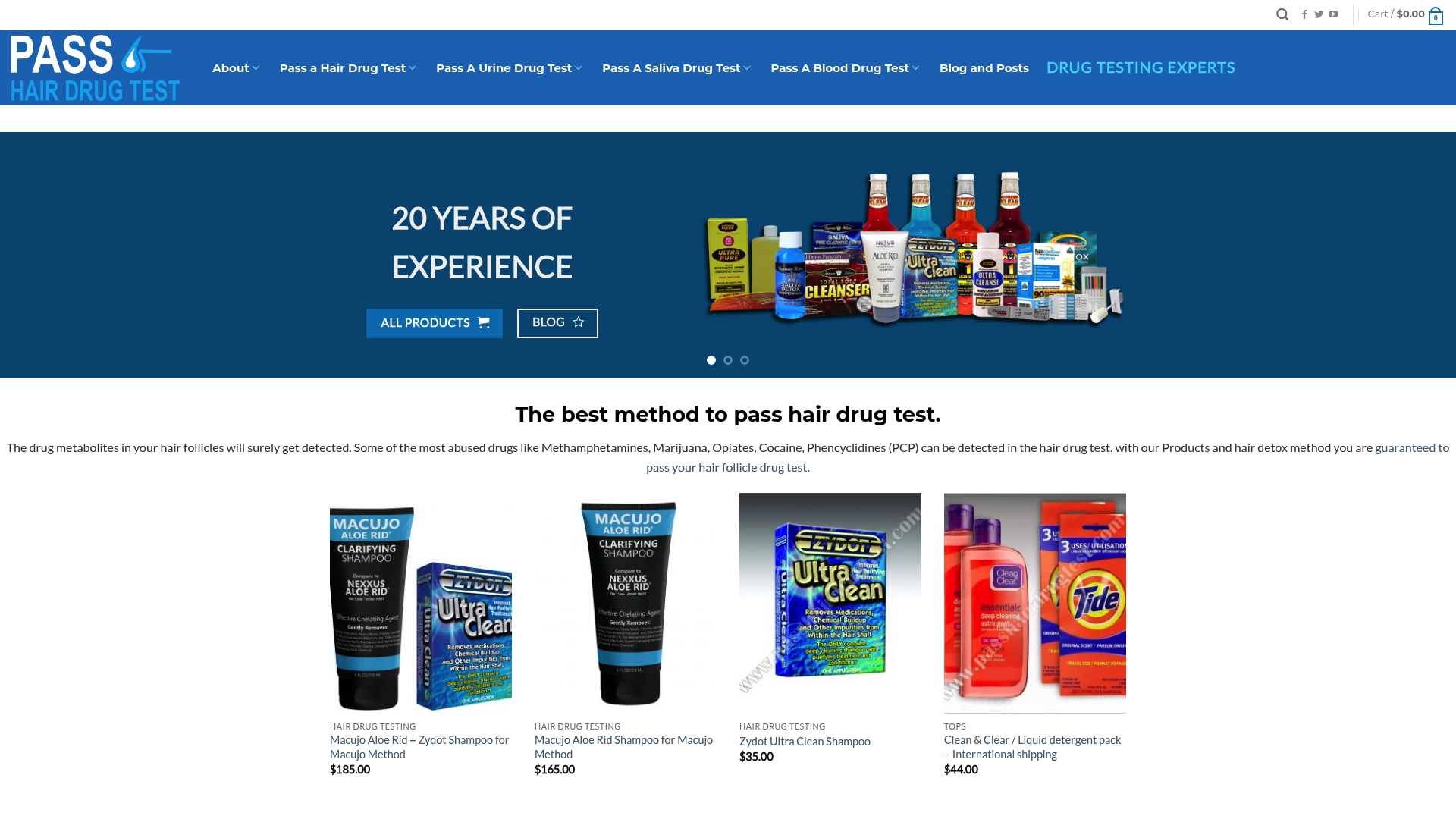
Passhairdrugtest’s approach centers on a few distinct product categories built for different timelines. For people with a few weeks of lead time, the Macujo Method using Aloe Rid Shampoo is the site’s flagship multi-step cleansing routine, designed for repeated use in the days leading up to a test. For people who need a faster option, Zydot Ultra Clean Shampoo is built as a same-day wash. And for anyone who wants to check where they stand before the real test, the site also carries at-home test kits so you’re not walking in blind.
No product on the market can promise a guaranteed outcome given how much detection depends on individual hair chemistry, usage history, and lab methodology, but if you want a place to start, browse the full shampoo kit lineup and pick the option that matches how much time you actually have before your test.
Frequently Asked Questions
Is a hair follicle drug test more accurate than a urine test?
Neither is universally “more accurate.” Hair testing tends to catch more chronic or concealed use thanks to its 90-day window, while urine testing is more sensitive to very recent use. Accuracy depends on what you’re trying to detect.
How far back does a hair drug test go?
A standard 1.5 inch hair sample cut close to the scalp covers roughly the last 90 days of drug use, though there’s a 5 to 7 day lag before recent use shows up in newly grown hair.
Can you fail a hair test and pass a urine test on the same day?
Yes. Since hair testing reflects use going back weeks or months and urine only reflects the last few days, someone with older drug use in their system but nothing recent could show a hair positive and a urine negative simultaneously.
Why do some drug testing programs use both hair and urine?
Combining matrices closes the gaps either test leaves alone. Urine catches recency; hair catches pattern and history. Programs in probation, transportation, and safety-sensitive industries increasingly run both for exactly that reason.
Does hair color or dyeing affect hair drug test results?
Melanin content and cosmetic treatments like bleaching can influence how certain drugs bind to hair, but labs use decontamination washes and metabolite-specific testing to reduce misclassification tied to hair color or treatment.
Which test is cheaper, hair or urine?
Urine testing is almost always less expensive and faster, with same-day rapid screening in most cases. Hair testing costs more due to additional lab steps like decontamination and typically takes several days to about a week for confirmed results.
Sources
- Hair versus Urine Drug Testing in Forensic Populations: A Systematic Review of Detection Accuracy and Utility
- A comparison of the utility of urine- and hair testing in detecting self-reported drug use among young adult opioid users — Palamar et al. (2019)
- Benefits of Drug Testing Hair vs. Urine | Quest Diagnostics
- Urinalysis – Mayo Clinic
- Hair testing vs. urine testing: which is more reliable? — Psychemedics blog
For legal or clinical decisions, read the confirmatory-testing sections of these sources closely. That’s where the real methodology lives.
Recommended
- Hair Drug Test Information – Pass Hair Drug Test
- Pass hair follicle drug test
- Hair Follicle Drug Test – Best guaide for hair drug test – Pass Hair Drug Test
- Body Hair Drug Test: What You Need to Know
