Uncategorized
Heavy Smoker Hair Test: What Labs Find and Your Options
Oct
If you smoke weed daily or nearly every day and a hair test is coming, you are the person this test is built to catch. Hair testing looks back about 90 days, and the research shows heavy users test positive far more often than light users. That does not make the situation hopeless, but it does mean you need accurate information, not forum folklore. This guide covers what the lab actually measures, why heavy use matters, what washing can and cannot change, and a realistic plan.
Table of Contents
TL;DR
- A standard hair test covers roughly the last 90 days. Daily or near-daily use leaves the strongest signal in that window.
- In one study, about 77% to 85% of heavy cannabis users tested positive in hair, against far lower rates for light users. Hair is better at flagging chronic use than occasional use.
- Secondhand smoke is not a realistic defense. Labs look for THC-COOH, a metabolite your body makes and smoke on your hair does not.
- Washing products can lower THC levels in hair, but no study supports a sure result. Heavy users have the most to lose from overconfidence.
- Plan around the timeline: how soon the test is, how much hair you have, and whether you can stop using right now.
Table of Contents
- How a hair test works for a heavy smoker
- Why heavy use shows up so clearly
- Secondhand smoke won’t explain a positive
- What washing can and can’t do
- A realistic plan if you smoke heavily
- Our perspective
- Where our products fit
- What to avoid
- FAQ
- Sources
How a hair test works for a heavy smoker
When you use cannabis, THC and its metabolites travel through your blood into the growing hair shaft. They are locked into the strand as it forms. That is why hair holds a record while urine only shows the past days.
Two timing facts matter:
- Lag time. Drugs and metabolites typically take 5 to 7 days to show up in hair above the scalp. Use from the past few days is usually not what a hair test is picking up.
- The window. For pre-employment screens, the standard sample is a segment of about 1.5 inches (roughly 3.8 cm) cut close to the scalp, representing about 90 days of history. That figure comes from federal workplace guidelines for federal programs. Private employers and labs set their own protocols, so check what yours uses.
If your head hair is short or you have none, collectors can take body hair, such as from the underarm, chest or legs. Body hair grows more slowly, so it can reflect a longer period than head hair.
For more background on the process, see our hair drug test information page and our guide to the hair follicle drug test.
Why heavy use shows up so clearly
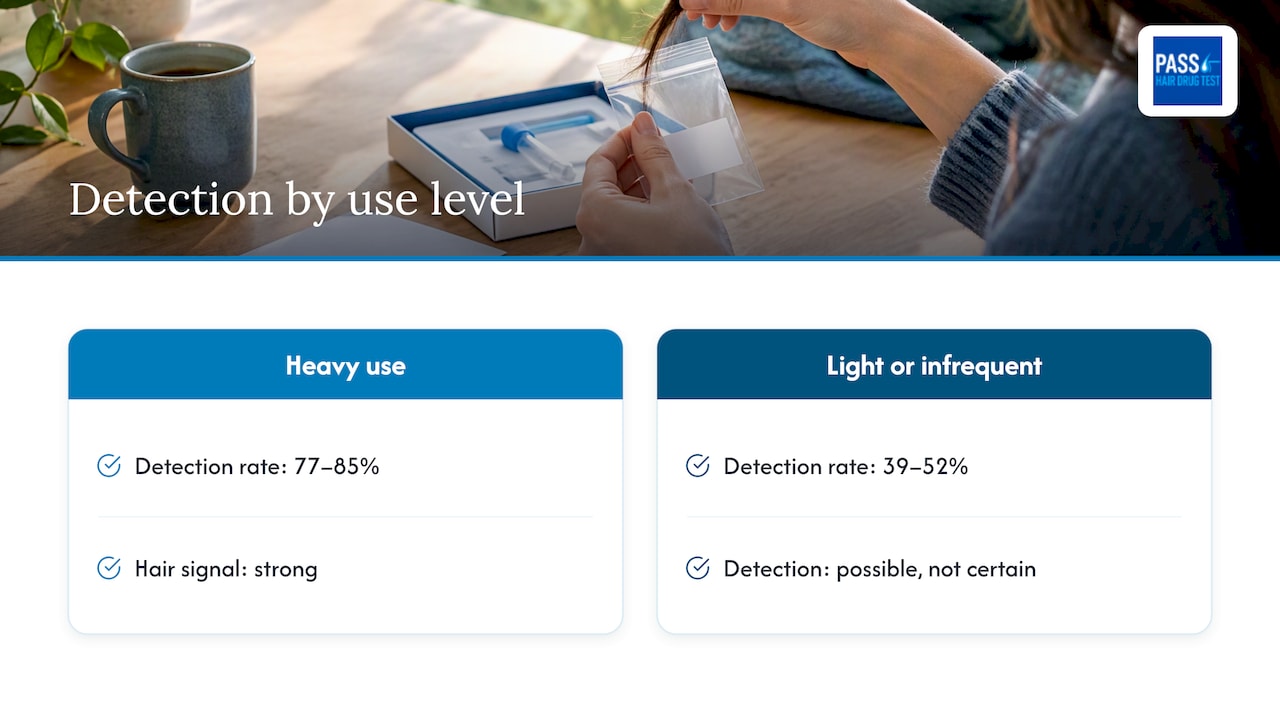
The more often you use, the more THC material circulates and the more ends up in each centimeter of hair. A study comparing cannabinoids in hair with self-reported use found that detection sensitivity was much higher in heavy users than in light users. Heavy users were detected roughly 77% to 85% of the time, while light or infrequent use was detected closer to 39% to 52% of the time.
Two things follow from those numbers.
1. Hair is not perfect, even for heavy users. A 15% to 23% miss rate means plenty of heavy users test negative. But you cannot count on being one of them. Hair color, growth rate and cosmetic treatments all change how much drug ends up in a strand. Toxicology researchers describe hair results as a qualitative indicator of chronic use, not a precise measure of how much you consumed.
2. Light use is a different problem. If you smoked a few times in three months, your odds are better, though still not zero. This article is about the heavier end, where the signal is strong.
What actually changes the result
| Factor | Effect on hair result |
|---|---|
| Frequency of use | Daily or near-daily use raises the odds of a positive and the concentration |
| Hair length | Longer hair cut to the lab’s sample length still reflects about 90 days |
| Hair color and growth rate | Influence how much drug is incorporated, in ways you cannot control |
| Bleaching, dyeing, perming, straightening | Can lower the drug concentration, but damage the cuticle and can make hair more open to outside contamination |
| Time since last use | Does not clear hair you already grew, since the strand keeps what it took in |
That last row is the hard truth for heavy users. Quitting today protects the hair you grow from now on, but the 1.5 inches closest to your scalp already holds the last 90 days, minus the first week of lag.
Secondhand smoke won’t explain a positive
Heavy smokers sometimes hope to say the smoke was in the room, not in their body. Labs have anticipated this. They wash samples with solvents and water before analysis, and they look for the metabolite THC-COOH. The consensus among hair-testing scientists is that THC-COOH in hair indicates actual ingestion rather than external exposure, with confirmation cut-offs often in the range of 0.1 to 0.2 pg/mg. A PubMed-indexed paper on washed hair reaches the same conclusion: carboxy-THC remains a reliable indicator of ingestion.
Researchers have also developed decontamination protocols built to strip external THC without removing what the body incorporated. In practice, if you use daily, a lab finding is far more likely to be treated as use than as environmental exposure.
What washing can and can’t do
This is where heavy smokers get the most conflicting advice, so here is what the evidence supports.
A study on commercially available products and hair THC found that ordinary products, including regular shampoos, alcohol-based tonics and anti-dandruff shampoos, reduced hair THC concentrations by roughly 52% to 65%, without guaranteeing a negative result. Forensic reviewers add that labs generally cannot tell these treatments apart from normal cosmetic use, but that they increasingly use segmented analysis and THC-COOH checks to confirm true ingestion.
Read that carefully:
- Washing can lower the concentration. That is real.
- A lower concentration is not the same as a negative. If you started with a heavy-use level, a 50% to 65% drop may still leave you above the cut-off.
- No wash or treatment is a certain outcome. Anyone who tells a heavy user otherwise is selling certainty the science does not offer.
Harsh treatments carry costs too. Repeated bleaching or aggressive chemical routines can leave hair brittle, and damaged hair can behave unpredictably in testing. We cover that in detox shampoo damage and what 20 years of evidence shows.
A realistic plan if you smoke heavily
Here is the order we would work through it, based on your timeline.
- Find out the details. Ask the employer or collector what hair length is taken and whether body hair is an option. Do not guess.
- Stop using now. Every day without use protects new growth and keeps the number from rising. It will not erase the last 90 days, but nothing else works without it.
- Decide how much time you have. If the test is days away, your options are narrow. If it is weeks or months away, new hair grows about half an inch a month, which matters if the lab takes only the segment nearest the scalp.
- Understand what you are buying. If you use a cleansing product, learn how it works, follow the directions exactly and treat it as a way to lower levels, not as a switch that flips the result. Our walkthrough on how to use detox shampoo for a hair drug test covers the steps, and detox vs clarifying shampoo explains why the two are not interchangeable.
- Check the product. Look at detox shampoo expiration before you rely on a bottle that has sat in a drawer.
- Avoid panic moves. Shaving your head can lead the collector to body hair, which may cover a longer period. Dyeing right before the test can look suspicious and may not help.
If you take a prescription that could matter, such as a medical cannabis recommendation, talk to the employer’s medical review officer before the test, since that is the person who handles legitimate-use disclosures after a lab result.
Our perspective
We have been in the drug-testing and detox-product business for more than 20 years, and the heavy user is the customer we hear from most. The honest picture is this: heavy use is the hardest case, and the people who do best are the ones who start early, follow instructions to the letter and do not cut corners.
That is why our hair work centers on a multi-step routine, the Mike’s Macujo Method, built around Macujo Aloe Rid Shampoo and Zydot Ultra Clean Shampoo. We believe a single wash is rarely enough for someone who has used daily, and that a repeatable process with clear directions beats a one-bottle shortcut. We also offer phone support, because questions come up the night before a test, not during business hours.
We also think you should hear the other side. Independent research says external washing outcomes are variable, and labs are getting better at confirming ingestion. So we tell customers to treat any product as one part of a plan: stop using, know your collection rules and allow as much time as you can. If you want to see how we think about effectiveness, read do detox shampoos work for hair follicle tests.
— MIchael
Where our products fit
If you have decided to prepare, our hair drug testing products page lists the hair-cleansing shampoos and the multi-step method we sell, along with test kits for other sample types. Not sure which route suits your timeline? Start with how to pass a hair drug test or our best hair detox shampoo comparison, then call us with your test date and hair length.
What to avoid
- Believing a test is only looking for smoke. Modern protocols separate surface contamination from incorporated metabolite.
- Stacking harsh chemicals. More is not better when hair is already stressed.
- Waiting. Most of the choices that help require days or weeks.
- Treating a home test as the final word. A home hair kit cannot replicate a lab’s washing, segmentation and confirmation.
If you are also facing another sample type, such as urine or saliva, the timelines are completely different. We have separate guides for urine and saliva tests.
FAQ
How long do I have to stop smoking for a hair follicle test?
Stopping does not remove what is already in the hair closest to your scalp, which reflects about 90 days. What stopping does is keep new growth clean. The longer you stay off, the more clean hair grows, which matters most if a lab only tests the segment nearest the scalp.
Can I fail a hair follicle test from secondhand smoke?
It is very unlikely to be treated as use. Labs wash hair and look for THC-COOH, a metabolite produced by your body, which indicates ingestion. Smoke on your hair does not create it.
Do heavy users always fail hair tests?
No. Studies found roughly 77% to 85% of heavy users were detected, so a meaningful minority were not. Still, that is a probability, not something to rely on.
Can I pass a hair follicle test in 30 days?
Thirty days of abstinence grows about an inch and a half of new hair at typical rates, but the lab may still sample hair that holds earlier use. Results depend on your history, your hair and the lab’s protocol, so no one can promise an outcome.
Sources
- Comparison of cannabinoids in hair with self-reported cannabis consumption in heavy, light and non-cannabis users
- Mandatory Guidelines for Federal Workplace Drug Testing Programs, Federal Register
- 2021 SoHT Consensus on Drugs of Abuse Testing in Hair
- Carboxy-THC in Washed Hair: Still the Reliable Indicator of Marijuana Ingestion
- Evidence based decontamination protocols for the removal of external THC from contaminated hair
- Manipulation of THC Hair Concentrations by Commercially Available Products
- Advances in testing for sample manipulation, part B: hair samples
- Review on Toxicology Testing in Hair, Journal of Applied Laboratory Medicine
Recommended
- Body Hair vs Head Hair: What Drug Test Labs Really Use
- Long Hair Drug Test: What Labs Actually Measure
- Gray Hair Drug Testing: Why White Hair Can Still Test Positive
- 90 Day Risk: Can an Occasional Smoker Fail a Hair Test?
