No products in the cart.
Uncategorized
Hair Drug Test Retest: Your Options After a Positive Result

10
Nov
Nov
Yes, in many cases you can ask for a retest after a positive hair drug test, but what that retest is depends on who ordered the test. In most workplace programs a retest means the lab re-analyzes the original sample (or a split portion of it) at your expense. It does not mean you give new hair and start over. A fresh collection is a separate event, usually only offered if an employer chooses to allow it. Below we explain how each path works, what to do in the first days after a positive, and how to prepare if you are facing another hair test.
Table of Contents
TL;DR
- A retest usually re-checks the same sample. It confirms the lab’s work, and it cannot capture a different window of your hair.
- Your first call after a positive result is normally to the Medical Review Officer (MRO), who reviews the result and talks with you before it goes to your employer.
- Request the retest in writing, fast. Labs need specific identifiers, and some programs set short deadlines.
- A standard hair sample covers about 90 days, so the timing of any new test matters more than anything else.
- If you must take another hair test, plan the preparation well ahead, with the right products and instructions.
Table of Contents
- What a hair drug test retest actually is
- How long a hair test looks back
- Can you ask for a retest? It depends on the program
- What to do in the first days after a positive result
- Why a re-analysis rarely flips a true positive
- If you face a new hair test: preparation is a timeline problem
- Perspective: why we favor a full routine over a one-time wash
- Choosing your next step
- Get ready for your next hair test
- FAQ
- Sources
What a hair drug test retest actually is
People searching for a “retest” mean one of three different things, and mixing them up leads to wasted days.
- A re-analysis of the original specimen. The lab runs the same sample again, or a second portion of it goes to a different certified lab. This is what the law and lab procedures usually mean by a retest.
- A new collection. A collector cuts fresh hair and a new test runs. Employers decide whether to allow this. It is not a right in most private-sector settings.
- A reapplication or a later test. After a failed pre-employment test, some employers let you reapply after a waiting period, and others do not.
The first option checks for lab error, mix-ups in the chain of custody, or paperwork problems. If your concern is that the sample belonged to someone else, was mislabeled, or was handled wrongly, a re-analysis is the right tool. If your concern is that your hair held something you would rather it did not, a re-analysis will most likely return the same answer, because it measures the same hair.
How long a hair test looks back
To understand why a retest rarely changes the picture, you need to know what the sample represents. According to Labcorp’s hair testing FAQ, drugs in hair may be detectable for approximately 90 days in workplace testing, compared with one to seven days in urine (longer in chronic users) and five to 48 hours in oral fluid. A 1.5-inch (3.9 cm) head-hair segment taken near the root covers about 90 days of growth, a standard that Quest Diagnostics also describes in its hair testing FAQ.
Hair grows at roughly half an inch per month, per general medically reviewed guidance, which is why 1.5 inches lines up with three months. The lab’s initial screen and confirmation need about 100 milligrams of hair, or 90 to 120 strands.
Two practical points follow from this:
- Hair does not show very recent use well. WorldatWork notes that hair testing generally should not be used for reasonable suspicion or post-accident testing, because slow growth means it cannot detect very recent use or current impairment.
- A second sample taken a week later still covers nearly the same 90-day window. Waiting a few days changes almost nothing. Waiting months does.
If you want a deeper look at what labs measure when hair is long, our page on the long hair drug test walks through it.
Can you ask for a retest? It depends on the program
Federally regulated testing
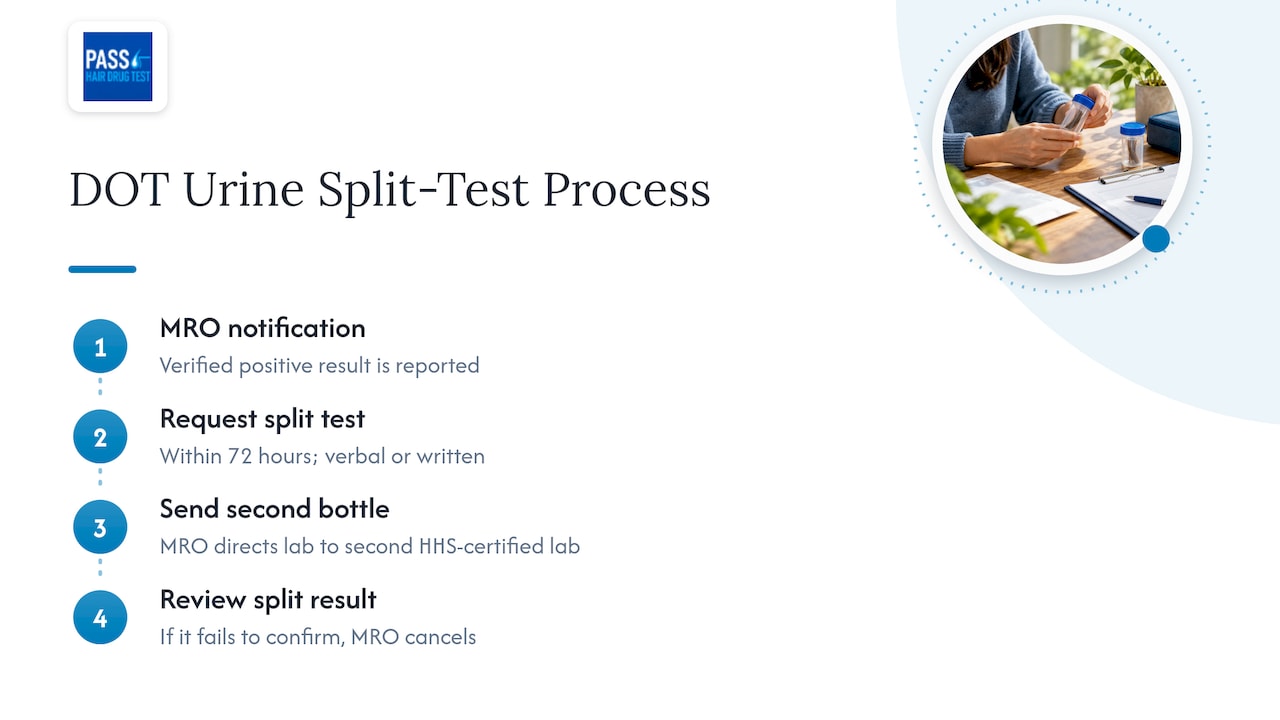
In programs run under federal rules, the process has formal steps. The Department of Transportation’s guidance for Medical Review Officers says that for verified non-negative results (other than invalid), the MRO must offer the employee the option of having the split specimen tested. When the employee makes a timely request, the MRO must immediately direct the lab that tested the primary specimen to send the second bottle to a second HHS-certified laboratory.
A summary from LegalClarity describes the DOT urine process this way: you have 72 hours from the moment the MRO notifies you of the verified positive to request the split test, and the request can be verbal or written. If the split fails to confirm, the MRO must cancel the test. That timeline is for DOT urine split specimens, so do not assume it applies to a hair test in your own situation. Ask the MRO what your deadline is, and ask on the same day you are notified.
Private-employer testing
Most people reading this are applying to or working for a private employer that orders hair tests through a contracted lab. Here the rules come from the employer’s written policy, your state’s law, and the lab’s procedures, not from a single federal checklist.
One court decision shows what can be at stake. In City of Houston v. Cortez (2022), the court described the employee as entitled to be told of his right to request, at his own expense, a referee test of the original hair sample that produced the positive. That was a public-employer case under its own policy, so it does not set a universal rule. It does show why you should read your employer’s drug policy and ask in writing what retest right it gives you.
What the lab needs from the request
Quest’s client FAQ explains that a retest at a second HHS-certified laboratory must be requested in writing and include identifiers such as the account number, your name, the accession number, the specimen ID or custody form number, the collection date, the analyte, the specimen type, which bottle to use if a split was collected, and the preferred lab. Federally regulated retest requests need the MRO’s signature, and non-regulated ones need the signature of the client’s authorized contact.
In plain terms: you usually cannot call the lab yourself and demand a retest. The request travels through the MRO or the employer’s designated contact. Keep your copy of the custody form, since it holds most of those identifiers.
What to do in the first days after a positive result
- Take the MRO’s call. The SAMHSA MRO guidance describes MRO review as an essential part of a testing program: the MRO reviews documentation and interviews the donor to find out whether there is an acceptable medical explanation. It also states that a confirmed positive does not automatically identify illicit or unauthorized drug use.
- List your medications and treatments. Prescriptions, over-the-counter products, and any cosmetic hair treatment can come up. Have names, doses, and prescribers ready.
- Ask about the retest deadline and cost. Ask whether a split or retained portion exists, who pays, and how to submit the request.
- Put the request in writing. Email or a letter to the MRO and the employer’s contact, citing your collection date and custody form number.
- Read the employer policy. It should say what happens after a verified positive: rehire waiting periods, a new test, or an appeal path.
- Ask about the next test. If a new collection is allowed, ask how soon, and what hair length will be taken.
Some employers never allow reapplication. A forum thread about a trucking company is not a source we rely on, so read your own offer letter and policy instead.
Why a re-analysis rarely flips a true positive
Labs confirm positives with a second, more specific method after the initial screen, so a re-analysis of the same hair is likely to land where the first one did. Where retests do matter is when something in the process went wrong: a sample labeled for the wrong person, a broken custody form, or a medical explanation the MRO should have weighed.
The external contamination question comes up often too. The lab washes hair before analysis. A 2025 review on hair toxicology says that washing is essential to remove interfering substances while preserving drugs incorporated in the hair structure, and also that no consensus exists on the best decontamination protocol. The same review reports decontamination effectiveness anywhere from 7% to 113% depending on the analyte and protocol. That is why lab protocols differ, and why you should ask the lab how it washes samples if you believe environmental exposure is involved.
If you face a new hair test: preparation is a timeline problem
When a retest is not available, or a new collection is allowed, the real question becomes: what will the next sample look like? Because hair records about 90 days per 1.5 inches, anything you do changes only what the lab sees in the newest growth and in the washed shaft.
Here is how we think about the timeline:
| Situation | What it means for your preparation |
|---|---|
| Test date is more than 90 days away and you stop use | New growth near the root will not carry recent use. Plan your wash routine for the remaining hair. |
| Test date is within weeks | The root-end segment still reflects the past 90 days. Hair preparation instructions matter most here. |
| You are waiting on a retest result | Do not make changes that could raise questions about the original sample. Follow the MRO’s instructions. |
| An employer lets you retake after a waiting period | Use the waiting time to follow a full multi-step routine and read the instructions end to end. |
One caution about the science, so you plan with open eyes. Research on cleansing shampoos is mixed and dated in places. A 2000 study on Ultra Clean found THC reduced by about 36% in the tested samples after a single application, and a 2024 article on homemade treatments reported reductions up to 60% for THC with some treatments. Both point the same way: repeated, consistent treatment appears to matter more than a one-time wash. That is the reasoning behind a multi-step routine. A 2023 toxicology review adds that extensive washing and cleansing shampoos cannot be detected at all with currently available methods.
A few habits make any routine work better:
- Start as early as you can, and keep the schedule the instructions give you.
- Follow every step in order and do not skip the repeat washes.
- Protect the hair you will be asked to give. Hair treated unevenly can leave you guessing.
- Keep the test date, the collection site, and the lab’s name written down.
If your hair is styled in locks, our page on dreadlocks and the 90-day test covers what to say at collection.
Perspective: why we favor a full routine over a one-time wash
We have spent more than 20 years in the drug-testing and detox-product industry, and the question we hear most from people facing a second hair test is how to avoid repeating the same mistake. Most of the time it comes down to preparation that was too short or too casual.
Our view is simple. A hair test is a 90-day record, so a single quick wash on the night before is not a plan. Our Mike’s Macujo Method is built as a multi-step routine for exactly that reason: it layers steps so that the hair is treated repeatedly and deliberately, not once. We offer it alongside Macujo Aloe Rid Shampoo and Zydot Ultra Clean Shampoo for people who want a simpler option.
We also believe in support. We provide detailed instructions and phone support so you are not guessing at each step, whether you are a lighter or a heavier user. Read the method’s instructions before you start, line up your timeline, and give yourself room to follow every step.
MIchael
Choosing your next step
The right move depends on where you are in the process.
You just got a positive and think the process failed. Contact the MRO, document everything, and request the re-analysis in writing. Do not wait.
You just got a positive and you know the result reflects use. A retest of the same sample will probably confirm it. Focus on the employer’s policy for a new test or reapplication, and on how long you must wait.
You have a hair test coming up. Count back 90 days, decide how your hair will be handled, and begin preparation immediately. Our guide to passing a hair follicle drug test lays out the process, and our overview of the Macujo method explains the steps.
For general background on collection, hair length, and lab handling, our hair drug test information page is a good starting point.
Get ready for your next hair test
If you need to prepare for another hair test, we carry hair-cleansing products built around Macujo Aloe Rid Shampoo, Zydot Ultra Clean Shampoo, and the multi-step Mike’s Macujo Method, along with instructions and phone support. Our approach is designed for both light and heavy users, and we state a guarantee on the method. Browse everything on our products page, or start with our page on how to pass a hair drug test.
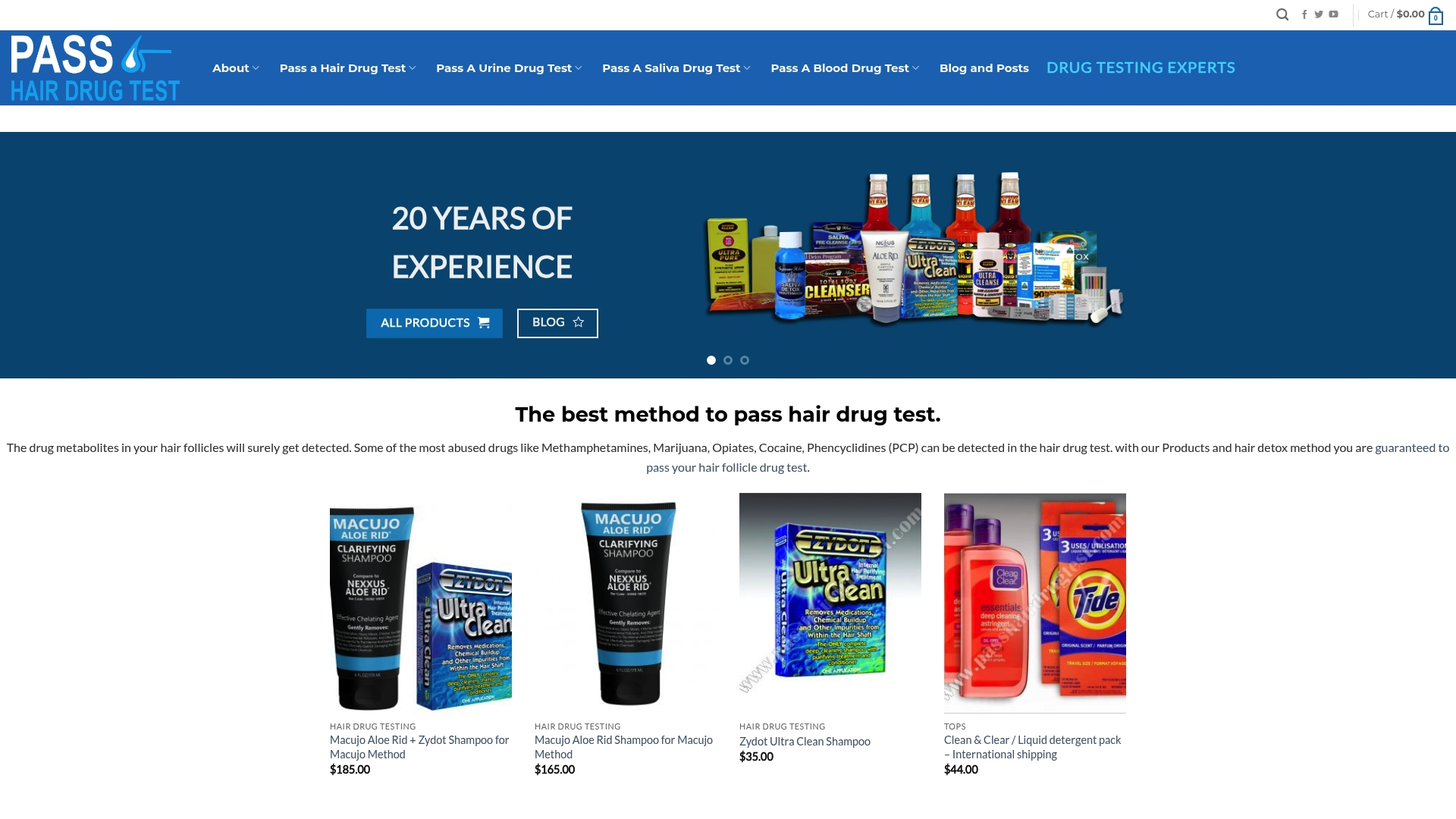
If you also face a urine, saliva, or blood test, the products page lists those categories too.
FAQ
Can you ask for a retest on a drug test?
Often yes, but the details depend on the program. In federally regulated testing, the MRO must offer a split specimen test for verified non-negative results, and the request goes to a second HHS-certified lab. In private testing, your employer’s policy and the lab’s procedures set the terms, and you may pay for it. Ask the MRO and read the written policy.
Will a retest use new hair?
Usually not. A retest typically re-analyzes the original sample or a retained portion of it. A new collection is a separate event that your employer would have to allow, and even then it covers a similar 90-day window.
How long does a hair drug test detect drug use?
A standard sample is the first 1.5 inches (3.9 cm) of head hair from the root, which represents approximately 90 days of use history, according to Labcorp and Quest. Urine, by comparison, generally covers one to seven days, and oral fluid five to 48 hours.
Who should I call first after a positive hair test?
Call the Medical Review Officer named in your paperwork. The MRO reviews the result, interviews you about medications and other explanations, and is the person who can start a retest request. Do it the same day you are notified, because some programs have short deadlines.
Do labs know if hair was washed before testing?
A 2023 toxicology review states that cleansing shampoos and extensive washing cannot be detected at all with currently available methods. Labs also wash every sample themselves as part of the process, so the exact protocol they use is worth asking about if you have concerns.
Sources
- Labcorp: Hair Drugs of Abuse Testing FAQ
- Quest Diagnostics: Hair testing FAQ
- Drugs.com: How far back does a hair follicle test detect drugs?
- Labcorp: Hair Follicle Drug Testing
- WorldatWork: Workforce Drug Use Is On the Rise
- DOT: Back to Basics for Medical Review Officers
- LegalClarity: How to Dispute a Positive Drug Test Result
- City of Houston v. Cortez (2022), FindLaw
- Quest Diagnostics client FAQ
- SAMHSA Medical Review Officer Guidance Manual
- Review on Toxicology Testing in Hair, Journal of Applied Laboratory Medicine
- Effect of the shampoo Ultra Clean on drug concentrations in hair
- Hair analysis: Assessment of homemade hair treatment, Drug Testing and Analysis
- Advances in testing for sample manipulation in clinical and forensic toxicology
Recommended
- Hair Drug Test Information
- Fail Hair Drug Test? What It Means and What to Do Next
- Hair Drug Test vs Urine: Which Detects Use When
- How to Pass a Drug Test on Hair Follicles?
