No products in the cart.
Uncategorized
External Contamination and Hair Drug Tests: THC Users’ Guide
25
Nov
External contamination means THC that reaches your hair from outside your body: smoke, residue on your fingers, sweat and sebum, or a shared pillow. It does not mean the drug came through your bloodstream. Research shows that THC and its related compounds do land on hair this way, and that a lab sample can carry them. If you have a hair follicle test coming, the surface of your hair is part of the problem, and that is the part a proper cleansing routine is built to address. Our Mike’s Macujo Method, a multi-step routine built around Macujo Aloe Rid Shampoo and Zydot Ultra Clean Shampoo, is our answer for the surface.
Table of Contents
TL;DR
- External contamination is drug deposited on the hair shaft from smoke, hands, dust or sweat, as opposed to drug absorbed into the body and built into growing hair.
- In a 2015 study, people who only rolled a joint for five days, without consuming it, had THC compounds in their hair, and most still did four weeks later.
- Labs wash samples and may analyze the wash, but no consensus protocol exists, so the surface of your hair matters before you ever walk in.
- A structured, multi-step cleansing routine started well ahead of your collection date is the practical way to deal with what sits on and in the outer hair.
Table of Contents
- What external contamination actually means
- How THC gets onto hair without being consumed
- How labs wash and read a hair sample
- Why THC is the tricky one
- What this means if you have a test coming
- Our hair cleansing products
- Our perspective
- FAQ
- Sources
What external contamination actually means
A hair follicle test looks for drugs and drug metabolites (the substances your body makes as it breaks a drug down) in a hair sample, usually cut close to the scalp. Hair grows slowly, so it holds a record of the previous weeks to months, not just the last few days.
There are two ways a drug gets there. In the first, the drug enters your blood and is carried into the growing hair, and also moves into hair through sweat and sebum, the natural oil your scalp makes. In the second, the drug never enters your body at all. The UN Office on Drugs and Crime describes external contamination as drug passively deposited on the surface of the hair from the environment, such as smoke, powder, or household and workplace exposure, with only minimal penetration under the hair surface.
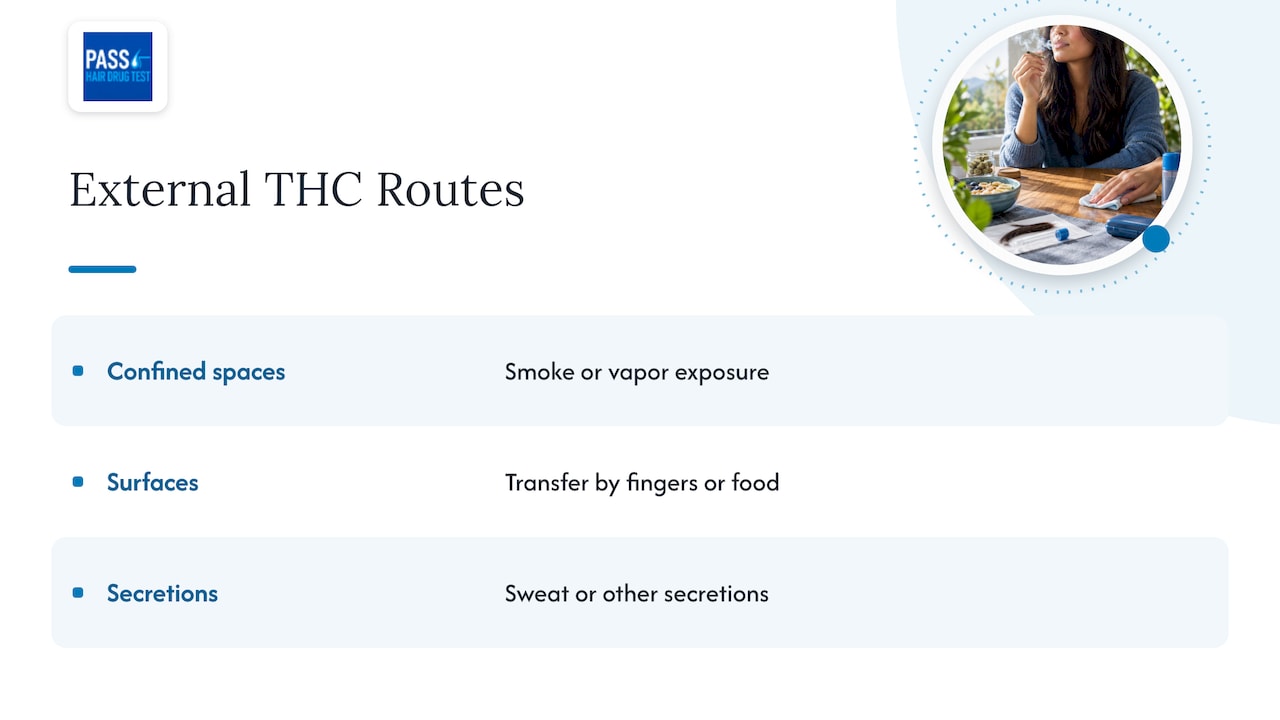
A 2017 review in Clinical Toxicology lists the common routes: a confined space where drugs were smoked or vaporized, transfer from contaminated surfaces by fingers or food, and transfer from sweat and other secretions. The same review notes that hair color, texture, where the sample was taken, growth rate and storage can all change how a result is read.
The National Institute of Justice, the research arm of the U.S. Department of Justice, says plainly that experts find the line between use and environmental exposure hard to draw, and that decontamination procedures are not standardized.
For you as a cannabis user, the practical point is simple. Whatever your use pattern, your hair is also exposed to THC from the outside, and that exposure is what you can act on most directly.
How THC gets onto hair without being consumed
Cannabis is one of the clearest examples in the literature, because THC is sticky, resinous and easy to move around with your hands.
Hands and handling
In a German study published in 2015, ten volunteers rolled a marijuana joint on five consecutive days without smoking it. THCA-A, the raw acid form found in the plant, turned up in every participant’s hair at 15 to 1,800 pg/mg, and THC itself at under 10 to 93 pg/mg. Four weeks later THCA-A was still detectable in nine of the ten. The authors concluded that at least part of the THC and most of the THCA-A seen in routine hair analysis can come from contaminated fingers touching hair.
Think about your own day: breaking up flower, loading a vape, rolling, then pushing your hair back or scratching your scalp. None of that involves inhaling anything, yet each touch moves residue onto your hair.
Sweat, sebum and smoke
A second 2015 study in Scientific Reports found that all three main cannabinoid markers (THC, THCA-A and THC-COOH) can be present in the hair of people who do not use cannabis, via transfer through hands, sebum and sweat, or cannabis smoke. It also found THC-COOH in hair segments that grew before the participants took oral THC, and in sebum and sweat samples, which points to diffusion through the hair from the outside in.
A 2025 review in the Journal of Applied Laboratory Medicine adds that THC-COOH is present in sweat and sebum, so it can pass to another person’s hair, especially in households where people share pillows and close contact.
Smoking and vaping both deposit THC
An in vitro study (hair exposed in a lab, not on people) published in Drug Testing and Analysis found that both smoke and vapor deposit measurable THC on hair. Hair exposed to high-THC cannabis carried 169.30 ng/mg of Δ9-THC, against 35.54 ng/mg for a 0.4% THC “light” product, and the two delivery methods did not differ statistically. Switching from joints to a vape does not take your hair out of the picture.
How labs wash and read a hair sample
Most people assume the lab simply cuts the hair and runs it. In practice, labs wash the sample first to strip off what is on the surface, then test what remains.
The 2025 JALM review says there is no consensus on decontamination protocols, though it recommends a combination of organic solvents and aqueous solutions. Some labs keep their wash liquid and analyze it. If a drug shows up in the hair but not in the wash, external contamination is less likely. If the wash holds a much larger amount, contamination has to be considered.
In one common approach, called the wash criterion, the last of five washes is analyzed, its drug amount is multiplied by a factor (usually 5), and the result is subtracted from the amount found in the hair. If what is left falls below the cutoff, the test is negative.
The UNODC manual lists four precautions for telling contamination from use:
- Wash the hair and compare the drug in the last wash residue to the amount in the hair.
- Check that the drug and its metabolites appear in sensible proportions.
- Apply cutoff levels.
- Compare drug concentrations in hair from different body sites.
The same manual explains that the choice of solvent matters. Non-protic solvents such as dichloromethane do not swell the hair and are believed to remove surface contamination without taking out incorporated compounds. Protic solvents such as water and methanol swell the hair and can pull out part of what is embedded. It also states that in cases of massive external contamination, no washing procedure can completely remove the contaminating compounds.
That last point is the one to take seriously. A lab wash is built to protect the integrity of the result, not to rescue yours. You cannot count on the laboratory to clean your hair for you, and you cannot know in advance which protocol your lab uses.
Why THC is the tricky one
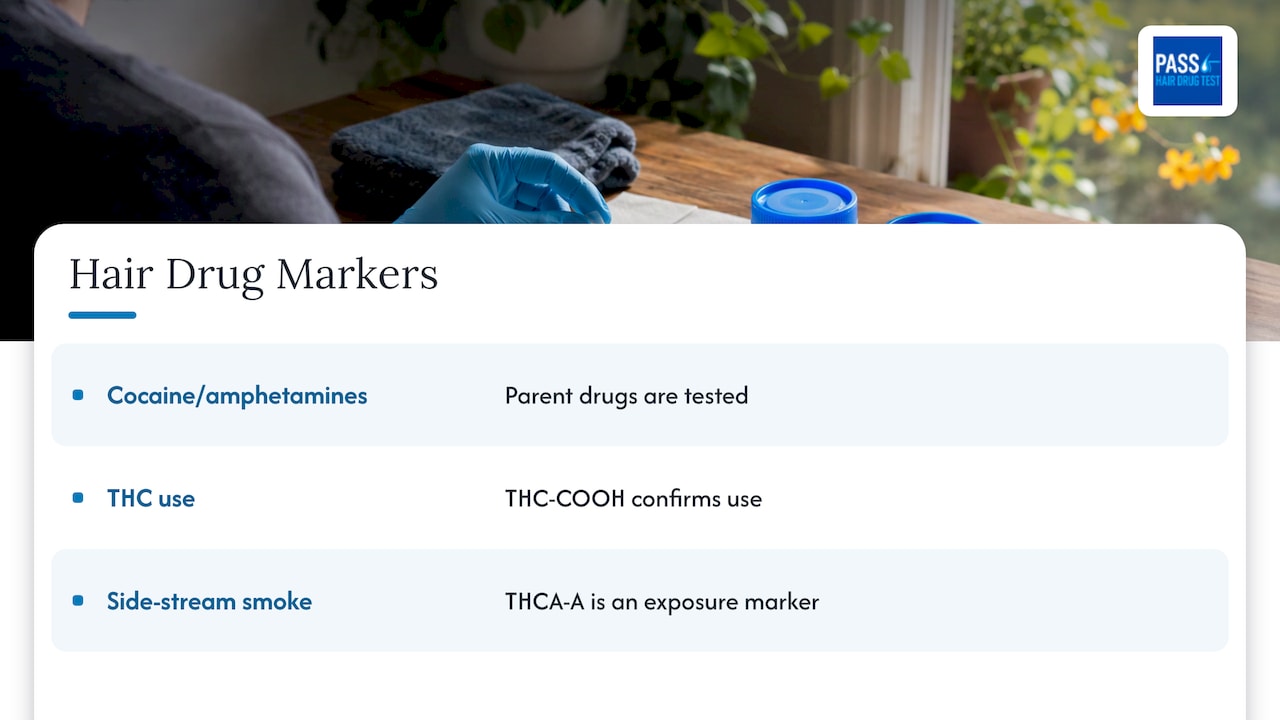
Cocaine and amphetamines are tested as the parent drug. THC is different. SAMHSA, the federal substance abuse agency, notes that most hair testing targets parent drugs except for THC’s major metabolite, THC-COOH. SAMHSA’s literature summary says THC-COOH in hair is widely accepted as confirmation of use, while THCA-A is examined as a marker of side-stream smoke exposure.
The numbers are tiny. The UNODC manual cites Society of Hair Testing cutoffs of 0.2 pg/mg for THC-COOH, and the SAMHSA cutoff in the 2025 JALM review is 0.05 pg/mg. A picogram is a trillionth of a gram, so a very small amount of residue is enough to matter. We break down these thresholds in our guide to hair test cutoff levels, and explain how labs use the follow-up compounds in phase II metabolites in hair.
Research from NIJ-funded work also shows why labs lean on metabolites. A grant report found that even blank hair contaminated only with methamphetamine and heroin could later show metabolites of those drugs, sometimes above recommended cutoffs. Individual variation in how much drug hair takes up during contamination was large. The takeaway for you is that the amount sitting on and in the outer hair varies from person to person, and you cannot judge your own level by looking at your hair or by how much you have used.
One more point from the JALM review: there is no strong correlation between the dose a person takes and the concentration in hair. Two people with the same habits can get different results. Preparation should not be based on assumptions about how “light” your use is.
What this means if you have a test coming
You cannot change what is already inside the hair shaft, but you can reduce the surface and outer-layer load, and you can stop adding to it. Here is how to approach it.
1. Stop the daily deposits
The studies above point to the same sources: fingers, smoke, sweat and sebum, and shared fabrics. Until your collection date:
- Wash your hands thoroughly after handling cannabis, and keep them away from your hair while you do.
- Avoid rooms where cannabis is smoked or vaped, and keep your hair out of the smoke when you cannot.
- Wash pillowcases, hats, hoodies and hair brushes you share or leave near cannabis.
- If you live with other users, keep your bedding and hair tools separate.
We cover the related question of creams and balms in our article on topical THC and hair drug tests.
2. Start cleansing well before the collection date
A single wash the night before does not match the way the research describes contamination: layered, repeated, and in some cases still detectable weeks later, as in the roll-a-joint study where THCA-A was still present at four weeks. A multi-step routine applied on a schedule is the sensible match for that. This is what Mike’s Macujo Method is built for. It is a multi-step cleansing routine, not a single product, and we provide detailed instructions and support materials with it. Our site states more than 20 years of experience in the drug-testing and detox-product industry, and we offer unlimited phone support so you can ask about timing and your hair type as you go.
Our hair follicle testing guide and the Macujo Aloe Rid Shampoo guide walk through the routine in more detail. For the wider picture of what a test looks for in a THC user, start with THC in hair.
3. Plan for your hair, not an average
Because hair color, texture, sampling location and growth rate all affect how results are read, give yourself margin. Heavier use, longer hair and daily handling of concentrates or flower all call for starting earlier and following the routine exactly as written. Our article on concentrates and hair drug tests covers the higher-potency products.
4. Keep the test date and your paperwork straight
Employers and testing programs differ in what they collect and when, and some give notice while others do not. Read the notice or offer letter, note the collection window it gives you, and count backward from it for your routine. If you are unsure what kind of test you are facing, our hair drug test information page explains the basics.
Our hair cleansing products
If you want a routine you can follow step by step, our hair cleansing line is built around Macujo Aloe Rid Shampoo, Zydot Ultra Clean Shampoo and Mike’s Macujo Method. You can see Macujo Aloe Rid Shampoo, the shampoo pairing for the Macujo Method, and our full product catalog, which also includes urine, saliva and blood testing products and home test kits.
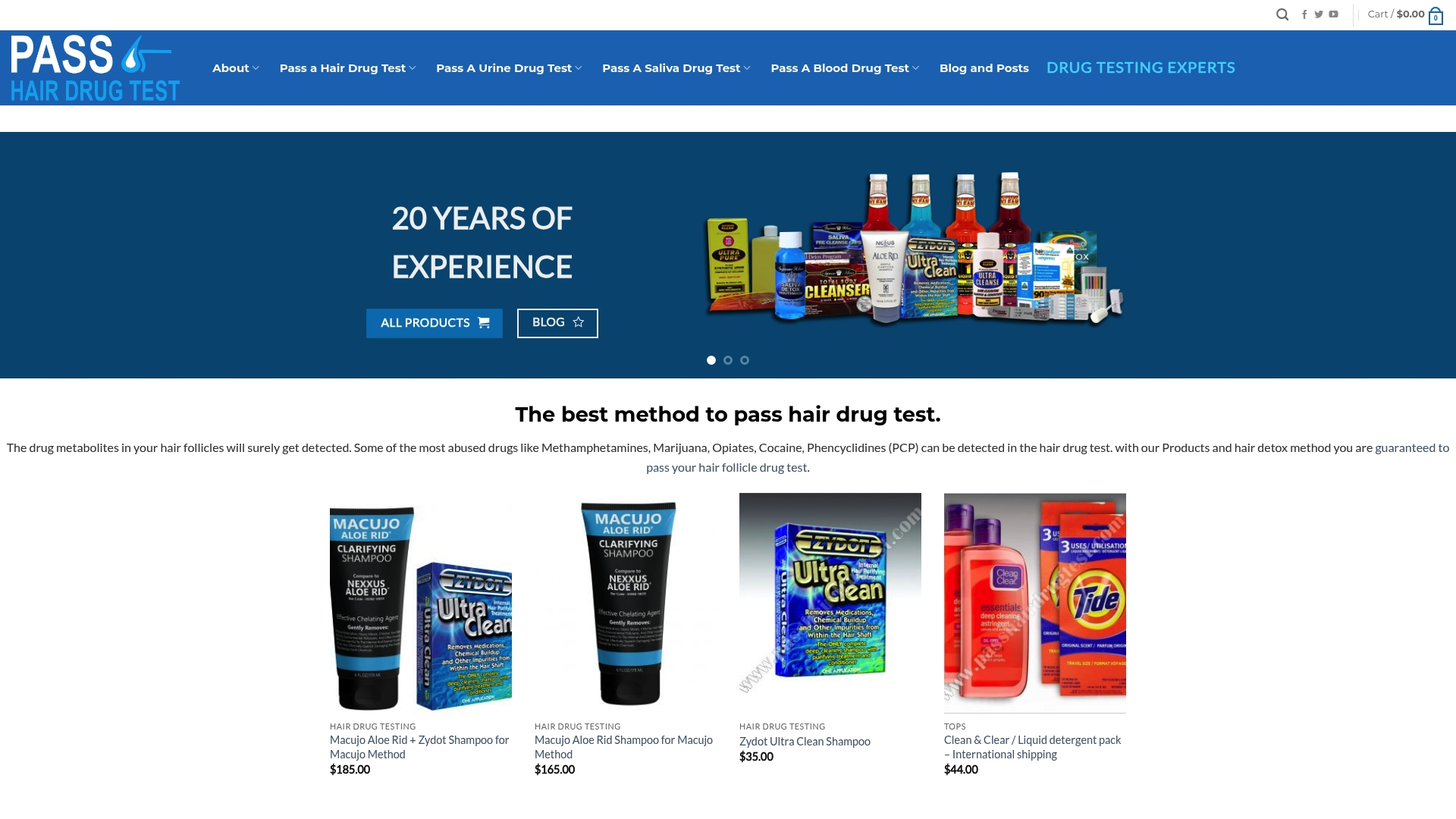
If you are not sure where to begin, start with our guide to passing a hair drug test with shampoo and call us with your test date.
Our perspective
The science on external contamination changed how we talk to customers. Studies show THC and its compounds can reach hair from fingers, smoke, sweat and shared surfaces. That is why we do not treat hair cleansing as a one-bottle, one-night job.
What we have built our hair business around is a method. Mike’s Macujo Method is a multi-step routine, and the shampoos in it, Macujo Aloe Rid and Zydot Ultra Clean, are made to work as part of that routine. We provide detailed instructions with it, and we back it with unlimited phone support, because every head of hair and every test date is a little different.
After more than 20 years in the drug-testing and detox-product industry, our view is simple: the people who feel best going into a test are the ones who started early, followed the steps in order and kept contamination from piling back up between washes. We would rather you do that with our method than guess.
MIchael
FAQ
Can I fail a hair test if I never smoked, only handled or was around cannabis?
It is possible for THC compounds to land in your hair that way. In the 2015 study, volunteers who only rolled a joint had THC and THCA-A in their hair afterward, and most still had THCA-A four weeks later. Labs wash samples and use metabolite markers and cutoffs to interpret results, but the research says the distinction is difficult in practice.
Does washing my hair at the lab remove contamination?
Labs wash samples before testing, but there is no consensus on the exact protocol, and the UNODC manual states that no wash completely removes contamination in heavy cases. You should treat the lab wash as a quality step for the lab, not as protection for you. Your own preparation before collection is what you control.
Is vaping safer for my hair than smoking?
Not based on the research. A lab study found that hair exposed to vapor and hair exposed to smoke carried statistically similar amounts of THC. What mattered more was the THC content of the product, which was far higher for high-THC cannabis than for low-THC products.
How far ahead should I start cleansing my hair?
As early as you can. The research shows contamination can persist for weeks, and hair differs from person to person. Our Mike’s Macujo Method is multi-step, so it works best when you have room to follow every step on schedule. Call us with your collection window and hair type and we will help you plan around it.
Does the cutoff level depend on which lab tests me?
Yes. The 2025 JALM review lists different recommended cutoffs from the Society of Hair Testing and from SAMHSA, for example 0.2 pg/mg and 0.05 pg/mg for THC-COOH. Your employer’s testing program decides which applies, so check what your notice says. Our cutoff levels guide explains the numbers.
Sources
- Guidelines for testing drugs under international control in hair, sweat and oral fluid (UNODC, 2014)
- Detecting Drugs in Hair: Is It Drug Use or Environmental Contamination? (NIJ, 2024)
- Hair analysis for Δ9-tetrahydrocannabinolic acid A (PubMed, 2015)
- Finding cannabinoids in hair does not prove cannabis consumption (Scientific Reports, 2015)
- External hair contamination from cannabis and light cannabis (Drug Testing and Analysis, 2023)
- Review on Toxicology Testing in Hair (Journal of Applied Laboratory Medicine, 2025)
- The interpretation of hair analysis for drugs and drug metabolites (Clinical Toxicology, 2017)
- Drug Metabolites and Hair Testing (SAMHSA, 2017)
- The science of hair testing, summary of literature review (SAMHSA, 2014)
- Analysis of Drugs of Abuse in Human Hair: Surface Contamination (NIJ grant report, 2015)
Recommended
- THC in Hair: What U.S. Cannabis Users Need to Know
- Topical THC and Hair Drug Tests: What Actually Shows Up
- Concentrates and Hair Drug Tests: What Labs Can Detect
- Trace THC in CBD Can Trigger a Positive Hair Drug Test for Workers
