No products in the cart.
Uncategorized
Hair Test Bias: What Skews Results and How to Prepare
28
Nov
Hair drug tests are not the neutral, one-size-fits-all measurement many employers assume. Hair color, hair texture, sweat, outside contamination and cosmetic treatments all change how much of a drug a lab finds, and none of them says anything about how much you actually used. If you are a THC user facing a hair follicle test, that matters in two ways: you should understand where the test is uneven, and you should prepare your hair deliberately instead of leaving it to chance. We built our hair-cleansing products and the multi-step Mike’s Macujo Method around that second part, and below you will see why a structured routine makes sense once you know how the test works.
Table of Contents
TL;DR
- “Bias” in hair testing means the result can be pushed up or down by things other than your use: hair color, hair treatments, sweat and sebum, and contamination from the environment.
- For THC, the lab looks for a metabolite that reaches the hair mostly through sweat and sebum, which is why the test is hard to interpret and why scientists warn against over-reading it.
- Labs in federal programs use washing, mass spectrometry confirmation and, in some cases, a second specimen to reduce errors. Those safeguards do not remove every source of variation.
- What you can control is your hair’s condition and your preparation. Our Macujo Method, Macujo Aloe Rid Shampoo and Zydot Ultra Clean Shampoo are built for that, with unlimited phone support from a team with more than 20 years in the industry.
Table of Contents
- What “bias” means in a hair drug test
- Hair color and texture: the best-documented bias
- Why THC results are especially hard to read
- Cutoffs: the line the lab draws
- Treatments, contamination and collection
- How labs try to reduce bias
- What you can control: preparing your hair
- Where to start
- Our perspective
- FAQ
- Sources
What “bias” means in a hair drug test
In ordinary testing talk, a biased test favors one group over another. In toxicology the idea is similar. A hair test is biased when two people with the same drug exposure can get different results because of their hair, not their behavior.
To see why, you need the basic mechanism. Drugs can enter hair from the bloodstream, through sweat or sebum (the natural oil on your scalp), or from outside contamination. A 2025 review in the Journal of Applied Laboratory Medicine notes that sample collection and segmenting need care because growth rates vary and sweat, sebum and contamination can confound interpretation.
The general timeline is well established. According to SAMHSA’s primary care drug testing guide, drug metabolites show up in the hair shaft roughly 7 to 10 days after use, and hair grows about 1 cm per month. That is why a standard 1.5 inch sample (about 3 to 4 cm) is usually described as covering roughly 90 days. The American Academy of Pediatrics gives the same 3 cm, 90-day window and adds that shampoos, bleaches and dyes can alter the drug concentrations in hair.
If you want the full walkthrough of how the test is collected and read, our hair drug test information page covers it step by step.
Hair color and texture: the best-documented bias
The most discussed form of bias is pigment. Drugs bind to melanin, the pigment that colors hair, so darker hair can hold more of certain drugs than lighter hair after the same dose.
The numbers come from federal documents and peer-reviewed work:
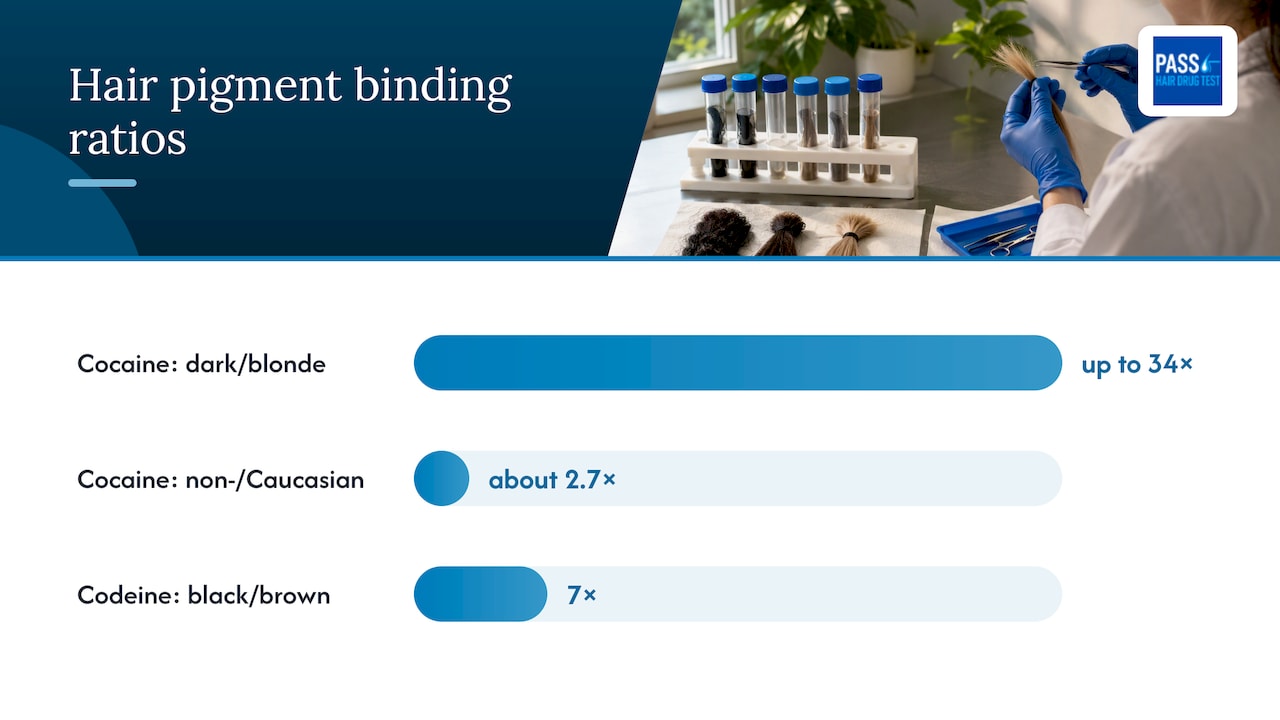
- In a 2020 notice, HHS reported laboratory binding experiments in which dark hair bound up to 34 times more cocaine than blonde hair. A controlled human study found about 2.7 times more labeled cocaine in the hair of non-Caucasian, primarily Black, participants than in Caucasian, primarily brown-haired participants given the same dose.
- The 2025 Journal of Applied Laboratory Medicine review found, in a codeine dosing study, concentrations 7 times higher in black hair than brown hair. At a 200 pg/mg cutoff, every black-haired subject would have tested positive, half of the brown-haired subjects and none of the blonde or red-haired subjects. The review describes this as racial bias in hair testing.
THC is a more nuanced case, and it is worth being precise. In the same 2020 notice, HHS states it is unaware of controlled dosing studies on how hair color affects the THC metabolite, and that epidemiological studies suggested no significant color effect for that metabolite. So the pigment evidence is strongest for drugs like cocaine and codeine. The Society of Hair Testing says incorporation may be influenced by natural hair color depending on the drug’s chemical properties.
The practical takeaway for you: your hair color is not something to fix, and no one can tell you from color alone whether you will test high or low. It is one reason to treat a hair test as a variable-outcome event and prepare thoroughly rather than guess.
Why THC results are especially hard to read
THC is where the science gets most interesting, and most useful for a reader in your position.
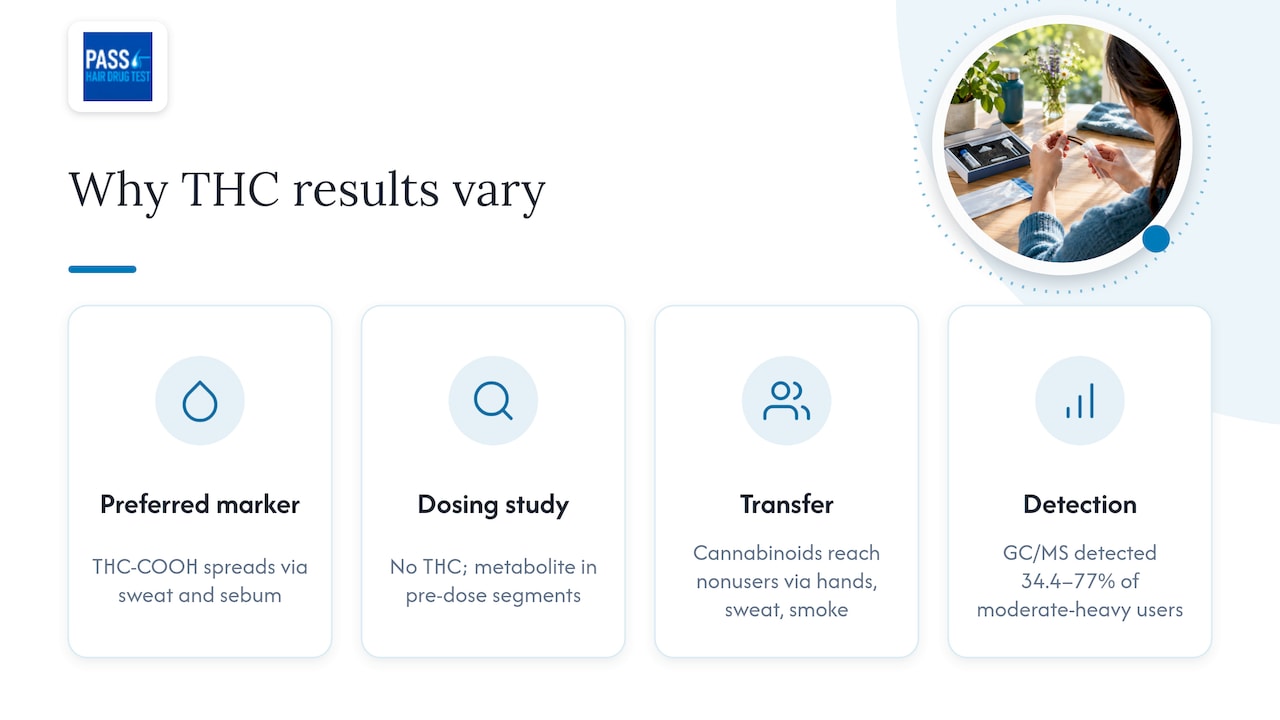
Hair labs rarely look for THC itself. The preferred marker is THC-COOH, a metabolite your body makes after processing THC. The 2025 review states that THC getting into hair from the blood is negligible, and that THC-COOH is found in the sweat and sebum bathing the hair, so it spreads through the hair matrix rather than being laid down at the moment of use.
A 2015 study in Scientific Reports by Moosmann and colleagues shows how odd that can look. Two volunteers took THC orally for 30 days. No THC turned up in their hair, yet THC-COOH was found even in segments that had grown before the dosing began. The authors also found that cannabinoids can reach the hair of people who do not use cannabis, through hands, sebum and sweat, or smoke. Their conclusion was that finding THC or THC-COOH in hair should not be over-interpreted as proof of consumption.
The same uncertainty cuts in the other direction. A 2017 review by Marrinan and colleagues reported that GC/MS methods detected between 34.4% and 77% of moderate to heavy cannabis users in recent studies. A 2025 review in WIREs Forensic Science adds that a negative hair test does not necessarily mean no exposure, since it can come from lower incorporation, collection and segmentation issues or limited analytical sensitivity.
Put together, a THC hair result depends on your sweat and sebum, your hair, your environment and the lab. That variability is the real bias problem. It is also why people who use cannabis regularly choose to take control of the one stage they can influence: the state of the hair before it reaches the lab.
Cutoffs: the line the lab draws
A cutoff is the concentration at or above which a lab reports a positive. Different standards draw it in different places, which adds another layer of variation.
- The 2021 Society of Hair Testing consensus sets a 50 pg/mg cutoff for THC in head hair segments of up to 3 cm. It also says that finding THC-COOH strongly supports THC intake, with a minimum quantification limit of 0.2 pg/mg for that confirmation.
- HHS’s 2020 proposal for federal workplace programs is far more sensitive for the THC metabolite: 1 pg/mg initial and 0.05 pg/mg confirmatory.
The Transportation Trades Department of the AFL-CIO, in a 2020 federal comment, argued that the proposed marijuana cutoff was four times lower than the European and Society of Hair Testing recommendations, raising false-positive risk from contamination and hemp or CBD exposure.
Most private employers do not publish their cutoffs. Whichever one applies to you, a lower cutoff means a smaller margin, which is the argument for careful preparation instead of hoping for a clean read.
Treatments, contamination and collection
Three more factors move numbers without any change in use.
Cosmetic treatments. The 2017 Marrinan review reports that Jurado and colleagues found drug content in bleached, colored or straightened hair was lower than in untreated hair, by about 40 to 60 percent on average depending on the substance, the treatment and the damage. The Society of Hair Testing says treatments such as bleaching, dyeing, perming, straightening and UV exposure can influence concentrations and should be documented at collection. We cover this in detail in our pages on hair dye and drug tests and bleach and hair drug tests.
External contamination. The 2025 WIREs review calls false positives from contamination a primary concern. The AAP notes that volatile drugs such as marijuana can adhere to hair. If you live or work around smoke, or handle cannabis, our guides on external contamination and topical THC explain what can and cannot end up on a strand.
Collection. HHS’s proposal calls for a single hair specimen collected under direct observation and split into an A and B sample. It also says segment-by-segment analysis is not recommended for workplace testing, because sweat can deposit drug along the whole length of the hair. In other words, you cannot assume a lab will read only the oldest or newest centimeter.
How labs try to reduce bias
Federal-style programs have safeguards, summarized in the 2020 Federal Register proposal:
- A validated decontamination wash, with organic and aqueous steps, before every confirmatory test.
- Confirmation by mass spectrometry for any presumptive positive. The Society of Hair Testing requires this as well.
- Method validation with at least annual re-verification, plus quality controls that include a deliberately contaminated sample.
- A specimen validity test to flag damaged hair.
- A second specimen (urine, blood or saliva) tested when a medical review officer directs it after a positive hair result. The proposal also notes hair is not suited to post-accident or reasonable-suspicion testing, because drugs take days to appear in it.
These steps make labs more consistent. They do not make every lab identical, and many employers use private vendors outside the federal framework. Researchers still caution that concentration in hair cannot show how much someone used, a point stated in the Society of Hair Testing consensus.
If your employer uses urine instead, the picture changes. Our comparison of hair versus urine testing shows what each looks back to.
What you can control: preparing your hair
You cannot change your pigment, your sweat or the lab’s cutoff. You can change your preparation, and this is the part of the process where we focus.
Here is the routine, and where a structured approach matters at each step.
- Know your test window. Count back roughly 90 days for a standard sample. Hair grows about 1 cm a month, so the length of hair collected defines the period looked at.
- Start early and stay consistent. Cleansing is a routine, not a single wash. Our multi-step Mike’s Macujo Method is designed as a sequence, with detailed instructions so you are not improvising each stage.
- Use purpose-built shampoos. Our hair-cleansing line is built around Macujo Aloe Rid Shampoo and Zydot Ultra Clean Shampoo. You can read the Macujo Aloe Rid Shampoo guide before you decide.
- Keep your hair in the state you cleansed it. Because outside contamination is a real source of variation, avoid smoke exposure and handling cannabis around your hair in the days before the test.
- Ask questions before test day. We offer unlimited phone support, so you can talk through your hair type, timeline and schedule instead of guessing.
Our hair follicle drug testing page lays out the full approach, and the how-to guide shows how the shampoos fit into the routine.
Where to start
If you have a hair test coming and you want a plan instead of a gamble, start with the products built for it. Our hair line centers on Macujo Aloe Rid Shampoo, Zydot Ultra Clean Shampoo and the multi-step Mike’s Macujo Method, supported by instructions and phone support, from a business with more than 20 years of experience in drug-testing and detox products.
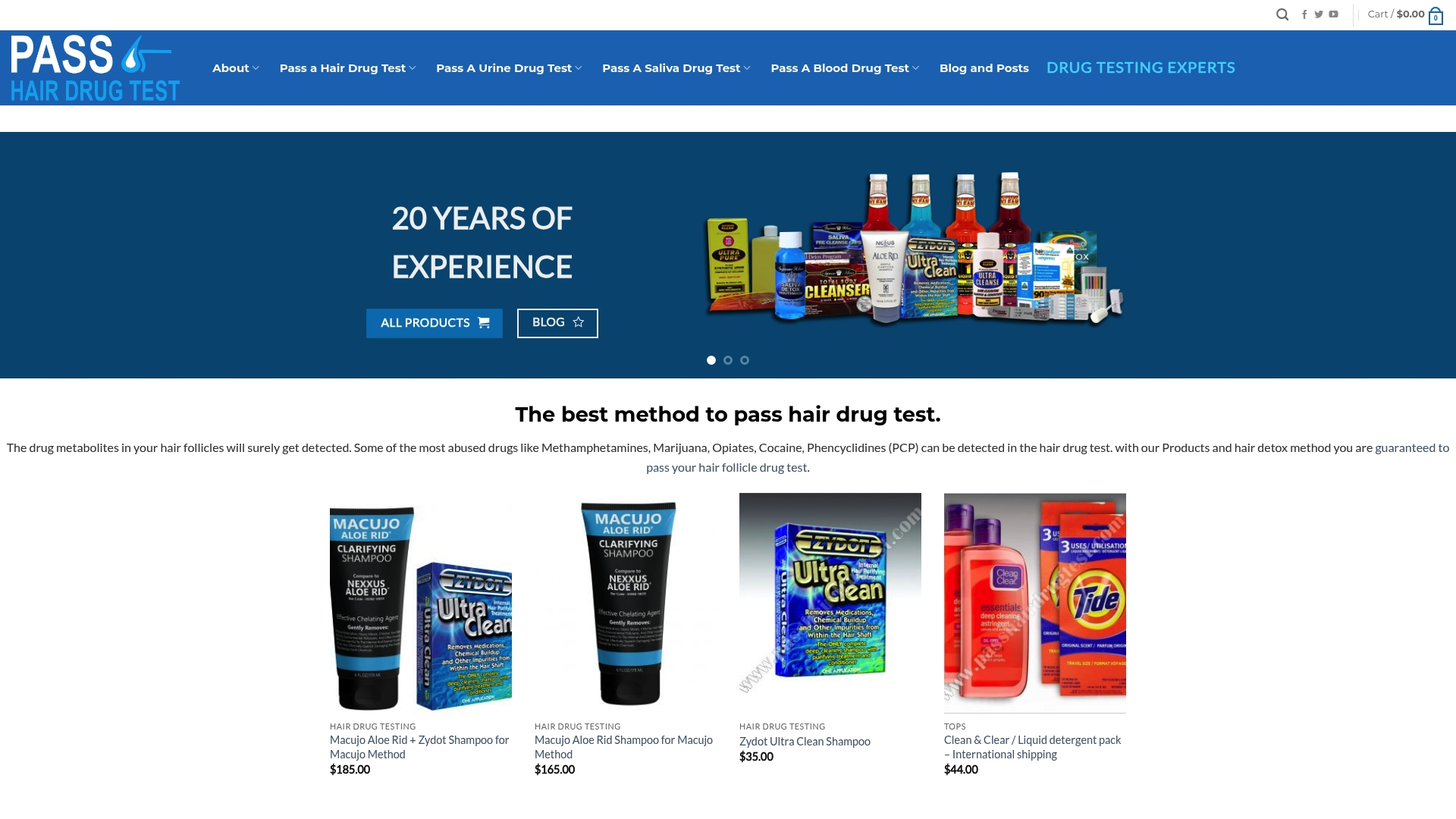
You can browse the full range on our products page, or go to the Macujo Aloe Rid Shampoo listing directly. If you want both shampoos in one order, the Macujo Aloe Rid and Zydot set is built for the Method.
Our perspective
The science on hair testing says something that rarely makes it into HR paperwork: the result is shaped by more than your behavior. Pigment, sweat, treatments and contamination all play a part, and labs themselves publish that caution.
We do not think that should leave you powerless. We think it should make you methodical. After more than 20 years in this industry, our view is that people do best when they follow a complete routine instead of a single quick fix. That is why we built the Macujo Method as a multi-step process and why we put detailed instructions and unlimited phone support behind it.
Our shampoos, Macujo Aloe Rid and Zydot Ultra Clean, are made for this exact purpose: preparing hair for a test that will look back about 90 days. If you are unsure how your hair type, treatments or schedule fit, call us before you start. Preparing with a plan beats hoping the lab is lenient.
MIchael
FAQ
Are hair drug tests biased against people with dark or Black hair?
For several drugs, yes, the research points that way. Federal and peer-reviewed sources report that dark hair can take up more cocaine and codeine than lighter hair after the same dose. For THC, HHS has said there are no controlled dosing studies on color, so the evidence is less clear. Either way, you should prepare as thoroughly as you can.
How far back does a hair follicle test look?
Usually about 90 days for the first 3 cm of hair, since hair grows around 1 cm a month, according to the AAP. Drugs take about 7 to 10 days to appear in the hair shaft, so very recent use usually is not captured.
Can bleaching or dyeing change a hair test?
Research reviewed in 2017 found that treated hair carried roughly 40 to 60 percent less drug than untreated hair on average, depending on the treatment and damage. Our pages on dye and bleach explain how labs and treatments interact.
Can a hair test show how much THC I used?
No. The Society of Hair Testing states that the concentration of a drug in hair cannot be used to determine how much was consumed. A result tells the lab whether the marker is above or below a cutoff, not your pattern of use.
Does a positive hair test always get confirmed?
In federal-style programs, yes. Presumptive positives must be confirmed by mass spectrometry, and an alternate specimen may be tested if a medical review officer directs it. Private employers vary, so ask your employer or the collection site about their procedure.
Sources
- Review on Toxicology Testing in Hair, Journal of Applied Laboratory Medicine (2025)
- Clinical Drug Testing in Primary Care, SAMHSA (2012)
- Testing for Drugs of Abuse in Children and Adolescents, American Academy of Pediatrics
- Mandatory Guidelines for Federal Workplace Drug Testing Programs, Federal Register (2020)
- Finding cannabinoids in hair does not prove cannabis consumption, Scientific Reports (2015)
- Hair analysis for the detection of drug use, Human Psychopharmacology (2017)
- Hair Testing in Forensic Toxicology, WIREs Forensic Science (2025)
- 2021 SoHT Consensus on Drugs of Abuse Testing in Hair
- HHS/SAMHSA Hair Testing Guidelines proposal, 2020
- TTD comment on the HHS hair testing proposal (2020)
Recommended
- How to Prepare for a Hair Test the Right Way
- Start Three Weeks Out: Evidence Backed Hair Sample Collection Protocol
- How to Pre-Test Your Hair at Home Before a Drug Test
- Hair Drug Test Accuracy: What the Science Actually Shows
