Uncategorized
Invalid Drug Test Result: What It Means for Hair Tests
Jul
Table of Contents
What an invalid drug test result actually means — and what happens next
An invalid drug test result is not a pass and not a fail. Under US DOT and SAMHSA guidelines, it means the laboratory could not obtain a scientifically supportable outcome because the specimen contained an unidentified adulterant, an interfering substance, an abnormal physical characteristic, or an endogenous substance at an abnormal concentration. The lab simply cannot complete valid analysis.
The governing federal regulation is 49 CFR § 40.159, which lays out exactly what the Medical Review Officer must do when this happens. The test gets cancelled, not reported as positive or negative, and a retest is typically ordered.
Federal protocol under 49 CFR § 40.159: When a specimen is reported invalid and the donor cannot provide a medical explanation, the MRO must cancel the test and direct an immediate recollection under direct observation, with minimum advance notice to the employee.
Key facts to know upfront:
- Invalid results cancel the test — they do not count as a failure on their own
- A directly observed retest is usually required when no medical explanation exists
- A specimen can be simultaneously positive and invalid; confirmation testing determines the final outcome
- Donors who admit to adulteration during the MRO call trigger a “refusal to test” finding, which carries the same consequences as a positive
Table of Contents
- Common causes of invalid results in hair follicle drug tests
- How invalid and inconclusive results differ from each other
- What the MRO does after an invalid result — and how to handle the call
- How to prepare for a hair follicle retest after an invalid result
- Workplace and legal implications of an invalid result
- Your rights when an invalid drug test result occurs
- Key Takeaways
Common causes of invalid results in hair follicle drug tests
Hair follicle testing has its own set of validity pitfalls, distinct from urine. The most frequent triggers include:
- Insufficient sample length or quantity — labs need roughly 1.5 inches of hair and at least 100 milligrams; falling short prevents complete analysis
- External chemical contamination — bleach, dyes, perms, or relaxers can degrade the hair shaft and interfere with immunoassay screening
- Adulteration attempts — adding substances to the sample or using products designed to strip metabolites can produce abnormal specimen characteristics the lab flags immediately
- Immunoassay interference — certain medications, including some antibiotics and proton-pump inhibitors, disrupt the initial screening chemistry
- Abnormal physical characteristics — severely damaged or chemically altered hair produces readings labs cannot categorize cleanly
Unlike urine, hair samples cannot be diluted by drinking water. But heavy chemical processing before collection can create the same outcome: a specimen the lab cannot read.
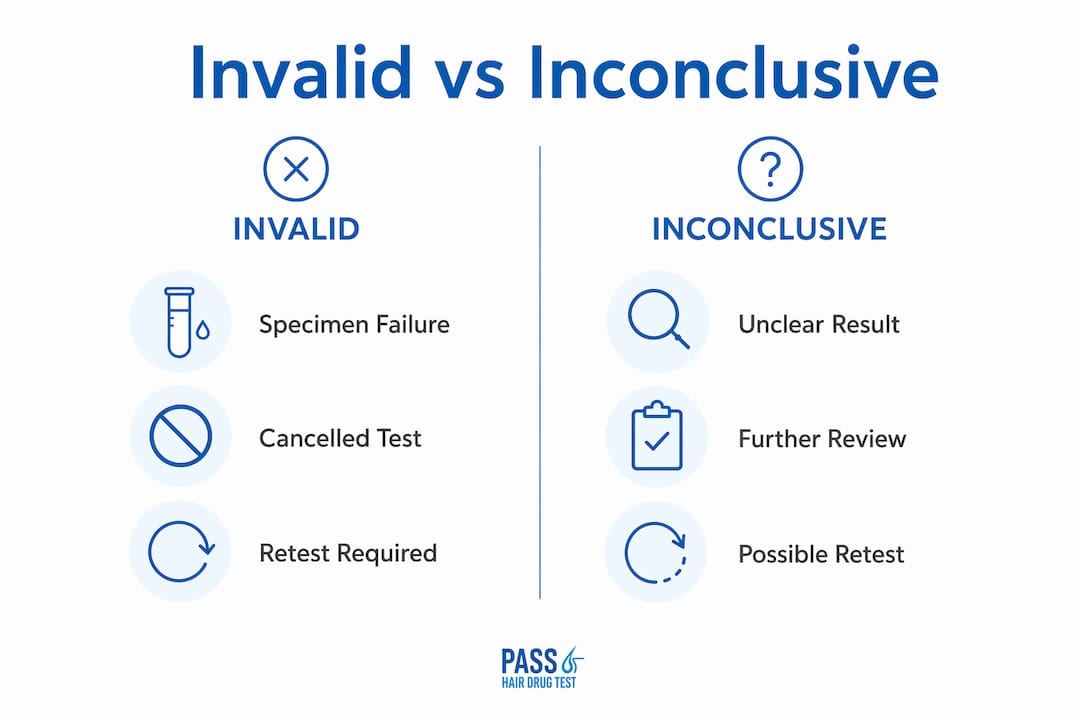
How invalid and inconclusive results differ from each other

People use these terms interchangeably, but they mean different things procedurally.
| Factor | Invalid result | Inconclusive result |
|---|---|---|
| Core cause | Specimen validity failure (adulterant, interference, abnormal characteristics) | Drug levels near the cutoff threshold; ambiguous detection |
| Lab action | Cannot complete testing | Testing completed but result is borderline |
| MRO involvement | Required; donor interview mandatory | Usually required; context-dependent |
| Next step | Retest, often under direct observation | Confirmatory testing or retest |
| Pass/fail status | Neither; test cancelled | Neither; further review needed |
The practical difference: an invalid result stems from something wrong with the specimen itself, while an inconclusive result means the drug reading was too close to call. Both require follow-up, but the MRO process for invalid results is more structured and federally prescribed.
What the MRO does after an invalid result — and how to handle the call
The Medical Review Officer is a licensed physician, not just an administrator. When the lab reports an invalid result, the MRO contacts the donor directly. That conversation follows a specific sequence:
- The MRO explains that the specimen was invalid and asks for a medical explanation
- The donor should disclose all prescription medications, supplements, and relevant medical conditions
- If the explanation is acceptable, the MRO cancels the test with no further action required
- If no valid explanation exists, the MRO orders an immediate retest under direct observation
- If the donor admits to adulteration, the MRO documents it and reports a refusal to test
Pro Tip: Have your prescription documentation ready before the MRO calls. A documented valid prescription that explains immunoassay interference can cancel the retest entirely.
DOT regulations prohibit employers from penalizing donors solely for an invalid result. The protection is real, but it applies specifically to regulated industries. Private employers have more discretion, though treating an unexplained invalid result as grounds for termination without offering a retest is legally difficult to defend.
How to prepare for a hair follicle retest after an invalid result
The retest is your real opportunity. If the original invalid result came from a contaminated or chemically compromised sample, cleaning up your preparation process matters as much as the detox itself.
The Mike’s Macujo Method is a multi-step hair cleansing protocol designed to reduce drug metabolites embedded in the hair cortex. Passhairdrugtest has supported this method for over 20 years, pairing it with Macujo Aloe Rid Shampoo and Zydot Ultra Clean Shampoo for a layered approach.
Preparation steps before your retest:
- Start the cleansing protocol as early as possible; more sessions mean deeper penetration into the hair shaft
- Use the hair follicle shampoo kit as directed, following each step without skipping
- Avoid re-exposure to any substances during the preparation window
- Do not use harsh chemical treatments (bleach, perms) close to the test date — they can cause another invalid result
- Arrive at the collection site with clean, unaltered hair
Because retests after invalid results are often directly observed, substitution is not an option. The only path forward is a genuinely clean sample.
Workplace and legal implications of an invalid result
In DOT-regulated workplaces, an invalid result triggers a mandatory process with defined protections. Employers cannot remove a safety-sensitive employee from duty based on an invalid result alone. The cancelled test must be followed by a proper retest before any employment action.
In legal or probation contexts, the stakes are higher. Courts and supervision programs often treat an unexplained invalid result with the same suspicion as a diluted sample. Some probation agreements explicitly classify tampered or invalid specimens as violations. If you are in a legal testing program, contact your attorney before the MRO call.
Private employers outside DOT jurisdiction follow their own written policies. Whatever that policy says, it must be applied consistently across employees in the same role.
Your rights when an invalid drug test result occurs
Federal regulations give donors specific protections:
- You have the right to an MRO interview before any adverse action
- You cannot be penalized for an invalid result if a valid medical explanation exists
- You are entitled to request a split specimen test in certain circumstances
- Refusing a retest carries the same consequences as a positive result, so cooperation is critical
If you believe your employer violated these procedures, an employment attorney familiar with DOT drug testing regulations is the right resource. Document every step of the process from the moment you receive the invalid notification.
Key Takeaways
An invalid drug test result cancels the test but does not end the process — a directly observed retest is typically required when no medical explanation exists.
| Point | Details |
|---|---|
| Invalid means cancelled, not failed | The test is cancelled pending retest; it is neither a pass nor a failure on its own. |
| MRO interview is mandatory | Disclose medications and medical conditions; a valid explanation can eliminate the retest requirement. |
| Hair-specific causes matter | Insufficient sample, chemical damage, and adulteration attempts are the main hair follicle triggers. |
| Retest is usually observed | Direct observation eliminates substitution; only a genuinely clean sample passes. |
| Preparation is your best move | Starting a structured hair cleansing protocol immediately gives you the best chance at the retest. |
This article is general information, not legal or medical advice. Confirm current regulations and your specific situation with a qualified professional or the relevant federal agency.
Recommended
- Hair Drug Test Information – Pass Hair Drug Test
- Hair Follicle Drug Test Information – Pass Hair Drug Test
- Hair Follicle Drug Test – Best guaide for hair drug test – Pass Hair Drug Test
- Pass hair Drug Test
