
Uncategorized
Poppy Seeds Drug Test: What You Need to Know
Jul
Eating a poppy seed bagel before a urine drug test can get you flagged for opiates. That’s not a myth. Poppy seeds carry trace amounts of morphine and codeine on their surface, absorbed from the poppy plant during harvesting, and those compounds are real enough to trigger a positive result on standard opiate screening. The so-called “poppy seed defense” exists precisely because this happens, and it creates genuine complications for anyone facing workplace, clinical, or military drug screening.
Key facts at a glance:
- Morphine and codeine are the primary opiates detected after poppy seed consumption
- Urine immunoassay tests are the most vulnerable to dietary opiate interference
- Detection depends on how much you ate, the seed’s opiate content, and the test’s cutoff threshold
- Eating poppy seeds does not cause intoxication, but drug tests detect trace amounts
- The “poppy seed defense” is legally recognized but difficult to prove from lab results alone
Table of Contents
How drug tests detect opiates, and why poppy seeds cause problems
Standard opiate drug screening uses two main methods: immunoassay and gas chromatography-mass spectrometry (GC-MS). Immunoassay is the initial screen, fast and inexpensive, but it cannot distinguish between morphine from a pain pill and morphine from a bagel. GC-MS is the confirmatory method, far more specific, but it still detects the same metabolites regardless of their dietary or pharmaceutical origin.
The cutoff threshold is where things get complicated. Federal workplace drug testing programs raised the urine opiate cutoff from 300 ng/mL to 2,000 ng/mL specifically to reduce false positives from poppy seed consumption. Clinical settings, however, often use cutoffs as low as 50 ng/mL or 300 ng/mL, which dramatically increases the chance that a poppy seed muffin shows up as a positive result.
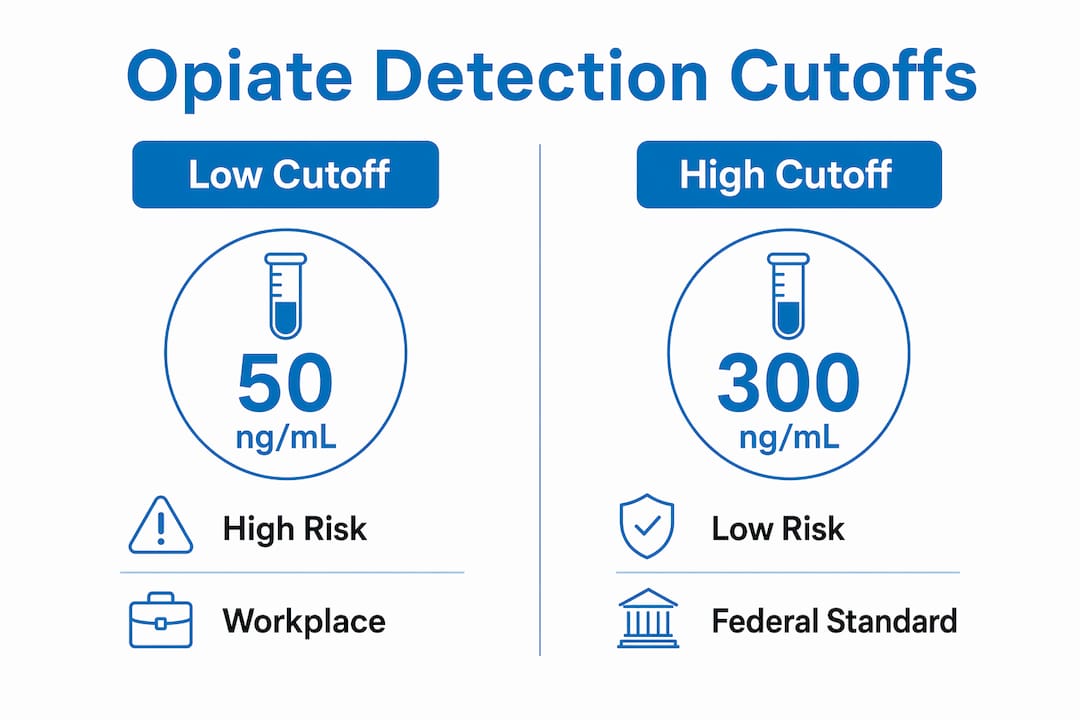
| Cutoff Level | Detection Risk from Poppy Seeds | Typical Setting |
|---|---|---|
| 50 ng/mL | Very high | Some clinical labs |
| 300 ng/mL | High | Clinical pain management |
| 2,000 ng/mL | Moderate | Federal workplace (SAMHSA) |
| 4,000 ng/mL | Low | Some forensic programs |
Morphine-to-codeine ratios have been proposed as a way to tell dietary exposure from drug use, but research shows this approach has real limits. Studies confirm that poppy seed foods can produce codeine-positive, morphine-negative results, which breaks the ratio-based logic entirely. Processing methods like washing and baking reduce opiate residues but do not eliminate them, so no food label can reliably warn you about the risk.
How long opiates from poppy seeds stay detectable
The detection window depends heavily on which cutoff the lab applies. A single serving of poppy seed pastry can produce detectable urinary opiates for up to 108 hours post-ingestion at very low cutoffs. At the federal 2,000 ng/mL threshold, most people clear within 24–48 hours.
Here is how detection duration breaks down by cutoff level, based on controlled research:
- 4,000 ng/mL: Most participants clear within 24 hours; a small number remain positive through 24 hours for codeine only.
- 2,000 ng/mL: Codeine detectable in isolated cases up to 48 hours post-ingestion.
- 300 ng/mL: Opiates detectable in most participants at 48 hours; some remain positive at 72 hours.
- 50 ng/mL: Opiates detectable up to 96–108 hours in a subset of participants.
Oral fluid tests tell a different story. Morphine and codeine appear in saliva within 30 minutes of consuming raw seeds but clear from oral fluid within 1–2 hours. That narrow window makes oral fluid testing considerably less susceptible to the poppy seed defense than urine testing, which is one reason some forensic programs favor it.
Factors that stretch or compress the window include the amount consumed, the seed’s country of origin (opiate content varies widely by source), individual metabolism, and the specific test cutoff. One poppy seed roll produced urinary morphine concentrations of 155–1,408 ng/mL in a controlled study, a range wide enough to fall below or above the federal threshold depending on the individual.
Pro Tip: If you know a urine test is coming, treat the 108-hour window as your minimum clearance buffer for the lowest cutoff (50 ng/mL). Lower-cutoff clinical tests require even more lead time; at the federal cutoff (2,000 ng/mL), 24 hours is typically sufficient for most individuals.
Which foods contain poppy seeds and what that means for screening
Poppy seeds show up in more everyday foods than most people realize. Common sources include:
- Bagels (one of the highest-concentration sources by serving size)
- Muffins and quick breads
- Pastries such as kolachi, strudel, and Danish rolls
- Hamburger and dinner rolls with seed toppings
- Salad dressings and seasoning blends
- Granola and muesli mixes
The problem is that no food labeling standard discloses opiate content. Two bagels from different bakeries can carry wildly different morphine loads depending on where the seeds were sourced and how they were processed. Washing reduces surface residues; baking reduces them further. But neither step eliminates the risk, and you have no way to know from the packaging how much opiate residue a product contains.
This unpredictability is the core issue. Someone who eats a single poppy seed bagel at breakfast and tests that afternoon at a clinical lab using a 300 ng/mL cutoff could easily produce a positive result, with no drug use involved whatsoever.

Are poppy seeds legal in the United States?
Poppy seeds are entirely legal in the United States. They are a common culinary ingredient, sold in every grocery store, and regulated as a food product by the FDA. The seeds are separated from narcotic components during commercial processing, but trace morphine and codeine remain on the seed surface as a natural byproduct of the plant.
There is no restriction on buying, selling, or consuming culinary poppy seeds. A positive drug test from eating them carries no legal implication about the seeds themselves. The legal complexity arises only when a positive test result is misinterpreted as evidence of illicit opiate use, which is a testing and interpretation problem, not a legal status problem. Controlled opiates derived from the poppy plant, such as heroin or pharmaceutical morphine without a prescription, are an entirely separate matter governed by federal drug law.
How to interpret a positive opiate test that may stem from poppy seeds
A positive urine opiate result does not automatically mean someone used illicit drugs. Medical Review Officers (MROs) are trained to evaluate positive results in context, considering patient history, clinical signs of intoxication, and the plausibility of dietary exposure. The challenge is that opiate concentrations alone cannot confirm the source of the positive result.
Misinterpreting these results carries real consequences. In workplace settings, a positive test can trigger termination or suspension. In military contexts, the US Department of Defense advises personnel to avoid all poppy seed products entirely because the risk of a career-damaging false positive is too high. In clinical pain management, a misread result can damage the patient-provider relationship and lead to unwarranted accusations, which undermines therapeutic trust and may push patients away from needed care.
Medical experts are clear that without corroborating signs of intoxication or other clinical evidence, a positive test alone should not be used to conclude illicit opiate use when poppy seed ingestion is a plausible explanation. MROs look for additional evidence beyond the lab number, and that standard exists for good reason.
How to reduce your risk of a false positive before testing
The most reliable strategy is straightforward: stop eating poppy seed foods well before any scheduled drug test. Since controlled studies have shown detection can persist up to 108 hours at the lowest cutoff (50 ng/mL), a 108-hour abstinence window is recommended for clinical tests using low thresholds, while a 24-hour window is generally reasonable for federal tests using the 2,000 ng/mL cutoff.
Practical steps to lower your risk:
- Avoid bagels, muffins, pastries, rolls, and seasoning blends containing poppy seeds for at least 72 hours before testing, and longer if the test uses a clinical cutoff below 300 ng/mL
- Ask the testing administrator or your employer which cutoff threshold applies to your test
- If you are subject to a clinical or pain management program, disclose any recent poppy seed consumption to your provider before the test
- Consider whether an oral fluid test is an option, since its detection window for dietary opiates closes within 1–2 hours
- Check ingredient labels on packaged foods, granola bars, and salad dressings, where poppy seeds appear without obvious visual cues
Pro Tip: Contact US Drug Test Centers or your testing provider directly to confirm the cutoff level used. Knowing whether your test uses 300 ng/mL or 2,000 ng/mL changes your required abstinence window significantly.
Variability in seed opiate content means you cannot gauge risk from the food itself. Two servings that look identical can carry very different morphine loads depending on seed origin. The only reliable protection is time and abstinence.
Key Takeaways
Poppy seed consumption can produce genuine positive opiate results in urine for several days, and the risk is highest when clinical labs use low cutoff levels below 300 ng/mL.
| Point | Details |
|---|---|
| Detection window varies by cutoff | At the lowest cutoff level (50 ng/mL), opiates can be detected for up to 108 hours after poppy seed ingestion; at the federal cutoff (2,000 ng/mL), most people clear within 24 hours, with rare cases detected up to 48 hours. |
| Oral fluid clears faster | Morphine and codeine from poppy seeds clear oral fluid within 1–2 hours, making it less prone to false positives. |
| One roll can exceed federal thresholds | A single poppy seed roll produced urinary morphine of 155–1,408 ng/mL in controlled research. |
| MROs evaluate context, not numbers alone | Medical Review Officers require clinical signs and history before concluding illicit use from a positive result. |
| Abstain several days before testing | No food label discloses opiate content, so time-based abstinence is the only reliable risk reduction strategy. |
Facing a drug test and want to understand all your options? Passhairdrugtest has spent more than 20 years helping people navigate drug testing with real products and clear information. Whether you are preparing for a hair follicle test or need guidance on urine screening, the resources at Passhairdrugtest cover the full picture.
Recommended
- Passing A Drug Mouth Swab Test – Pass Hair Drug Test
- Hair Drug Test Information – Pass Hair Drug Test
- The Science Behind the Hair Drug Test – Pass Hair Drug Test
- Pass A Oral Drug Test – Pass Hair Drug Test
Article generated by BabyLoveGrowth
