Uncategorized
Jerry G Method for THC Hair Tests: Step-by-Step Guide
Jul
The Jerry G Method can reduce THC metabolite concentrations in hair, but it does not guarantee a negative result. It combines bleaching, ammonia-based permanent dye, and detox shampoos to chemically open the hair cuticle and flush trapped metabolites from the cortex. Whether it works for you depends heavily on three factors: how frequently you used THC, your hair’s natural porosity and color, and how much time you have before the test.
- Usage history is the biggest variable. Daily or near-daily users carry far higher metabolite loads than occasional users, and a single treatment cycle rarely brings concentrations below lab detection thresholds.
- Hair type and color matter because darker, coarser hair tends to bind metabolites more tightly, while bleached or chemically processed hair is already more porous.
- Timing is critical. Starting at least 10 days before the test gives you room for two full treatment cycles. Attempting this the day before is unlikely to produce meaningful results.
Safety callout: Bleach and ammonia dye used together cause real chemical damage. Scalp burns, severe breakage, and allergic reactions are documented risks. If you have never bleached your hair before, consult a professional stylist before attempting this at home.
This article is general information, not medical or legal advice. Confirm current testing policies and any health concerns with a qualified professional before proceeding.
Table of Contents
Table of Contents
- What is the Jerry G Method and how does it work?
- How hair follicle drug tests detect THC
- Step-by-step Jerry G Method instructions
- Jerry G Method vs. Macujo Method: which one is right for you?
- What the evidence actually says about effectiveness
- Risks, safety cautions, and when to get professional help
- Day-of-test checklist and safer alternatives
- Who should actually try the Jerry G Method?
- Key Takeaways
- A realistic perspective on what this method can and cannot do
- Passhairdrugtest has the products you need for any hair detox protocol
- Useful sources and further reading
What is the Jerry G Method and how does it work?
The Jerry G Method originated on online drug-testing forums, where a user going by “Jerry G” shared the protocol as a DIY alternative to salon-based hair detox. It spread through community boards and eventually became one of the two most-discussed DIY approaches alongside the Macujo Method.
The core mechanism works in three stages. First, a strong bleach (typically 30–40 volume developer) oxidizes the hair’s proteins and breaks down melanin. This process forces open the cuticle, the overlapping scale-like outer layer of each hair strand. Second, an ammonia-based permanent dye is applied. The ammonia continues the cuticle-opening process and helps displace metabolites that have been loosened by the bleach. Third, detox shampoos like Aloe Toxin Rid and Zydot Ultra Clean are used to flush out what the chemical steps have loosened.
“Detox shampoos work primarily as surfactants on the outer hair shaft. Without the cuticle-opening action of bleach and dye, shampoos alone cannot reach the cortex-bound metabolites that drug tests are designed to detect.” — Council for the Advancement of Nursing Science
That distinction matters practically. Many people assume the shampoo is doing the heavy lifting. It is not. The bleach and dye are the active steps; the shampoo is the cleanup. Baking soda paste is added on test day as a final alkaline treatment to further disrupt any remaining residue on the hair shaft. The method requires all four components working together, not any single one in isolation.
How hair follicle drug tests detect THC
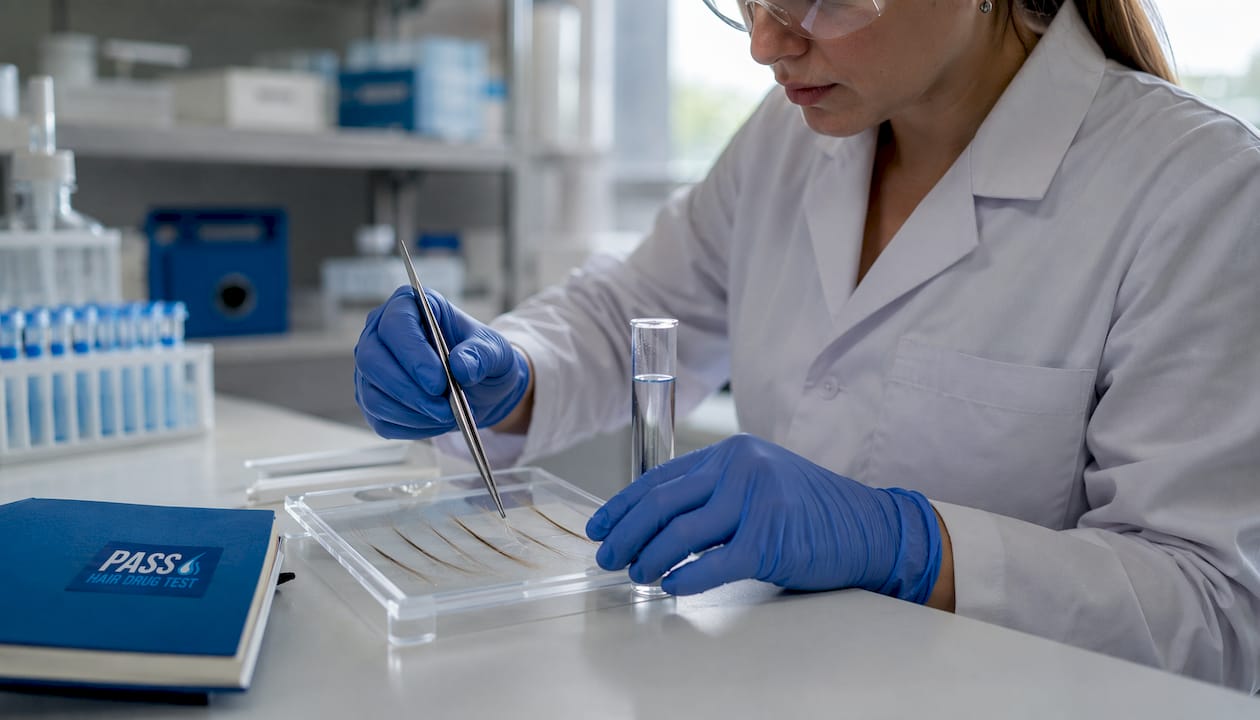
Hair follicle tests do not look for THC itself. They measure drug metabolites that the body produces after processing THC, primarily THC-COOH, which enters the hair shaft through the bloodstream during the growth phase and becomes embedded in the cortex.
Hair grows roughly half an inch per month. Standard collection protocols take a 1.5-inch segment cut close to the scalp, which covers approximately 90 days of growth. Some labs extend sampling to 120 days when longer hair is available. The key point is that metabolites are locked inside the cortex, not sitting on the surface. Surface contamination from smoke or handling can also deposit trace amounts on the outer cuticle, but labs use washing procedures to distinguish between external contamination and internal metabolite presence.
Hair structure has three layers: the cuticle (outer scales), the cortex (the bulk of the strand, where metabolites are stored), and the medulla (the inner core). Standard detox shampoos act on the cuticle and the immediate surface of the cortex. They cannot penetrate deeply enough to remove metabolites that have been incorporated during hair growth. That is precisely why the Jerry G Method uses chemical disruption rather than just washing.
Step-by-step Jerry G Method instructions
Materials checklist
Before you start, gather everything. Running out mid-process and substituting products is one of the most common failure points.
- 30–40 volume hair bleach (powder bleach + developer)
- Ammonia-based permanent hair dye matched as closely as possible to your natural color
- Old Style Aloe Toxin Rid shampoo (also called Aloe Rid or Macujo Aloe Rid Shampoo)
- Zydot Ultra Clean shampoo
- Baking soda
- Disposable gloves (two pairs per session)
- Safety goggles
- New, clean combs and towels (do not reuse old ones)
- Timer
Numbered procedure
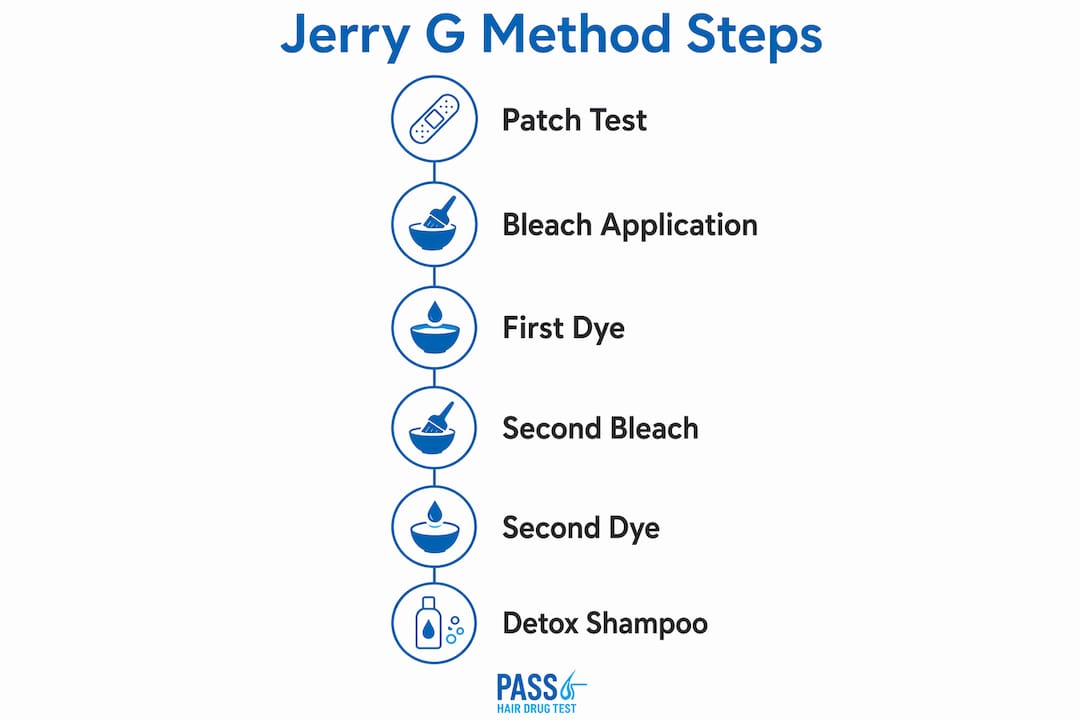
- Stop all THC use immediately. New metabolites entering the bloodstream will continue depositing in growing hair. Every day of abstinence reduces the load you are trying to remove.
- Day 1, bleach application. Put on gloves and goggles. Mix bleach according to package directions and apply evenly from roots to ends. Leave on for the time specified on the product (typically 30–45 minutes). Rinse thoroughly with warm water.
- Day 1, dye application. Without waiting more than a few hours, apply the ammonia-based permanent dye. Follow the dye’s instructions for timing. Rinse completely.
- Day 1, detox shampoo wash. Apply Aloe Toxin Rid shampoo, massage into the scalp and hair for at least 3–5 minutes, and rinse. Repeat this wash 2–3 times. Follow with Zydot Ultra Clean as a final rinse.
- Days 2–9, daily detox washes. Use Aloe Toxin Rid daily during this window. Avoid heat styling entirely. Use only your new clean comb and fresh towels.
- Day 10, repeat bleach and dye. Repeat steps 2–4 in full. This second chemical cycle is where the method gets most of its additional metabolite reduction. Heavy users may be advised to repeat the shampoo washes several more times across this window.
- Test day, baking soda paste. Mix baking soda with a small amount of water to form a thick paste. Apply to damp hair, work through from roots to ends, and leave on for 15 minutes. Rinse thoroughly.
- Test day, final detox sequence. Wash with Aloe Toxin Rid (2–3 times), then finish with Zydot Ultra Clean. Use a clean towel to dry. Do not touch your hair with unwashed hands before the collection.
Pro Tip: Do a patch test on a small section of skin 24–48 hours before your first bleach application. Ammonia and bleach can cause allergic contact dermatitis, and discovering that on the day of treatment is far worse than discovering it a day earlier.
The full process takes roughly 10 days and costs between $100–$200 depending on the brands you choose for bleach, dye, and shampoos. Starting at least 7–10 days before the test is the minimum; 10+ days with two full chemical cycles is the standard recommendation.
Jerry G Method vs. Macujo Method: which one is right for you?
The two methods share the same goal but take meaningfully different routes. Here is how they compare across the dimensions that matter most:
| Dimension | Jerry G Method | Macujo Method |
|---|---|---|
| Step complexity | Moderate (bleach + dye + shampoos) | Higher (multi-product acid/soap/shampoo cycles) |
| Core products | Bleach, ammonia dye, Aloe Toxin Rid, Zydot Ultra Clean, baking soda | Aloe Toxin Rid, Zydot Ultra Clean, vinegar, Clean & Clear, Tide detergent |
| Time required | 10+ days, two chemical cycles | 7–10+ days, multiple wash cycles |
| Hair damage risk | High (bleach + ammonia = structural weakening) | Moderate to high (acid + detergent cycles are harsh but avoid bleach) |
| Anecdotal success factors | Depends heavily on bleach penetration and correct timing | Reported more consistently effective in community write-ups |
| Scalp risk | High (chemical burns possible) | Moderate (irritation common, burns less frequent) |
Jerry G pros:
- Cheaper overall (bleach and dye cost less than some Macujo-specific products)
- Faster to execute per session
- Works for people who are already bleaching their hair regularly (less incremental damage)
Jerry G cons:
- Bleach causes the most structural damage to any step in either method
- Results are highly variable, especially for dark or coarse hair
- Two full bleach sessions in 10 days can leave hair too brittle or short for lab collection
Macujo pros:
- Avoids bleach, so hair integrity is better preserved
- Community write-ups position it as more consistently effective for heavy users
- Better suited for people with sensitive scalps
Macujo cons:
- More steps per session, more products to source
- Vinegar and detergent cycles are still harsh on the scalp
If your hair is already chemically treated or you have a sensitive scalp, the Macujo approach is generally the safer starting point. You can read Passhairdrugtest’s full breakdown in their Macujo Method guide to compare protocols side by side.
What the evidence actually says about effectiveness
The honest answer is that the evidence is partial and the results are variable. A study cited in professional forensic summaries found that a single bleaching can reduce metabolite concentrations in hair by roughly 40–80%. That sounds promising until you consider what it means in practice.
Key figure: A 40–80% reduction in metabolite concentration after one bleaching does not guarantee a negative result. Lab detection thresholds for THC metabolites in hair are typically set at 1 picogram per milligram (pg/mg). A heavy daily user may start with concentrations many times above that threshold. Even an 80% reduction may leave enough metabolites to trigger a positive.
| Factor | Effect on outcome |
|---|---|
| Usage frequency | Daily users carry higher baseline loads; harder to reduce below threshold |
| Hair color/porosity | Lighter, more porous hair releases metabolites more readily |
| Number of chemical cycles | Two cycles reduce concentration more than one |
| Lab detection threshold | Lower thresholds (1 pg/mg) leave less margin for partial reduction |
| Timing before test | More days = more wash cycles = better odds |
The anecdotal record is large but unreliable. Hundreds of forum threads describe both passes and failures using the same protocol. Community guides consistently note that combining chemical steps with strict abstinence and multiple detox shampoo washes produces the best reported outcomes. But “best reported” in an anecdotal pool is not the same as a controlled success rate.
The practical interpretation: the Jerry G Method may meaningfully reduce metabolite concentrations, particularly for light-to-moderate users with lighter hair who start the process 10+ days out. For heavy daily users with dark, coarse hair starting close to test day, the odds of getting below the detection threshold are considerably lower.
Risks, safety cautions, and when to get professional help
Chemical damage is not a side effect of the Jerry G Method. It is the mechanism. You are intentionally weakening the hair structure to release metabolites. That creates real risks you need to weigh before starting.
Hair and scalp risks:
- Chemical burns: Bleach left on too long, or applied to a sensitive scalp, can cause first-degree chemical burns. Symptoms include intense burning, redness, and blistering.
- Severe breakage: Two bleach sessions in 10 days can leave hair so structurally compromised that it snaps at the root. This is not just a cosmetic problem; if your hair breaks off and becomes too short, the lab may not be able to collect a sufficient sample.
- Allergic reactions: Ammonia-based dyes are a known allergen. Reactions range from contact dermatitis to, in rare cases, anaphylaxis.
- Scalp irritation: Even without a full burn, the combination of bleach, ammonia, and acidic shampoos causes significant irritation for people with sensitive scalps. People with sensitive scalps sometimes need to trim damaged sections, which creates both a safety concern and a sample-length problem.
Testing consequences of hair damage:
If your hair breaks or you trim it and the remaining length falls below 1.5 inches, the collector may be unable to complete a standard head-hair collection. Labs and collection sites have protocols for this situation, which may include body hair collection (which has a longer detection window) or flagging the sample as insufficient. Neither outcome is favorable.
When to get professional help:
- If you have never bleached your hair before, have a salon stylist perform the first bleach application.
- If you experience burning that does not subside within a few minutes of rinsing, seek medical attention.
- If you have a known allergy to hair dye or ammonia, do not attempt this method.
Practical mitigations:
- Always do a patch test 24–48 hours before the first session.
- Work in a well-ventilated space; bleach fumes are irritating to airways.
- Avoid all heat styling (blow dryers, flat irons, curling irons) for the entire 10-day window. Chemically weakened hair breaks under heat stress. Avoiding heat tools also reduces the risk of hair becoming too short for lab collection.
- Use new combs and towels every session. Reusing contaminated implements can redeposit metabolites onto treated hair.
Day-of-test checklist and safer alternatives
What to do on test day
- Apply baking soda paste to damp hair, work through thoroughly, leave for 15 minutes, rinse.
- Wash with Aloe Toxin Rid shampoo 2–3 times, massaging the scalp each time.
- Finish with Zydot Ultra Clean as the final wash.
- Dry with a clean, unused towel.
- Do not touch your hair with unwashed hands between washing and collection.
- Avoid external contamination: no smoke exposure, no contact with surfaces that may carry residue.
- Use only clean combs or brushes you have not used during the treatment period.
- If the collector asks about recent chemical treatments, answer honestly about cosmetic procedures. You are not required to disclose the purpose.
What not to do:
- Do not apply any new chemical treatments on test day beyond the baking soda and detox shampoo sequence.
- Do not trim your hair the morning of the test. Any length reduction that brings you below the 1.5-inch threshold will complicate collection.
- Do not use dry shampoo, hairspray, or styling products before collection. These can interfere with the sample.
Safer alternatives if you decide not to use Jerry G
Abstinence is the only approach with a clear, evidence-based outcome. THC metabolites in hair cannot be added retroactively. Stopping use and waiting for new, clean hair to grow out is the most reliable strategy, though it requires time most people facing an imminent test do not have.
Pre-test home screening lets you check your own hair before the lab does. At-home hair drug test kits are available and give you a rough read on whether your current hair is likely to trigger a positive. They are not as sensitive as lab tests, but a negative on a home screen is a useful data point.
Professional salon consultation is worth considering if you are committed to a chemical approach. A stylist can assess your hair’s current condition, advise on whether it can tolerate two bleach sessions, and perform the bleach application more safely than most people can at home.
Detox shampoo-focused approaches without the bleach and dye steps are less aggressive and carry lower damage risk. They are more appropriate for light or infrequent users who may have lower baseline metabolite concentrations. Passhairdrugtest carries hair follicle shampoo kits that combine Aloe Toxin Rid and Zydot Ultra Clean in a single order, which simplifies sourcing the shampoo components of any detox protocol.
Shaving your head is not a practical workaround. Collection sites that cannot obtain a sufficient head-hair sample will typically collect body hair instead, and body hair has a longer detection window than head hair. Shaving can also raise flags with the collection site.
Who should actually try the Jerry G Method?
The honest decision framework comes down to four variables: how much you used, how long you have, what condition your hair is in, and how much risk you can tolerate.
Light or occasional users with 10+ days: The method is most likely to produce meaningful results here. Two chemical cycles combined with daily Aloe Toxin Rid washes and strict abstinence give you the best realistic shot at getting below the detection threshold.
Heavy daily users with 10+ days: The odds are lower but not zero. Two full cycles may reduce concentrations enough if your baseline is not extremely high. Combining the Jerry G approach with the Macujo Method’s additional wash cycles is something some community guides suggest, though the cumulative damage risk increases.
Anyone with fewer than 7 days: The method is unlikely to produce sufficient reduction in this window. A pre-test home screen and a detox shampoo regimen are more realistic options.
Anyone with damaged, brittle, or very short hair: Skip the bleach steps. The risk of breakage leaving you with insufficient sample length is too high. A shampoo-only approach or professional consultation is the better path.
The legal and ethical note is straightforward: misrepresenting a drug test result to an employer carries real consequences depending on your industry, contract, and jurisdiction. Understand what you are risking before you start.
Key Takeaways
The Jerry G Method can reduce THC metabolite concentrations by 40–80% after bleaching, but whether that reduction gets you below the lab detection threshold depends on your usage history, hair type, and timing.
| Point | Details |
|---|---|
| Start early | Begin at least 10 days before the test to complete two full bleach and dye cycles. |
| Bleaching reduces, not eliminates | A single bleaching reduces metabolite concentration by 40–80%; heavy users may still test positive. |
| Damage is the mechanism | Chemical weakening is intentional; patch test first and avoid heat styling throughout. |
| Shampoos are adjuncts | Aloe Toxin Rid and Zydot Ultra Clean work only after bleach opens the cuticle; neither works alone. |
| Passhairdrugtest kits simplify sourcing | The hair follicle shampoo kit combines the detox shampoo components in one order for readers using any chemical protocol. |
A realistic perspective on what this method can and cannot do
The Jerry G Method gets discussed as if it is either a guaranteed pass or a complete myth. Neither framing is accurate, and both lead people to make bad decisions.
The chemistry is real. Bleaching does open the cuticle. Ammonia dye does continue that disruption. Detox shampoos do remove loosened surface material. The 40–80% metabolite reduction figure from bleaching studies is a real finding, not marketing copy. The problem is that “real chemistry” and “reliable outcome” are not the same thing. A 40% reduction for someone who smokes daily and starts three days before a test is almost certainly not enough. An 80% reduction for someone who used twice in the past month and starts 12 days out might be.
What most guides understate is the recontamination risk. Using the same comb you used before treatment, drying your hair with an old towel, or touching your hair with unwashed hands between the final wash and collection can deposit metabolites back onto treated hair. These are fixable problems, but they are also the kind of detail that gets skipped when people are anxious and rushing.
The other thing worth saying plainly: the method causes real damage. Not “your hair might feel a bit dry” damage. Structural weakening that can leave hair brittle, prone to breakage, and potentially too short for standard collection. Anyone going into this without understanding that is not making an informed choice.
For readers who want a less aggressive starting point, the Macujo Method’s shampoo-focused protocol is worth reading through before committing to bleach. Passhairdrugtest has covered both approaches in detail, and the how to pass a hair drug test guide walks through the product options without requiring you to commit to the most chemically intensive route first.
Passhairdrugtest has the products you need for any hair detox protocol
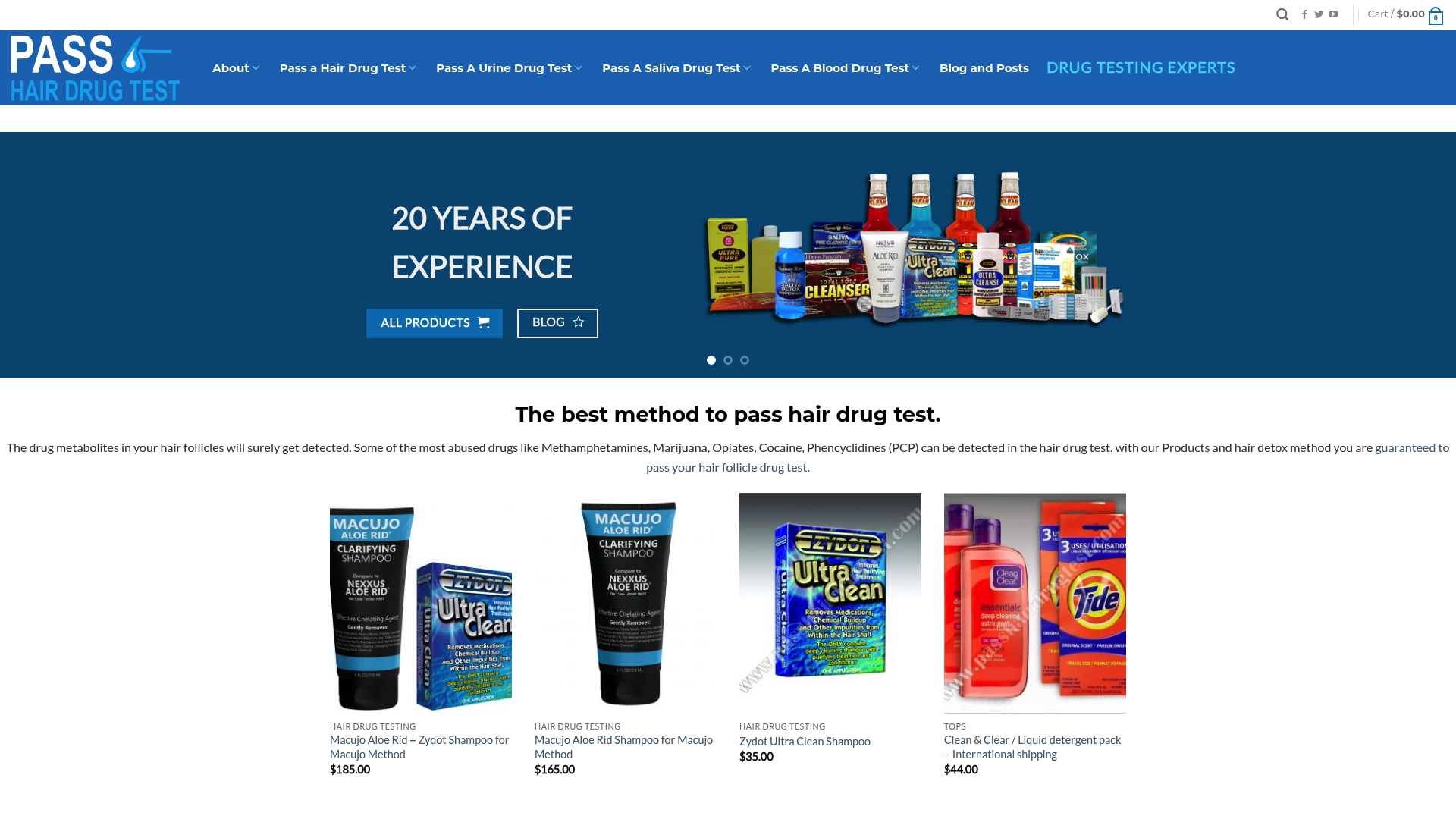
Whether you follow the Jerry G Method’s full chemical protocol or prefer a shampoo-focused approach, the detox shampoo steps are non-negotiable in either case. Passhairdrugtest has supplied Aloe Toxin Rid and Zydot Ultra Clean to customers preparing for hair follicle tests for more than 20 years. The Hair Follicle Shampoo Kit bundles both shampoos in a single order, so you are not sourcing them separately or risking a substitution that changes the protocol. For readers who want to review the full product range and decide which kit fits their situation, the hair testing shampoo kits page lists every available option with clear descriptions. Orders ship directly to your door, and the site’s support resources walk you through the correct usage sequence for whichever method you choose.
Useful sources and further reading
| Source | Type | What you will find there |
|---|---|---|
| NCBI: Drug Testing in Hair | Primary/lab | Overview of hair drug testing methodology, detection windows, and metabolite incorporation |
| SAMHSA Hair Testing Guidelines | Regulatory | Federal guidelines on hair specimen collection, thresholds, and laboratory standards |
| PubMed: Hair Drug Testing Study | Peer-reviewed | Published research on metabolite concentrations and the effects of chemical treatments on hair samples |
| NCBI PMC: Hair Analysis Review | Peer-reviewed | Review of hair analysis techniques, limitations, and factors affecting metabolite detection |
| DNA Legal: Bleached Hair and Drug Testing | Forensic/professional | Explains how bleaching affects metabolite concentrations; source for the 40–80% reduction finding |
| Methadone.org (NAMA Recovery): Hair Drug Test Guide | Editorial/health | Covers Jerry G Method steps, materials, and product recommendations in a health-focused context |
| CCWRC: Jerry G Method Review | Editorial summary | Reliability assessment, comparison with Macujo, and outcome variability discussion |
| Aptitude Research Partners: Jerry G Method | Editorial/how-to | Detailed step-by-step protocol, timing guidance, and community-sourced success factors |
| Passhairdrugtest: How to Pass a Hair Drug Test | Publisher/product | Product guide covering detox shampoos and their role in hair cleansing protocols |
| Passhairdrugtest: Macujo Method Guide | Publisher/how-to | Full Macujo Method protocol for readers comparing approaches |
Recommended
- The Science Behind the Hair Drug Test – Pass Hair Drug Test
- THC In Blood Drug Testing – Pass Hair Drug Test
- Hair Detox Products for Drug Testing – Pass Hair Drug Test
- How to Pass a Hair Test: Your Guide to the Macujo Method – Pass Hair Drug Test
