Uncategorized
Trucking Hair Follicle Test: What Every Driver Must Know

Aug
Hair follicle tests are widely used by private carriers as a pre-employment screening tool, but they are not accepted for DOT compliance under current federal rules. Under 49 CFR Part 40 §40.210, only urine and oral fluid specimens processed at HHS-certified laboratories satisfy DOT requirements. A failed hair result cannot be reported to the FMCSA Drug and Alcohol Clearinghouse as a DOT violation — but it can end your shot at a job with any carrier running a private hair screen.
Three things to do right now if you’re facing a test:
- Ask the recruiter or safety manager whether the test is DOT or non-DOT.
- Confirm who pays for the test and whether a Medical Review Officer (MRO) reviews any positive result.
- Know that you have the right to request MRO review and to provide a legitimate medical explanation for any confirmed positive.
Pro Tip: Always get the employer’s drug testing policy in writing before your first day. Policies vary widely across carriers, and knowing whether hair testing is part of the program before you accept an offer saves you from surprises at the collection site.
Table of Contents
Table of Contents
- How a hair follicle drug test actually works
- Detection windows and accuracy: what hair results mean for drivers
- What federal rules actually say about DOT hair testing
- Who in trucking uses hair follicle testing and when
- What to expect when your employer orders a hair follicle test
- Why hair testing is controversial in trucking
- Can you beat a hair follicle test? What the evidence actually shows
- Latest research and what it means for drivers in 2026
- Key Takeaways
- A note from the publisher
- Facing a non-DOT hair screen? Here’s what Passhairdrugtest offers
- Authoritative sources and further reading
How a hair follicle drug test actually works
Hair testing works differently from urine or saliva at a fundamental level. When you use a drug, metabolites enter your bloodstream and deposit into the hair follicle as the strand grows. Those metabolites become locked into the hair shaft, creating a chronological record of exposure that persists long after the substance has cleared your urine or saliva.

Standard collection uses head hair cut close to the scalp, typically from the back of the crown. The lab analyzes a 1.5-inch segment, which typically corresponds to about 90 days of growth for head hair. If head hair is unavailable or too short, collectors use body hair from sites such as beard, arm, chest, leg, or underarm, and the exact detection window depends on the growth rate at that site.
Once collected, the sample goes through a two-stage process:
- Initial immunoassay screen — a rapid test that flags samples above cutoff thresholds for drug classes.
- Confirmatory GC/MS or LC-MS/MS testing — a more precise gas or liquid chromatography-mass spectrometry analysis that identifies specific metabolites and rules out false positives.
- Chain-of-custody documentation — every transfer of the sample is logged from collection to lab to MRO.
- MRO review — a licensed physician reviews confirmed positives, contacts the donor for a legitimate medical explanation, and issues the final result to the employer.
“Hair testing is primarily a supplemental measure to detect longer-term patterns rather than replace short-window urine tests in DOT programs.”
— MDPI research on hair testing as a supplemental filter
The key difference from urine testing is collection. Urine requires a monitored restroom visit with privacy concerns and clear opportunities for substitution or dilution. Hair collection is observed, non-invasive, and nearly impossible to substitute on-site. That’s a significant reason safety-focused carriers prefer it as a hiring filter.
| Feature | Hair Test | Urine Test | Oral Fluid |
|---|---|---|---|
| Detection window | Up to about 90 days (head hair) | Days (varies by drug) | Hours to ~2 days |
| Collection method | Observed cut from scalp | Monitored void | Observed swab |
| Substitution risk | Very low | Moderate to high | Low |
| DOT-authorized | No | Yes | Yes |
| Lab confirmation | GC/MS or LC-MS/MS | GC/MS | GC/MS |
Detection windows and accuracy: what hair results mean for drivers
The 90-day detection window is the single biggest practical difference between hair and urine testing. A driver who stopped using marijuana three weeks ago will likely pass a urine screen. That same driver will almost certainly show a positive on a hair test.
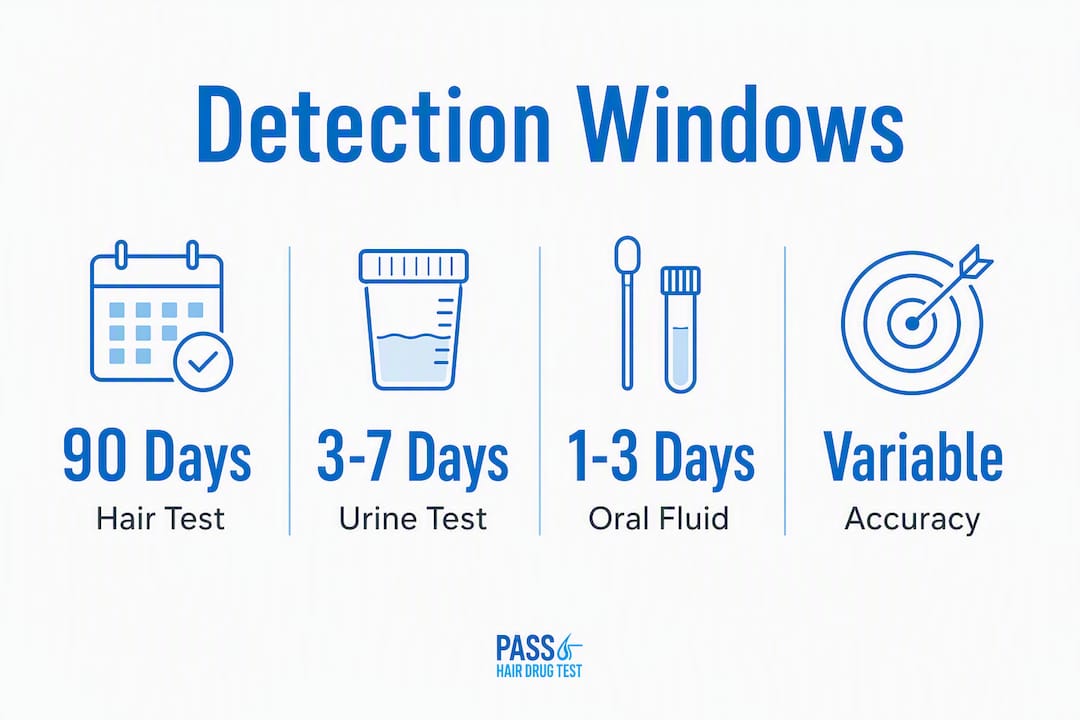
Urine tests typically detect most substances within a window of days — often 3–7 days for most drugs, though heavy cannabis use can extend that to several weeks. Oral fluid tests are even shorter, generally detecting use from the past 24–48 hours. Hair sits in a different category entirely.
| Drug | Hair Detection | Urine Detection | Oral Fluid Detection |
|---|---|---|---|
| Cannabis (THC) | Up to about 90 days (head hair) | 3 days | 4–24 hours |
| Cocaine | Up to about 90 days (head hair) | 2–4 days | 1–2 days |
| Opioids | Up to about 90 days (head hair) | 2–4 days | 1–3 days |
| Amphetamines | Up to about 90 days (head hair) | 2–4 days | 1–2 days |
| PCP | Up to about 90 days (head hair) | 7 days | 1–3 days |
These windows assume standard 1.5-inch head hair segments. Longer hair segments can extend the lookback period further.
Accuracy has real limitations worth knowing. Hair color and texture affect how drug metabolites bind to the shaft. Melanin-rich hair — common in people with darker hair — binds certain drug metabolites more readily than lighter hair, which has raised concerns about disparate positive rates across racial and ethnic groups. Cosmetic treatments like bleaching, perming, or relaxing can degrade metabolite concentrations in the shaft, potentially producing false negatives. Conversely, external contamination from drug smoke or residue can theoretically produce a positive result, though labs apply wash procedures to reduce that risk.
False positives from legitimate medications are possible but addressed through MRO review. If a confirmed positive is tied to a prescription, the MRO can reclassify the result as negative. That process only works if you disclose the prescription to the MRO — not to the employer directly.
What federal rules actually say about DOT hair testing
Hair testing is not authorized for DOT compliance. Full stop. 49 CFR Part 40 lists the only acceptable specimen types for federally mandated testing: urine and oral fluid, both processed at HHS-certified labs. Hair tests and point-of-collection instant tests are explicitly excluded under §40.210.
The path to changing that runs through the Department of Health and Human Services. The FAST Act of 2015 directed HHS to develop mandatory guidelines for hair testing before any federal agency, including FMCSA, could incorporate hair testing into DOT-regulated programs. HHS has repeatedly delayed issuing those guidelines, resetting the rulemaking clock multiple times. Until HHS finalizes its mandatory guidelines, FMCSA cannot move forward with a final rule, regardless of industry pressure.
Even after HHS issues guidelines, the regulatory process requires FMCSA to publish a proposed rule, accept public comment, and finalize the rule — a process that typically takes months to years. Drivers should not expect hair testing to become a DOT requirement in the near term.
| Regulatory step | Status |
|---|---|
| FAST Act direction to HHS | Completed (2015) |
| HHS mandatory guidelines | Delayed; timeline reset multiple times |
| FMCSA proposed rule | Cannot proceed without HHS guidelines |
| DOT final rule incorporating hair | No timeline established |
Because positive hair results fall outside the Clearinghouse’s scope under current rules, a failed private hair screen at one carrier does not automatically follow you to the next employer. That’s a meaningful distinction — but it also means drivers who fail hair tests at safety-focused carriers can still be hired by carriers running only DOT urine programs.
Who in trucking uses hair follicle testing and when
Large carriers and safety-focused fleets are the primary users. The Trucking Alliance, a coalition of large carriers, has been the most vocal advocate for hair testing as a pre-employment filter. Member carriers typically require applicants to pass both a hair test and the required DOT urine test, which means paying for two separate screens per candidate.
Common use cases in trucking:
- Pre-employment non-DOT screening — the most common application; carriers use hair tests alongside the mandatory DOT urine test to catch longer-term users.
- Reasonable-suspicion investigations — some carriers order hair tests when behavioral evidence suggests ongoing drug use, though this sits outside the DOT program.
- Vendor and subcontractor screening — some shippers and brokers require hair tests for drivers operating on their facilities or contracts.
- Return-to-duty supplemental screens — a small number of carriers add hair testing as an extra layer when a driver returns after a DOT violation, beyond the required return-to-duty urine test.
Owner-operators working under their own authority face less exposure to private hair screens, since they only need to satisfy DOT urine requirements. But if you lease onto a carrier or bid on freight contracts with large shippers, those parties may impose their own hair testing requirements as a condition of the relationship.
Pro Tip: Before signing a lease agreement or accepting a long-term contract with a shipper, ask specifically whether hair testing is required and at what frequency. Some contracts include annual or random hair screens that aren’t obvious in the initial paperwork.
What to expect when your employer orders a hair follicle test
The collection process is straightforward, but knowing the steps reduces anxiety and helps you avoid mistakes that could complicate your result.
- Arrive with valid photo ID. The collector must verify your identity before touching the sample.
- The collector selects the sample site. Head hair from the back of the crown is standard. The collector cuts a small bundle of strands close to the scalp.
- Sample size matters. Standard protocols call for 90–120 strands to give the lab enough material for both the initial screen and confirmation testing.
- If head hair is insufficient, the collector moves to body hair — beard, arm, chest, leg, or underarm. Body hair grows more slowly than head hair, so the same 1.5-inch segment may represent a longer or shorter time window depending on the site.
- Chain-of-custody paperwork is completed on-site. You sign the form confirming the sample is yours and that collection was conducted properly. Read it before you sign.
- The sample is sealed and shipped to an HHS-certified lab for initial screening and, if needed, GC/MS confirmation.
After a positive screening result:
- The lab runs GC/MS or LC-MS/MS confirmation before reporting anything.
- The MRO contacts you directly — not your employer — to ask about prescription medications or other legitimate explanations.
- Only after MRO review does the final result go to the employer.
Pro Tip: If the MRO calls, answer. Missed MRO calls are treated as refusals in many employer policies, which carries the same consequence as a confirmed positive. Save the MRO’s number and pick up.
For non-DOT tests, the employer’s internal policy governs what happens next. Some carriers offer a second-chance program; others treat a positive as an immediate disqualifier. Know the policy before you test.
Why hair testing is controversial in trucking
The debate is real and it runs deep. Safety advocates and civil-rights groups are not talking past each other — they’re responding to the same data and reaching different conclusions about what matters most.
The case for hair testing:
- Longer detection window catches lifestyle users who abstain for a few days before a urine test.
- Observed collection makes on-site adulteration nearly impossible.
- Paired pre-employment data from 151,662 applicants showed 0.6% failed urine versus 8.5% failed or refused hair — a gap that safety advocates argue represents real risk on the road.
- Harder drugs like cocaine and opioids show up clearly in hair for weeks after use.
The case against:
- No federal standardization means cutoff thresholds and collection protocols vary by lab and employer.
- Higher cost per test, especially when carriers run both hair and DOT urine screens.
- Melanin-rich hair binds drug metabolites more readily, raising concerns about disparate positive rates for Black and Hispanic drivers — a point OOIDA and civil-rights groups have pressed consistently.
- Cosmetic treatments common among certain demographic groups can affect metabolite concentrations, complicating result interpretation.
“The industry debate is polarized: large carriers and the Trucking Alliance support hair testing for safety; OOIDA and civil-rights groups point to fairness and standardization concerns that remain unresolved.”
— FreightWaves industry reporting
The University of Central Arkansas research reviewed the generalizability of paired-sample data and examined whether disparate impact claims hold up under scrutiny. The findings don’t resolve the debate, but they do confirm that hair characteristics — color, texture, cosmetic treatment history — affect test outcomes in ways that urine testing does not replicate.
| Argument | Supporting side | Core concern |
|---|---|---|
| Longer detection window | Trucking Alliance, large carriers | Safety: catches users who game urine tests |
| Racial/ethnic disparate impact | OOIDA, civil-rights advocates | Fairness: melanin binding affects positive rates |
| No federal standardization | OOIDA, legal advocates | Consistency: cutoffs vary by employer and lab |
| Higher cost | Owner-operators, small fleets | Economics: two tests per hire adds up |
Can you beat a hair follicle test? What the evidence actually shows
The short answer: no reliable, guaranteed method exists. Labs and collectors are aware of every common approach, and some attempts to beat the test create more problems than they solve.
Common methods and what the evidence says:
- Shaving your head — collectors simply move to body hair. Shaving all body hair is a refusal in most employer policies, treated the same as a positive.
- Cutting hair very short — if there isn’t enough hair for a valid sample, the collection fails. Most employers treat an inability to provide a sample as a refusal.
- Bleaching or chemical treatments — can degrade metabolite concentrations in the shaft, but labs apply wash procedures and use lower cutoffs for treated hair. Results are inconsistent and the treatment itself signals possible tampering.
- Detox shampoos — products like Macujo Aloe Rid Shampoo and Zydot Ultra Clean are the most discussed options. These work by opening the hair cuticle and attempting to flush metabolites from the shaft. The evidence base is largely anecdotal, but multi-step methods like Mike’s Macujo Method have a long track record in the consumer detox space. No method carries a guaranteed outcome.
- Home remedies — vinegar, baking soda, and similar DIY approaches have no credible scientific support for removing embedded metabolites from hair shafts.
Pro Tip: If you’re facing a non-DOT hair screen and want to explore cleansing options, start well in advance. Multi-step protocols require multiple treatments over several days. Starting the night before a test is not a realistic strategy.
The risks of aggressive tampering go beyond a failed test. Employers who suspect adulteration can treat the result as a refusal, which in some carrier policies triggers immediate disqualification. For DOT-regulated tests, a refusal carries the same consequences as a positive and goes into the Clearinghouse.
Latest research and what it means for drivers in 2026
The most significant recent data comes from the Trucking Alliance’s paired-sample analysis. Across 151,662 pre-employment results, the gap between urine and hair failure rates was stark: 0.6% on urine versus 8.5% on hair. Trucking Alliance carriers cite this as evidence that urine testing alone leaves a significant portion of drug-using applicants undetected.
The University of Central Arkansas study examined the same dataset with a focus on generalizability and disparate impact. Key questions the research addressed:
- Whether the paired-sample population is representative of the broader CDL driver applicant pool.
- Whether hair characteristics associated with race and ethnicity produce systematically different positive rates independent of actual drug use.
- What the policy implications are if disparate impact is confirmed at scale.
The research did not fully resolve the disparate impact question, but it confirmed that hair characteristics matter for test outcomes — a finding that strengthens the case for HHS to address standardization before any federal mandate.
On the regulatory front, HHS has reset its rulemaking timeline multiple times. As of 2026, no supplemental notice of proposed rulemaking has been finalized. FMCSA cannot act until HHS moves, and HHS has given no firm commitment on timing.
| Study / Source | Key finding | Relevance to drivers |
|---|---|---|
| Trucking Alliance paired-sample analysis | 0.6% urine fail vs. 8.5% hair fail/refuse (n=151,662) | Shows scale of detection gap; explains why large carriers use hair |
| University of Central Arkansas review | Hair characteristics affect outcomes; disparate impact unresolved | Supports caution on universal mandates; relevant to fairness arguments |
| HHS rulemaking timeline | Repeatedly delayed; no final guidelines issued | Hair testing remains non-DOT; no federal mandate imminent |
Key Takeaways
Hair follicle tests are a real part of pre-employment screening at many large U.S. carriers, but they remain outside federal DOT requirements — and drivers who understand the distinction are better positioned to navigate both types of programs.
| Point | Details |
|---|---|
| Not DOT-authorized | Hair tests cannot satisfy 49 CFR Part 40 requirements; only urine and oral fluid count for DOT compliance. |
| 90-day detection window | Hair tests can detect drug use up to about 90 days back using a standard 1.5-inch head hair segment; the actual window varies if body hair is used. |
| Clearinghouse gap | Failed private hair screens are not reported to the FMCSA Clearinghouse under current rules. |
| Racial bias concerns | Melanin-rich hair binds metabolites more readily, raising unresolved fairness questions that have stalled federal adoption. |
| Passhairdrugtest resources | Passhairdrugtest offers Macujo Aloe Rid, Zydot Ultra Clean, and multi-step kits for drivers preparing for non-DOT hair screens. |
A note from the publisher
The gap between what drivers know about hair testing and what they need to know is wider than it should be. Most articles either overstate the legal risk (“you’ll lose your CDL!”) or understate the practical one (“it’s just a private test, no big deal”). Neither framing helps you make a good decision.
Hair follicle testing in trucking sits in genuinely complicated territory. It’s not a DOT requirement, but it’s a real employment barrier at a growing number of carriers. The science behind it is solid in some respects and contested in others. The regulatory path to federalizing it exists on paper but has stalled repeatedly in practice. And the methods people use to prepare for non-DOT hair screens range from well-documented to completely unsupported.
What I’d push back on hardest is the idea that because hair testing isn’t in the Clearinghouse, it doesn’t matter. For a driver applying to a Trucking Alliance carrier or a large private fleet, a failed hair screen ends that application immediately. The fact that it doesn’t follow you federally is cold comfort when the job you wanted is gone.
The smarter move is to know your employer’s policy before you test, understand what the MRO process actually protects you from, and if you’re facing a non-DOT screen, make informed decisions about preparation with enough lead time to do it properly.
Facing a non-DOT hair screen? Here’s what Passhairdrugtest offers
Passhairdrugtest has spent more than 20 years helping people navigate hair drug test preparation, and the product line reflects that experience. For drivers facing a private, non-DOT hair screen, the core options are the Macujo Aloe Rid Shampoo, Zydot Ultra Clean Shampoo, and the complete hair follicle shampoo kit built around Mike’s Macujo Method — a multi-step protocol designed to open the hair cuticle and reduce metabolite concentrations before testing.
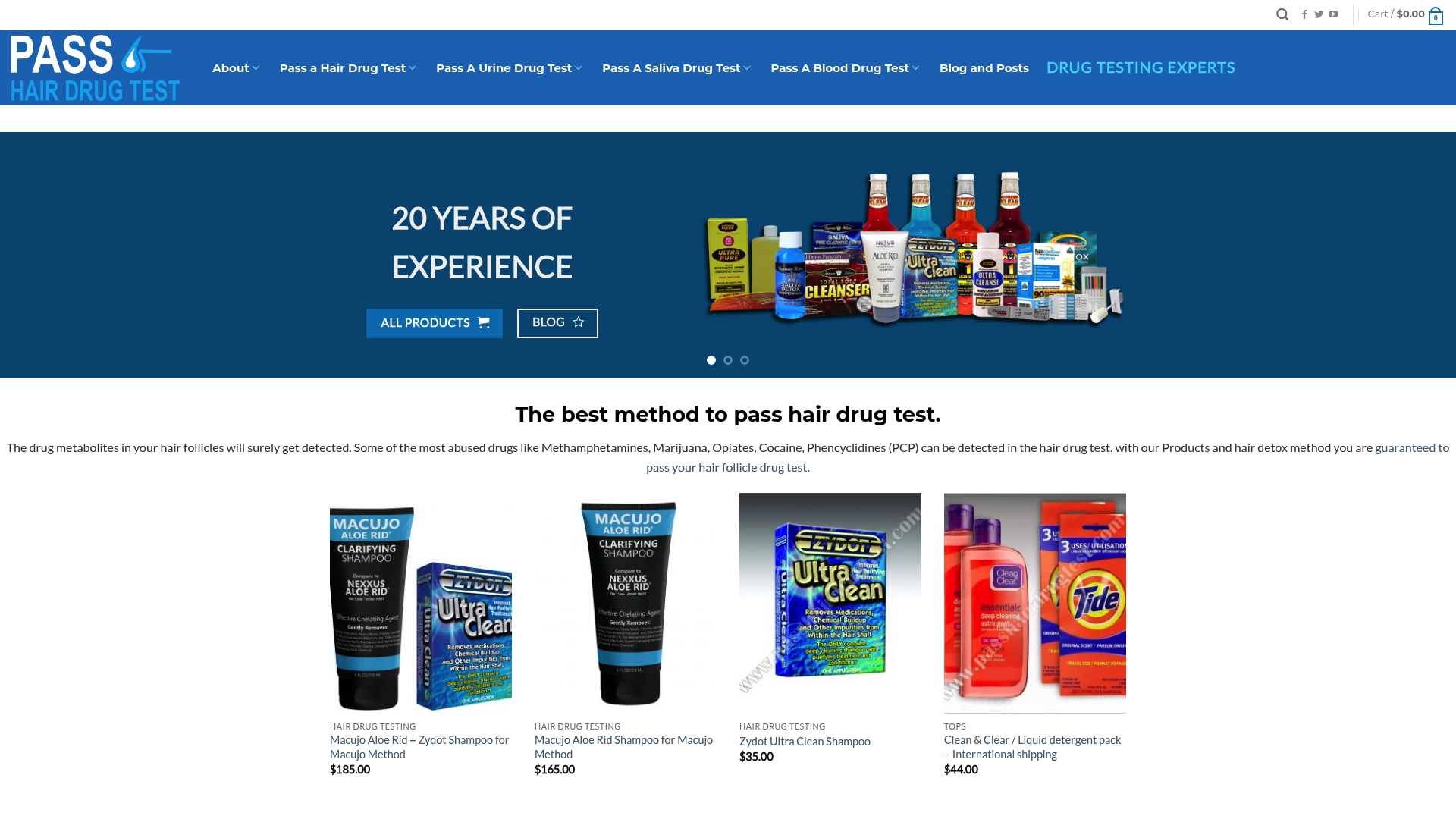
These products are for non-DOT preparation only. DOT-regulated tests follow 49 CFR Part 40, and no shampoo or cleansing kit changes that process. If you’re facing a DOT urine or oral fluid test, the MRO appeals process and your prescribing physician are the right resources. For a private hair screen at a carrier that runs its own program, Passhairdrugtest’s kits give you a structured, step-by-step approach backed by detailed instructions. No product carries a guaranteed result, and the best outcomes come from starting the protocol with adequate lead time. Confirm your employer’s policy, check whether MRO review applies, and explore the full kit options to find the right fit for your situation.
This article is general information, not legal or medical advice. Confirm current testing requirements with your employer, a qualified MRO, or a licensed attorney before making decisions about your employment or drug testing program.
Authoritative sources and further reading
- 49 CFR Part 40 — DOT Drug and Alcohol Testing Procedures — The primary federal rule governing DOT-regulated testing; defines authorized specimen types and excludes hair.
- FMCSA Drug and Alcohol Clearinghouse — Official database for DOT drug and alcohol violations; does not accept private hair test results under current rules.
- FMCSA: What Tests Are Required and When — FMCSA guidance on required testing occasions for CDL drivers.
- HHS Resets Clock on Hair Testing Guidelines — FreightWaves — Reporting on the repeated HHS rulemaking delays and what they mean for FMCSA.
- Hair v. Urine Testing Efficacy — Trucking Alliance / University Research — Paired-sample analysis of 151,662 pre-employment results showing the detection gap between urine and hair.
- Trucking Alliance: Hair Tests More Effective for Truck Driver Drug Screenings — Industry advocacy group summary of research supporting wider hair test adoption.
- FAST Act — 114th Congress H.R. 22 — Legislative text directing HHS to develop mandatory hair testing guidelines as a prerequisite for federal adoption.
- Hair Testing as a Supplemental Filter — MDPI — Peer-reviewed framing of hair testing as a supplemental detection tool rather than a DOT replacement.
- CRST Non-DOT Hair Drug Testing Collector Protocol — Carrier-level collection guidance covering sample size (90–120 strands) and body hair fallback procedures.
- Truckers, Drugs and Safety — Heavy Duty Trucking — Industry reporting on carrier practices, dual-testing costs, and employer rationale for private hair screens.
Recommended
- Pre-Employment Research: What Companies Do Hair Follicle Testing? – Pass Hair Drug Test
- Hair Follicle Drug Test Information – Pass Hair Drug Test
- Pass hair follicle drug test
- Hair Follicle Drug Test – Best guaide for hair drug test – Pass Hair Drug Test
