No products in the cart.
Uncategorized
Post-Macujo Hair Care: What to Do After the Wash
30
Oct
Oct
Post-Macujo hair care is how you treat your scalp and hair after finishing a Macujo cleansing cycle: gentle conditioning, no new chemical treatments, no stacking harsh products, and a sensible plan for test day. The routine is harsh on hair, so aftercare is mostly about limiting damage and staying consistent. It does not turn a wash into a guaranteed result, and we will say plainly what the research does and does not support.
Table of Contents
TL;DR
- “Post-Macujo” care means looking after hair and scalp once a cleansing cycle ends: moisture, gentle handling, and no extra chemicals.
- Detergents, astringents and acids can dry the hair shaft and irritate the scalp, so rinse thoroughly and stop if you feel burning.
- Studies show some products can lower THC levels in hair, but the results vary and no standard method proves any routine “cleans” hair.
- A hair test looks at about 1.5 inches of hair, roughly 90 days, so timing and hair length matter as much as washing.
- If a result looks wrong, you can ask the Medical Review Officer (MRO) about reanalysis of the original specimen.
Table of Contents
- What “post-Macujo hair care” actually refers to
- Why aftercare matters: what harsh cleansing does to hair and scalp
- Your first 24 hours after a cleansing cycle
- Moisture without a new problem
- How often should you repeat the method?
- What the research says about cleansing and results
- Why timing and hair length matter more than any wash
- Test-day habits
- Perspective: how we think about aftercare
- Where to start if you need the products
- If a result looks wrong
- FAQ
- Sources
What “post-Macujo hair care” actually refers to
The Macujo method is a do-it-yourself hair cleansing routine that people use before a hair follicle drug test. The best-known version, Mike’s Macujo Method, is a multi-step process that alternates a clarifying shampoo (Macujo Aloe Rid) with household and drugstore products such as white vinegar, an astringent and a small amount of laundry detergent. Our own Macujo Method guide walks through the full sequence.
The routine is demanding by design. It strips oils, product residue and surface material from the hair. Once the last rinse is done, three practical questions come up:
- How do I keep my hair and scalp from being damaged?
- What can I safely put on my hair before the test, and what should I leave alone?
- How do I handle the days between the last cycle and the sample collection?
That is what post-Macujo care covers. It is not a separate treatment. It is a short list of habits that protect you and avoid undoing your own prep.
Why aftercare matters: what harsh cleansing does to hair and scalp
Shampoo surfactants can strip moisture from the hair and may contribute to damage of the hair shaft, and the American Academy of Dermatology’s guidance is to concentrate shampoo on the scalp rather than the lengths (AAD). A Macujo cycle does the opposite of gentle: it uses strong cleansers repeatedly and often works them through the full length of the hair.
The scalp is the other concern. The AAD notes that harsh detergents, strong soaps, solvents and chemicals on the skin can trigger flare-ups of seborrheic dermatitis (AAD). If you already have flaking, redness or itching, a multi-step routine with acids and detergents is more likely to aggravate it.
What that looks like in practice:
- Dry, straw-like texture. Hair feels rough, tangles easily and may break at the ends.
- Scalp tightness or itching. Often the first sign you have over-washed.
- Redness or burning. Stop. Rinse with plenty of lukewarm water and do not continue the cycle.
If redness, burning or blistering persists, see a dermatologist or your primary care doctor. Do not push through it to finish a schedule.
Your first 24 hours after a cleansing cycle
The hours after a cycle are about rinsing out what you used and letting your scalp settle.
Rinse longer than feels necessary
Vinegar, astringent and detergent residue left on skin is what causes most irritation. Rinse with lukewarm water, not hot, until the hair no longer feels slick or smells of vinegar. Pat dry with a clean towel rather than rubbing, since wet hair is at its most fragile.
Check the skin around the hairline
If you used petroleum jelly or a barrier cream on your hairline, ears and neck, wash it off gently. Look for red patches. Mild tingling that fades is common. Persistent burning is not.
Skip heat and tight styles
Avoid blow-drying on high heat, flat irons and tight ponytails or braids. Air dry when you can. Dry, stripped hair breaks more easily, and breakage shortens the length available to be sampled.
Moisture without a new problem
After stripping, many people want to condition heavily. The trade-off is simple: conditioners and oils restore softness, but you are adding products to hair you just cleaned.
A reasonable middle path:
- Use a plain, fragrance-light conditioner on the lengths only, and rinse it out fully.
- Avoid heavy oils, butters, waxes and styling gels in the days before the test. They add coating, which defeats the point of the cleansing.
- Do not dye, bleach, relax or perm your hair as a shortcut. These are chemical treatments that damage the hair and are a separate matter from washing.
On that last point, a published study of cosmetic treatments found that bleaching and dyeing lowered drug concentrations in hair, with mean differences mostly in the 40% to 60% range and about 30% for THC, with larger decreases in more damaged hair (PubMed). That is a finding about chemical damage, not a recommendation. Damaged hair is brittle, and a lab may note the condition of the sample. We do not recommend treating your hair that way.
How often should you repeat the method?
The Macujo e-book that ranks for this topic suggests light THC users do the method roughly 5 to 8 times and heavy users 10 to 15 washes. We include that because it is the widely circulated guidance, not because it is a validated protocol. No lab study has established a wash count that works for everyone.
What matters for aftercare is spacing. Doing cycle after cycle without recovery time compounds dryness and scalp irritation. If your hair feels brittle or your scalp is inflamed, a rest day with only lukewarm water and a gentle rinse is better than pressing on. Our hair test shampoo kits page explains how the shampoos are used and what the kits contain.
What the research says about cleansing and results
Here is the part most product pages skip. The evidence is mixed, and it does not support a promise.
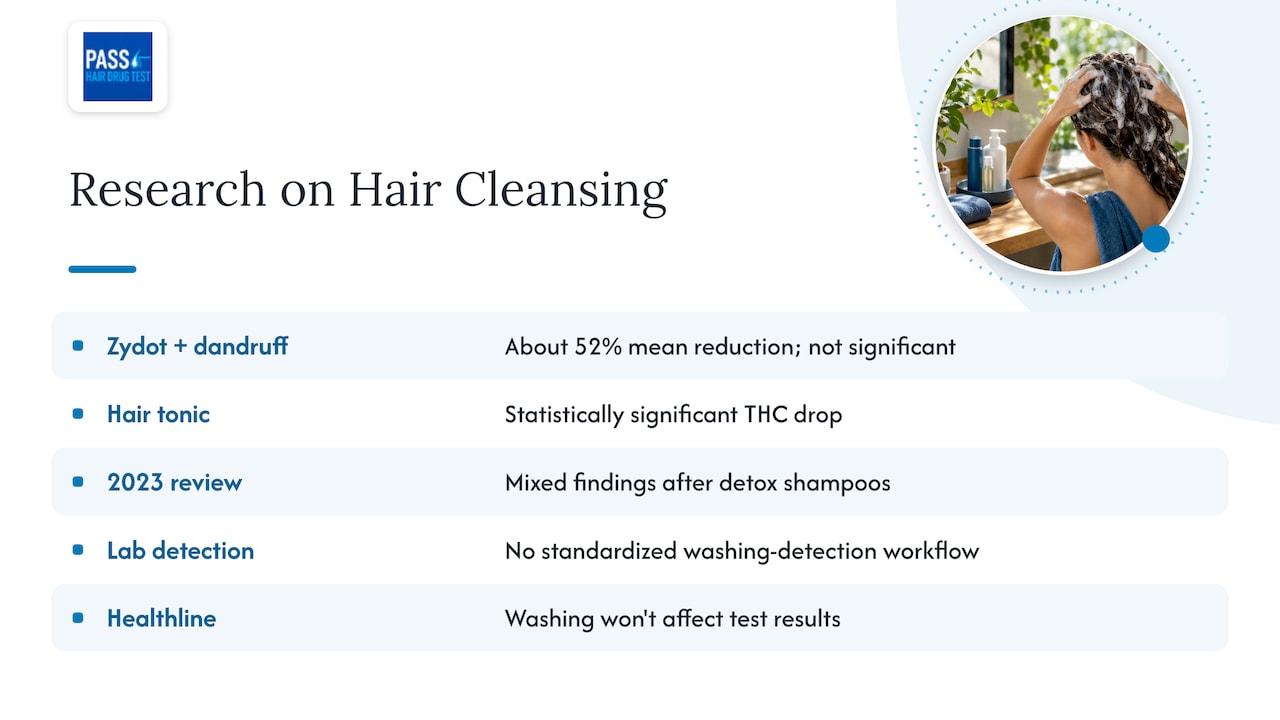
A 2022 study from Germany tested several commercial and everyday hair products on THC-positive hair. Some reduced THC concentrations, occasionally to non-detectable levels (PMC). Notably, the mean THC reductions after a Zydot shampoo and a mainstream dandruff shampoo were about 52%, and those reductions were not statistically significant, unlike the drop after a hair tonic in the same study (PMC). The authors advised caution when interpreting quantitative hair results.
A 2023 review of sample manipulation reports that some studies saw decreases after detox shampoos, while another found no significant change in one marker after a single application (PMC). The same review’s authors say there is no standardized, routine workflow for objectively detecting extensive washing or cleansing-shampoo treatment (Springer). In plain terms, labs cannot reliably flag a shampoo routine, but the research also does not show that any routine reliably produces a negative result.
On the other side, Healthline’s explainer says that washing, dyeing or styling products will not affect hair test results (Healthline). The UNODC takes a more nuanced view: external contamination and repeated washing complicate interpretation, especially in hair segments far from the root (UNODC).
The honest summary: cleansing can reduce what is on and in hair to a degree that varies by person, hair type, product and how much THC was incorporated. It is not a certainty, and nobody can promise one. Our Macujo success rate breakdown covers the evidence in more depth.
Why timing and hair length matter more than any wash
Washing only acts on part of the picture, because drug metabolites get into hair from the blood supply during growth, and also from sweat, sebum and the environment (UNODC). Cleansing targets the outer part. What grew into the shaft from the inside is a different matter.
The test window is set by length. Labs typically analyze the first 1.5 inches (about 3.9 cm) of hair from the scalp, which corresponds to roughly 90 days of repetitive use (Quest Diagnostics). Very recent use may not show up yet: it can take up to 10 days for drugs to be detected in hair above the scalp (Journal of Applied Laboratory Medicine).
That leads to a few practical points for aftercare planning:
| Factor | Why it matters | What to do |
|---|---|---|
| Length of hair | The lab analyzes the first ~1.5 in. from the scalp | Do not cut or shave hair unexpectedly if a lab may then use body hair, which can be a different window |
| Time since last use | Use within the last ~10 days may not be detectable yet | Count your timeline from your last use, not only your last wash |
| Hair condition | Brittle hair breaks and tangles | Handle gently, rest between cycles |
| Products on hair | Coatings and residue add noise | Keep styling products minimal before the sample |
For background on what the sample reflects, see our guide to THC in hair and our hair drug test information page.
Test-day habits
On the day, keep it simple.
- Wash as you normally would the day before or the morning of, with the shampoo you plan to use, and rinse well.
- Arrive with clean, product-free hair. No gel, spray, oils or thick leave-in conditioner.
- Do not change your routine dramatically at the last minute, such as a sudden new color or cut.
- Bring photo ID and read the collection instructions. Collectors take a small sample close to the scalp.
If you are using Zydot Ultra Clean as part of the Macujo sequence, the kit instructions place it close to the test, which is why we sell it with the full method. Our Zydot and Macujo shampoo page has the details.
Perspective: how we think about aftercare
We have sold hair-cleansing products and guides for more than 20 years, and the most common mistake we see is not skipping a step. It is treating the routine as something that can be pushed harder and harder. People do cycle after cycle, ignore a burning scalp, then add heavy conditioners and oils the night before. That makes hair worse and the plan less reliable.
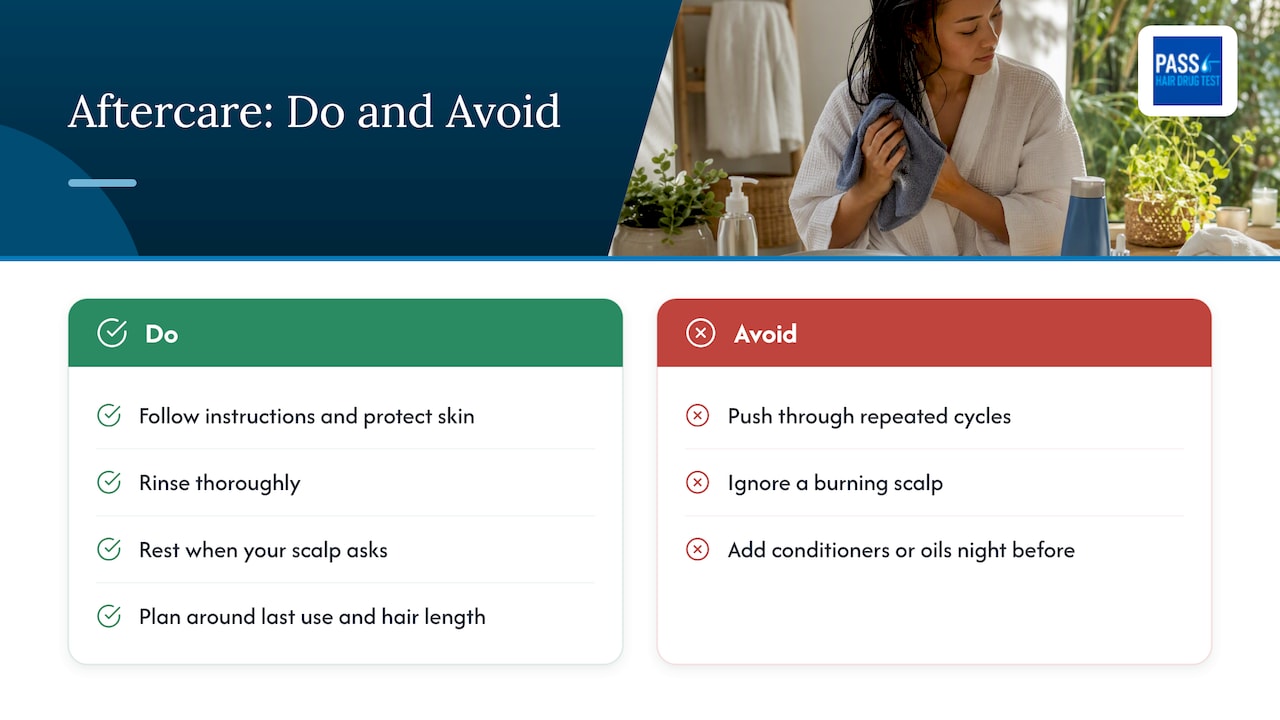
Our view is that the method works best as a disciplined routine: follow the instructions, protect your skin, rinse thoroughly, rest when your scalp asks for it, and keep the final days boring. We also think you deserve straight talk. Published research shows that some products can lower THC in hair, and that labs have no standard way to detect washing, but it does not show that any routine is certain. Plan your timeline around your last use and your hair length first, and treat the washing as one part of that plan.
If you want to talk through your situation, our team offers support through the store, and our hair follicle testing guide lays out the basics.
— MIchael
Where to start if you need the products
If you are preparing for a hair test and want the full method in one place, our hair-testing shampoo kits bundle the Macujo Aloe Rid shampoo and Zydot Ultra Clean with instructions. You can see the options on our hair testing shampoo kits page, or browse everything we carry, including urine, saliva and blood testing products, in the full product catalog.
If a result looks wrong
Sometimes a result does not match your history. In the US, there are formal steps.
First, the lab’s non-negative result generally goes through a screening and confirmation process, and an MRO may discuss it with you (Healthline). A result can be contested by requesting reanalysis of the original specimen through the MRO, who explains the process, timeframe and cost (ADP/First Advantage help center).
Second, if you are in a federally regulated transportation role, 49 U.S.C. § 31306 lets a person with a positive confirmation result request an independent second confirmation test of the retained specimen at another certified laboratory, within 3 days of being advised of the result (US Code). Do not wait.
Third, NIDA notes that final review and consultation with an MRO, clinical chemist or medical toxicologist can improve interpretation, and results should not be read in isolation (NIDA). If you have a prescription, a medical condition or a disputed collection, raise it with the MRO immediately.
FAQ
Can I use regular conditioner after a Macujo wash?
Yes, a plain conditioner on the lengths is fine for comfort, as long as you rinse it out fully. Avoid heavy oils, butters and styling products in the days before the sample, because they leave residue that undercuts the cleansing.
How long should I wait between Macujo cycles?
There is no validated schedule. Many people space cycles so their scalp can recover, and rest if they notice tightness, itching or redness. If you see burning or blistering, stop and talk to a doctor or dermatologist.
How long does a hair test take to come back?
Quest typically releases negative results within 24 hours of the sample arriving at the lab. Non-negative specimens need extra time for confirmation (Quest Diagnostics). The overall wait also depends on shipping and your employer’s process.
Can a hair follicle test be cheated?
Research shows some products reduce THC in hair, but results vary, and no study establishes that a routine reliably yields a negative test. We would not promise it. Timing, hair length and honest planning matter as much as any wash.
Sources
- Hair testing – FAQ (Quest Diagnostics)
- Guidelines for testing drugs under international control in hair, sweat and oral fluid (UNODC)
- Review on Toxicology Testing in Hair (Journal of Applied Laboratory Medicine)
- Manipulation of THC Hair Concentrations by Commercially Available Products (PMC)
- Advances in testing for sample manipulation in clinical and forensic toxicology (PMC)
- Advances in testing for sample manipulation (Analytical and Bioanalytical Chemistry)
- Influence of the cosmetic treatment of hair on drug testing (PubMed)
- Hair Strand Drug Test: How It Works (Healthline)
- Shampoo and hair care guidance (American Academy of Dermatology)
- Seborrheic dermatitis: Self-care (American Academy of Dermatology)
- 49 U.S.C. § 31306 (US Code)
- How do I contest my drug test result? (First Advantage)
- Drug Testing (NIDA)
Recommended
- Mike’s Macujo Method Guide
- Macujo Aloe Rid Shampoo for Macujo Method
- Macujo Aloe Rid + Zydot Shampoo for Macujo Method
- Macujo Method Success Rate: What the Evidence Actually Shows
