No products in the cart.
Uncategorized
Does Heat Styling Change a Hair Drug Test Result?
27
Oct
Oct
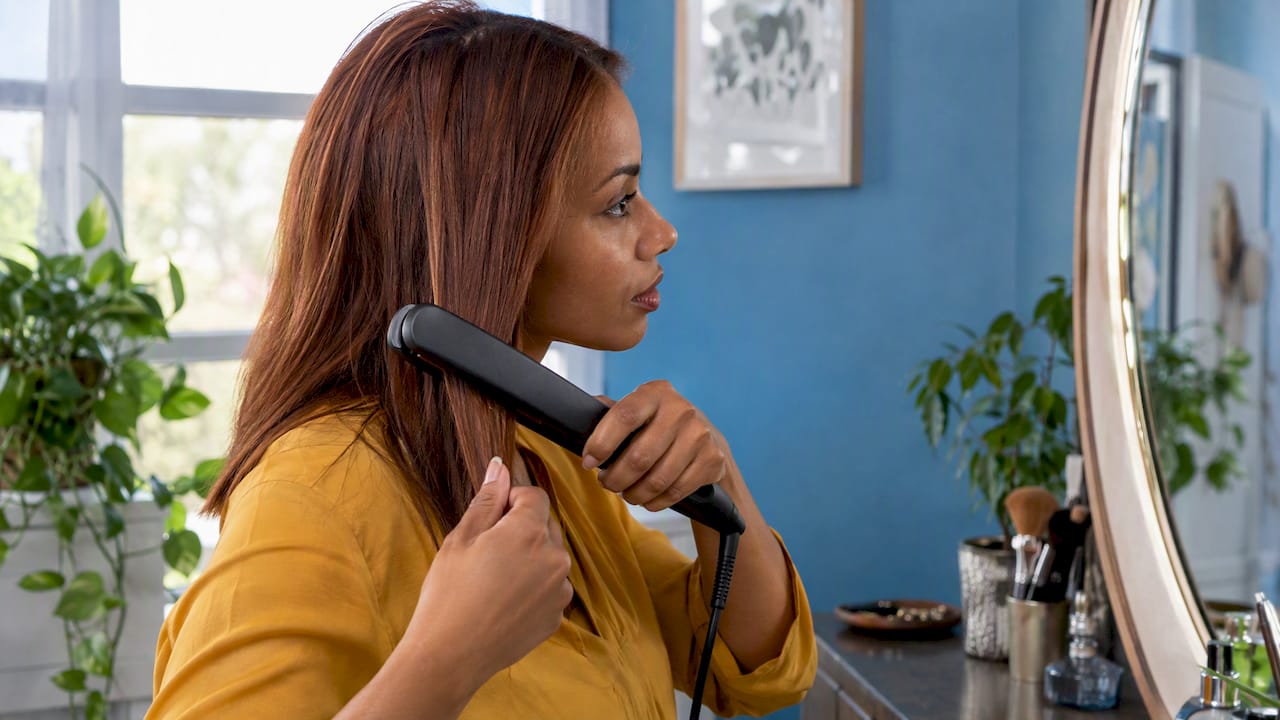
Heat styling can change what a lab measures in your hair, but it does not reliably turn a positive into a negative. A 2025 laboratory medicine review found that heat from a hair straightener can alter detection, with some substances going down and others going up, and THC moving in either direction depending on hair color. So a flat iron is not a plan. It is one variable among many, and a poor one to bet a job offer on.
This guide explains what the studies actually measured, why the results are inconsistent, what labs do when they know your hair has been treated, and what you can sensibly do in the weeks before a hair follicle test.
Table of Contents
TL;DR
- Heat can change drug concentrations in hair, but the direction is not predictable: in one study THC fell in some samples and rose in others.
- The lab studies used 200 °C plates and repeated passes. They show the effect is variable, not that styling hides drug use.
- Bleaching and chemical straightening affected drug levels far more than heat alone in the research we reviewed.
- Labs record your hair treatment history and can wash samples to check for external contamination, so styling does not go unnoticed.
- A standard head-hair test looks back about 90 days, so what you did to your hair this week matters less than what you did over the last three months.
Table of Contents
- What heat styling does to drugs inside a hair strand
- What the studies found about THC and other drugs
- Heat alone is a weak lever compared with chemical treatments
- How a lab reads a result when your hair has been treated
- The detection window matters more than your styling routine
- Our perspective: why we do not sell heat as a method
- What to do in the weeks before a hair test
- Where our products fit
- FAQ
- Sources
What heat styling does to drugs inside a hair strand
Hair does not just carry drugs on its surface. Substances travel in the blood to the growing root and become trapped in the strand as it forms. That is why a test can look back months instead of days. The 2025 review explains that drugs enter the hair bulb quickly after ingestion, but they generally are not detectable above the scalp surface for at least several days, sometimes up to 10.
Once a molecule is in the hair, it is exposed to whatever you do to that hair. Heat can break some compounds down and convert others into different compounds. Both effects have been observed in the lab.
Temperatures matter here. A 2023 review notes that thermal straightener plates are usually heated to 150 to 250 °C. That is the range of a typical flat iron on its mid to high settings, so researchers were testing realistic conditions rather than extreme ones.
What the studies found about THC and other drugs
The best-known experiment is a 2016 preliminary study of thermal straightening on hair from people who tested positive for cannabis and cocaine. Researchers passed hair over 200 °C plates 30 times for 2 seconds each, one minute of total contact. Here is what changed:
| Substance | Effect after 200 °C straightening |
|---|---|
| THC | Decreased in 11 of 17 samples, increased in 6 |
| CBN (a THC breakdown product) | Increased in all samples |
| Cocaine and cocaethylene | Decreased in all seven cocaine-positive samples |
| Benzoylecgonine (cocaine metabolite) | Increased |
Source: the 2016 thermal straightening study.
Read that table twice. Even in a controlled setting, with the same temperature and the same number of passes, THC went down in about two thirds of the samples and up in the rest. If you are a cannabis user hoping heat will help, that is roughly a coin flip tilted slightly your way, and you cannot know which side your hair falls on before the lab does.
The 2023 review explains the increases: higher CBN and benzoylecgonine after straightening are attributed to heat converting THC and cocaine into those compounds. Heat does not simply erase a drug. It rearranges it.
Why a rise can happen
The 2016 work is a preliminary study, so the sample is small and the conditions are in-vitro. A separate study on cocaine-positive hair measured changes after 200 °C treatment: median AEME, a compound associated with smoked cocaine, rose 110.3%, benzoylecgonine rose 27.6%, while cocaine fell 56.9%. The authors concluded that straightening can produce AEME, so finding it in hair is not irrefutable proof of crack-cocaine smoking when heat treatment is possible.
That finding points to something useful about how science treats heat: it is a reason for caution in interpreting a result, not a way to erase one. The 2025 review frames heat as part of a broader cosmetic-treatment and contamination problem rather than a uniform mechanism that always lowers results.
Heat alone is a weak lever compared with chemical treatments
If you want to understand what really moves hair test numbers, look at chemistry rather than temperature.
A micro-segmental analysis study reported that repeated heating for one minute and daily shampoo use barely affected the medicines it tested, whereas hydrogen peroxide bleaching cut some analytes by up to 58%. Effects depend on the analyte and the conditions.
The U.S. National Institute of Standards and Technology looked at chemical straightening. It found the process significantly decreased cocaine, benzoylecgonine, cocaethylene, PCP and THC. After one treatment, 6 to 67% of the drug remained in reference hair, and 5 to 30% remained in authentic cocaine-positive hair.
The 2025 review adds the mechanism: cosmetic practices can alter hair structure, remove pigment, degrade drugs or reduce the stability of incorporated drugs. It also warns that damaged hair may show lower internal concentrations while being more open to external contamination. In other words, damage can cut both ways, and it leaves a trail.
What this means for your hair
- A flat iron or curling iron is the mildest of these variables, and the least predictable.
- Bleaching and perming change hair more, and they also change how hair looks and behaves, which a collector can see.
- Porous or damaged hair can alter how drugs are incorporated, fixed or released and can increase leaching, according to the 2023 review. Burning your hair to chase a result can leave you with brittle strands and no reliable payoff.
How a lab reads a result when your hair has been treated
Many people assume a lab simply measures a number and compares it to a cutoff. Interpretation is more careful than that.
The 2021 Society of Hair Testing consensus says hair treatment history should be documented at collection and considered during interpretation. Washings can help identify potential external contamination, and required metabolites are weighed alongside all other factors. Natural hair color and treatments such as bleaching, dyeing, perming, straightening and UV exposure are all named as influences.
A 2018 Clinical Toxicology review makes the same point from another angle: a hair result is not self-interpreting. It lists hair color and texture, collection area, individual growth rate, storage, contamination, sweat, bleaching and heat treatment as factors to assess together.
Two more points matter to a reader planning around a test:
- No routine screen catches everything. The 2023 review says no standardized workflow yet objectively screens for all cosmetic treatment or extensive washing, and markers of oxidative treatment have limitations. That does not mean treatment is invisible. It means labs rely on documentation, washes and judgment.
- Concentration is not quantity. The SoHT consensus states that hair concentration cannot tell how much someone consumed. Segmental analysis can show patterns of use over time.
SAMHSA has also described external contamination as a central defensibility issue, since parent drug in hair can arise from mechanisms other than ingestion. That works in favor of people who were exposed passively, and it is why labs look for metabolites rather than only the parent drug.
The detection window matters more than your styling routine
The Texas Department of Family and Protective Services describes a head-hair strand test as detecting listed drugs over the last 90 days. Its listed panel includes marijuana, cocaine, PCP, amphetamine, methamphetamine and nonsynthetic opioids.
The 2025 StatPearls review agrees that scalp hair typically reflects about three months of exposure, while slower-growing body hair may reflect use up to 12 months earlier.
That has practical consequences:
- Hair near the scalp is the most recent history. Hair is collected close to the scalp, and the 2025 review notes that failing to cut close can shift the segmental timing.
- One styling session on the day before a test touches the whole length of the sample, but the drug history is built over about 13 weeks of growth.
- If a collector cannot get enough head hair, body hair is an alternative, and it reaches further back. We explain that in our guide to the body hair drug test.
Our perspective: why we do not sell heat as a method
We have worked in the drug-testing and detox-product space for more than 20 years, and the question about flat irons and blow dryers comes up constantly. Our answer is consistent: heat is not a method.
Here is how we see it. People who face a hair test are usually applicants or employees under time pressure, and they search for the one trick that will make it simple. The research does not support a single trick. Heat changes some molecules, creates others, and leaves THC going down in some hair and up in other hair. Nobody should plan a job around that.
What we have built our hair business around is a defined routine instead: Macujo Aloe Rid Shampoo, Zydot Ultra Clean Shampoo, and the multi-step Mike’s Macujo Method, with written instructions and phone support. You can read how those products are meant to be used in our guide to how to pass a hair drug test with shampoo. We also tell customers plainly what shampoo cannot do. Washing is only one part of preparation, and a long history of heavy use over the past three months is a harder problem than a short, light one.
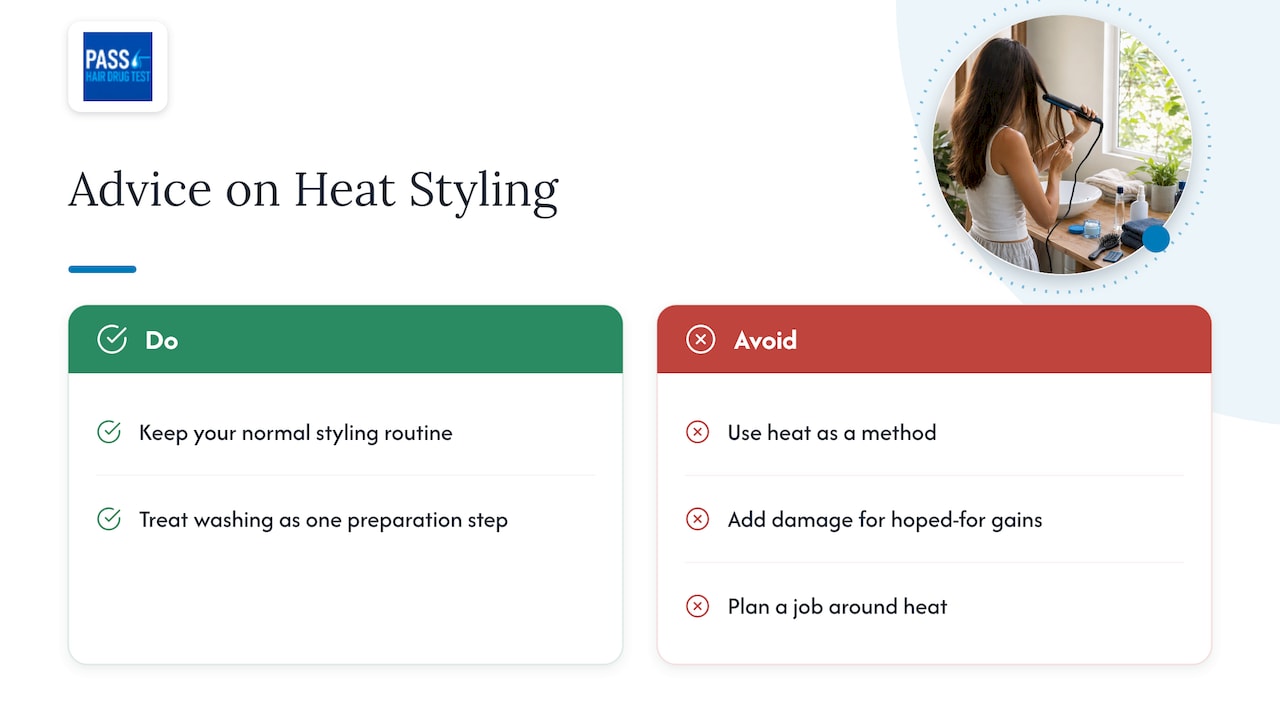
Our advice on heat is simple. Do not add damage to your hair in hopes of gaining something. If you normally style your hair, keep your routine normal, because a sudden change right before a test is more noticeable than the styling itself.
— MIchael
What to do in the weeks before a hair test
These steps are about preparing sensibly, not gambling on one variable.
- Find out the test type and the sample. Ask the employer or collection site whether it is a head-hair or body-hair test and what panel it covers. If you are unsure how the process works, start with our hair follicle drug test information page.
- Count back 90 days. Whatever you used in that window is what the sample can reflect. Stopping now will not remove what is already in the strand, but it keeps new use from being added.
- Keep your hair care routine consistent. Wash your hair as you normally do and avoid sudden bleaching, perming or relaxing on the theory that it will help. The NIST and SoHT findings show those treatments are documented and variable, and they can damage hair.
- Do not style over product buildup. Styling dirty hair can bake product and oils into the strand, as stylists often note, and it does your hair no favors. Wash first, then style at moderate heat.
- Tell the collector the truth about treatments. The SoHT consensus asks for treatment history at collection. Being straightforward about a recent dye or straightening is better than having it flagged later.
- Understand what shampoos can and cannot do. Read whether detox shampoos work before spending money, and check the detox shampoo expiration checks if a bottle has been sitting in a cabinet.
A note on safe styling temperatures
If your real question is how hot is too hot for your hair, the answer from hair-science sources is that moderate settings do the job for most hair types. Trade guidance on claim substantiation cites research suggesting an optimum for dry hair near 180 °C, with damage evidence above it. Fine, bleached and color-treated hair tolerates less. Always style fully dry hair. None of this has anything to do with drug testing, but it keeps you from trading a possible test problem for a certain hair problem.
Where our products fit
If you want a structured preparation routine instead of improvising with heat, our hair drug testing products page lists the hair shampoos and kits we carry, along with test kits for urine, saliva and blood. Each comes with instructions, and our team is available by phone if you are unsure which fits your situation. For a comparison of how a detox shampoo differs from a regular clarifying shampoo, see our detox vs clarifying shampoo guide.
FAQ
Can a flat iron make me pass a hair follicle test?
Not reliably. In a 2016 preliminary study, 200 °C straightening lowered THC in 11 of 17 samples and raised it in 6, and it raised CBN in all of them. You cannot predict which way your own hair will go.
Does blow drying or curling affect drug levels in hair?
The research we reviewed focused on flat-iron plates at 150 to 250 °C, not blow dryers or curling irons. One micro-segmental study found that repeated heating for one minute barely affected the medicines tested. Treat everyday heat as a minor factor, not a strategy.
Will the lab know I straightened or bleached my hair?
Often yes, or at least it is expected to be recorded. The Society of Hair Testing consensus calls for hair treatment history to be documented at collection and considered when results are interpreted. Labs can also wash samples to check for external contamination.
How far back does a hair drug test look?
A standard head-hair test looks back about 90 days, according to the Texas Department of Family and Protective Services. Body hair grows more slowly and can reflect a longer period, up to about 12 months in one review.
Is heat damage a good way to remove drugs from hair?
No. Heat conversion can make some compounds go up, and bleaching or chemical treatment may lower some levels but changes your hair and is noted by labs. You risk breakage and still have an uncertain result.
Sources
- Review on Toxicology Testing in Hair, Journal of Applied Laboratory Medicine
- Influence of thermal hair straightening on cannabis and cocaine in hair
- Advances in testing for sample manipulation in clinical and forensic toxicology
- AEME production in cocaine positive hair after thermal hair straightening
- Evaluation of applicability of micro-segmental analysis to hair
- NIST: Influence of chemical straightening on the stability of drugs of abuse in hair
- 2021 SoHT Consensus on Drugs of Abuse Testing in Hair
- The interpretation of hair analysis for drugs and drug metabolites, Clinical Toxicology
- SAMHSA: Detection of opioid glucuronides in user hair
- Texas Department of Family and Protective Services, Substance Use Resource Guide
- Drug Testing, StatPearls
Recommended
- How Can I Pass a Hair Drug Test?
- Hair Drug Test Information
- How to pass hair drug test
- 40–90% Reductions: How Bleach and Dye Change Hair Drug Tests
