Uncategorized
Edibles in Hair Tests: Why One Gummy May Be Missed
Oct
Yes, edibles can show up on a hair follicle test, because THC from food and drinks enters the bloodstream and gets deposited into growing hair the same way smoked cannabis does. The standard 1.5 inch sample covers roughly 90 days of growth, with a 7 to 10 day lag before recent use appears. A single low-dose edible is often missed, while regular use raises detection odds substantially, and labs confirm results by looking for the metabolite THC-COOH rather than guessing from parent THC alone.
TL;DR:
- A standard 1.5 inch scalp sample reflects about 90 days of growth, but body hair gives a less precise timeline because it grows unevenly.
- THC may take 7 to 10 days to appear in new hair, so a test soon after use can miss recent exposure.
- Sensitivity reached about 77% among heavy users in one study, while light users were detected far less often, making occasional use unpredictable.
- A positive screen requires mass spectrometry confirmation; detection of THC’s metabolite above 0.2 picograms per milligram supports ingestion more strongly than parent THC alone.
- If a result is positive, request the confirmatory report, verify chain of custody, and ask an accredited lab about independent reanalysis.
Table of Contents
Table of Contents
- How hair follicle drug tests work
- Detection window and timeline: what ‘90 days’ actually captures
- Factors that influence whether an edible will be detected
- Lab confirmation, metabolites, and cutoffs: what a positive result proves
- What edibles mean in practice: single gummy vs. regular use
- Reading results and next steps if you test positive
- Our take on the edibles and hair testing question
- How we can help you prepare before a hair test
- FAQ
- Sources
How hair follicle drug tests work
A hair follicle test starts with a physical sample, usually cut as close to the scalp as possible. Labs request the closest 1.5 inches of hair because that segment reflects, on average, about three months of growth. When head hair is too short or unavailable, collectors switch to body hair, which grows more slowly and unevenly, so the detection window estimate becomes less precise.
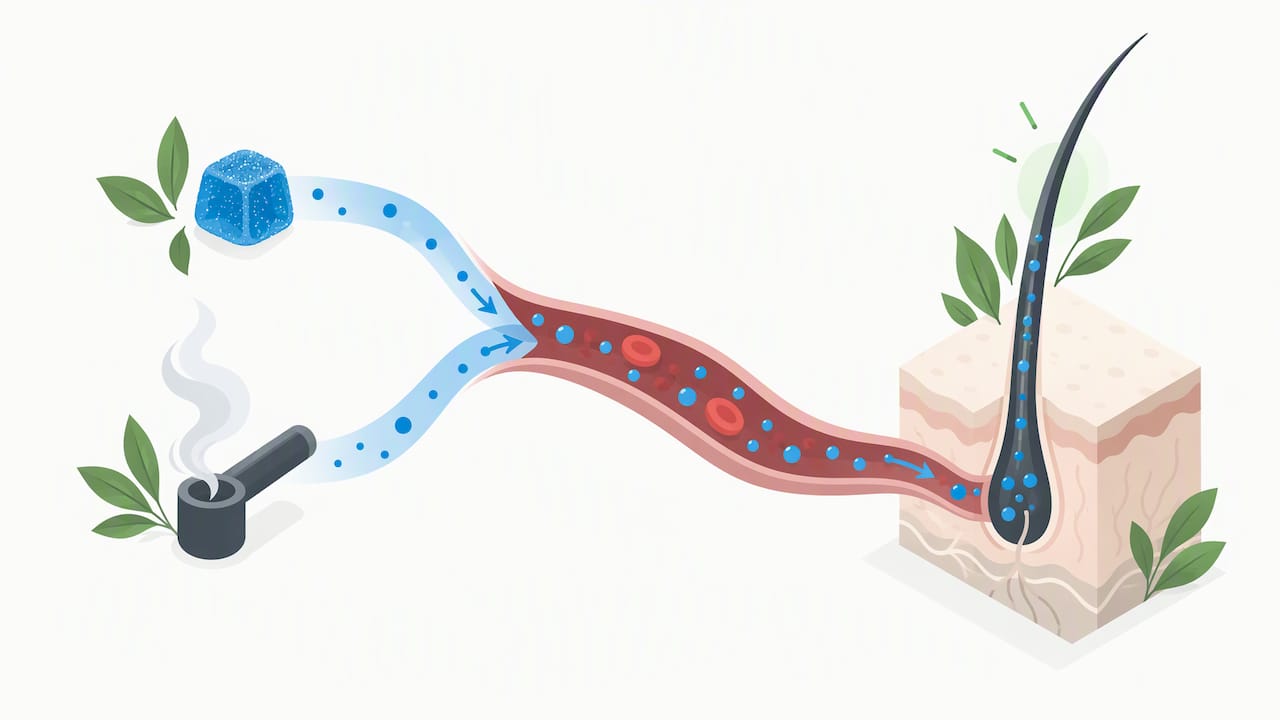
Once THC is metabolized, it circulates in the bloodstream and gets incorporated into the hair shaft as the follicle builds new hair. That is the main pathway for cannabinoids ending up in a sample. Hair can also pick up cannabinoids from the outside, through sebum, sweat, secondhand smoke, or direct handling, which is part of why labs do not rely on a single screening result to call something positive.
The lab workflow generally follows a few consistent steps:
- The sample gets decontaminated or washed to strip away surface residue before analysis begins.
- A screening immunoassay flags samples that may contain cannabinoids above a baseline threshold.
- Any sample that screens positive moves to confirmatory testing using GC-MS or LC-MS/MS, instruments sensitive enough to detect cannabinoids at femtogram to picogram per milligram levels.
- Results get reported only after confirmation, not from the initial screen alone.
That workflow explains why incorporation lag matters. THC consumed today will not show up immediately, because it takes roughly 7 to 10 days for hair to grow enough at the follicle to carry a detectable trace. Someone tested the day after eating an edible is being tested on hair that formed before that exposure.
Detection window and timeline: what ‘90 days’ actually captures
The “90 day” figure is really a conversion from hair length. Scalp hair grows at an average rate that works out to roughly 1 centimeter per month, so the standard 1.5 inch (about 3.9 cm) sample taken close to the scalp corresponds to close to three months of growth history, according to reviews of hair testing methodology. That figure is an average, not a guarantee, because individual growth rates vary by person, age, and hair condition.
Labs can go further than a single yes or no answer by using segmental analysis:
- The sample gets cut into smaller segments, often 1 centimeter each, moving from root to tip.
- Each segment is tested separately, which lets a lab approximate when in the growth period a particular level of cannabinoid showed up.
- Because 1 centimeter roughly equals one month, a spike in one segment but not others can point toward a specific window of use rather than a blanket 90 day exposure.
- This approach depends entirely on accurate sample handling, since the root end has to be marked and the hair stored properly (often in aluminum foil) to keep the timeline meaningful.
Growth rate variability means the 90 day estimate stretches or compresses depending on the person and the body site sampled. Body hair, used when head hair is unavailable, grows more slowly and less predictably, so detection windows drawn from body hair are rougher estimates than those from scalp hair.
A short example makes the lag concrete: someone who eats an edible on day one and gets tested on day five is being tested on hair that had already finished forming before the exposure reached the follicle. Testing later increases the chance that new growth will carry a detectable trace, assuming the dose and frequency were enough to register at all.
Factors that influence whether an edible will be detected
Not every edible exposure leaves the same mark. Several variables shift the odds up or down:
- Dose and frequency matter more than almost anything else; occasional light use is far less likely to register than regular, heavier consumption.
- Metabolism and body composition affect how much THC and its metabolites circulate in blood over time, so two people with the same dose can end up with different hair concentrations.
- Hair melanin content influences cannabinoid binding, and some research points to color-related differences in how much gets retained.
- Cosmetic treatments such as bleaching or dyeing can significantly reduce detectable cannabinoid concentrations, which can push a borderline result toward a false negative.
- External contamination from handling edibles, touching packaging, or spending time around smoke can deposit cannabinoids on the hair surface, separate from anything actually ingested.
Chronic, frequent users are far more likely to test positive than someone who had one gummy at a party months ago. That single difference in usage pattern accounts for most of the variation in real-world detection outcomes, more than any other factor on this list.
Pro Tip: If you’ve used hemp-derived CBD products regularly, keep in mind that trace THC in those products can accumulate in hair just like THC from edibles, even if you never intended to use cannabis.
Lab confirmation, metabolites, and cutoffs: what a positive result proves
A hair test does not report “THC detected” the way a quick home strip does. Labs distinguish between parent THC, the unmetabolized compound, and THC-COOH, a metabolite that only forms once THC has been processed by the body. Because THC-COOH requires metabolism, its presence is considered stronger evidence of actual ingestion rather than surface contact.
The 2021 Society of Hair Testing consensus lays out the practical standards labs are expected to follow:
- A minimum limit of quantification for THC-COOH of 0.2 picograms per milligram, below which a result should not be reported as positive.
- A documented wash or decontamination step before testing, intended to strip external residue before analysis.
- Confirmation of any screening-positive sample using mass spectrometry rather than relying on the immunoassay alone.
- Cutoffs that can vary depending on the purpose of the test, whether clinical, forensic, or workplace related.
THC-COOH’s limit of quantification sits at just 0.2 picograms per milligram under SoHT consensus guidance, a threshold low enough that it demands highly sensitive LC-MS/MS instrumentation to measure reliably.
The screen-then-confirm sequence exists because immunoassays are fast but prone to cross-reactivity, while GC-MS and LC-MS/MS are slower but far more specific to the exact molecule being measured. One important limitation worth understanding: a hair concentration tells a lab that cannabinoids are present above a threshold, but it does not reliably translate into how much was consumed or exactly how often. Hair testing answers a yes or no question about exposure within the window, not a dosage question.
What edibles mean in practice: single gummy vs. regular use
Once THC from an edible is absorbed and metabolized, it reaches hair follicles through the same bloodstream pathway as THC from smoking or vaping. Labs do not distinguish the route of consumption; a positive result reflects exposure, not how the cannabinoid got into the body.
Real-world detection rates back this up. A study comparing self-reported cannabis use with hair test results found detection sensitivity around 77% for heavy users, while sensitivity for light users was substantially lower, meaning plenty of light or occasional users tested negative despite admitting use.
That split plays out across three common scenarios:
- A single low-dose edible, taken once, often falls below the amount needed for reliable detection, especially if the sample is taken well outside the 7 to 10 day incorporation window.
- Occasional, moderate use, say a few times a month, sits in a gray zone where detection becomes more likely but is still inconsistent depending on timing and hair properties.
- Regular or heavy use produces the most reliable positive results, consistent with the higher sensitivity seen in heavy users in the comparative study above.
One more wrinkle worth flagging: regular use of hemp or CBD products containing trace amounts of THC can add up over time, contributing to a positive result even without intentional cannabis use.
Reading results and next steps if you test positive
A positive hair test is not necessarily the final word, and there are concrete steps worth taking before accepting it at face value.
- Ask whether the result reflects a confirmed finding (GC-MS or LC-MS/MS) or only an initial screen, since screens alone carry a higher chance of a false flag.
- Check the chain of custody paperwork to confirm the sample was collected, labeled, and transported according to standard protocol.
- Request metabolite-specific confirmation for THC-COOH rather than a result based on parent THC alone, since metabolite presence is the stronger evidence of actual ingestion.
- If something still seems off, ask about independent reanalysis at an accredited lab, which can retest a retained portion of the same sample.
Before any of that, think about what is worth disclosing. Prescription medications, documented CBD or hemp product use, and any relevant medical history can all be worth mentioning to an employer or collector, particularly if trace THC exposure is a plausible explanation. It is also reasonable to ask a testing provider about their lab’s accreditation and to request a detailed report rather than a simple pass or fail notice.
Cosmetic treatments and haircuts complicate things further. Recent bleaching or dyeing can lower detectable concentrations enough to affect results, and when head hair is too short to collect, body hair becomes the fallback, carrying its own timeline uncertainty since it grows more slowly and less predictably than scalp hair.
Pro Tip: Keep records of any hemp or CBD product packaging and purchase dates. If trace THC is the likely explanation for a result, documentation showing what you used and when can support a conversation with an employer or a request for retesting.
If you want a deeper walkthrough of how to approach an upcoming test, our guide on how to prepare for a hair test covers the planning side in more detail.
Our take on the edibles and hair testing question
Most of the anxiety around edibles and hair testing comes from treating “edibles” as a special case, when the biology does not support that distinction. Once THC is metabolized, it does not matter whether it arrived by smoke or by gummy. What matters is dose, frequency, and timing relative to the 7 to 10 day incorporation lag, and most people overestimate the first and underestimate the second.
The more useful question isn’t “do edibles show up in hair tests,” it’s “does my actual pattern of use, over the last 90 days, look more like the light-user group or the heavy-user group in the research.” That reframing does more to predict a real-world outcome than any single rule of thumb about edibles being safer or riskier than smoking.
We have experience in the drug-testing and detox-product space, and the pattern we see most often is people searching for a shortcut answer to a question that genuinely depends on individual history.
— MIchael
How we can help you prepare before a hair test
We offer a catalog oriented toward practical solutions: hair detox shampoos, multi-step cleansing kits, and at-home test kits for people who want a clear read on where they stand before a real test happens.
- If you’re facing a test in the coming days, our hair follicle drug test guide walks through which products fit an imminent deadline.
- If you’re planning further ahead or want to understand your options before committing, our hair drug test information hub covers the broader decision.
- For edible-specific scenarios in particular, our edibles and hair testing breakdown goes into more product-specific detail than we can cover here.
Whichever timeline you’re working with, start by browsing our full product catalog to compare shampoos and kits against your own usage history and the days you have left before testing.
FAQ
How long will edibles stay in your hair?
Cannabinoids from edibles can remain detectable in hair for as long as the hair itself retains that growth segment, and a standard 1.5 inch sample covers roughly 90 days of growth. Detection beyond that point depends on how much hair is sampled and how far from the scalp it is cut.
What can throw off a hair follicle test?
External contamination from handling cannabis products, secondhand smoke, or contact with someone who has recently used can deposit cannabinoids on the hair surface without any ingestion. Cosmetic treatments like bleaching or dyeing can also lower detectable concentrations enough to affect the outcome.
Will I fail a drug test if I take edibles?
It depends heavily on dose and frequency: a single low-dose edible is often inconsistently detected, while regular or heavy use produces much higher detection sensitivity, around 77% in studies of heavy users. Labs confirm any positive screen with mass spectrometry before reporting a result.
How long do I need to be clean to pass a hair follicle test?
Since the standard sample reflects close to 90 days of growth, there is no single short window that guarantees a clean result, because the test is designed to look back across that entire period. The 7 to 10 day incorporation lag means very recent use may not yet appear, but older use within the 90 day window generally still can.
Sources
- 2021 SoHT consensus on drugs of abuse testing in hair (SoHT)
- A review of bioanalytical techniques for evaluation of cannabis in human hair (PMC)
Recommended
- One Edible vs Daily Use: How Labs Detect Edibles in a Hair Drug Test
- Why the 5–14 Day Lag Makes Hair Tests Miss One Time Use
- Hair Drug Test vs Urine: Which Detects Use When
- Trace THC in CBD Can Trigger a Positive Hair Drug Test for Workers
