
Uncategorized
Read Your Hair Test: Why Units (1 ng = 1,000 pg) Change Results
Sep
A hair test result is a concentration, reported in pg/mg or ng/mg, measured against a laboratory’s cut-off. If the number clears that cut-off and a confirmation test backs it up, the lab calls it positive. That figure reflects drug deposited in the hair over the tested segment, not a specific date, dose, or single event, so reading it well means understanding what it can and cannot tell you.
TL;DR:
- Hair growth variability, seasonality, and lag time limit the precision of a three-month window, making the testing period approximate rather than exact.
- Units of measurement are critical; results in ng/mg versus pg/mg require careful conversion to avoid misinterpretation of substance levels.
- Confirmed positive results rely on a two-stage process, with initial immunoassay screening followed by definitive GC-MS or LC-MS/MS testing.
- External factors such as hair color, treatments, and contamination can significantly skew drug concentration readings without indicating actual use.
- Interpreting low or moderate levels without understanding cut-offs, units, and confirmation results can lead to inaccurate conclusions about exposure frequency or severity.
Table of Contents
Table of Contents
- How to Read Hair Test Results by Time Frame
- What Do the Numbers on the Report Mean?
- Why Do Labs Confirm Positive Results Twice?
- What Factors Can Skew a Hair Test Result?
- How Should I Interpret Low, Moderate, and High Levels?
- Understanding the Difference Between Product Marketing and Lab Science
- What Should I Do After an Unexpected Result?
- Where to Verify Methods and Cut-Offs
- Get the Right Support Before You Act on a Result
- The Real Problem With How People Read These Reports
- Sources
- FAQ
How to Read Hair Test Results by Time Frame
Labs typically test about one and a half inches of hair closest to the scalp, which approximates a three-month window, though growth rate varies enough between people that “approximates” is doing real work in that sentence. Hair grows at roughly half an inch a month on average, though growth rate varies between individuals, but thyroid conditions, age, and even the season can push that faster or slower. That variability means the tested period isn’t a clean 90 day block ending on collection day.
There’s also a lag. Hair needs time to grow up through the follicle and out past the scalp surface before it can be cut and tested, so the window a hair sample actually reflects usually ends several days to roughly two weeks before the sample was collected, not on the collection date itself.
Body hair, when scalp hair isn’t available, tells a different story. It grows more slowly and less predictably, so labs can offer a longer look back, often several months, but with far less precision about when exposure happened.
A few practical points worth holding onto:
- 1.5 inches of scalp hair is the standard segment for a roughly 90 day estimate, but it’s an estimate, not a calendar.
- Segmental analysis, cutting a longer sample into sections, gives approximate timing across those segments, not exact dates.
- Growth rate differences, hair treatments, and the lag between deposition and collection all stretch or compress that window.
- Body hair extends the lookback period but sacrifices the ability to localize when exposure occurred.
Read any lab’s time-frame language as a range with soft edges. Understanding how hair length maps to the testing period matters more than memorizing a single number, especially if you’re trying to reconcile a result with your own timeline.
What Do the Numbers on the Report Mean?
Every result on a hair test report comes down to two units: picograms per milligram (pg/mg) and nanograms per milligram (ng/mg). A nanogram is 1,000 picograms, so 1 ng/mg equals 1,000 pg/mg (this unit conversion is important to avoid misreading results). That conversion sounds simple, but it trips people up constantly, because a cut-off written as “0.2 ng/mg” looks small next to “20 pg/mg” when they’re actually nowhere near equivalent (0.2 ng/mg is 200 pg/mg, ten times higher than 20 pg/mg). Skimming past the unit is the single easiest way to misread a report.
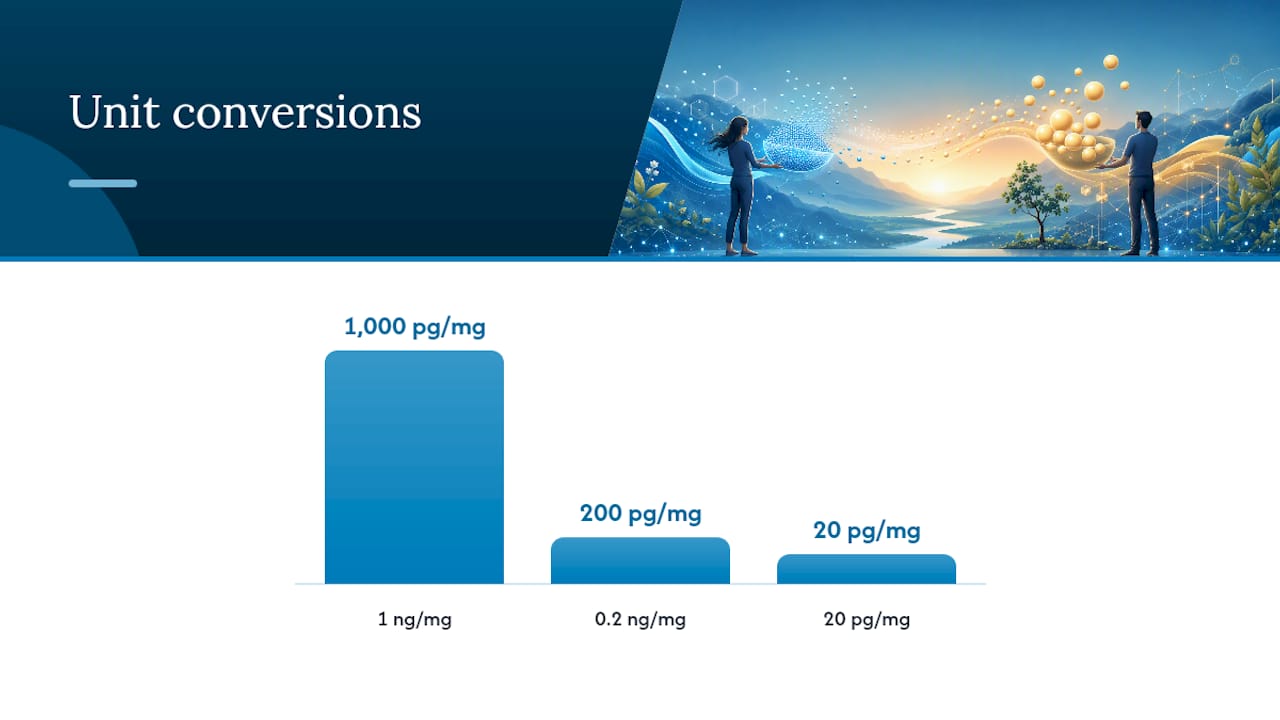
Labs set numeric thresholds, cut-offs, that a measured concentration has to clear before the substance is reported as present. Below that line, the report reads negative regardless of what trace signal the instrument might have picked up. Practical explainers on unit conversion stress this exact point: the unit changes what a number means far more than the digits themselves do.
Cut-off values vary by drug class and by lab, but rough examples that commonly appear in the industry include:
| Substance class | Typical cut-off range | Unit |
|---|---|---|
| Cocaine and metabolites | Around 0.2 ng/mg | ng/mg |
| Opiates | Around 0.2 ng/mg | ng/mg |
| Amphetamines | Around 0.2 ng/mg | ng/mg |
| Cannabinoids (THC/metabolites) | Often reported in pg/mg ranges | pg/mg |
| Ethyl glucuronide (EtG, alcohol marker) | Consensus bands published by the Society of Hair Testing | pg/mg |
Treat that table as a reference point, not gospel. Individual labs set their own thresholds, and the Society of Hair Testing publishes consensus guidance specifically because cut-offs aren’t universally standardized across every facility.
Pro Tip: Before you argue with a number, call the lab and ask which cut-off they applied, which confirmation method backed it up, and what unit the result is expressed in. Those three answers resolve more disputes than any calculator ever will.
Why Do Labs Confirm Positive Results Twice?
Because the first test is built for speed, not certainty. Hair testing runs on a two-stage process, and skipping straight from a screening number to a conclusion is where a lot of confusion starts.
Stage one is an immunoassay screen: fast, cheap, and sensitive, but prone to false positives because it reacts to structurally similar compounds, not just the exact target substance. Anything that screens positive moves to stage two: confirmation testing using gas chromatography mass spectrometry (GC-MS) or liquid chromatography tandem mass spectrometry (LC-MS/MS). These methods identify the specific metabolite and quantify it, which is what gives a confirmed result its weight in employment disputes, legal proceedings, or custody matters. This two-tier structure is the industry standard specifically because screening alone isn’t reliable enough to stand on its own.
A report that only shows a screening result is not the same document as one showing a GC-MS or LC-MS/MS confirmed positive. If you’re looking at a number and unsure which stage it came from, here’s what to check:
- Does the report explicitly name a confirmation method (GC-MS or LC-MS/MS), or does it only list a screening assay?
- What cut-off value did the confirmation stage use, and does it match or differ from the screening cut-off?
- Is there a lot number, assay date, and chain-of-custody reference attached to the confirmed result?
- Was a wash-residue check performed, and what did it show?
Any lab running forensic-grade testing should be able to answer all four points directly. If they can’t, that’s information in itself, and reason enough to slow down before accepting the result at face value.
What Factors Can Skew a Hair Test Result?
Biology and cosmetics both push measured concentrations up or down, sometimes dramatically, and that’s exactly why interpreting a single number in isolation is risky. Darker, coarser hair tends to bind more of certain drug compounds than lighter, finer hair, which means two people with identical exposure histories can produce different numbers purely because of pigment and hair structure. Individual growth rate adds another layer of variability on top of that.
Contamination is the other major wildcard. External exposure, someone handling a substance and touching their hair, secondhand smoke settling on strands, can deposit trace material on the hair’s surface without it ever being metabolized internally. Labs try to catch this by washing samples before testing and comparing what shows up in the wash residue against what’s found inside the hair shaft; residue levels that outpace internal levels point toward surface contamination rather than actual use.
Cosmetic treatments complicate the picture further:
- Bleaching and repeated dyeing can strip drug metabolites out of the hair shaft, sometimes lowering a true positive into a false negative range.
- Chemical straightening and relaxing processes have similarly unpredictable effects on measured concentrations.
- Frequent washing with certain shampoos can reduce surface-bound material without necessarily affecting what’s embedded internally.
Prescribed medications, individual metabolism, and occupational or environmental exposure round out the list of variables labs and toxicologists weigh before drawing conclusions. A critical review of interpretation problems in hair analysis documents legal cases where these confounders were central to disputed outcomes, which is exactly why a single number rarely tells the whole story on its own.
How Should I Interpret Low, Moderate, and High Levels?
Where a number falls relative to the cut-off shapes what it commonly suggests, though none of these bands translate into an exact date or a precise dose. Below cut-off means the lab didn’t detect a reportable level, which is recorded as negative even if trace signal existed below the reporting threshold; that can reflect no exposure at all, or exposure so minor or so environmental that it never crossed the line.
A low positive, sitting just above the cut-off, often points toward light or occasional use, but “often” is the operative word since contamination and individual biology can produce a similarly modest number from very different underlying situations. Moderate positives, well clear of the threshold, tend to suggest repeated exposure across the tested window. High positives, multiples above cut-off, generally indicate frequent or heavy use.
| Result band | Relation to cut-off | Common interpretation | Key caveat |
|---|---|---|---|
| Negative | Below cut-off | No reportable exposure | May still reflect minor or environmental exposure below threshold |
| Low positive | Just above cut-off | Light or occasional use | Ambiguous; contamination can mimic this range |
| Moderate positive | Well above cut-off | Repeated use over weeks | Overlaps with heavy single-episode exposure in some cases |
| High positive | Multiples above cut-off | Frequent or heavy use | Still not a dose or frequency count |
These bands describe patterns, not timelines or amounts. Research on hair testing and self-reported use confirms that concentration level correlates with frequency more than with precise timing, and the categories overlap enough at the edges that two people with genuinely different histories can land in the same band. Reading the number is only step one; reading it in context is what actually matters. For a closer look at how specific thresholds get set, cut-off level explanations break down the mechanics lab by lab.
Understanding the Difference Between Product Marketing and Lab Science
The site sells various hair-cleansing products and publishes informational content about how hair testing works. That’s worth stating plainly, because it matters for how you should weigh what you read here against what a laboratory report tells you.
Marketing claims about detox products, including the ones Passhairdrugtest sells, don’t change how a lab sets its cut-offs, runs its confirmation tests, or interprets a chain-of-custody record. Those are separate systems entirely. A shampoo’s effectiveness claims have zero bearing on whether a GC-MS confirmation is accurate or whether a wash-residue check flagged contamination.
If you are disputing a result, the forensic toxicologists who specialize in this field and the laboratory’s own documentation are the authorities that matter, not product pages, including this one’s.
- Keep any product research and any lab dispute as two entirely separate tracks.
- Lean on method documentation, cut-off values, and forensic review when you need to actually understand or contest a number.
- Treat informational pages, including this article, as orientation, not as evidence you’d submit anywhere.
Pro Tip: If a result is being contested in an employment or legal setting, keep every product receipt and every lab document in separate folders. Mixing them muddies a case that should rest entirely on the lab’s own paperwork.
What Should I Do After an Unexpected Result?
Don’t argue with the number until you’ve pulled the full paper trail behind it. Work through these steps in order:
- Read the report header carefully. Confirm the lab’s name, the test method used, the specific cut-off values applied, your sample ID, and the collection date.
- Call the lab directly. Ask what confirmation method was used (GC-MS or LC-MS/MS), what cut-off triggered the positive, and whether wash-residue data was collected and what it showed.
- Request the chain-of-custody record. This documents who handled your sample from collection through testing and flags any gaps or irregularities.
- Ask about reanalysis or split-sample testing. Many labs retain a portion of the original sample specifically for this purpose.
- Consider a complementary matrix. Urine or blood testing can help clarify recent use if the hair result timeline is in question.
- Bring in a forensic toxicologist or attorney for high-stakes situations. Job termination, custody disputes, and licensing boards are contexts where expert interpretation is worth the cost.
Pro Tip: Request everything in writing, including phone conversations you have with lab staff. A verbal explanation that never makes it into your file won’t help you later if the dispute escalates. If the result already came back unfavorable, a breakdown of what a failed test means and what comes next covers the practical side of moving forward.
Where to Verify Methods and Cut-Offs
For deeper verification, the Society of Hair Testing publishes consensus cut-off documents, ATSDR’s guidance covers environmental exposure limitations, and the 2017 critical review in the toxicology literature catalogs real interpretation disputes. Each fills a different gap: standards, exposure context, and documented pitfalls.
Get the Right Support Before You Act on a Result
Passhairdrugtest built its business on more than two decades in the drug-testing and detox-product space, and that experience shapes how the company talks about hair testing on its own informational pages. If you’re researching hair-cleansing options ahead of a scheduled test, the Macujo Method and related product line is built around the same shampoos, Aloe Rid and Zydot Ultra Clean, that the company has centered its guidance on for years, backed by phone support for anyone working through the multi-step process.
None of that changes what a laboratory report says once a sample has already been collected and analyzed. But if you’re still in the preparation window, understanding your options before test day matters more than trying to reinterpret a result after the fact.
The Real Problem With How People Read These Reports
Most confusion around hair test numbers doesn’t come from the science being complicated. It comes from skipping the unit. People see “0.3” and assume it means something in isolation, without checking whether that’s pg/mg or ng/mg, and that single oversight can flip a sensitivity comparison completely backward.
The conventional advice, “ask what your number means,” is fine but incomplete. The better question is narrower: what unit, what cut-off, and what confirmation method. Those three data points do more interpretive work than any levels chart or general explainer, including this one.
Where I think most guidance falls short is treating hair testing like it produces a clean timeline. It doesn’t. It produces a pattern, blurred at the edges by growth rate, cosmetic history, and contamination risk. Readers chasing an exact date or an exact dose off a single number are asking the test to do something it was never built to do. The number tells you roughly how much, roughly how often, over a window that’s itself approximate. Anyone disputing a result should spend their energy on the lab’s documentation, not on decoding the number harder.
— MIchael
This article is general information, not a substitute for advice from a qualified lawyer. Consult a qualified legal professional about your own circumstances before acting on anything here.
Sources
- Hair follicle drug test: How it works, what to expect, and accuracy – Medical News Today
- Critical review on interpretation problems in hair analysis (2017) – PubMed
- Hair sample testing: What can hair sampling results tell me about environmental exposures? – ATSDR
- Hair test results: the levels chart, and what pg/mg means – HairTestingAnalysis
FAQ
How Do I Read Hair Follicle Test Levels?
Compare the reported concentration, in pg/mg or ng/mg, against the lab’s cut-off for that substance. If confirmation testing backs a result above that threshold, it’s reported as positive; below it, negative.
What Does a 90 Day Hair Sample Test Actually Show?
A 90 day estimate comes from testing 1.5 inches of scalp hair closest to the root, but it reflects a pattern of exposure over that approximate window rather than an exact date or specific dose.
What Can Throw Off a Hair Follicle Test Result?
Hair pigment and growth rate, external contamination from handling or secondhand exposure, and cosmetic treatments like bleaching or straightening can all raise, lower, or distort a measured concentration.
What Are the Cut-Off Levels for an EtG Hair Test?
Cut-off values for ethyl glucuronide, the alcohol marker tested in hair, follow consensus bands published by the Society of Hair Testing, and individual labs may apply their own thresholds within that guidance.
Recommended
- Hair Test Cutoff Levels: What the Numbers Actually Mean
- How Labs Use Phase II Metabolites to Confirm Drug Use in Hair
- Body Hair vs Head Hair: What Drug Test Labs Really Use
- Hair Drug Test Information
