Uncategorized
Pre-Employment Hair Test: What Job Applicants Need to Know
Aug
A pre-employment hair test clips a small lock of hair close to the scalp and analyzes it for drug metabolites, covering roughly the past 90 days of use. It is more resistant to short-term evasion than urine or saliva tests, and major labs like Quest Diagnostics and LabCorp use it widely in hiring programs across safety-sensitive industries.
Quick facts:
- Sample size: a small cosmetically undetectable lock of hair, typically about a single row of hair roughly 1 cm wide, clipped close to the scalp
- Confirmation method: initial immunoassay screen followed by confirmatory GC‑MS/MS
- Who orders it: employers in transportation, healthcare, manufacturing, and other safety-sensitive sectors; GoodHire and similar background-screening platforms facilitate ordering for smaller employers
- DOT/SAMHSA standards apply to federally regulated transportation workers; private employers follow their own policies within state law
Table of Contents
Key Takeaways
A pre-employment hair test covers roughly 90 days of drug use history, uses GC‑MS/MS confirmation to minimize false positives, and is significantly harder to evade through short-term abstinence than urine testing.
| Point | Details |
|---|---|
| 90-day detection window | Hair grows ~1 cm/month; labs analyze 3 cm, covering roughly three months of use history. |
| Two-stage lab process | Initial immunoassay screen plus confirmatory GC‑MS/MS; a non-negative screen is not a confirmed positive. |
| 5–7 day blind spot | Drugs take about 5–7 days to appear in hair, making hair testing unsuitable for post-accident screening. |
| Legal and policy variation | DOT does not currently mandate hair testing; state laws vary on pre-employment testing rights and marijuana protections. |
| Passhairdrugtest | Sells Macujo Aloe Rid Shampoo, Zydot Ultra Clean, and multi-step kits for applicants researching hair-cleansing protocols before a test. |
Table of Contents
- What is a hair follicle drug test in pre-employment screening?
- How is a pre-employment hair test performed?
- Which drugs does a pre-employment hair panel screen for?
- How far back does a hair drug test actually look?
- How accurate is a hair drug test, and what causes false results?
- What should you expect at a pre-employment hair collection?
- U.S. employer and legal considerations for hair testing
- What to do if your pre-employment hair test comes back non-negative
- What does the evidence say about detox shampoos and evasion methods?
- Why employers choose hair testing over other methods
- An honest perspective on what applicants actually face
- What Passhairdrugtest offers readers researching hair-cleansing options
- Sources
What is a hair follicle drug test in pre-employment screening?
The phrase “hair follicle test” is a common misnomer. The test actually analyzes the hair shaft above the scalp, not the living follicle beneath the skin. Samples are clipped, not plucked. Plucking would be painful and is not used in routine testing.
Employers choose this test for roles where sustained impairment poses a safety or liability risk: truck drivers, nurses, heavy-equipment operators, and similar positions. It typically appears as a condition of a job offer rather than during the interview stage, and many employers include it in random post-hire testing programs as well.
One reason employers favor hair over urine alone is the combination strategy. Quest Diagnostics notes that employers commonly pair hair testing with urine or oral-fluid testing to cover both very recent use and longer-term patterns. Urine catches the last few days; hair catches the last three months. Together, they close most gaps.
How is a pre-employment hair test performed?
Collection
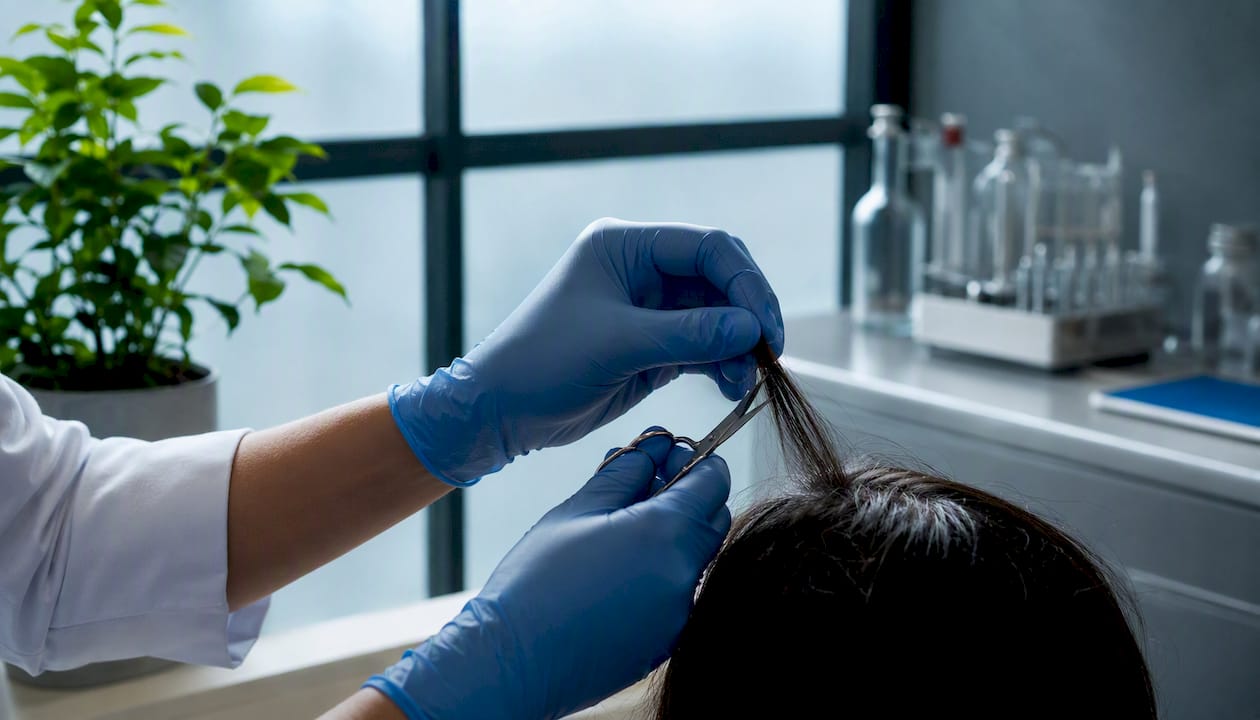
A collector at a clinic or employer-designated site checks your ID, visually inspects your hair, and cuts a small bundle from the back of the crown, as close to the scalp as possible. The standard sample is a single row roughly 1 cm wide, yielding approximately 90–120 strands (about 100 mg of hair). That amount is enough for both the initial screen and a confirmatory test if needed, and the cut is cosmetically undetectable in most hairstyles.

If head hair is too short or unavailable, body hair from the chest, underarm, or leg can substitute. Body hair grows more slowly and reflects a longer, less precise timeline, so labs note the source on the report.
Lab workflow
The sample goes through two analytical stages:
- Initial screen: An immunoassay or ELISA screen flags samples that exceed cutoff thresholds for targeted drug classes.
- Confirmatory testing: Any non-negative result moves to GC‑MS/MS or LC‑MS/MS, which identifies and quantifies specific metabolites. This step is what separates a presumptive screen from a confirmed positive.
Typical turnaround from collection to result is 2–3 business days for a negative screen. Confirmed positives take longer because of the additional analytical step and Medical Review Officer (MRO) review.
Chain-of-custody and accreditation
| Parameter | Standard Practice |
|---|---|
| Sample size | ~100 mg / 90–120 strands |
| Initial method | Immunoassay / ELISA screen |
| Confirmation method | GC‑MS/MS or LC‑MS/MS |
| Typical turnaround | 2–3 business days (negative); longer for confirmed positives |
| Accreditation signals | CAP, CLIA certification; SAMHSA cutoffs for regulated programs |
Chain-of-custody documentation tracks the sample from collection through final reporting. Labs certified under CAP (College of American Pathologists) or CLIA (Clinical Laboratory Improvement Amendments) follow strict handling protocols. Split samples, where a portion is retained for potential retesting, are standard at accredited labs.
Pro Tip: At collection, ask for a copy of the chain-of-custody form and note the collector’s name and the lab’s accreditation. If you need to dispute a result later, this documentation is your starting point.
Which drugs does a pre-employment hair panel screen for?
Standard five-panel hair tests cover the same drug classes as federal urine testing programs:
- THC (marijuana metabolites, specifically 11-nor-9-carboxy-THC)
- Cocaine (benzoylecgonine and cocaine metabolite)
- Opiates (codeine, morphine, 6-acetylmorphine for heroin)
- Amphetamines (amphetamine, methamphetamine, MDMA/ecstasy)
- PCP (phencyclidine)
Expanded panels add benzodiazepines, barbiturates, propoxyphene, methadone, and oxycodone, among others. The exact metabolites tested and the cutoff concentrations depend on the lab and whether the employer follows SAMHSA guidelines or a custom panel. Prescription medications that produce positive results are reviewed by an MRO, who contacts the applicant to verify legitimate use before a result is reported to the employer.
How far back does a hair drug test actually look?
The standard detection window is approximately 90 days. Hair grows at roughly 1 cm per month, and labs analyze the 3 cm of hair closest to the scalp. Each centimeter represents about one month of history, so the test can be segmented to show roughly when use occurred.
Healthline explains that drugs take about 5–7 days to appear in the hair shaft after use, because the substance must be incorporated into new hair as it grows from the follicle. That lag means the test has a blind spot for very recent use.
| Test type | Approximate detection window |
|---|---|
| Hair | ~90 days |
| Urine | Days (varies by substance) |
| Oral fluid | 1–3 days |
The 5–7 day lag also explains why hair testing is a poor choice for post-accident testing, where employers need to know about use in the hours before an incident. NCBI resources confirm that urine or oral-fluid tests are better suited for immediate post-incident screening precisely because hair cannot capture that window.
How accurate is a hair drug test, and what causes false results?
Hair testing is generally considered highly accurate when performed by an accredited lab using confirmatory GC‑MS/MS. The two-stage process, screen then confirm, is specifically designed to eliminate the false positives that immunoassay screens alone can produce.
That said, several factors can affect measured concentrations:
- Bleaching, dyeing, and perming can reduce drug concentrations in the hair shaft and may lower detectability, though they do not guarantee a negative result
- Hair color matters because melanin binds some drug compounds more readily; darker hair may show higher concentrations of certain substances at equivalent exposure levels
- Environmental contamination (passive smoke exposure, for example) is a recognized issue, but labs distinguish between external contamination and actual ingestion by looking for metabolites rather than parent drugs alone
- Body hair grows more slowly and reflects a longer, less defined timeline than head hair, which can complicate interpretation
- Low or slow hair growth affects the accuracy of the 90-day estimate
Confirmatory GC‑MS/MS testing is the standard safeguard against false positives. An immunoassay screen alone is never sufficient to report a confirmed positive result. Labs accredited under CAP or CLIA are required to follow this two-step protocol before any result reaches an employer.
What should you expect at a pre-employment hair collection?
Here is the typical sequence at a collection site:
- Present a government-issued photo ID. The collector verifies your identity before anything else.
- The collector inspects your hair. They check length and density to confirm a sufficient sample is available.
- Hair is cut close to the scalp. The collector uses scissors to clip the bundle from the back of the crown. You will not feel pain.
- The sample is sealed and labeled. The collector places the hair in a foil packet or collection envelope, seals it, and labels it with your identifying information in your presence.
- You sign the chain-of-custody form. Both you and the collector sign to document the handoff.
- The sample is shipped to the lab. Most collection sites use overnight or same-day courier services to accredited labs.
If your head hair is shorter than about 1 inch, the collector may ask about body hair. Refusing to provide a sample is treated the same as a positive result by most employers, and Medical News Today notes that employers typically cover the cost of pre-employment tests. Applicants are generally not compensated for their time at collection, though this varies by state.
U.S. employer and legal considerations for hair testing
Hair testing sits in a patchwork of federal and state rules.
- Federal transportation workers: DOT Part 40 governs drug and alcohol testing for regulated transportation employees (truck drivers, pilots, railroad workers, etc.). DOT currently mandates urine testing for regulated programs; hair testing is not yet an approved DOT specimen type for mandatory testing, though some employers use it as a supplemental non-DOT test.
- State law variation: Some states restrict pre-employment drug testing, limit which substances can be tested, or require advance notice. California, New York, and several other states have enacted protections around marijuana testing specifically. Check your state’s labor statutes or the ACLU’s state-by-state summaries before building a testing policy.
- Employer obligations: Employers must apply testing policies consistently to avoid discrimination claims. The ADA requires that employers not penalize applicants for lawful prescription drug use without giving them an opportunity to explain a positive result through MRO review.
- Cost: Employers pay for pre-employment tests. Applicants are not required to cover testing costs.
- Notice and consent: Most states require written notice that testing is a condition of employment. Consent forms are standard at collection.
What to do if your pre-employment hair test comes back non-negative
A non-negative result on the initial screen is not a confirmed positive. The process has several checkpoints before a result reaches your employer.
- Confirmatory testing happens automatically at accredited labs. The sample moves to GC‑MS/MS before any result is reported.
- MRO review: A Medical Review Officer contacts you to ask about legitimate prescription use or other medical explanations before finalizing the result.
- Request the lab report: You have the right to ask for a copy of your results. Ask the MRO or the employer’s HR contact for the full report, not just the pass/fail outcome.
- Request chain-of-custody records: If you believe the sample was mishandled, chain-of-custody documentation is the evidence you need.
- Split sample or retest: Ask whether a split sample was retained. If so, you can request independent testing at a certified lab of your choice.
- Document prescription medications: If you take a prescription that could explain the result, gather documentation (pharmacy records, prescriber letter) before the MRO call.
Pro Tip: Ask the MRO specifically which substance triggered the non-negative result and at what concentration. That detail tells you whether a prescription explanation is plausible and whether the concentration is consistent with the use pattern you would describe.
What does the evidence say about detox shampoos and evasion methods?
This is where the marketing claims and the published research diverge significantly.
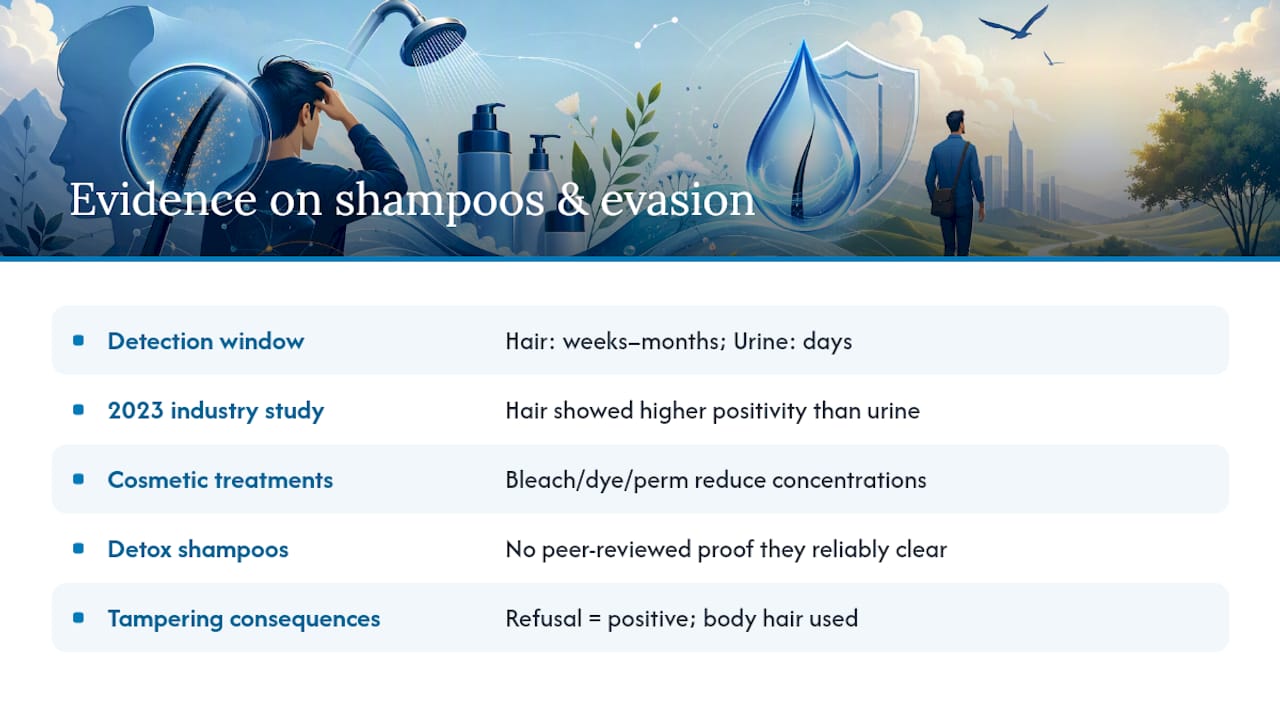
A 2023 industry study in U.S. trucking found that hair testing produced a statistically higher positivity rate than urine testing in the examined dataset, suggesting that hair’s longer window captures repetitive use that urine misses. The implication: people who successfully clear a urine test through short-term abstinence are more likely to show positive on hair.
On cosmetic treatments, bleaching, dyeing, and perming can reduce measured drug concentrations in the hair shaft. No peer-reviewed study has demonstrated that any shampoo protocol reliably produces a negative result across all substances and all users.
The core problem with evasion research is that most published studies involve small samples, controlled lab conditions, or industry-funded data. Consumer-facing claims about “guaranteed” results have no peer-reviewed support. What the evidence does show is that cosmetic treatments alter concentrations, not that they eliminate them reliably enough to change a confirmed GC‑MS/MS result.
Attempting to tamper with or substitute a sample is treated as a refusal by most employers and carries the same consequences as a positive result. Shaving your head does not help either; collectors will move to body hair, and a refusal to provide any sample is documented.
Why employers choose hair testing over other methods
The 90-day window is the primary draw. Urine testing catches recent use; hair testing reveals a pattern. For employers filling roles where chronic impairment is a safety concern, that distinction matters more than catching someone who used once last weekend.
Three practical advantages drive employer adoption:
- Tamper resistance: Collection is observed, and the sample is a physical lock of hair. Substitution is not possible the way it can be with urine. Quest Diagnostics’ employer materials note that hair testing often finds more positives than urine precisely because short-term abstinence does not clear a 90-day record.
- Pattern detection: Segmented analysis can show whether use was recent or months ago, giving employers more context than a single urine result.
- Reduced collection logistics: No restroom required, no temperature checks, no observed collection concerns.
Hair testing is most common in transportation, healthcare, manufacturing, and federal contracting. GoodHire, LabCorp, and Quest Diagnostics all offer hair testing as part of pre-employment background and screening packages. Where hair testing is weakest is post-accident and reasonable-suspicion testing, where the 5–7 day lag makes it the wrong tool. For those situations, oral fluid or urine remains the standard.
For a deeper look at hair follicle drug testing procedures and why employers prefer them, Passhairdrugtest’s resource library covers the employer-side reasoning in detail.
An honest perspective on what applicants actually face
The conventional advice you see everywhere is “just stop using.” That is correct, but it undersells how long “just stop” needs to be for hair. Three months of abstinence clears the standard 90-day window. Two months does not. One month definitely does not.
What applicants consistently underestimate is the segmentation capability. Labs can tell whether your use was concentrated in month one, month two, or month three of the window. Stopping use two weeks before a test and hoping the recent segment looks clean is not a strategy; it is a gamble against a test that was specifically designed to see through short-term abstinence.
The other thing worth saying plainly: the detox shampoo market is large, and the evidence base for it is thin. That does not mean every product is useless, but it does mean that anyone claiming a guaranteed outcome is overstating what the published research supports. Cosmetic treatments alter concentrations. Whether they alter them enough to cross a specific lab’s cutoff threshold, for your specific substance, at your specific use level, is genuinely uncertain.
Preparation that actually helps: stop use as early as possible, keep prescription documentation current, be cooperative at collection, and know your chain-of-custody rights before you walk in.
What Passhairdrugtest offers readers researching hair-cleansing options
For applicants who have already decided to explore hair-cleansing protocols, Passhairdrugtest carries the products most commonly referenced in this space: Macujo Aloe Rid Shampoo for use with Mike’s Macujo Method, Zydot Ultra Clean Shampoo, and multi-step hair follicle shampoo kits that combine both products with usage instructions.
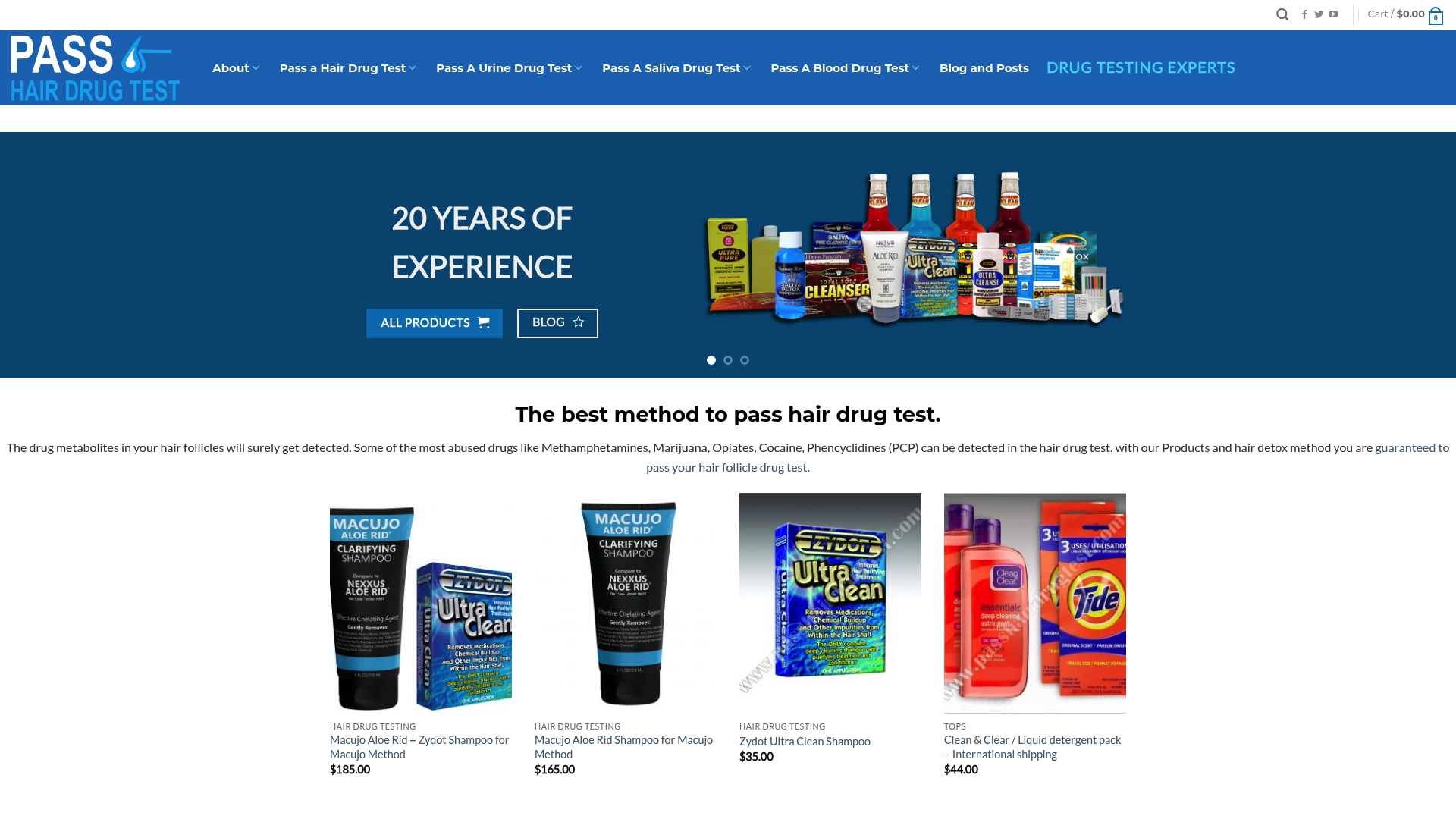
These products aim to reduce detectable metabolite concentrations in the hair shaft through a multi-step cleansing protocol. As covered in this article, published evidence on detox shampoo efficacy is limited and inconsistent. Passhairdrugtest does not claim guaranteed results, and these products do not replace confirmatory testing rights or MRO review. If you are facing a pre-employment screening, follow your employer’s policy, exercise your right to confirmatory testing if needed, and use these products as one part of a broader preparation approach. Browse the full hair testing shampoo kit range to compare options and protocols.
Sources
The claims in this article draw from the following primary and peer-reviewed sources. Each covers a distinct aspect of hair drug testing.
- Hair testing – FAQ
- Hair Strand Drug Test: How It Works, Uses, and What to Expect
- Hair follicle drug test: How it works, what to expect, and accuracy
- Research comparing pre-employment test results in the U.S. trucking industry
- DOT Part 40 guidance
- NCBI: Forensic toxicology and detection windows (chapter/resource)
This article is general information, not a substitute for advice from a qualified lawyer. Consult a qualified legal professional about your own circumstances before acting on anything here.
Recommended
- Hair Drug Test Information – Pass Hair Drug Test
- Body Hair Drug Test: What You Need to Know
- Hair Follicle Drug Test Information – Pass Hair Drug Test
- The Science Behind the Hair Drug Test – Pass Hair Drug Test
