Uncategorized
How to Pass a DOT Hair Test: What the Law and Labs Say
Aug
If you’re searching for how to pass a DOT hair test, here’s the short answer: under current federal rules, you almost certainly aren’t facing a DOT hair test at all. Under Part 40, DOT authorizes only urine and oral fluid specimens for federally mandated drug testing. Hair is not an approved primary specimen. So if your employer told you a hair test is coming, it’s almost certainly a non-DOT program, and that distinction changes everything about your options.
Three things to do right now:
- Verify the test type. Ask HR or your employer whether this is a DOT-regulated test or a company-run non-DOT program. The answer determines your legal exposure and your realistic options.
- Confirm the sample collection date. Time is the most valuable resource you have. Even a few extra weeks of abstinence meaningfully changes what a lab can detect.
- Review your options. If it’s non-DOT, you have more room to prepare. Abstinence, timeline management, and a structured product-assisted protocol are all on the table.
Pro Tip: Ask your employer’s HR department for the name of the testing laboratory and whether the test is DOT-regulated. That single piece of information tells you which rules apply and what your real risk level is.
Table of Contents
Key Takeaways
Hair testing is not authorized under DOT’s Part 40, so most people facing a hair test are in a non-DOT employer program where abstinence, timeline management, and a structured product protocol are the most realistic tools available.
| Point | Details |
|---|---|
| DOT does not use hair tests | Part 40 authorizes only urine and oral fluid; a hair test is almost always a non-DOT employer program. |
| 90-day detection window | A standard 1.5-inch scalp sample covers approximately 90 days of use history. |
| Abstinence is the foundation | No product removes embedded metabolites reliably; stopping use immediately is the single most effective step. |
| Chemical treatments reduce, not eliminate | Lab studies show some protocols lower detectable concentrations but cannot guarantee a negative result. |
| Passhairdrugtest kits support prep | Multi-step kits (Aloe Rid + Zydot Ultra Clean) are best used alongside early abstinence and a structured timeline. |
Table of Contents
- How does hair follicle drug testing actually work?
- Which drugs does a hair test detect, and how far back does it look?
- What does a collector need from you, and what happens if you shave?
- Do detox shampoos and the Macujo method actually work?
- How labs confirm results, and what DOT rules actually say
- What you can realistically do before a scheduled hair test
- What are the real risks of trying to cheat a hair test?
- An honest take on hair test prep
- Passhairdrugtest has the kits and guides to support your prep plan
- Sources
How does hair follicle drug testing actually work?
The mechanism is straightforward but hard to beat. Drugs enter the hair shaft via the bloodstream during hair formation, which means metabolites become physically embedded in the hair matrix as it grows. This is systemic exposure, not surface contamination. Washing your hair the night before a test does almost nothing to the metabolites locked inside the strand.
Most people assume “hair follicle test” means the root is plucked. It doesn’t. Workplace tests use cut hair strands, approximately 1.5 inches taken as close to the scalp as possible, representing roughly a 90-day look-back window. The follicle itself rarely leaves the building. That distinction matters because it changes what you can and can’t do about the sample.
Here’s what happens in the lab after collection:
- The sample is washed to remove surface contaminants (sweat, environmental residue, external drug exposure).
- The hair is segmented, typically into approximately 1.5-inch sections, each representing about 90 days.
- The sample is dissolved and extracted, then screened using an immunoassay (ELISA).
- Any nonnegative result goes to confirmatory testing via GC/MS or LC-MS/MS, which identifies specific drugs and their metabolites with high precision.
Key point: The lab wash removes external contamination, but it does not remove metabolites embedded in the hair cortex. That’s why surface-level shampoos face a fundamental biological limit.
The two-step process, screen then confirm, is specifically designed to eliminate false positives from foods, medications, or environmental exposure. If ELISA flags a sample, GC/MS or LC-MS/MS confirms the actual drug compound and concentration before any result is reported.
Pro Tip: Hair growth averages about half an inch per month, but this varies by individual, hair type, and body location. Body hair grows more slowly, which means a body hair sample can represent a much longer look-back period than scalp hair.
Which drugs does a hair test detect, and how far back does it look?
Hair panels typically screen for five drug classes: THC metabolites (marijuana), cocaine and its metabolites, opiates (including heroin, codeine, and morphine), amphetamines and methamphetamine, and phencyclidine (PCP). Many expanded panels also include MDMA, oxycodone, and other prescription opioids.

The standard detection window is approximately 90 days for a 1.5-inch scalp sample. Hair grows at roughly half an inch per month, so the math maps cleanly to time:
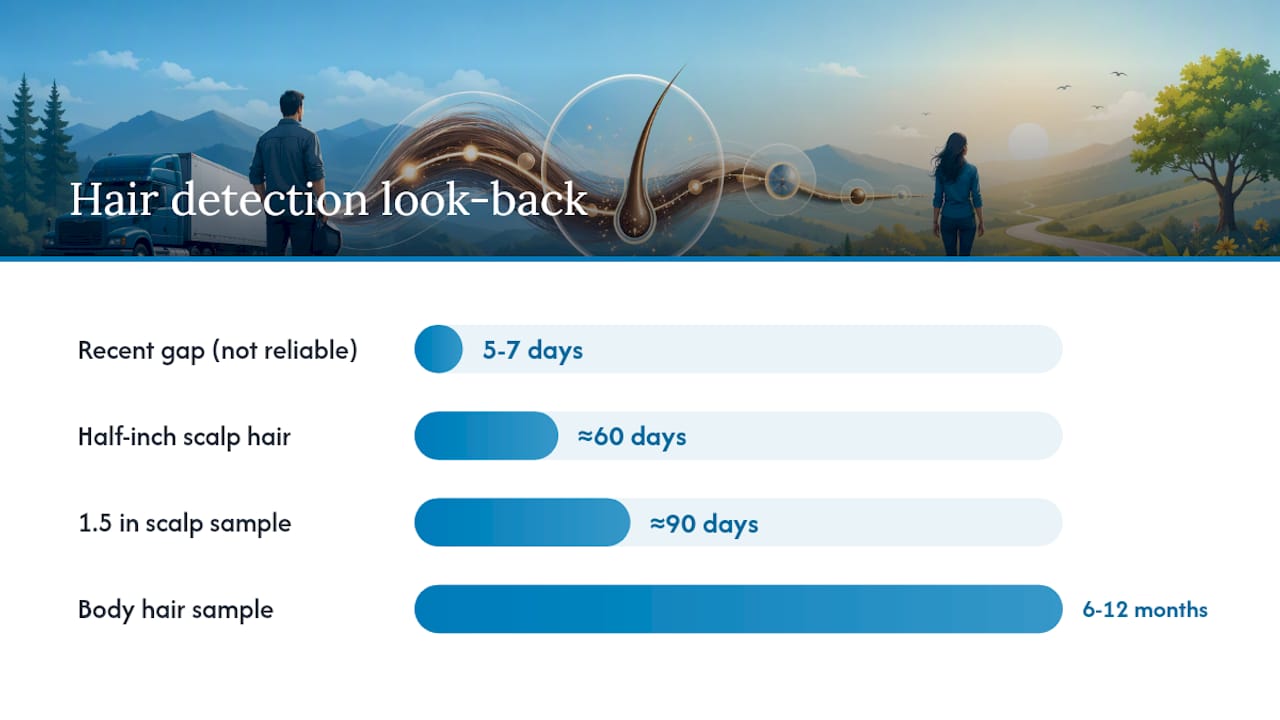
| Hair length collected | Approximate look-back period |
|---|---|
| half an inch | approximately 60 days |
| — | ~60 days |
| 1.5 inches | ~90 days |
| — | about 90 days |
There’s a critical gap at the recent end: hair tests are not reliable for detecting use within the past 5–7 days because newly grown hair near the scalp hasn’t fully keratinized and incorporated metabolites yet. If your last use was yesterday, a hair test won’t catch it. If it was three weeks ago, it likely will.
A few important limits:
- Hair color and texture affect metabolite concentration. Darker, coarser hair tends to bind certain drug metabolites more readily than lighter hair, which can affect measured levels.
- Body hair grows more slowly than scalp hair, so a body hair sample may represent 6–12 months of history rather than 90 days.
- Hair tests detect patterns of consistent or repeated use more reliably than single-use events, though a single heavy-use episode can still produce a positive result depending on the drug and the dose.
What does a collector need from you, and what happens if you shave?
The standard sample spec is about 1.5 inches of hair, cut in a bundle roughly the diameter of a pencil, taken from the crown of the scalp as close to the skin as possible. That’s it. The collector documents the sample source, seals it in a tamper-evident package, and initiates a chain-of-custody form that follows the sample to the lab.
What happens when scalp hair is short or absent:
- Short scalp hair: If your hair is shorter than 1.5 inches, the collector takes what’s available. A shorter sample means a shorter look-back window, not a failed collection.
- Shaved head: Collectors are trained for this. They move to body hair, typically chest, arm, or leg hair. Body hair grows more slowly, so a 1.5-inch body hair sample can represent 6–12 months of history rather than 90 days. Shaving your head before a test can actually work against you.
- No usable hair anywhere: A collector who cannot obtain any sample documents the situation. Depending on the employer’s policy, this may be treated as a refusal, which carries the same consequences as a positive result in many programs.
Chain-of-custody is the backbone of the process. The collector signs and seals the sample at the point of collection, and every transfer to the lab is documented. Labs can and do rewash and retest samples if tampering or contamination is suspected, per federal mandatory guidelines for workplace drug-testing programs. An unbroken chain of custody is what makes the result legally defensible.
Do detox shampoos and the Macujo method actually work?
No external method reliably guarantees a negative result. Abstinence is the only approach with a proven track record. That said, the evidence on chemical treatments is more nuanced than a flat “they don’t work” dismissal.
Controlled laboratory studies show that some chemical treatments, including bleach, strong solvents, and salicylic acid-based products, can reduce measurable metabolite concentrations in hair. The key word is “reduce,” not “eliminate.” Here’s what the evidence actually says about common approaches:
- Clarifying shampoos alone: Minimal effect on embedded metabolites. They remove surface buildup and external contamination, but the cortex of the hair shaft is largely unaffected.
- Bleaching and chemical dye: Can reduce metabolite levels measurably in lab settings. The reduction is inconsistent and depends on the drug, the concentration, and how many treatments are applied. Bleaching also visibly damages hair.
- Multi-step protocols (Macujo-style methods): These combine acidic treatments, clarifying agents, and deep-cleansing shampoos in a repeated sequence designed to open the hair cuticle and flush metabolites from the cortex. Lab evidence suggests these approaches can lower detectable levels more than single-product use, but results vary significantly by drug type, use history, and hair characteristics.
- Zydot Ultra Clean: A same-day deep-cleanse product commonly used as the final step in a multi-day protocol. It targets the hair shaft surface and cuticle layer.
Labs are trained to spot chemically damaged hair. Discoloration, brittle texture, and inconsistent fiber integrity are all flags that can prompt additional scrutiny or a request for a retest. The lab doesn’t automatically fail you for damaged hair, but it does raise questions.
Pro Tip: The more time between last use and the test, the more any product-assisted protocol can help. A multi-day regimen started immediately after abstaining gives metabolite levels time to drop naturally while the protocol works on what remains in the shaft.
How labs confirm results, and what DOT rules actually say
Labs run a two-stage process. Every hair sample that screens nonnegative on the initial immunoassay (ELISA) goes to a second, more precise test: GC/MS or LC-MS/MS confirmation. This second test identifies the specific drug compound and its concentration, which is why environmental contamination or passive exposure is rarely a successful defense for a confirmed positive.
The pre-wash step matters here. Labs wash the hair sample before analysis specifically to remove external contamination. The argument that you tested positive because someone near you was smoking is largely neutralized by this step. What remains after the wash is what was inside the hair shaft, which reflects systemic exposure.
On the DOT question: DOT does not currently accept hair testing as the primary method for clearing DOT violations. Private employers in trucking, aviation, and other safety-sensitive industries may run non-DOT hair programs alongside their DOT urine programs, but those hair results cannot be submitted to the DOT Clearinghouse as official DOT violations. A positive non-DOT hair test has employment consequences, but it is not a federal DOT violation.
A longitudinal dataset of 936,872 pre-employment tests from 2017 to 2022 found that hair testing detected substantially higher positivity rates than urine across multiple drug classes, including opioids, cocaine, and amphetamines. This is program-level data from one industry sector, not a universal benchmark, but it illustrates why employers who want a broader historical picture are increasingly adding hair to their non-DOT programs.
After a nonnegative hair result, you can typically expect or request:
- Confirmatory GC/MS or LC-MS/MS testing on the same sample before any result is reported.
- Medical Review Officer (MRO) review, where a licensed physician evaluates the result and gives you the opportunity to provide a legitimate medical explanation (such as a valid prescription).
- A retest on the split sample, if one was collected and your employer’s program allows it.
- HR or safety officer notification only after the MRO has finalized the result.
What you can realistically do before a scheduled hair test
The single best action is to stop using immediately. Hair reflects the past weeks and months, not today. Every day of abstinence from this point forward is a day that won’t appear in the next 1.5 inches of growth, even if it doesn’t help the sample that’s already on your head.
Here’s a practical sequence based on your timeline:
- Verify the test type. Confirm with HR whether this is DOT or non-DOT. If it’s DOT, the test will be urine or oral fluid, not hair.
- Get the collection date. Know exactly how many days you have. This determines which protocol is realistic.
- Abstain immediately. No exceptions. New growth from this point will be clean.
- Consider rescheduling. If your employer allows it, even a two-week delay adds meaningful distance between last use and the test.
- Start a multi-day cleansing protocol. If you have 7 or more days, a structured multi-step regimen using a clarifying treatment followed by a deep-cleanse shampoo gives you the best product-assisted odds. Review step-by-step detox shampoo routines to match the protocol to your timeline.
- Use a same-day final cleanse on test day. A product like Zydot Ultra Clean is designed for this step.
- Do not tamper with the sample. Substituting, adulterating, or refusing to provide a sample carries consequences at least as severe as a positive result.
Scenario A: Last use was 60+ days ago. Your risk is lower. The 1.5-inch sample may not reach back far enough to capture that use, depending on your hair growth rate. A multi-day protocol and same-day cleanse are reasonable precautions.
Scenario B: Last use was within the past 7–14 days. Your risk is higher. The metabolites are in the hair that’s already grown. Abstinence won’t remove them from existing hair. A multi-day protocol may reduce concentrations, but there are no guarantees. Be realistic about your options.
Pro Tip: If you take prescription medications that could cross-react with a drug panel (opioid pain medications, ADHD stimulants, certain antihistamines), tell the MRO before results are finalized. Bring documentation. The MRO’s job is to evaluate legitimate medical explanations, and a valid prescription can change the outcome of a confirmed positive.
What are the real risks of trying to cheat a hair test?
Attempting to tamper with a hair sample carries consequences that often exceed the risk of the positive result itself. Labs and collectors are trained to identify irregularities, and the chain-of-custody process creates a documented record of everything that happens from collection to result.
Common consequences of tampering or a confirmed positive in a non-DOT hair program:
- Immediate disqualification from the position or termination of employment.
- A documented refusal-to-test finding if the sample is deemed invalid or the candidate refuses collection.
- Follow-up testing requirements, often more frequent and more invasive, if the employee is retained.
- MRO referral and potential mandatory substance-use evaluation.
- In safety-sensitive industries, removal from safety-sensitive duties pending resolution.
The safest and most defensible path is always the documented, legal one: abstinence, honest disclosure of legitimate prescriptions, and verified medical evidence when applicable. Tampering with a drug test is not a gray area in most employment contracts.
If you have a legitimate medical reason for a potentially positive result, the MRO process exists specifically to evaluate it. SAMHSA provides federal resources for workplace drug-testing programs and treatment referral options if you need support beyond the employment context. A clinician can document your prescription history and provide the MRO with the evidence needed to reclassify a result.
One line of legal guidance: prefer documented, legal steps over tampering attempts. A positive result you can explain is almost always a better position than a tampering finding you cannot.
An honest take on hair test prep
There’s a version of this topic that sells certainty it can’t back up, and a version that refuses to acknowledge that product-assisted prep has any role at all. Neither is useful.
The evidence is clear that abstinence is the foundation. No product changes what’s already embedded in your hair shaft from months of use. What products can do, under the right conditions, is reduce measurable concentrations in the existing sample. That’s a meaningful difference when you’re close to the detection threshold, and it’s essentially irrelevant when you’re a heavy daily user who used three days ago.
The people most likely to benefit from a structured multi-day protocol are those who stopped using several weeks before the test, have moderate rather than heavy use history, and follow the protocol correctly and consistently. The people least likely to benefit are those who used heavily and recently and are hoping a single wash will fix it.
PassHairDrugTest.com has spent more than 20 years in this space. The honest position is this: use the products as part of a broader strategy that starts with abstinence and timeline management. Don’t use them as a substitute for that strategy.
Passhairdrugtest has the kits and guides to support your prep plan
If you’ve confirmed your test is non-DOT and you’re ready to build a real prep routine, Passhairdrugtest offers the products most commonly used in structured multi-step protocols, including Macujo Aloe Rid Shampoo for the multi-day clarifying phase and Zydot Ultra Clean Shampoo as the same-day final cleanse. These aren’t standalone magic solutions. They’re tools that work best when you’ve already started abstaining and you have enough lead time to run the full protocol.
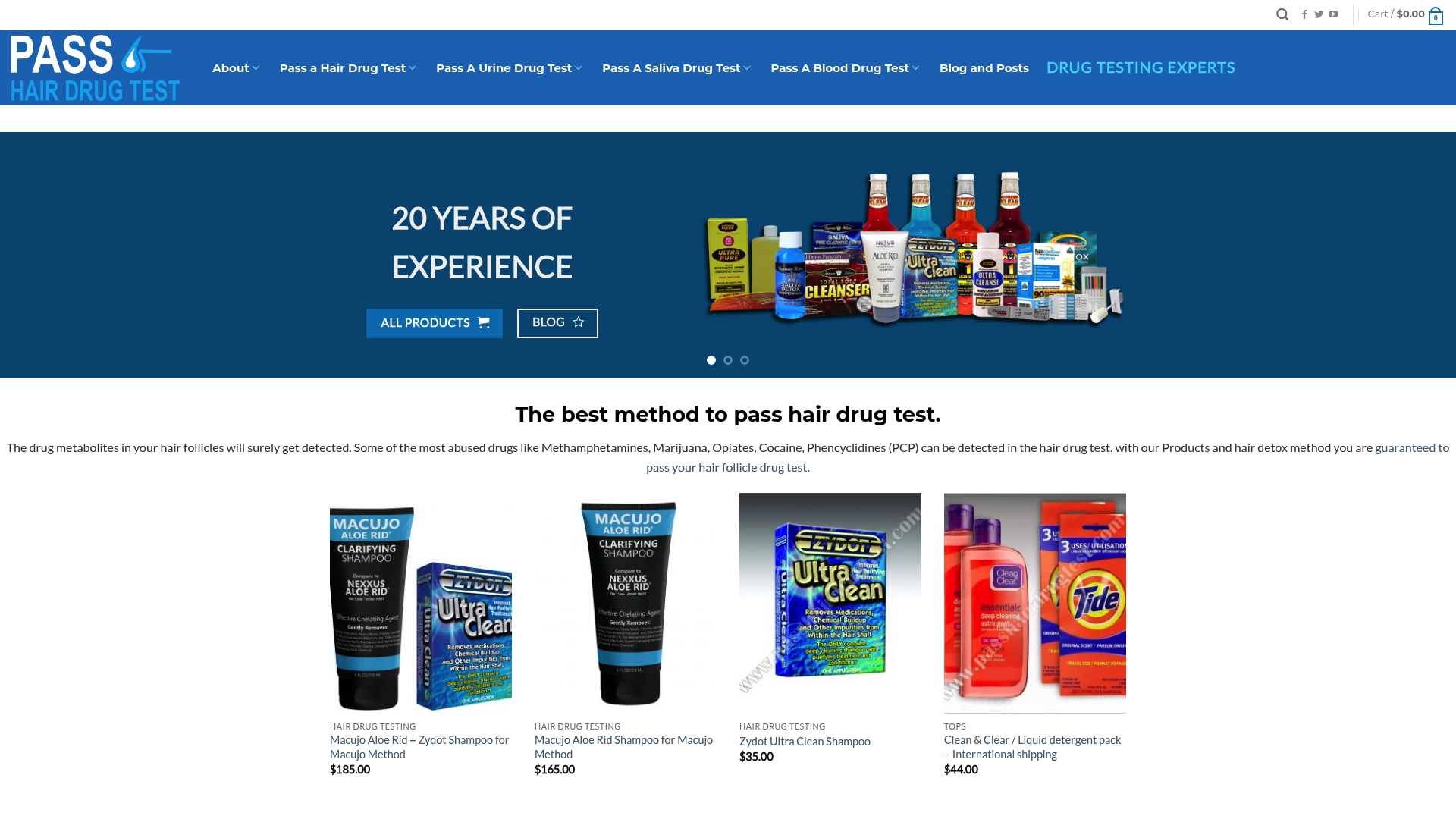
The hair follicle shampoo kit bundles the core products for a complete multi-day and same-day routine, which is the most practical option for most timelines. If you’re working with less time, the Zydot Ultra Clean same-day shampoo is available as a standalone. For readers who want to understand the full sequencing before buying, the Mike’s Macujo Method guide walks through the step-by-step protocol with product timing built in. Customer support and instructional guides are available on the site. No method is 100% guaranteed, and Passhairdrugtest doesn’t claim otherwise. What the products give you is the best-supported product-assisted option currently available.
Sources
The claims in this article draw from federal regulatory guidance, peer-reviewed laboratory science, and clinical reference resources. If you want to verify any specific point or go deeper on the science, these are the primary sources worth consulting.
- Hair Drug Testing 101 — Concentra
- Part 40 — Specimen types authorized for DOT drug testing — U.S. Department of Transportation
- A Longitudinal and Statistical Assessment of Hair vs. Urine Testing — Trucking Alliance (2022 data)
- Effects of cosmetic treatments on drug concentrations in hair — Analytical Science Journals (Wiley)
- SAMHSA — Substance Abuse and Mental Health Services Administration
- Drug testing — Lab tests — MedlinePlus
- How drugs get into hair — NCBI / US National Library of Medicine
This article provides general information only and is not a substitute for legal, medical, or employment advice. Verify current testing rules with your employer, the relevant regulatory authority, or a qualified professional before acting.
Recommended
- Pass hair Drug Test
- How Can I Pass a Hair Drug Test? – Pass Hair Drug Test
- How to Pass a Drug Test on Hair Follicles? – Pass Hair Drug Test
- Hair Detox Products for Drug Testing – Pass Hair Drug Test
