No products in the cart.
Uncategorized
Microdosing THC and Hair Tests: What Labs Can Detect
08
Nov
Nov
Microdosing THC (a few milligrams at a time) does not come with a guarantee of a negative hair test. A hair test looks back about 90 days, and published research shows that light use is detected less reliably than heavy use. Even so, how much hair carries and how a lab reads it depend on your hair, how often you dose, and the lab’s cutoff. This guide covers what the studies found, what the numbers mean and how to prepare if a test is coming.
Table of Contents
TL;DR
- A standard hair test covers roughly the last 90 days, so a microdosing routine inside that window is part of what the lab can look at.
- In published research, hair analysis was better at flagging heavy, near-daily use than light use, and it could not tell how much was taken.
- In one controlled study, volunteers took 2.5 mg of oral THC three times a day for 30 days, and no THC was found in their hair. Real-world results still vary by person and lab.
- Hair color, cosmetic treatments, hair length and the lab’s cutoff all change the outcome, so no one can promise a result for you.
- If you have a hair test coming, start preparing early. We explain the options below.
Table of Contents
- What counts as microdosing, and why hair is different
- How THC gets into hair
- What the research says about low-dose use
- Cutoffs: the numbers behind pass and fail
- Microdosing scenarios, in plain terms
- Does a hair-cleansing shampoo change what a lab sees?
- How to prepare when you have a hair test coming
- Our perspective
- Ready to prepare? Start with the right products
- FAQ
- Sources
What counts as microdosing, and why hair is different
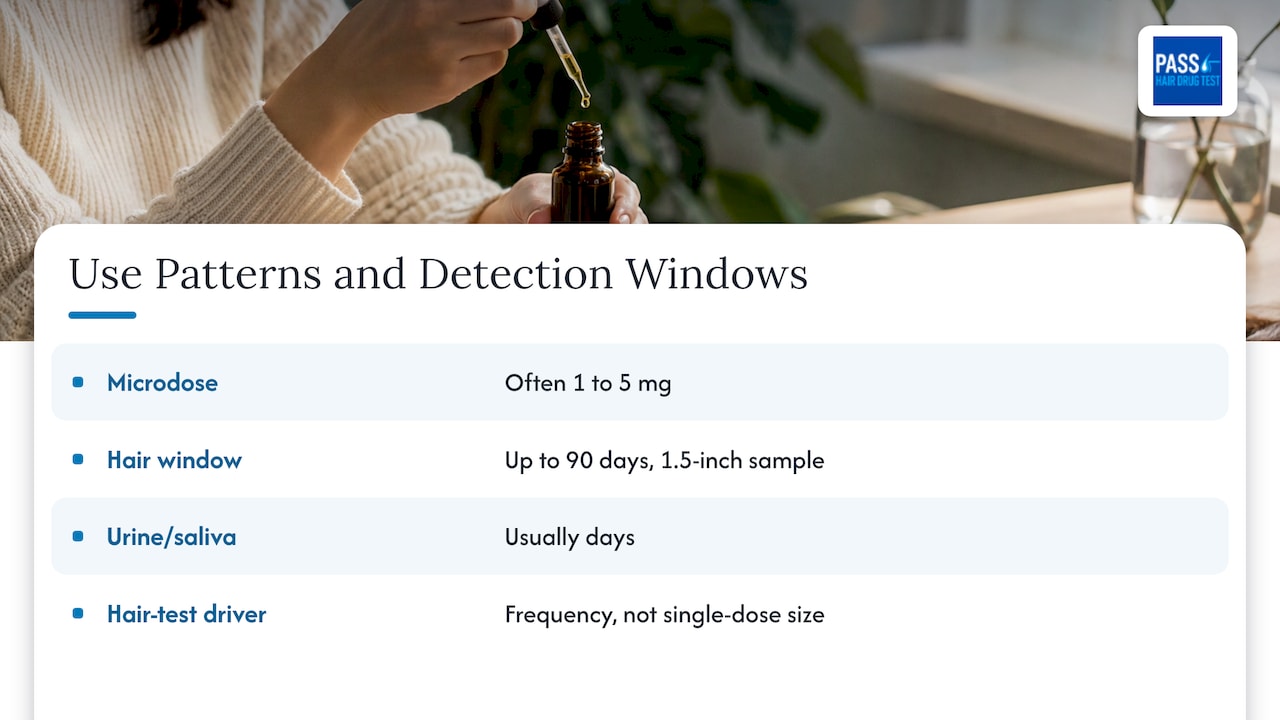
Microdosing usually means taking a small amount of THC, often 1 to 5 mg, in an edible, tincture or a puff or two. The idea is to get subtle effects without feeling high. People often do it daily or several times a week, and that is what matters for a hair test. Frequency, not the size of one dose, drives what ends up in hair over months.
Urine and saliva tests look at recent use, usually days. A hair test is built for a longer view. Labcorp states that hair testing offers a detection window of up to 90 days, based on a 1.5-inch sample. That is why employers who want a longer look use it, and why people who microdose regularly ask whether a low dose is “too small to count.”
The honest answer has two parts. A single small dose is unlikely to be the issue. A steady routine over three months is a different situation, and the science here is less settled than most websites suggest.
How THC gets into hair
Hair grows from the follicle, and substances in the blood can be taken up into the growing hair. A 2025 review in the Journal of Applied Laboratory Medicine explains that drugs can reach the hair bulb in as little as 30 minutes, in a way that depends on pigment. The same review notes that drugs will not show up in hair above the scalp for at least a couple of days, and that this can take up to 10 days.
That gap is why a hair test does not catch what you took last night. For THC specifically, a 2019 review by Shah and colleagues says it takes about two weeks for THC to reach and deposit in hair. It also says samples for THC analysis should be collected a month after the first intake, because that is how long it takes for the drug to be securely deposited.
Two more points matter for microdosers:
- Pigment. Pigmented hair binds more drug than non-pigmented hair, and white hair incorporates almost none in the bulb, according to the same 2025 review and the Shah review.
- Sweat, oils and the environment. THC can reach hair from outside the body too. The SoHT, the professional society for hair testing, notes that external contamination can change concentrations, and that bleaching, dyeing, perming, straightening and UV exposure can all affect what a lab measures.
The practical takeaway is that two people on the same microdosing schedule can get different results. Hair color and hair care are part of the equation.
What the research says about low-dose use
This is the part most people searching this topic want. Here is what the studies actually found.
Light use is detected less reliably
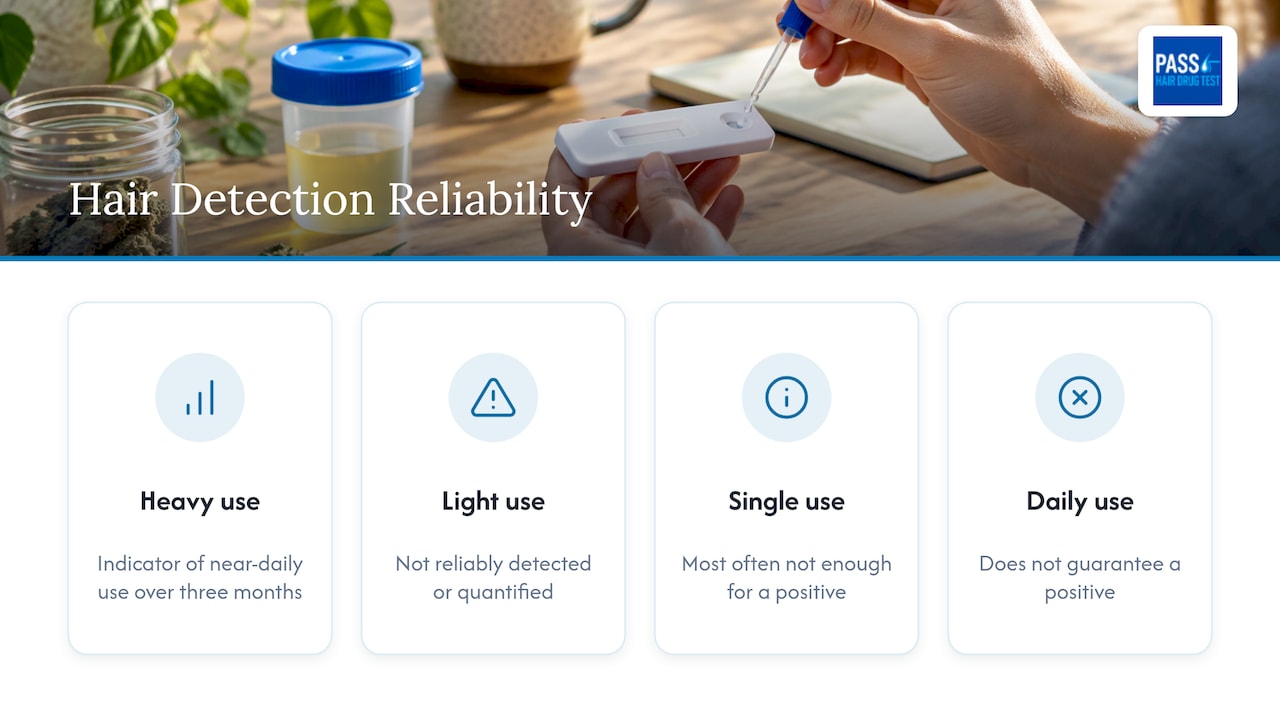
A study by Taylor and colleagues (published in Drug and Alcohol Review, 2017) compared hair results with self-reported use. It found that hair analysis works as an indicator of heavy, near-daily cannabis use in the past three months, but cannot reliably detect light use or work out how much was used. A 2011 Norwegian review reached a similar view: hair is a poor specimen for cannabis, a single use is most often not enough for a positive, and even daily use does not guarantee one.
These findings describe how hair behaves in research settings. They do not tell you what your lab will report. A daily microdose is a regular routine, and a regular routine is closer to the pattern labs look for than an occasional one.
The 2.5 mg study
One controlled study stands out for this keyword. Two volunteers took oral dronabinol (a THC medicine) at 2.5 mg three times a day for 30 days. No THC was found in their head, beard or body hair at a limit of detection of 1 pg/mg, even though their blood levels showed clear exposure. The authors concluded that reaching the SoHT-recommended cutoff through the bloodstream would take extremely high amounts of THC, and that THC in hair cannot on its own be treated as proof of cannabis use.
Two volunteers is a very small sample, and the dose was an oral medicine. It does not prove that a daily edible microdose is safe from detection. It does show why hair results for low-dose use are hard to predict.
Why a positive can still happen
Labs do not all use the same cutoff, and some are very sensitive. Quest Diagnostics told Live Science that only about 1 pg/mg of marijuana needs to be present in hair for a positive, compared with far higher levels for other drugs. That is a much lower line than the 50 pg/mg that research bodies recommend. Which number applies to you depends on the lab and the program, so a low dose that falls under one cutoff could sit above another.
Cutoffs: the numbers behind pass and fail
A cutoff is the concentration at or above which a lab reports a positive. The SoHT 2021 consensus sets a THC cutoff of 50 pg/mg for head-hair segments no longer than 3 cm. It also says that finding THC-COOH, a metabolite, strongly supports that THC was taken in rather than just contaminating the hair. In Germany, forensic guidelines for driving license cases use a detection threshold of 0.02 ng/mg THC, while the SoHT recommends 0.05 ng/mg. Those two figures are in different units from the rest of this section: 0.05 ng/mg equals 50 pg/mg.
Employers in the US often rely on the lab’s own panel, and the screening and confirmation steps may use different levels. The SoHT’s general guidance says that all presumptive positive screens must be confirmed with mass spectrometry. We break the numbers down further in our guide to hair test cutoff levels.
Two cautions apply to every cutoff discussion:
- A hair result does not tell the lab how much you took. The SoHT states that hair concentration cannot determine the quantity consumed.
- Hair length matters. A segment of about 1.5 inches covers around 90 days. Our pages on a long hair drug test and a thick hair drug test explain what labs collect in those cases.
Microdosing scenarios, in plain terms
No article can say what your result will be. This table shows how the factors line up, based on the research above.
| Your situation | What the research suggests | What to keep in mind |
|---|---|---|
| A single small dose, weeks ago | Single use is most often insufficient for a positive | Still depends on the lab and your hair |
| A few doses a week for 90 days | Light use is detected less reliably than heavy use | A regular pattern is closer to what labs look for |
| A daily microdose for months | A routine, near-daily pattern is what hair analysis flags best | Plan ahead rather than hope for a miss |
| Dark, pigmented hair | Pigmented hair binds more drug | Pigment raises the chance that drug is retained |
| Bleached or dyed hair | Bleaching and dyeing reduced THC by a mean of about 60% in one study | Treatments change results unpredictably |
The bleaching figure comes from a 2023 study by Mestria and colleagues, which also found no noticeable damage to the hair’s keratin. It is a lab result on prepared samples, not a promise for your head.
Does a hair-cleansing shampoo change what a lab sees?
Hair care products do change THC levels in hair. A 2022 study by Bertges and colleagues treated 54 THC-positive hair samples with commercial products, including Zydot shampoo. Average THC reductions ranged from 52% to 65% across the products, and some samples dropped below the detection limit. The authors also warned that quantitative THC results should not be over-interpreted, because everyday hair products can alter them without any visible sign.
That is useful if you are preparing for a test: what you do to your hair in the weeks before matters, and results differ from person to person. If you are curious about how labs see treated hair, read our page on whether a lab can detect detox shampoo in your hair.
How to prepare when you have a hair test coming
If you microdose and a hair test is ahead, treat it like any other deadline.
- Find out the test type and cutoff. Ask the employer or the testing program what sample they take (head hair or body hair) and which panel they use.
- Stop adding to the window. Hair keeps a record of about 90 days. The longer the stretch without new use, the more of that window is filled with new growth. Hair grows slowly, so this takes weeks.
- Know your hair. Length, thickness, color and past treatments all matter. Our guide on how to pre-test your hair at home walks you through checking where you stand before test day.
- Follow a full routine, not a shortcut. Cleansing steps work best when you follow a complete method, with the right timing, as written.
- Do not make changes on the morning of the test. Last-minute treatments can change how hair looks and handles at collection. Plan each step in advance.
If you are also facing a urine or saliva test, those have much shorter windows and different rules. Our THC in hair overview and hair drug test information pages cover the differences.
Our perspective
Most people who write to us about microdosing assume the dose is the problem. We see it differently: the pattern is. A hair test looks at about three months of growth, and a routine that feels small day to day is still a routine across that window.
That is why we do not treat “I only take 2.5 mg” as a plan. The research shows hair results for light use can be hard to predict, which means you cannot count on that uncertainty working for you. A job offer or a position is too important to leave to chance.
Our approach is built on more than 20 years in the drug-testing and detox-product field. For hair, we focus on Macujo Aloe Rid Shampoo, Zydot Ultra Clean Shampoo and the multi-step Mike’s Macujo Method, which we describe as the way to cleanse hair for light and heavy users alike. We provide detailed instructions and unlimited phone support so you are never guessing at a step.
If your test date is close, start now and follow the whole routine as written.
MIchael
Ready to prepare? Start with the right products
If you have a hair test ahead and want a plan you can follow step by step, our hair-cleansing range includes Macujo Aloe Rid Shampoo, Zydot Ultra Clean Shampoo and the multi-step Mike’s Macujo Method, each with instructions and phone support from our team. See how our shampoo method works or go straight to all hair drug testing products.
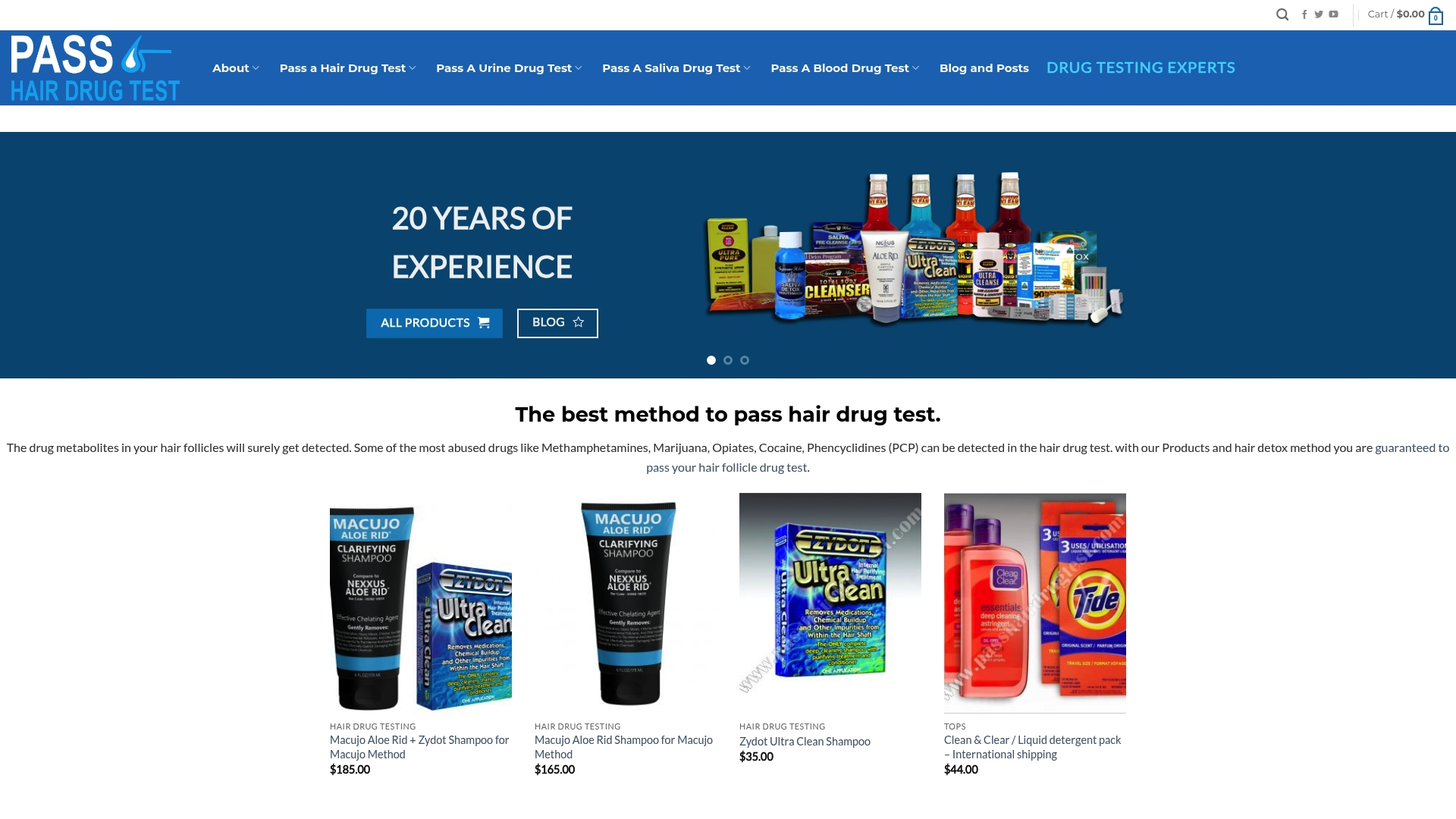
We also carry products for urine, saliva and blood tests, which is helpful if your employer uses more than one type of screen.
FAQ
How long does a microdose of THC last in your system?
It depends on the test. Urine and saliva tests generally look at days, while a hair test looks back up to about 90 days, according to Labcorp. THC also takes time to reach hair, about two weeks according to a 2019 review, so a very recent dose will not show up in a hair sample yet.
Will 2.5 mg of THC show up on a hair test?
Not necessarily. In a controlled study, volunteers took 2.5 mg of oral THC three times daily for 30 days, and no THC was detected in their hair. That was two people, though, and labs use different cutoffs, so it cannot predict your result.
How much THC fails a hair follicle test?
There is no single amount of THC you take that decides it. The result depends on the lab’s cutoff, such as the SoHT’s 50 pg/mg for head hair, and on your hair. The SoHT also says hair concentration cannot show how much was consumed.
Does hair color or bleaching change the result?
Yes, it can. Pigmented hair binds more drug than non-pigmented hair, and a 2023 study found bleaching and dyeing lowered THC by a mean of about 60%. Treated hair behaves less predictably, so results vary from person to person.
Can body hair be tested instead of head hair?
Labs can use body hair when head hair is short or absent. Body hair can reflect a longer period, up to several months to a year, according to AverHealth. Ask the testing program which sample they plan to collect.
Sources
- Hair Follicle Drug Testing: Process & Benefits (Labcorp)
- Review on Toxicology Testing in Hair (Journal of Applied Laboratory Medicine, 2025)
- A review of bioanalytical techniques for evaluation of cannabinoids (PMC, 2019)
- Comparison of cannabinoids in hair with self-reported cannabis consumption (Drug and Alcohol Review)
- Finding cannabinoids in hair does not prove cannabis consumption (PMC)
- Using biological samples in epidemiological research on drug use (Norwegian review, 2011)
- 2021 SoHT Consensus on Drugs of Abuse Testing in Hair
- SoHT General Consensus on Hair Testing, 2022
- Manipulation of THC Hair Concentrations by Commercially Available Products (Bertges et al., 2022)
- Hair analysis: Assessment of homemade hair treatments (Mestria et al.)
- Officer’s Failed Drug Test: How Long Does Marijuana Stay in Hair (Live Science)
- How Long Can Hair Detect Drugs (AverHealth)
Recommended
- Concentrates and Hair Drug Tests: What Labs Can Detect
- THC in Hair: What U.S. Cannabis Users Need to Know
- One Edible vs Daily Use: How Labs Detect Edibles in a Hair Drug Test
- 90 Day Delta 8 Hair Test Risk, Labs Found It in 9.0% of Samples
