
Uncategorized
LSD Hair Test: Forensic Reliability and Interpretive Limits
Aug
LSD can be detected in hair, but only through specialized testing that most drug panels never run. Standard hair drug panels typically screen for cocaine, marijuana, amphetamines, opiates, and PCP, and routinely exclude LSD entirely. Detecting it requires targeted LC-MS/MS methods built specifically to find LSD and its metabolite at picogram levels.
A positive result confirms laboratory-grade evidence that LSD or its metabolite entered the hair. It does not reliably prove how often someone used it. A negative result is just as murky. Because typical doses are microscopic and the drug metabolizes fast, a clean hair result does not definitively rule out prior use.
- LSD hair testing is possible but not routine.
- It requires specialized LC-MS/MS analysis, not a standard hair panel.
- Positive and negative results both carry major interpretive caveats.
Quick fact: validated methods have reported hair limits of detection as low as 0.25 picograms per milligram for LSD, a threshold so low it demands laboratory equipment most testing facilities simply don’t stock.
Table of Contents
Key Takeaways
LSD detection in hair is analytically possible but demands specialized LC-MS/MS testing, and neither a positive nor a negative result settles the question of how often someone used it.
| Point | Details |
|---|---|
| Standard panels miss LSD | Routine hair drug panels exclude LSD; detection requires specialized LC-MS/MS methods most labs don’t offer. |
| Sensitivity is extreme | Validated LODs reach 0.25 pg/mg for LSD and 0.5 pg/mg for its metabolite, far below thresholds for other drugs. |
| Frequency can’t be confirmed | Forensic reviewers call distinguishing single from repeated use via hair concentration effectively “utopian.” |
| Negative results aren’t proof | Low doses and rapid metabolism mean a clean hair result doesn’t rule out prior LSD use. |
| Preparation still matters | Passhairdrugtest’s shampoo kits and Macujo Method address standard hair panels, not LSD-specific claims. |
Table of Contents
- How Does an LSD Hair Test Actually Work?
- Why Do People Cite a 90-Day Detection Window for LSD Hair Tests?
- How Do Labs Validate and Confirm an LSD Hair Result?
- Can a Hair Test Distinguish Single Use From Repeated Use?
- Hair, Urine, Blood, or Oral Fluid: Which Test Actually Catches LSD?
- What Does the Research Still Get Wrong About LSD Hair Testing?
- What a Hair-Test Specialist Wants You to Understand
- Preparing for a Hair Test? Here’s Where Passhairdrugtest Fits In
- Frequently Asked Questions About LSD Hair Testing
- Sources
How Does an LSD Hair Test Actually Work?
Forensic chemists targeting LSD in hair aren’t just looking for the parent compound. They are also hunting for 2-oxo-3-hydroxy-LSD, known as O-H-LSD, the primary metabolite your body produces after ingestion. Finding the metabolite alongside the parent drug matters because metabolites form inside the body. Their presence argues against the sample simply being contaminated by outside contact with the drug.
The workflow starts with decontamination. Hair gets washed in solvent to strip away surface residue, since a strand that merely brushed against LSD residue at a party shouldn’t register the same as a strand that grew from a body actively metabolizing the drug. After washing, technicians extract the drug from the hair matrix, usually incubating segments in methanol to pull the compound out of the keratin structure. The extract then runs through liquid chromatography tandem mass spectrometry, or LC-MS/MS, the platform most forensic reviews now recommend for its sensitivity. Some labs supplement with GC-MS/MS or capillary electrophoresis mass spectrometry, though these see less use for LSD specifically.
Labs that do this work responsibly publish validation data: limit of detection (LOD), limit of quantification (LOQ), linearity range, recovery rate, and matrix effects. One validated method reported LODs of 0.25 pg/mg for LSD and 0.5 pg/mg for O-H-LSD, figures far smaller than what’s needed to catch cocaine or opiates in hair.
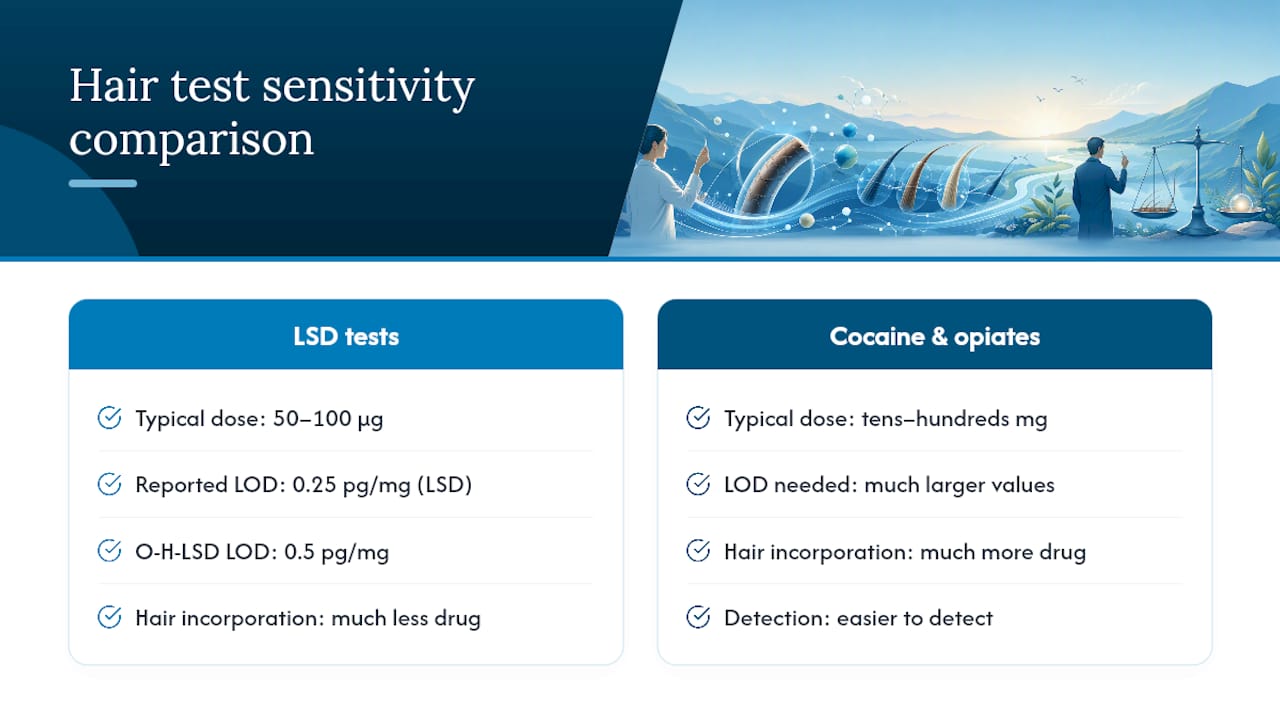
That gap in sensitivity requirements explains why LSD is harder to catch than most other drugs of abuse. A typical LSD dose measures in micrograms, sometimes as little as 50 to 100 micrograms. Cocaine and opiate doses run in the tens or hundreds of milligrams, a thousandfold difference that leaves far more drug available to incorporate into the hair shaft. Less drug consumed means less drug embedded in keratin, which means labs need instrumentation sensitive enough to find a needle in a much smaller haystack. If you’re researching how hair follicle drug testing works more broadly, this sensitivity gap is the single biggest reason LSD sits in its own testing category.
Why Do People Cite a 90-Day Detection Window for LSD Hair Tests?
The “90 days” figure floating around most drug-testing content comes from a basic assumption: head hair grows roughly half an inch per month, so a 1.5-inch segment theoretically represents about three months of growth. That math holds up reasonably well for drugs incorporated into hair at higher, more consistent concentrations. For LSD, it’s a much shakier claim.
The problem isn’t the growth-rate math. It’s that LSD’s incorporation into hair is inconsistent and poorly mapped by comparison to more commonly tested substances. A drug present at only a few picograms per milligram can degrade, wash out, or simply never appear in measurable form in a given segment, even when the timeline says it should be there.
| Claim | What The Number Actually Reflects |
|---|---|
| “Up to 90 days” detection | Theoretical window based on hair growth rate, not confirmed LSD incorporation data |
| LOD: 0.25 pg/mg | Actual validated detection threshold for LSD in a peer-reviewed method |
| LOD: 0.5 pg/mg | Actual validated detection threshold for O-H-LSD metabolite |
| Case concentrations: 1.27 and — | Real measured values from forensic case work |
Several factors widen or narrow that theoretical window in practice:
- Faster or slower individual hair growth shifts how much history a given hair length actually represents.
- Segmental analysis (cutting hair into monthly sections) can localize a positive to a rough timeframe, but only if concentrations are high enough to detect in that segment.
- Bleaching, perming, and frequent heat styling degrade drug residues embedded in the hair shaft, sometimes erasing evidence of use that segmental analysis would otherwise catch.
A forensic review examining LSD hair concentrations across the available literature found the data pool sparse, only a handful of studies with usable concentration figures, which is precisely why confident claims about “months of history” deserve skepticism when applied to this specific drug.
How Do Labs Validate and Confirm an LSD Hair Result?
Chain of custody starts at collection. Analysts typically take a pencil-thick lock of head hair cut close to the scalp, avoiding pubic or body hair when possible since scalp hair grows at a more predictable, well-studied rate. The collector documents the sample, seals it, and logs every hand-off from collection through analysis to prevent tampering claims later.
Once in the lab, the hair goes through washing to remove surface contamination, then digestion or solvent extraction to pull compounds out of the keratin matrix. Technicians add internal standards, chemically similar reference compounds, to track recovery and correct for loss during processing. Confirmatory testing follows the initial screen, typically a second, independent analytical run to verify the first result wasn’t a fluke or cross-reaction.
A properly validated method should have published data covering:
- Specificity (ability to distinguish LSD from structurally similar compounds)
- Recovery rate (percentage of drug successfully extracted from the matrix)
- Matrix effects (how the hair sample itself might suppress or enhance the signal)
- Stability testing (whether the drug degrades in storage before analysis)
| Validation Parameter | Why It Matters |
|---|---|
| LOD/LOQ | Defines the smallest amount the method can reliably detect and quantify |
| Recovery rate | Confirms how much drug the extraction process actually captures |
| Matrix effects | Reveals whether the hair sample itself distorts the signal |
| Reference materials | Certified standards used to calibrate and confirm accuracy |
Pro Tip: If a hair result matters to your case, ask the lab directly for its LOD and LOQ figures, its full method validation report, and confirmation that it tested for O-H-LSD, not just the parent drug. A lab that can’t produce this documentation on request is not equipped to defend an LSD finding under scrutiny.
Can a Hair Test Distinguish Single Use From Repeated Use?
Not reliably, and forensic scientists are candid about that limitation. A literature review examining LSD hair analysis described using hair concentration to distinguish single-dose from repeated exposure as effectively “utopian,” a word choice that tells you how far the science still has to go. Incorporation into hair varies too much between individuals, and the reference data pool is too thin, to draw that distinction with confidence.

External contamination compounds the problem. Someone who merely touched a surface with LSD residue on it, or was in a room where it was used, could theoretically transfer trace amounts to their hair without ever ingesting anything. This is exactly why labs targeting O-H-LSD matter: since metabolites form inside the body, finding the metabolite alongside the parent compound argues against pure surface contamination, though it doesn’t eliminate every alternative explanation.
Pubic hair testing deserves specific caution here. Pubic hair sits close to areas exposed to urine, and contamination from that route can produce a positive reading that has nothing to do with deliberate ingestion. Reviews of hair-testing forensics flag pubic hair positives as particularly unreliable evidence of repeated use, more so than well-collected head hair samples.
Cosmetic treatment adds another layer of uncertainty. Bleaching and chemical relaxing can strip drug residues from the hair shaft, while darker, coarser hair sometimes retains basic compounds like LSD more readily than lighter, finer hair, though the data on this effect specific to LSD remains limited.
Pro Tip: In any legal or clinical dispute involving a hair result, insist on confirmatory testing and an independent forensic toxicologist’s interpretation before treating the finding as conclusive. Raw lab output without expert context is where most disputes go wrong.
Hair, Urine, Blood, or Oral Fluid: Which Test Actually Catches LSD?
Every matrix trades sensitivity for detection window in a different way. Blood and oral fluid catch LSD only within a narrow recent window, typically hours, because the drug clears the bloodstream fast. Urine extends that window to roughly one to three days for most users. Hair, in principle, offers the longest look back, weeks to months, but that advantage only matters if the drug actually incorporated into the strand in detectable amounts, which isn’t guaranteed given how little LSD the body processes per dose.
| Matrix | Practical Detection Window | Sensitivity for LSD | Routine Availability |
|---|---|---|---|
| Blood | Hours | Low, drug clears quickly | Limited, mostly clinical/ER settings |
| Oral fluid | Hours to about 1 day | Low to moderate | Uncommon for LSD specifically |
| Urine | 1 to 3 days | Moderate | More available than hair, still specialized |
| Hair | Weeks to months (theoretical) | Low, requires specialized LC-MS/MS | Rare, few labs offer it |
- Hair’s longer theoretical window is real but undermined by low incorporation rates and sparse reference data.
- Urine remains the more practical choice for confirming recent use.
- Hair testing suits retrospective questions better than urgent, recent-use questions, when a lab capable of the analysis can be found at all.
What Does the Research Still Get Wrong About LSD Hair Testing?
The honest answer is that the evidence base is thin. Case series remain small, often single-digit patient counts, and studies rarely use consistent extraction or validation protocols, making cross-study comparison unreliable. Certified reference materials for LSD and its analogs are limited, which slows down broader method validation across different hair types and ethnic hair textures.
- Few labs publish matrix-specific stability data showing how long LSD survives in hair before it degrades.
- Certified reference materials for LSD metabolites remain scarce industry-wide.
- Studies comparing incorporation across hair colors and textures are nearly nonexistent for this specific drug.
A 2025 review of LSD detection techniques called explicitly for standardized validation across matrices, a signal that even researchers publishing in this space consider current data incomplete. Practically, that means if you contact a lab requesting LSD hair analysis, expect a smaller pool of providers, higher cost, and a reasonable expectation that they should hand over LOD/LOQ figures and validation documentation before you trust the result.
What a Hair-Test Specialist Wants You to Understand
Most people asking about LSD hair testing want certainty a hair strand simply can’t deliver right now. Ask any lab for its validation report before trusting a result, request metabolite testing specifically, and consider urine as a better fit if the question is about recent use rather than a retrospective pattern. The science here is narrow and specialized. Anyone selling you confidence beyond that, in either direction, is overselling what the data supports.
Preparing for a Hair Test? Here’s Where Passhairdrugtest Fits In
Whatever the science says about detection windows, most people facing a hair test aren’t worried about LSD specifically. They’re worried about a broader panel, and Passhairdrugtest has spent more than 20 years focused on exactly that problem: helping people prepare for the hair follicle tests employers and agencies actually run.
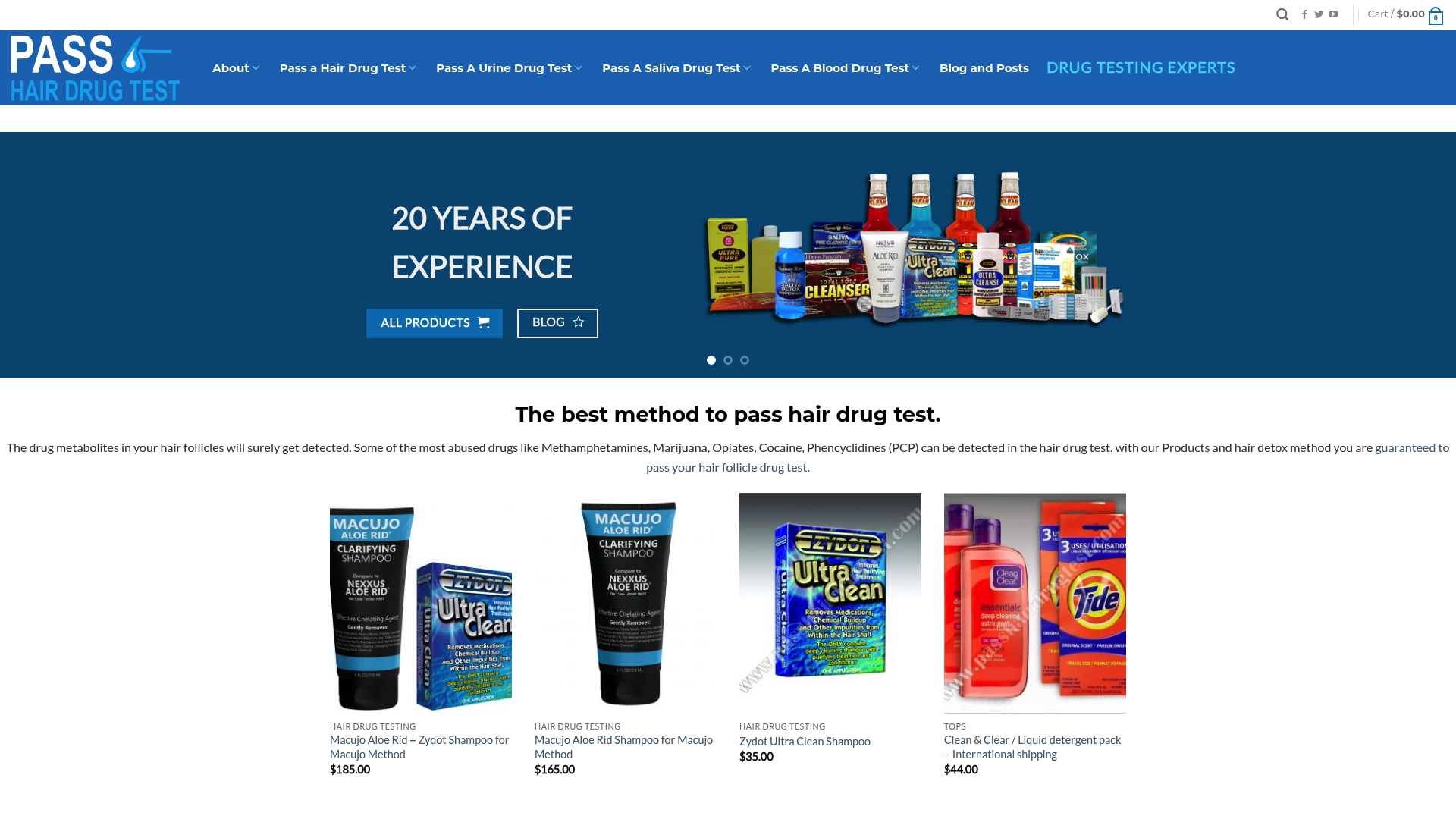
The site’s core offerings center on the Hair Follicle Shampoo Kit, Zydot Ultra Clean Shampoo, and the multi-step Macujo Method, a structured protocol built around opening the hair cuticle and working a detox shampoo deep into the shaft rather than just rinsing the surface. None of this changes the forensic science laid out above, and no product claims to alter published detection thresholds or defeat a properly validated lab test. What these products offer is a preparation option for people who want to walk into a standard hair panel having done everything reasonable on their end.
Before you order anything, check with the testing lab or employer on exactly which panel you’re facing and what timeline you’re working with. If a multi-step approach makes sense for your situation, the shampoo kits and step-by-step Macujo guide are the place to start.
Frequently Asked Questions About LSD Hair Testing
Does a standard hair follicle drug test check for LSD?
No. Most standard hair panels screen for cocaine, marijuana, amphetamines, opiates, and PCP, and exclude LSD unless a lab specifically adds specialized LC-MS/MS analysis for it.
How accurate is an LSD hair test?
Validated methods can detect LSD down to 0.25 pg/mg, which is technically precise, but interpreting what a positive means for use frequency remains scientifically unreliable given sparse case data.
Can a hair test tell if I used LSD once versus multiple times?
No. Forensic researchers describe this distinction as effectively impossible to make reliably from hair concentration alone, due to incorporation variability and limited reference studies.
Does a negative LSD hair result prove I never used it?
Not definitively. Low typical doses and rapid metabolism mean the drug may never reach detectable concentrations in hair even after genuine use.
Why does LSD hair testing cost more or take longer than standard panels?
Few labs run the specialized LC-MS/MS methods required, and the extreme sensitivity needed, down to fractions of a picogram, demands equipment and expertise most standard testing facilities don’t maintain.
This article is general information, not a substitute for advice from a qualified lawyer. Consult a qualified legal professional about your own circumstances before acting on anything here.
Sources
Readers who want the primary data behind this article’s claims, rather than a summary of it, should start with the forensic literature directly.
- LSD detection and interpretation in hair — PubMed
- Simultaneous determination of LSD and 2‑oxo‑3‑hydroxy LSD in hair and urine by LC‑MS/MS — PubMed
- Detecting drugs in hair: Is it drug use or environmental contamination? — NIJ
- How long does acid stay in your system? Urine, blood, hair, and more — Medical News Today
If a hair result affects a legal or employment matter, request the testing lab’s full method validation report and consider an independent forensic toxicologist’s review before treating any single result as final.
Recommended
- The Science Behind the Hair Drug Test – Pass Hair Drug Test
- Long Hair Drug Test: What Labs Actually Measure
- Hair Drug Test Information – Pass Hair Drug Test
- Hair Follicle Drug Test Information – Pass Hair Drug Test
