Uncategorized
Before a Hair Test: Detox Shampoo Damage and 20 Years’ Evidence
Oct
Detox shampoos can sometimes lower the amount of drug residue a lab measures, but they rarely remove enough to pass a hair-follicle test on their own, and aggressive methods carry a real risk of detectable hair damage. A single-application study on Ultra Clean found only modest reductions in drug concentration, while the Society of Hair Testing’s 2021 consensus describes decontamination and wash-analysis procedures built specifically to catch tampering. If you are weighing your options, the mechanism, the study data, and the detection methods below matter more than any product label.
TL;DR:
- Detoxicating shampoos, including aggressive protocols, can modestly reduce drug levels but rarely eliminate enough to pass a hair-follicle test on their own.
- Surficial washing mainly removes external contamination; drugs embedded inside the hair cortex are much harder to target without causing significant hair damage.
- Laboratory detection methods often identify chemical damage from harsh cleansing procedures, risking re-collection or tampering flags during forensic analysis.
- Abstinence before testing remains the only guaranteed way to avoid detection without risking hair damage or chemical alterations.
- Multi-step cleansing methods may lower drug concentrations more effectively but come with increased risk of hair damage and detection scrutiny if not executed precisely.
Table of Contents
Table of Contents
- How drugs get into hair and why surface washing often fails
- What forensic studies actually measured
- How aggressive cleansing damages hair and how labs catch it
- What you can actually do and how the trade-offs stack up
- What two decades in this space have taught me about the decision
- If you decide to pursue a multi-step cleansing approach
- FAQ
- Sources
How drugs get into hair and why surface washing often fails
Once a substance enters your bloodstream, trace amounts travel through sweat and sebum into the hair follicle, where they become locked into the cortex as the strand grows. This is fundamentally different from surface contamination, where residue (say, from secondhand smoke or handling) sits on the outside of the shaft. A shampoo can lift surface residue reasonably well because it never penetrated the hair in the first place.
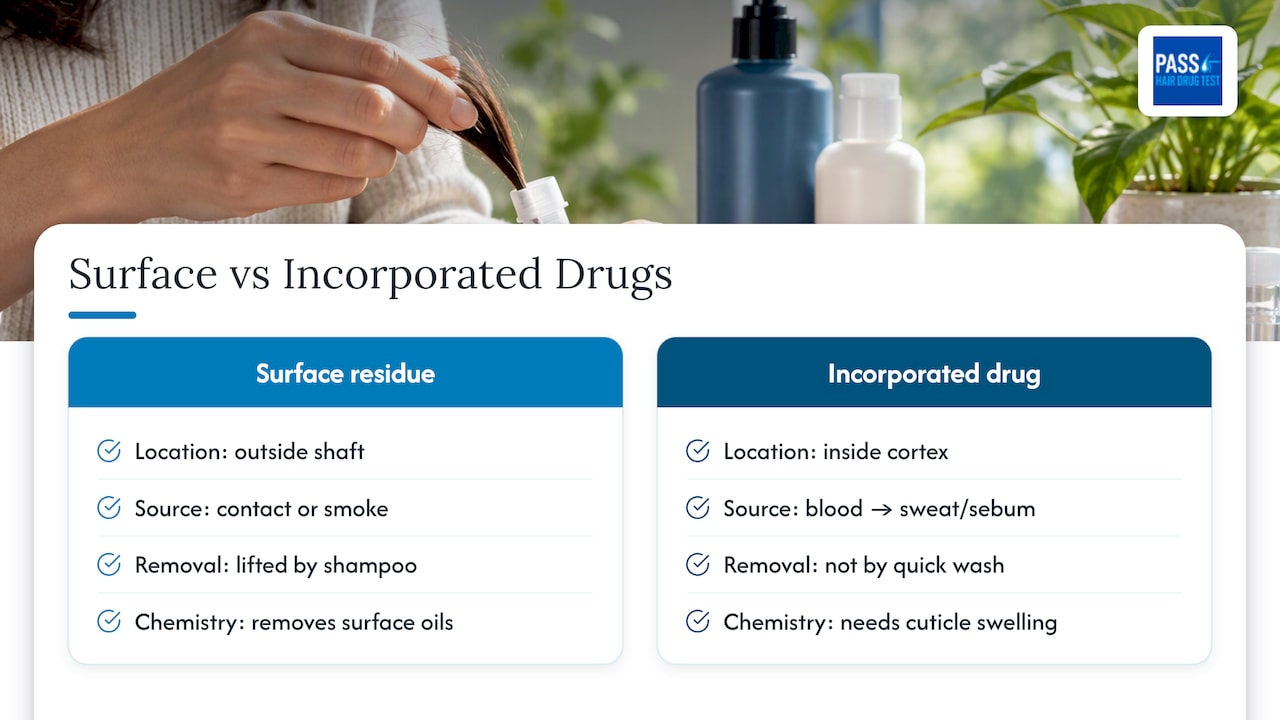
Drugs incorporated during growth are a different problem. They are embedded inside the keratin structure, not sitting on top of it, so a quick wash and rinse has little chance of reaching them. This is the core reason detox shampoo damage conversations miss the point when they focus only on “does it clean the hair” rather than “can it reach what is already inside the shaft.”
Chemistry plays a role in how far any treatment can reach. Water and methanol are protic solvents that cause hair to swell slightly, opening the cuticle and cortex just enough to allow some exchange with incorporated material. Non-swelling organic solvents behave very differently, often removing surface oils without meaningfully disturbing the internal structure. Laboratories exploit this difference deliberately: their decontamination protocols use solvent sequences designed to strip external contamination while leaving incorporated drug residue intact for accurate measurement.
What forensic studies actually measured
The published data on detox shampoos and household treatments paints a mixed picture: some reduction is real, but it is inconsistent and far from a reliable way to drop below a cutoff.
- A single application of Ultra Clean produced small decreases across drug classes, with reported reductions around 5% for cocaine, 26% for morphine, and 36% for THC in a study of 14 autopsy hair samples.
- An in vitro study of common household and cosmetic products, including shampoos, hair tonic, disinfectant, and even vodka, reported mean THC reductions in the 50% to 65% range under extended incubation and repeated wash cycles.
- A 2023 analytical review of internet-sourced cleansing procedures found that combinations involving bleaching or alkaline treatment pushed reductions toward 80% to 90% for some analytes under controlled laboratory conditions.
One finding stands out across this research: reduction percentages vary enormously by drug class, hair type, and treatment intensity, which the in vitro THC study demonstrates directly by reporting different mean reductions for each product tested. Many of these results come from extended incubation or repeated-cycle conditions that do not resemble a single at-home wash the night before a test, so the lab numbers describe a best-case ceiling, not a guaranteed outcome.
How aggressive cleansing damages hair and how labs catch it
The treatments capable of meaningfully lowering drug concentrations tend to be the same ones that visibly or chemically alter the hair shaft. That trade-off is central to understanding detox shampoo damage as a real cost, not just a marketing term.
- Cuticle erosion and increased porosity result from repeated harsh washing, which opens the hair’s protective outer layer and makes it more fragile.
- Oxidation from peroxide or bleach breaks down melanin and structural proteins, often leaving hair visibly lighter or brittle.
- Alkaline hydrolysis from strong bases weakens the internal protein bonds that give hair its strength, sometimes to the point of breakage at the root.
Forensic laboratories do not just measure drug concentration. They calculate wash-to-hair ratios and analyze the final wash solution to separate external contamination from internal incorporation, a method detailed in research on ethanolic wash criteria. Labs also use microscopy and chemical biomarkers like PTCA to flag oxidative treatments such as bleaching, and international guidance from both SoHT and UNODC recommends these checks as standard practice. The consequences of a flagged sample range from a request for re-collection to a formal tampering notation, and in some cases the chemical damage itself becomes more noticeable to an employer than the original test result would have been.
Pro Tip: If hair feels unusually dry, brittle, or chemically altered before a scheduled collection, that change can draw more scrutiny than a borderline drug concentration would.
What you can actually do and how the trade-offs stack up
Abstinence before a known testing window remains the only approach with no damage risk and no detection risk, since labs generally test roughly the last 1.5 inches of hair closest to the scalp, corresponding to about the most recent growth period. Short of that, your realistic options fall into a few categories.
- Low-risk, low-certainty: frequent normal washing with a regular shampoo removes some surface residue and carries essentially no damage or tamper risk, though it does little for incorporated drug.
- Higher-intensity chemical protocols: repeated harsh treatments or extended methanol-based washes can lower measured concentrations further, based on the lab studies above, but they raise both detectable hair damage and the odds of a wash-ratio flag.
- Multi-step commercial methods: protocols like Mike’s Macujo Method pair a pre-wash clarifying step with cycles of a targeted shampoo such as Aloe Rid, followed by a neutralizing or conditioning step. We walk through the full sequence in our guide to using detox shampoo, and following the instructions precisely matters more than with ordinary shampoo use.
- Alternatives worth considering: a pre-test using an at-home kit, discussing an alternate specimen type with the testing party, or speaking with legal counsel if the test is tied to employment or a legal proceeding.
Pro Tip: Read every step of a multi-step protocol before you start since timing between cycles affects both results and hair condition.
None of these options come with a guaranteed outcome, and the aggressive end of the spectrum is also the end with the most damage and detection risk.
What two decades in this space have taught me about the decision
People who do best are the ones who read the research first and choose a method that matches their actual timeline and hair condition, rather than grabbing whatever is marketed as strongest. We would only recommend an aggressive multi-step approach when abstinence is not possible and the reader has time to follow every step correctly. When there is any flexibility at all, pre-testing and documenting your choices beats guessing.
— MIchael
If you decide to pursue a multi-step cleansing approach
Choosing between a basic clarifying wash and a full multi-step protocol comes down to how much time you have and how incorporated the residue likely is. The product lineup and instructional pages cover that distinction so you are not guessing which step applies to your situation.
Our hair drug test information page covers testing windows and collection procedures in more depth, and our step-by-step guide to the Macujo Method walks through the pre-wash, targeted shampoo cycles, and conditioning sequence in order. If you want to browse the shampoos and kits directly, our products page lists the full lineup along with instructions for each. Whatever you choose, follow the directions closely, account for the hair damage risks covered above, and consider a pre-test checkpoint before the day that matters.
FAQ
Can detox shampoo alone remove drugs from hair?
A single application generally produces only a modest reduction in measured drug concentration, as shown in the Ultra Clean study, and is often not enough on its own to drop below a lab’s cutoff. Combining a targeted shampoo with a full multi-step protocol tends to have a larger measured effect than shampoo alone.
How does detox shampoo damage hair?
Repeated or aggressive cleansing cycles can erode the cuticle, increase porosity, and in some cases involve oxidizing agents that weaken the hair’s internal protein structure. Labs can sometimes detect this kind of chemical alteration through microscopy and biomarker analysis, as outlined in forensic hair testing guidance.
Will labs know if I used a detox shampoo?
Laboratories compare wash-to-hair ratios and analyze the final wash solution specifically to distinguish surface contamination from internal drug incorporation, a method described in forensic wash-criteria research. Heavily altered hair or an unusual wash profile can prompt additional scrutiny rather than a clean pass.
Is the Macujo Method more effective than a single detox shampoo?
Multi-step methods that combine a pre-wash, targeted shampoo cycles, and conditioning are designed to reach further into the hair shaft than a single wash, and a Macujo Method guide explains the full sequence. Effectiveness still depends heavily on hair type, how recently the substance was used, and how precisely the steps are followed.
What is a safer alternative to aggressive hair cleansing?
Abstaining before a known testing window carries no damage or detection risk, since most labs test roughly the hair closest to the scalp from recent growth. A pre-test or a conversation about alternate specimen types is a lower-risk way to gauge your situation before committing to any chemical protocol.
Sources
- Effect of the shampoo Ultra Clean on drug concentrations in human hair – PubMed
- Manipulation of THC Hair Concentrations by Commercially Available Products – PMC
- Analytical review of internet ‘cleansing’ procedures and experimental treatments – 2023
- Society of Hair Testing consensus on hair testing (DoA) – SoHT (2021)
- UNODC guidance on hair testing and decontamination methods
Recommended
- How to Use Detox Shampoo for a Hair Drug Test
- Detox vs Clarifying Shampoo for Hair Drug Test Prep
- Do Detox Shampoos Work for Hair Follicle Tests?
- Match Your Hair Detox Kit to Your Test Date, Backed by 20+ Years of Protocols
