No products in the cart.
Uncategorized
Psilocybin Hair Test: Psilocin, Picogram LODs and the 90 Day Window
21
Sep
Sep
Labs testing hair for mushroom use don’t look for psilocybin at all. They look for psilocin, the active compound psilocybin converts into almost immediately in the body. Detection is technically possible with high-sensitivity LC–MS/MS equipment, typically covering the most recent 90 days of growth on a 1.5-inch sample, but these assays are specialized, expensive, and genuinely rare outside forensic and legal settings.
TL;DR:
- Hair testing for psilocin can detect use within a roughly 90-day window, but requires specialized, high-sensitivity LC–MS/MS equipment that is rare outside forensic labs.
- Psilocybin is rarely detected directly because it converts to psilocin quickly in the body, and most assays target psilocin, not psilocybin itself.
- Detection in hair depends on sample handling, with delays of 5 to 10 days before psilocin appears in hair, meaning recent use might not be reflected in the sample.
- Standard drug panels do not include psilocybin or psilocin, and hair tests for hallucinogens are usually ordered only in forensic or legal settings due to expense and technical complexity.
- A negative hair test does not prove abstinence, as low doses, sample degradation, or improper handling can lead to false negatives.
Table of Contents
Table of Contents
- What a Psilocybin Hair Test Actually Screens For
- How Hair Length Determines the Detection Window
- Lab Methods Behind Detecting Psilocybin in Hair
- Reading a Positive or Negative Result the Right Way
- When Does Someone Actually Order This Test?
- What Passhairdrugtest Has Learned From Two Decades in This Industry
- Why Most People Overestimate How Often This Test Gets Used
- Practical Hair-Test Prep Resources From Passhairdrugtest
- Sources
- FAQ
What a Psilocybin Hair Test Actually Screens For
No standard drug panel, including a 12-panel test, screens for psilocybin or psilocin. Those panels target THC, cocaine, opiates, amphetamines, and a handful of other common substances because that’s what employers and courts request most often. Hallucinogens require a separate, deliberately ordered assay.
Detection windows vary sharply by specimen type, and the differences explain why hair sits in a category of its own:
- Urine and blood: psilocin clears the body within roughly 24 to 72 hours after use, so these tests only catch very recent exposure.
- Saliva: similarly short, often just hours after ingestion.
- Hair and nails: the only specimens that offer a meaningful retrospective window, because the analyte becomes locked into the keratin structure as it grows.
Psilocybin is rapidly dephosphorylated into psilocin once it enters the bloodstream, and clinical reviews note psilocybin itself is rarely found intact in biological samples, which is why every serious forensic and toxicological analysis targets psilocin instead. That distinction matters if you’re reading a lab report: a result that says “psilocybin not detected” tells you almost nothing, because that’s not what the assay was built to find. Hair testing for psilocin requires equipment most labs don’t own and don’t run routinely, which is exactly why hair follicle drug tests for common drugs are far more standardized than anything targeting hallucinogens.
How Hair Length Determines the Detection Window
Hair grows at a fairly predictable rate, and forensic toxicology leans on that predictability to date drug exposure the way a geologist reads rock layers. The math is simple, but the interpretation around it is not.
- Standard conversion: scalp hair grows about 0.5 inch per month, so a 1.5-inch segment cut close to the scalp represents roughly the most recent 90 days, a figure widely cited by Drugs.
- Segmental analysis: instead of testing one long piece, labs can slice the sample into smaller segments and test each one separately, which can localize a positive result to a specific window rather than just “sometime in the last three months.”
- Growth lag: psilocin doesn’t show up in hair the moment someone uses mushrooms. It takes roughly 5 to 10 days for the analyte to travel from the bloodstream into the follicle and become detectable in hair emerging above the scalp, so the most recent week or so of a person’s actual hair growth may read negative even after real exposure.
- Collection standards: technicians collect from the back of the scalp where growth is most consistent, cut as close to the skin as possible, and document exact length and location, since interpretation depends entirely on knowing which segment corresponds to which time frame.
Anyone comparing this to how hair follicle drug testing works for THC or cocaine will recognize the same growth-rate logic. The chemistry of what’s being searched for is where things get far more demanding.
Lab Methods Behind Detecting Psilocybin in Hair
Standard immunoassay cups and dip tests, the kind used for most drug panels, cannot detect psilocin. The molecule doesn’t trigger the antibody reactions those tests rely on, and it’s present in such small quantities that only mass spectrometry has the sensitivity to find it. Labs running a legitimate psilocybin hair test use LC–MS/MS or UHPLC–MS/MS, sometimes paired with Q-Trap technology, to isolate and quantify psilocin at the picogram level.
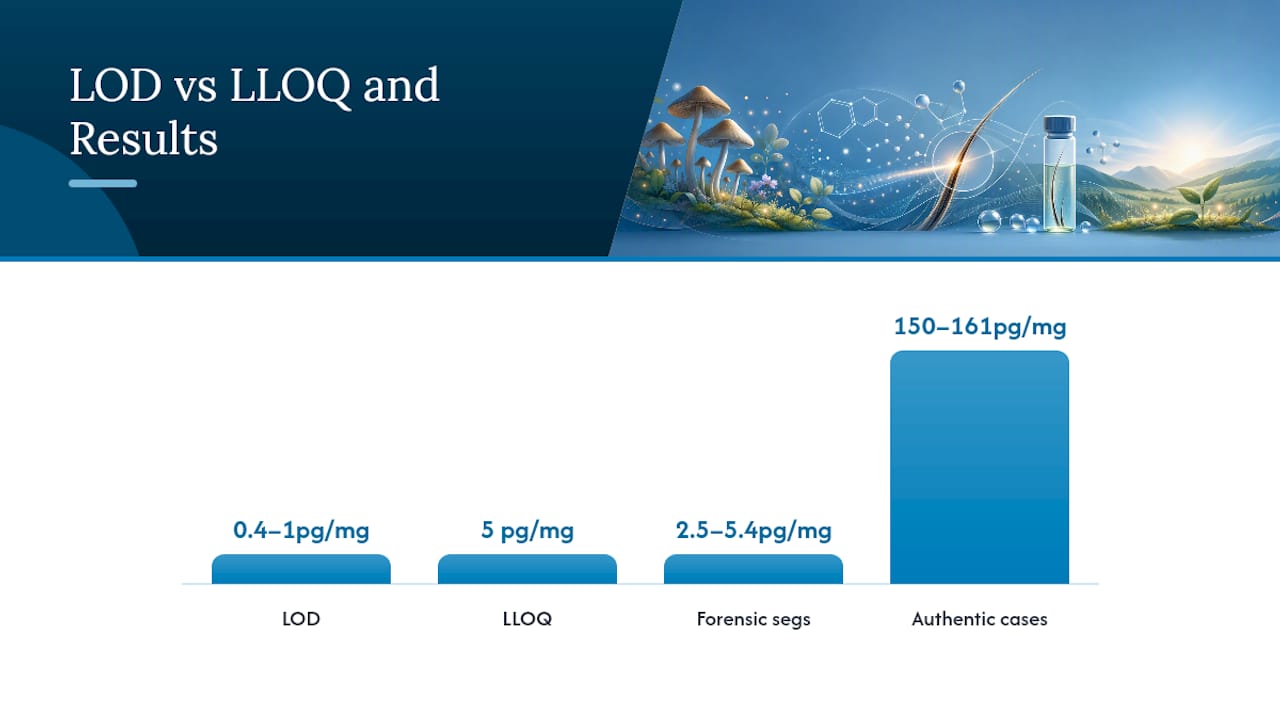
The numbers involved are tiny. One UHPLC–MS/MS method validated for authentic hair samples reported a limit of detection (LOD) of 1 pg/mg and a lower limit of quantification (LLOQ) of 5 pg/mg, with calibration linearity running from 5 to 500 pg/mg. In real cases tested with that method, concentrations landed around 150 to 161 pg/mg, well above the quantification threshold. Other forensic LC–MS/MS work has pushed sensitivity even further, reporting LODs as low as roughly 0.4 pg/mg in optimized protocols, though real segment concentrations in that study clustered in the 2.5 to 5.4 pg/mg range, far closer to the noise floor.
| Method Detail | Typical Reported Value |
|---|---|
| Limit of detection (LOD) | ~0.4 to 1 pg/mg |
| Lower limit of quantification (LLOQ) | ~5 pg/mg |
| Calibration linearity range | 5 to 500 pg/mg |
| Authentic case concentrations | 150 to 161 pg/mg (higher-exposure cases) |
| Segment concentrations in forensic samples | 2.5 to 5.4 pg/mg (lower-exposure cases) |
Sample handling is just as important as the instrument. Psilocin is chemically unstable and degrades when exposed to light, air, or warm temperatures, so proper forensic workflow calls for cold storage, light protection, and same-day processing whenever possible. Some labs add antioxidants like ascorbic acid during prep specifically to slow that breakdown.
Pro Tip: If you’re evaluating a lab’s credibility for this kind of test, ask directly whether their reported number is above the LLOQ or just above the LOD. A result sitting between those two thresholds gets labeled “detected but not quantified,” which carries far less weight in a legal or employment dispute than a fully quantified value.
Reading a Positive or Negative Result the Right Way
A negative result on a psilocybin hair test doesn’t mean someone never used mushrooms. It can just as easily mean the dose was low, the analyte degraded before testing, or the sample wasn’t handled correctly.
A few interpretation rules consistently trip people up:
- Negatives are not proof of abstinence. Low, single-use exposure can sit right at or below the LOD, especially if the sample sat unprotected from light or heat before analysis.
- Positives need context, not just a number. A concentration near the LLOQ tells a very different story than one at 150 pg/mg, and a lab report without that nuance is incomplete.
- Segmental patterns carry more weight than a single data point. A concentration that rises across sequential segments points toward repeated use, while one isolated low-level segment demands more corroboration before anyone draws a conclusion from it.
- Passive exposure is a real, if narrow, concern. Labs address this with wash steps before extraction, though the research base on external contamination for psilocin specifically is thinner than for something like cocaine.
- Psilocybin itself almost never turns up. Because it converts to psilocin so quickly in the body, a forensic report built around detecting intact psilocybin is looking for the wrong molecule.
None of this makes psilocybin hair testing unreliable when it’s done correctly. It makes it a test that requires a trained toxicologist to read, not a simple pass or fail line the way a standard immunoassay works.
When Does Someone Actually Order This Test?
Psilocin hair testing almost never shows up in a standard employment drug screen. It’s expensive, it requires equipment most labs don’t keep on hand, and hallucinogen use represents a small fraction of what workplace panels are built to catch in the first place.
Where it does get ordered:
- Forensic investigations, particularly cases tied to impaired driving, overdose deaths, or criminal proceedings where establishing a timeline of drug use matters.
- Child custody and family court disputes, where a parent’s substance use history is directly relevant to a ruling.
- Targeted research studies examining psilocybin use patterns or pharmacokinetics.
- Military and security clearance contexts, where some branches have explored expanded hallucinogen screening beyond the standard panel.
If you’re ever on the requesting end of one of these tests, ask the lab which analyte and method they use, what their LOD and LLOQ are, how they handle sample degradation, and whether they can provide segmental analysis rather than a single bulk result.
What Passhairdrugtest Has Learned From Two Decades in This Industry
Passhairdrugtest has spent more than 20 years in the drug-testing and detox-product industry, and one pattern holds steady across that time: specialized tests like this one get misunderstood because the marketing language rarely matches the lab reality.
If you’re trying to evaluate whether a psilocybin hair test result is credible, the questions worth asking a lab are specific: which analyte and method are you using (psilocin via LC–MS/MS, ideally), what’s your LOD and LLOQ, how do you protect samples from light and heat during handling, and can you run segmental analysis instead of one bulk number? A lab that can’t answer those clearly probably isn’t running the assay correctly. For readers who want a broader grounding in how hair testing works generally, Passhairdrugtest’s hair drug test information page covers the mechanics that apply across substances, not just psilocybin.
Why Most People Overestimate How Often This Test Gets Used
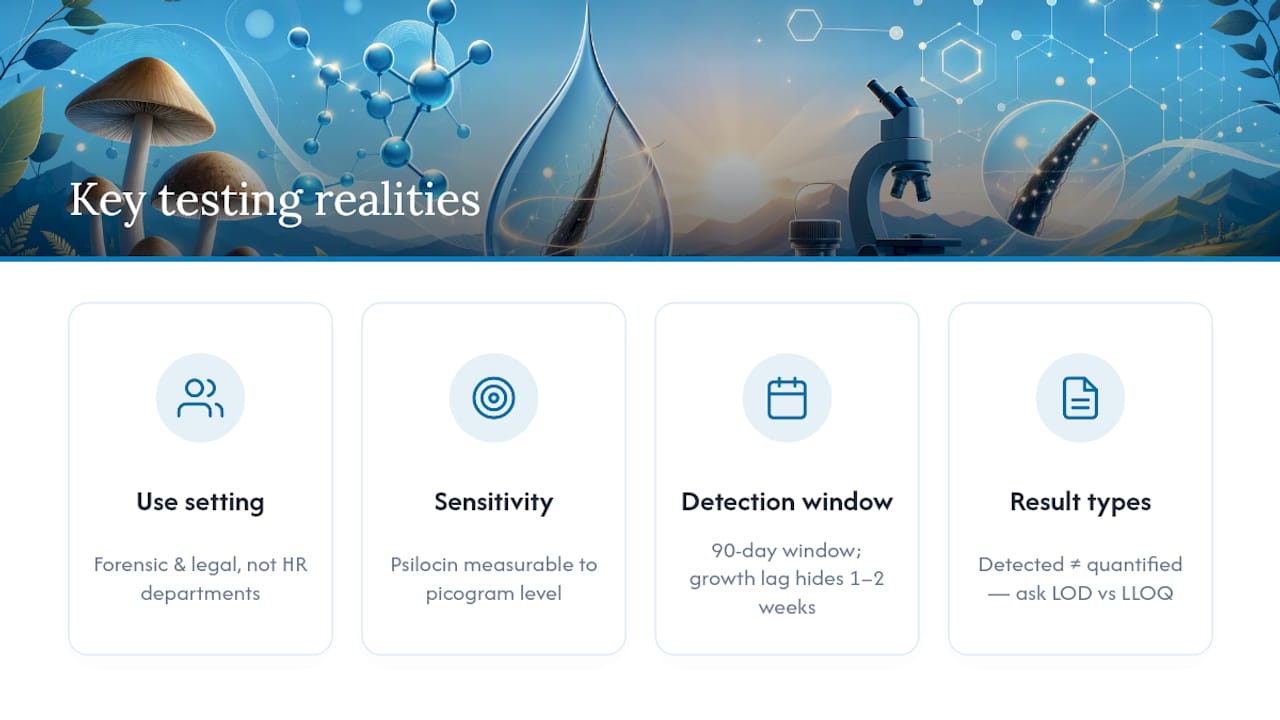
The conventional wisdom treats psilocybin hair testing like it’s one drop-down menu option away on any standard panel. It isn’t. The bigger misconception isn’t about detectability. It’s about frequency. People assume that because a method exists and works, it gets deployed constantly. In reality, cost and rarity keep it confined to forensic and legal corners of the world, not HR departments.
What the evidence actually supports is narrower and more useful: psilocin can be measured down to the picogram level, the 90-day window is real, and growth lag means the most recent week or two of hair may not reflect recent use yet. Where most explainers fall short is treating a “detected” result and a “quantified” result as the same thing. They aren’t, and that gap changes how a result should be read in a legal or employment context. If you take one thing from this, prioritize asking about LOD versus LLOQ before you trust any number a lab hands you.
— MIchael
Practical Hair-Test Prep Resources From Passhairdrugtest
This business is focused on helping people prepare for hair follicle drug tests using detox shampoos and structured cleansing routines, not laboratory-grade hallucinogen detection.
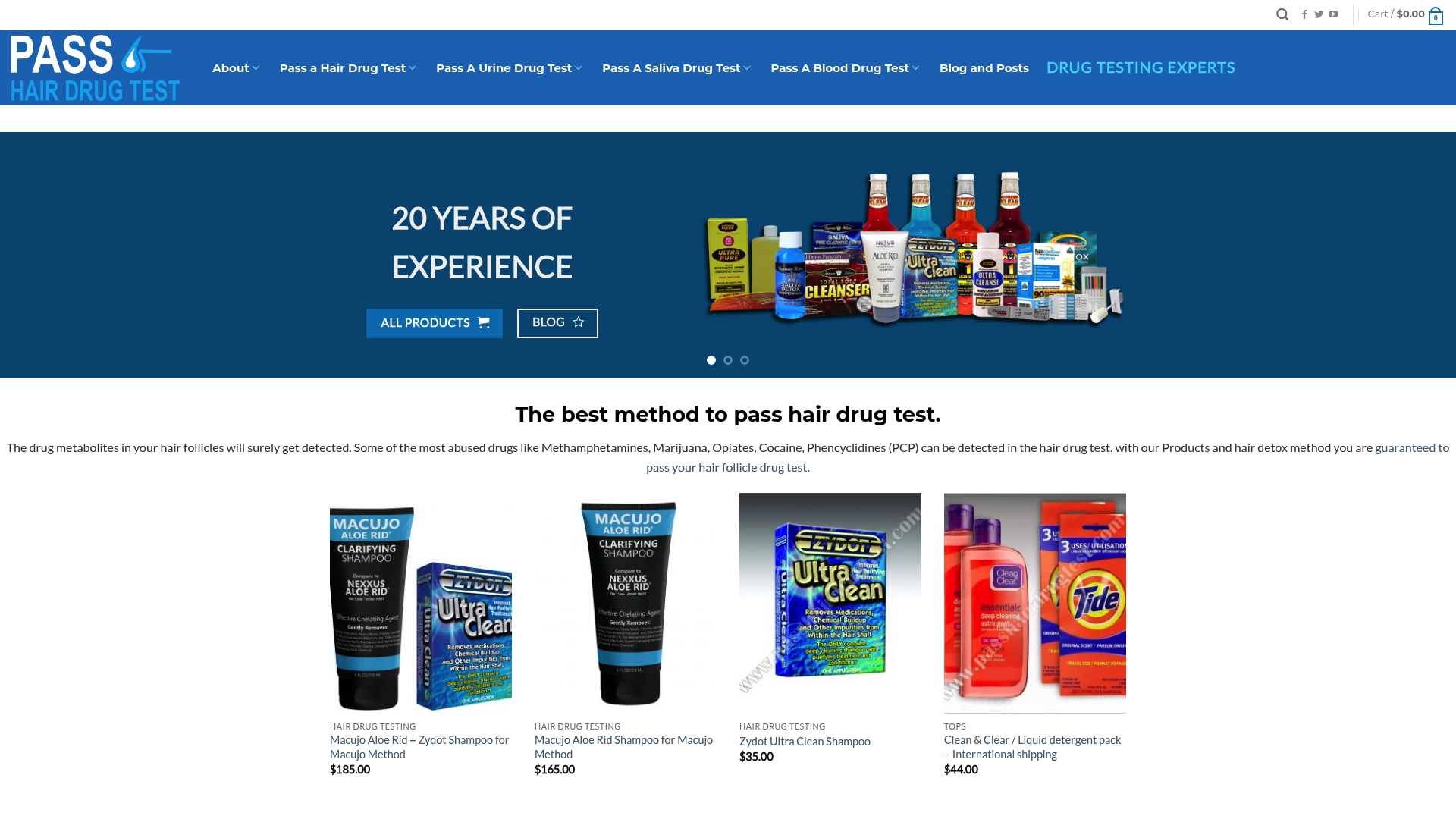
The product lineup centers on the Macujo Aloe Rid Shampoo, Zydot Ultra Clean Shampoo, and the multistep Mike’s Macujo Method, alongside a broader catalog of hair, urine, saliva, and blood drug testing products. None of these products are marketed as tools to defeat a specialized psilocin assay. They’re built around the far more common scenario: someone facing a standard hair follicle test for THC or other frequently screened substances who want a detailed, step-by-step cleansing method to follow. If that’s your situation, the full walkthrough of the Macujo Method and detox shampoo instructions breaks down exactly how the multi-step process works, and support is available for anyone who has questions before ordering.
Sources
Core references: psilocin quantification in hair (Springer), LC-MS/MS pitfalls and limitations (Forensic Chemistry), MedlinePlus drug testing overview, and Healthline’s shroom drug test summary.
This article is general information, not a substitute for advice from a qualified doctor. Consult a qualified healthcare professional about your own circumstances before acting on anything here.
FAQ
What Shows Up on a 12-Panel Hair Follicle Test?
A standard 12-panel test screens for common substances like THC, cocaine, opiates, amphetamines, and PCP, but it does not include psilocybin or psilocin. Detecting mushroom use requires a separate, specialized LC–MS/MS assay that most panels don’t run.
How Long Until Psilocybin Is Out of Your System?
Psilocybin converts to psilocin almost immediately and clears from urine, blood, and saliva within roughly 24 to 72 hours in most cases. Hair is the exception, holding a detectable record of psilocin for months after the compound leaves the bloodstream.
Can Psilocybin Be Found in Hair?
Psilocybin itself is rarely detected in hair because it converts to psilocin almost instantly in the body. Specialized LC–MS/MS methods have successfully quantified psilocin in authentic hair samples at concentrations from roughly 150 to 161 pg/mg in documented cases.
Can Psilocybin Be Detected on a Drug Test?
Standard workplace drug tests, including routine hair panels, do not screen for psilocybin or psilocin. Detection only happens through a specialized, high-sensitivity assay that’s typically ordered in forensic, legal, or research contexts rather than everyday employment screening.
Does Passhairdrugtest Sell Anything for Psilocybin Specifically?
The product line, including the Macujo Method and detox shampoos, is built around preparing for standard hair follicle drug tests rather than specialized hallucinogen assays. Current products and pricing are listed on the Passhairdrugtest product catalog.
Recommended
- LSD Hair Test: Forensic Reliability and Interpretive Limits
- 90 Day Window Explained: Opioid Hair Detection Time and the 5–10 Day Lag
- Why ‘Up to 90 Days’ Misleads in MDMA Hair Testing
- How Labs Use Phase II Metabolites to Confirm Drug Use in Hair
