No products in the cart.

Uncategorized
90 Day Fentanyl Hair Detection: Why 0.1–5 pg/mg Sensitivity Matters
20
Sep
Sep
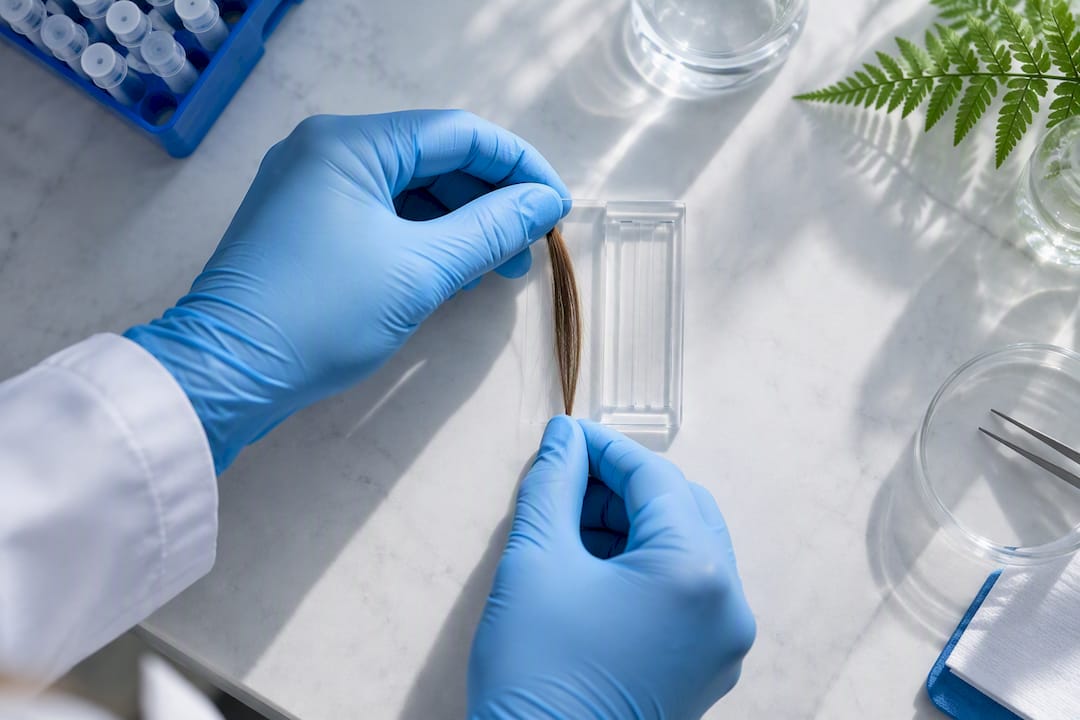
A standard 3 to 4 centimeter hair sample typically reveals fentanyl exposure going back roughly 90 days, since hair grows about a centimeter a month and each segment locks in a record of what passed through the bloodstream while it formed. That number moves depending on which lab panel gets used and how sensitive its testing method is. Very recent use, meaning anything from the last few days to about a week, usually does not show up yet, no matter how good the lab is.
TL;DR:
- Hair testing for fentanyl typically covers about 90 days, but the sensitivity depends on the lab panel and detection methods used.
- Fentanyl is present in hair at extremely low concentrations, often in the picogram range, which can challenge standard testing sensitivity.
- External contamination, cosmetic treatments, and individual biology can influence whether fentanyl shows up in hair results.
- Confirmatory testing and targeted panels are essential, as generic opioid tests may miss fentanyl unless explicitly included.
- Hair length and sample collection quality directly impact the detection window and accuracy of fentanyl hair testing.
Table of Contents
Table of Contents
- How Hair Drug Testing Works: Incorporation, Growth Rate, and the Diagnostic Window
- Fentanyl-Specific Detection Window and Study Evidence
- Factors That Affect Whether Fentanyl Shows Up in Hair
- Interpreting a Positive or Negative Fentanyl Hair Result
- Sample Collection Rules: Minimum Hair Length, Weight, and Alternatives
- Laboratory Methods and Sensitivity for Fentanyl and Analogs
- What Our Experience Adds: Resources and Limits
- Practical Takeaways: What to Do if You Expect a Hair Test
- If You Want Product Resources: Hair-Test Prep Options
- Sources
- FAQ
How Hair Drug Testing Works: Incorporation, Growth Rate, and the Diagnostic Window
Hair does not test for drugs the way urine or saliva does. It tests for a chemical record.
Fentanyl and its metabolites reach the hair follicle mainly through blood flowing to the papilla, the structure at the root that builds each strand from the inside out. Once a strand incorporates that trace, it is locked in place as the hair grows upward and eventually pushes past the scalp. Sweat and sebum can also deposit trace amounts onto the hair shaft after it has grown, and so can external contact with drug residue on hands, surfaces, or paraphernalia. That is one reason interpretation gets complicated later, but the core mechanism is straightforward: what is in the blood when a hair segment forms tends to end up in that segment.
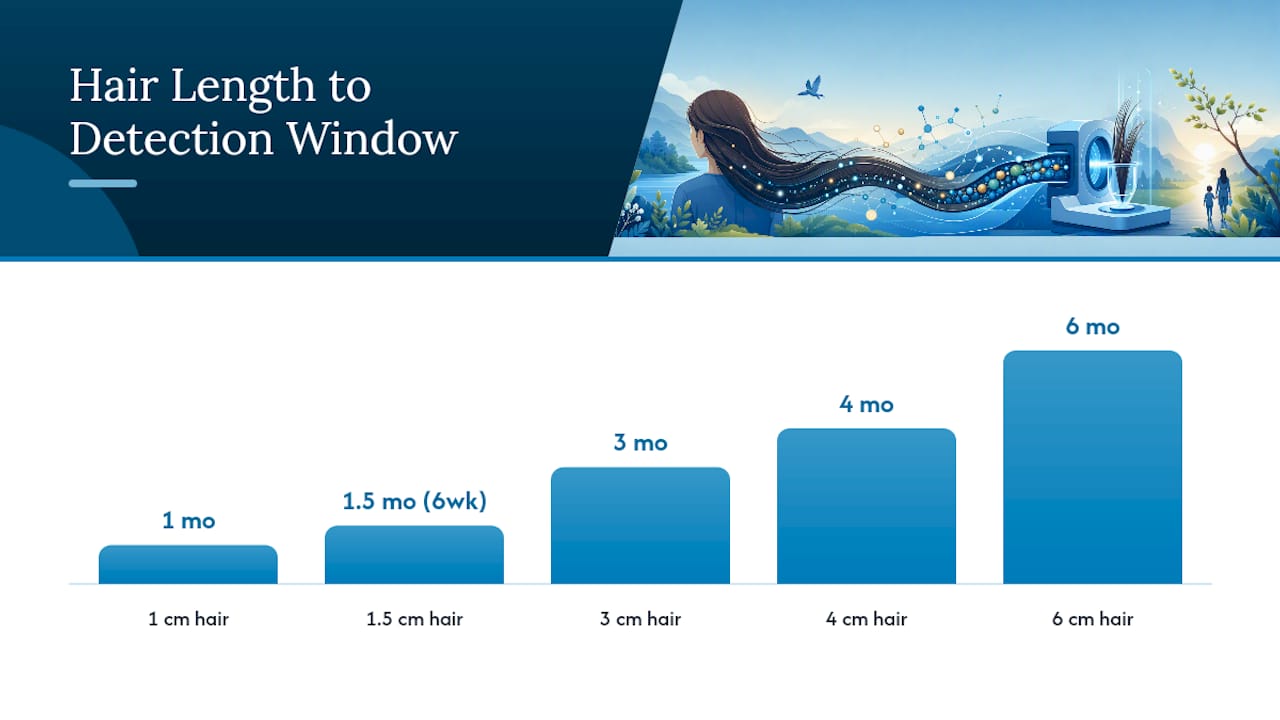
Average human hair growth runs close to 1 centimeter per month, according to Quest Diagnostics, which is why a standard 3 to 4 centimeter proximal scalp sample maps to roughly 3 to 4 months of history. Cut a 6 centimeter sample and you are looking at half a year. Cut a 1.5 centimeter sample and you are only getting about six weeks. The math is not exact for every person (growth rate varies by individual, hair type, and even season), but it is close enough that labs build their reporting windows around it.
This is also where segmental analysis comes in. Instead of testing one full sample as a single block, a lab can cut it into smaller sections and test each one separately, effectively building a month-by-month timeline instead of one lump result covering the whole window. That approach is more common in forensic and clinical research settings than in routine employment screening, but it is the closest thing hair testing offers to a timeline rather than a yes-or-no answer.
A few practical points fall out of this mechanism:
- Longer samples cover longer windows, but growth near the scalp is what gets tested first.
- The segment closest to the scalp reflects the most recent weeks, while the tip reflects the oldest exposure.
- Growth rate differences between individuals mean the 90-day estimate is an average, not a guarantee.
- Segmental testing can narrow down roughly when exposure occurred, but it requires extra lab work most standard panels skip.
Fentanyl-Specific Detection Window and Study Evidence
Fentanyl shows up in hair at extremely low concentrations compared to drugs like cocaine or methamphetamine, and that changes what “detectable” actually means in practice.
Forensic researchers analyzing real hair samples have reported fentanyl concentrations that commonly fall in the picogram-per-milligram range, with one study finding a median concentration around 95 pg/mg among positive samples, according to research published in PMC. To put that in perspective, a picogram is a trillionth of a gram. Detecting that requires instruments sensitive enough to find a needle in a haystack the size of a stadium.
By the numbers: Validated UHPLC‑MS/MS methods report limits of detection and quantitation for fentanyl and its analogs often between 0.1 and 5 pg/mg, depending on the exact method and target compound, per findings summarized in PMC.
That sensitivity range matters because it draws a hard line between “the drug was present” and “the panel could see it.” Standard workplace drug panels were built decades ago around opioids like morphine and codeine, not synthetic opioids like fentanyl. The Substance Abuse and Mental Health Services Administration notes that typical panels may not reliably catch fentanyl unless the test is expanded to specifically target it. A negative result on a generic opioid panel does not mean fentanyl was absent. It might just mean nobody looked for it.
Federal reporting backs up why this gap matters. The DEA’s 2024 National Drug Threat Assessment documents how widespread fentanyl has become in the illicit drug supply, which is part of why forensic labs and court-monitoring programs have pushed to add fentanyl-specific targets to their hair panels rather than relying on legacy opioid tests. Detection, in other words, is not just about how long fentanyl stays in hair. It is about whether the test being run was ever built to find it.
Factors That Affect Whether Fentanyl Shows Up in Hair
No two hair tests are working with identical biology, and that is exactly why two people with similar exposure histories can get different results.
Metabolism plays a role in how much of a dose gets converted and deposited versus cleared through other pathways, and dose and frequency obviously matter too. Someone with a single low-dose exposure sits much closer to the sensitivity floor than someone with repeated, heavier use. Melanin content in hair has also been linked to how readily certain drugs bind to the hair shaft, which means pigmented hair and lighter hair do not necessarily incorporate drugs at identical rates. A review of forensic hair toxicology published in Springer flags this kind of inter-individual variability as one of the persistent interpretive challenges in the field.

Cosmetic treatments complicate things further. Bleaching, chemical straightening, and repeated harsh shampooing can degrade drug residues sitting in the hair shaft, sometimes lowering measured concentrations. External contamination cuts the opposite direction: someone who handles fentanyl without direct use can pick up surface residue that a wash step is supposed to remove but does not always fully eliminate.
Sampling choices matter just as much as biology:
- Body hair grows on a different cycle than scalp hair and does not map cleanly to the 1 cm per month estimate, making window estimates far less precise.
- A sample that is too short or too light in weight may fall below what the lab needs to run a full confirmatory panel.
- A panel that was never configured to target fentanyl analogs will not report them, regardless of how much was actually present.
Pro Tip: If a hair test is coming up and fentanyl exposure is a concern, ask directly whether the panel includes fentanyl and its analogs by name. “Opioid panel” on a lab order sheet does not automatically mean fentanyl is on the target list.
Interpreting a Positive or Negative Fentanyl Hair Result
A positive result confirms exposure happened somewhere inside the detection window. It does not, by itself, tell you how often, how much, or exactly when.
That distinction trips up a lot of people reading a lab report for the first time. Without segmental testing broken into smaller sections, a single positive on a 3 to 4 centimeter sample just says fentanyl was present at some point in the last several months, not whether it was one incident or a pattern.
Metabolite and precursor markers help sharpen that picture. Norfentanyl, a metabolite fentanyl breaks down into, and 4‑ANPP, a precursor compound that often shows up alongside it, both give toxicologists secondary data points to weigh against contamination theories, as detailed in the PMC analysis of real-world hair samples. Finding fentanyl alongside its metabolite is a stronger signal of actual physiological exposure than finding fentanyl alone, since external contamination is less likely to also deposit the metabolite in matching proportions. These markers strengthen a case but do not settle it outright.
Labs address contamination risk with wash steps before extraction, rinsing the hair to strip away surface residue that never entered the shaft. How rigorous that wash protocol is, and where the cutoff concentration is set, varies by lab and by context. A few things generally hold across settings:
- Forensic and legal cases tend to demand confirmatory testing (usually a second, more specific method) before a result is treated as final.
- Clinical and workplace contexts sometimes rely on a single screening method with a higher cutoff, trading some sensitivity for speed and cost.
- Chain-of-custody documentation matters more in legal proceedings than in routine employment screening, where the stakes and appeal options differ.
Sample Collection Rules: Minimum Hair Length, Weight, and Alternatives
Collection standards are not arbitrary. They exist because the sample has to carry enough material to run a valid test and enough length to represent a meaningful window.
- Standard length: Most labs request 3 to 4 centimeters of hair cut close to the scalp, which corresponds to the roughly 90-day window collectors typically quote.
- Minimum weight: Studies on fentanyl hair analysis commonly report needing around 25 milligrams of hair to run a complete panel with confirmatory testing.
- Short hair limitations: Anyone with hair shorter than the standard cut simply cannot provide a sample covering the full 90-day estimate. Shorter hair means a shorter, more recent window, not a failed test.
- Body hair as an alternative: When scalp hair is unavailable, collectors sometimes use body hair, but its growth cycle differs enough from scalp hair that the standard 1 cm per month conversion does not apply cleanly.
- Professional collection expectations: A trained collector cuts hair close to the scalp in a discreet area, typically at the back of the head, and documents the sample’s origin and length.
- Chain of custody: Forensic and legal testing requires documented handling from collection through lab receipt, sealed packaging, and signed transfer records at each step. Anyone preparing for a hair follicle drug test should expect this level of documentation in any legally defensible testing scenario.
Laboratory Methods and Sensitivity for Fentanyl and Analogs
The instruments doing this work have gotten dramatically more sensitive over the past decade, and that shift is exactly why fentanyl hair testing has become viable at all.
Liquid chromatography tandem mass spectrometry, commonly written as LC‑MS/MS, remains the backbone method for confirmatory drug testing. Ultra-high-performance variants (UHPLC‑MS/MS) and high-resolution mass spectrometry (HRMS) push sensitivity further and allow labs to separate fentanyl from its many structural cousins, called analogs, which can differ in potency and are constantly evolving as illicit chemists tweak molecular structures. Research on UHPLC‑MS/MS methods for multiple fentanyl analogues, published in PMC, points to two complementary strategies: targeted analysis, which hunts for specific known compounds, and untargeted analysis, which scans more broadly and can catch novel analogs a targeted panel would simply miss.
By the numbers: Modern validated methods commonly report limits of detection and quantitation for fentanyl and its analogs in the range of 0.1 to 5 pg/mg, a sensitivity threshold that did not exist in most forensic labs a generation ago.
That combination of targeted and untargeted testing matters because new fentanyl analogs keep appearing on the illicit market. A panel calibrated only for known compounds risks missing whatever comes next.
Before any of that analysis happens, labs typically run the hair sample through a decontamination wash designed to strip external residue without degrading what has actually incorporated into the shaft. Getting that balance right is one of the more technically demanding parts of the whole process:
- Wash protocols aim to remove surface contamination while preserving internally incorporated drug residue.
- Extraction methods break down the hair matrix to release trapped compounds for analysis.
- Reference standards for each analog need continual updates as new fentanyl variants enter circulation.
What Our Experience Adds: Resources and Limits
Our site draws on experience in the drug-testing and detox-product industry, which shapes how we discuss hair testing here. Our detailed hair follicle drug test information page and our breakdown of the 90-day detection window walk through the practical side of what this article covers scientifically.
What we offer is product and procedural guidance, not laboratory confirmation. If a real result needs interpreting, that call belongs to a toxicologist, a Medical Review Officer, or a clinician reading the actual lab report, not a product website.
Practical Takeaways: What to Do if You Expect a Hair Test
Ask the testing organization exactly which analytes and panels they run, and what hair length they require. Fentanyl is not automatically included in a generic opioid screen, and that gap catches people off guard.
If a result gets disputed, request confirmatory testing rather than accepting a single screening pass. A toxicologist or clinician is the right person to interpret ambiguous findings, especially where legal or employment consequences are on the line.
And if the concern is recent use rather than a months-long history, remember that hair is the wrong tool for that question. Urine and oral fluid tests cover days, not months, and answer a completely different question than hair does.
— MIchael
If You Want Product Resources: Hair-Test Prep Options
This site offers hair-care and test-prep products built specifically around the science this article just walked through, not a generic detox aisle. Our catalog centers on the Macujo Aloe Rid Shampoo line and the multi-step Mike’s Macujo Method, developed for people who need a practical response to exactly the kind of detection window and sensitivity thresholds described above.
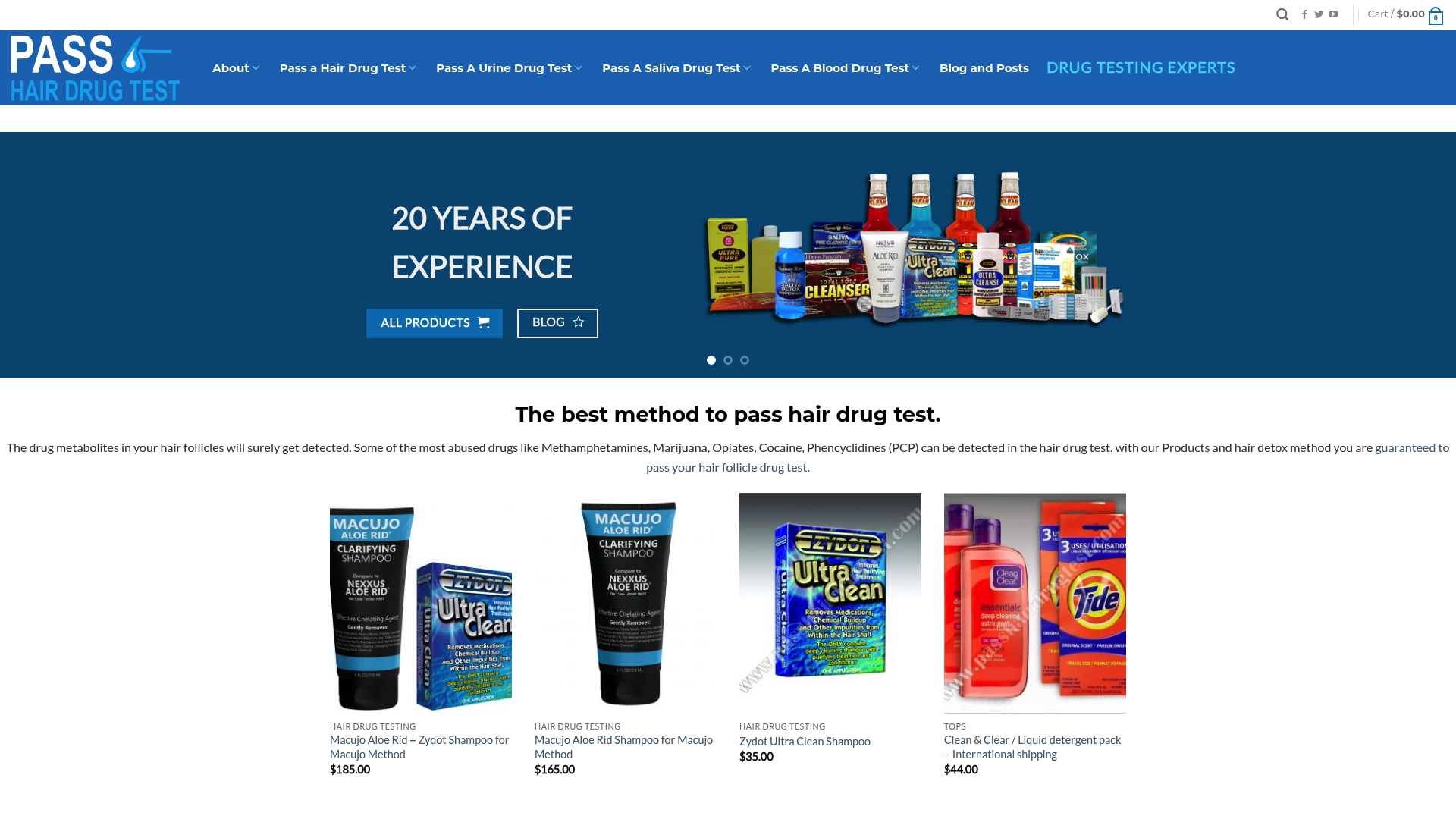
These are commercial products, not laboratory tests or medical treatments, and they do not substitute for confirmatory lab work or a clinician’s interpretation of a real result. What they offer is a documented, instruction-backed process for people who want to address hair-care preparation ahead of a scheduled test. Support is available for procedural questions, and product pages include step-by-step usage guidance. Browse the full hair drug testing product lineup to see what fits your timeline and hair type before your test date arrives.
Sources
- Hair testing FAQ — Quest Diagnostics
- Toward the Interpretation of Positive Testing for Fentanyl and Its Analogs in Real Hair Samples: Preliminary Considerations — PMC
This article is general information, not a substitute for advice from a qualified doctor. Consult a qualified healthcare professional about your own circumstances before acting on anything here.
FAQ
How Long Does Fentanyl Stay in Hair?
A standard 3 to 4 centimeter hair sample typically reflects fentanyl exposure over the prior 3 to 4 months, since hair grows roughly a centimeter each month. Longer samples extend that window further back in time.
How Long Do I Need to Be Clean to Pass a Hair Follicle Test?
There is no single universal timeframe, since the answer depends on how much hair is tested and how sensitive the lab’s panel is. Because detection windows run close to 90 days for a standard sample, anyone preparing for a scheduled test typically needs a plan that addresses that full window, not just recent days.
What Throws Off a Hair Follicle Test?
Cosmetic treatments like bleaching and chemical straightening can degrade drug residue in the hair shaft, while external contamination from handling drugs can add residue that never reflects actual use. Melanin content and individual metabolism also affect how readily fentanyl incorporates into a given person’s hair.
Can Fentanyl Be Detected in Hair From Recent Use?
Not reliably within the first several days, since incorporation into the hair shaft and the lag until new growth emerges above the scalp both take time. Someone worried about very recent exposure should look at urine or oral fluid testing instead, since those windows cover days rather than months.
What Is the Minimum Hair Length for a Drug Test?
Labs generally request hair cut close to the scalp, with 3 to 4 centimeters being the standard length for a full detection window. Shorter hair can still be tested, but it will only reflect a shorter, more recent period rather than the full 90-day estimate.
Recommended
- 90 Day Window Explained: Opioid Hair Detection Time and the 5–10 Day Lag
- Hair Test Cutoff Levels: What the Numbers Actually Mean
- 90 Day Risk: Can an Occasional Smoker Fail a Hair Test?
- Long Hair Drug Test: What Labs Actually Measure
