Uncategorized
THC in Hair: What U.S. Cannabis Users Need to Know
Jul
You can reduce the chance of THC showing up on a hair drug test, but no method guarantees a pass. That’s the honest answer, and anyone who tells you otherwise is selling false confidence. Labs use a two-step process, ELISA screening followed by confirmatory GC-MS or LC-MS/MS, that is specifically designed to catch attempts at evasion.
Here’s what to do right now:
- Stop all cannabis use immediately. Every day you continue adds to the detection window.
- Buy an at-home hair test kit and run a self-check before your actual test date.
- Start a validated cleansing regimen (Macujo-style wash plus a quality detox shampoo) if you have at least a week or two before the test.
- Document any prescriptions or medical cannabis authorizations in writing.
No cleansing product or method has been proven in peer-reviewed research to guarantee a negative result on a confirmatory GC-MS/LC-MS/MS test. Passhairdrugtest has more than 20 years of experience in hair-detox products and is transparent about this. Attempting to tamper with or substitute a sample is illegal and can carry serious consequences of a failed test.
Table of Contents
Table of Contents
- How does a hair follicle drug test actually work?
- Which factors make THC more or less likely to show up?
- What should you do in the days and weeks before a hair test?
- What cleansing methods and products do people actually use?
- What do hair test results actually mean?
- What are the U.S. legal and workplace risks of trying to alter a hair test?
- Key Takeaways
- What 20 years in hair detox actually teaches you
- Passhairdrugtest products for your prep timeline
- Useful sources for further reading
How does a hair follicle drug test actually work?
Labs screen with ELISA first, then confirm any non-negative result with GC-MS or LC-MS/MS, a two-step workflow that makes false positives rare but not impossible. Understanding this process tells you exactly why “quick fixes” rarely hold up.
| Step | What happens | Timing |
|---|---|---|
| Sample collection | a moderate number of hair strands cut close to the scalp | Day of test |
| ELISA screening | Immunoassay flags potential positives | Same day or next day |
| GC-MS / LC-MS/MS confirmation | Mass spectrometry confirms and quantifies | — |
| Result reported | Negative, confirmed positive, or inconclusive | 3–5 business days total |
Hair samples are typically 100–120 strands cut from the scalp, representing roughly 1.5 inches of growth. That 1.5-inch segment covers approximately 90 days of history, because scalp hair grows about half an inch per month. When head hair is unavailable, labs can use body hair, which carries a longer and less time-resolved detection window.
A lag of several days between use and detectability in hair is why a test won’t catch last night’s session, but it will catch everything from the past three months.
One detail most guides skip: labs segment longer hair to look back through specific time periods. A 3-inch sample doesn’t just show “yes or no” — it can show when use occurred.
Which factors make THC more or less likely to show up?
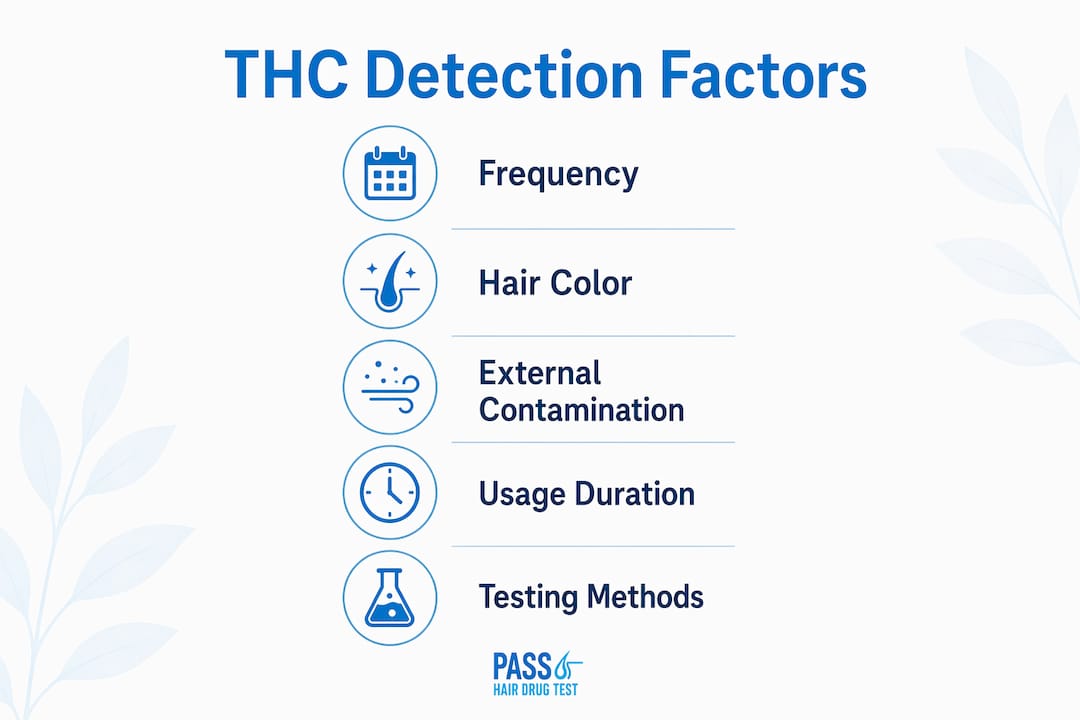
Use frequency matters most. Detection sensitivity is significantly higher for heavy users than light users but drops considerably for light or infrequent users. That gap is significant if you’re trying to assess your personal risk before a test.
Hair color and melanin content also play a role. THC and its metabolites bind to melanin, so darker hair tends to incorporate higher concentrations than lighter or gray hair. Bleached or chemically treated hair shows significantly reduced THC and THC-COOH concentrations, which is why some people consider bleaching, though it damages hair and doesn’t guarantee a clean result.
External contamination is a real variable. Secondhand smoke and skin contact can deposit cannabinoids on hair and generate a positive finding even without ingestion. Labs are aware of this, which is why confirmatory testing looks for THC-COOH, a metabolite considered stronger evidence of actual consumption. Even so, THC-COOH can appear in hair via sebum and sweat transfer, so a positive is not always definitive proof.
Pro Tip: If you have dark hair and have been around heavy smokers, your risk of a borderline positive is higher than for a light-haired person with the same use pattern. Run an at-home test first to calibrate your actual situation before committing to a full cleansing regimen.
What should you do in the days and weeks before a hair test?
Stop using cannabis the moment you know a test is coming. That single step does more than any product.
- Immediately: Cease all cannabis use. Avoid secondhand smoke environments. Wash pillowcases and shared hair tools to reduce recontamination.
- Days 1–7: Order an at-home hair test kit and run a baseline check. Start a cleansing regimen if you have the time and the test is more than a week out.
- Weeks 2–4: Continue the cleansing protocol consistently. Repeat the at-home test to track progress. Avoid any new exposure.
- Week 6+: If you have this much lead time, abstinence alone meaningfully reduces the concentration of detectable cannabinoids in the new growth.
- Day before the test: Use Zydot Ultra Clean Shampoo as a final wash. Avoid touching your hair unnecessarily. Do not use anyone else’s brush or hat.
The 90-day detection window means that hair grown before you stopped using cannabis will still carry THC traces. New growth after the 5–7 day lag will be clean, but labs test the full 1.5-inch segment. The math is straightforward: the earlier you stop, the smaller the proportion of your sample that carries detectable levels.
Do not bleach your hair repeatedly or apply harsh chemicals without understanding the scalp damage risk. Aggressive chemical treatment can cause burns and may not reliably reduce metabolite levels below the cutoff threshold.
What cleansing methods and products do people actually use?
No home method has been scientifically proven to guarantee a negative confirmatory result. That said, multi-step chemical cleansing regimens and quality detox shampoos are the standard proactive strategy practitioners report for last-minute preparation, with the caveat that technique and timing matter enormously.

| Method | Best for | How it works | Time needed | Pros / Cons |
|---|---|---|---|---|
| Multi-step chemical wash (Macujo-style) | Longer prep (1–4 weeks) | Opens hair cuticle with acidic/alkaline agents to flush metabolites | Multiple sessions over days/weeks | Thorough; higher damage risk; requires commitment |
| Specialized detox shampoos (Aloe Rid, Zydot Ultra) | Last-minute or combined use | Surfactants and chelating agents strip surface and cortex deposits | 1–3 days before test | Widely available; lower damage; evidence is mixed |
| Long-term abstinence | 90+ days available | New clean hair growth replaces contaminated segments | 90+ days | Most reliable; not always feasible |
| Body hair substitution | No head hair available | Body hair collected instead; longer window, less precise | N/A | Lab option only; wider detection window |
Macujo Aloe Rid Shampoo
This is the anchor product in the Macujo Method, a multi-step regimen designed to open the hair cuticle and flush out THC metabolites. The shampoo’s formulation is built for repeated use over several sessions. It works best when you have at least a week before your test and can run multiple wash cycles.
- Best for: users with 1–4 weeks of prep time
- Pros: purpose-built for the Macujo protocol; designed for repeated application
- Cons: requires multiple sessions; can cause dryness with overuse
Zydot Ultra Clean Shampoo
Zydot is a single-use, day-of-test shampoo that combines a purifying shampoo, a deep-cleaning conditioner, and a scalp purifier. It’s the standard last-minute addition to any regimen and is most effective when used after a multi-step protocol rather than alone.
- Best for: final wash on test day, or light users with short prep time
- Pros: easy to use; widely available in the U.S.; low damage risk
- Cons: limited effect as a standalone solution for heavy users
Mike’s Macujo Method
Mike’s Macujo Method is a specific multi-step protocol that combines Macujo Aloe Rid Shampoo with other cleansing agents in a defined sequence. It’s the most thorough option available through Passhairdrugtest and is designed for users who have a week or more to prepare and want the most complete regimen possible.
What do hair test results actually mean?
Labs report three basic outcomes. A negative means no cannabinoids were detected above the cutoff threshold. A confirmed positive means ELISA flagged it and GC-MS or LC-MS/MS confirmed the presence of THC or its metabolites above the cutoff. An inconclusive result usually means the sample was insufficient or contaminated, and the lab may request a new collection.
- Negative: No action required; result stands.
- Confirmed positive: Request the full confirmatory report and chain-of-custody documentation. You have the right to ask which specific metabolites were detected and at what concentrations.
- Inconclusive: A new sample will likely be requested. This is not a positive, but it does restart the clock.
Some labs now use LC-MS/MS panels that detect Delta-8 and Delta-10 THC isomers in addition to Delta-9. If you’ve used any hemp-derived products, this matters. A positive on an expanded panel can still be challenged if the isomer profile doesn’t match typical cannabis consumption patterns.
What are the U.S. legal and workplace risks of trying to alter a hair test?
Attempting to tamper with, substitute, or falsify a hair sample can carry consequences well beyond a failed test, including termination for cause, loss of professional licenses, and in federally regulated industries, potential criminal liability. The chain-of-custody process at accredited labs is specifically designed to detect tampering.
• Employer policies vary widely. Some conduct a single test; others retest on reasonable suspicion.
- A screening result alone is not grounds for termination at most employers. A confirmed positive from GC-MS/LC-MS/MS is what HR and legal teams act on.
- If you use medical cannabis legally in your state, document it. Honest disclosure of a valid prescription or medical authorization is often a safer path than attempting remediation that fails.
- If you believe a result is wrong, you can request an independent retest at a certified laboratory and ask for the chain-of-custody records.
Consult HR or an employment attorney before taking any action that could be construed as tampering. This article is general information, not legal advice.
Key Takeaways
The most reliable strategy for reducing THC detection in hair combines immediate cessation, a multi-step cleansing regimen, and a pre-test at-home check, with realistic expectations that no method guarantees a negative confirmatory result.
| Point | Details |
|---|---|
| Stop use immediately | Every additional day of use extends the contaminated segment of your hair sample. |
| Know the detection window | Scalp hair covers roughly 90 days; THC becomes detectable 5–7 days after use. |
| Labs use two-step confirmation | ELISA screens, then GC-MS or LC-MS/MS confirms, making false negatives from cleansing harder to achieve. |
| Contamination can cause positives | Secondhand smoke and skin contact can deposit cannabinoids on hair without ingestion. |
| Passhairdrugtest offers validated kits | Macujo Aloe Rid, Zydot Ultra Clean, and Mike’s Macujo Method kits are available for different prep timelines. |
What 20 years in hair detox actually teaches you
Most people who come to this topic are looking for certainty in a situation that doesn’t offer it. The honest perspective, after more than two decades watching this space, is that the people who do best are the ones who act early, test themselves first, and use products correctly rather than desperately.
The Macujo-style regimen works better with time. A single wash the night before a test is not the same as a week of consistent protocol. Zydot Ultra Clean is a finishing step, not a standalone solution for a heavy user. These distinctions matter, and they’re the ones that separate a realistic preparation from wishful thinking.
The lab science has also gotten sharper. Expanded isomer panels and lower detection thresholds mean that methods which worked reliably a decade ago face a tougher standard today. That’s not a reason to give up on preparation. It’s a reason to be precise about what you’re doing and why.
Passhairdrugtest products for your prep timeline
If you’ve read this far, you know the variables. Passhairdrugtest maps its product line directly to the timelines that matter: the Hair Follicle Shampoo Kit for structured multi-step preparation, Macujo Aloe Rid Shampoo for the core Macujo protocol, and Zydot Ultra Clean as the day-before finishing wash.
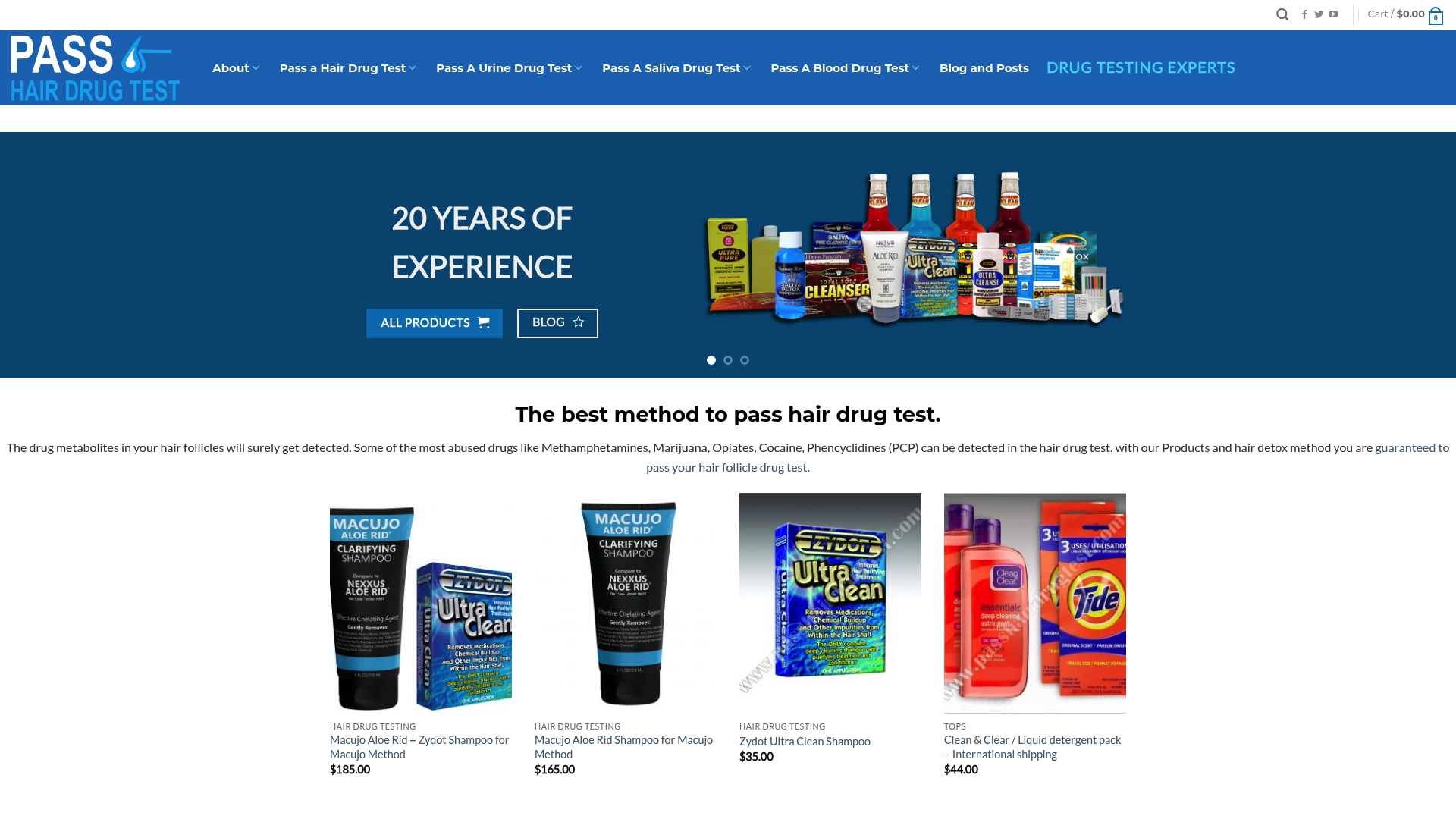
Every product ships within the U.S. and comes with usage instructions built around the regimens described in this guide. At-home test kits are also available so you can check your baseline before committing to a full protocol. No product on the site comes with a guarantee of passing, because no honest seller can make that claim. What Passhairdrugtest offers is 20+ years of product experience, clear instructions, and the right tools for the time you have. Check the full kit options and pick the one that fits your timeline. If you’re in a regulated industry or facing a legal test, consult HR or legal counsel before purchasing.
Useful sources for further reading
The claims in this guide draw from peer-reviewed toxicology research and major clinical lab documentation. For verification, these are the primary sources worth reviewing directly.
- Quest Diagnostics: Hair Drug Testing overview — collection norms, sample weight, and body hair protocols
- Medical News Today: Hair follicle drug test explainer — ELISA and confirmatory testing workflow, result categories
- Healthline: Hair strand drug test overview — detection windows, 5–7 day lag, and common cleansing strategies
- PMC: Cannabinoids in hair and contamination research — environmental contamination routes and interpretation limits
- PMC: Sensitivity comparison by use pattern — heavy vs. light user detection rates
- PMC: Advances in cannabinoid isomer detection — Delta-8/Delta-10 and expanded LC-MS/MS panels
Check each lab’s published cutoff policies and request the confirmatory method details if you receive a positive result. Cutoffs and panel scope vary by employer and testing provider.
Recommended
- THC In Blood Drug Testing – Pass Hair Drug Test
- Hair Drug Test Information – Pass Hair Drug Test
- The Science Behind the Hair Drug Test – Pass Hair Drug Test
- Hair Follicle Drug Test Information – Pass Hair Drug Test
