Uncategorized
Opiate Hair Test Detox: What Research and 20 Years’ Practice Show
Sep
No detox product reliably clears opiates from hair on demand, and the honest baseline is time: opioids can remain detectable in the proximal hair segment for roughly 90 days, sometimes longer. Growth lag and individual biology shift that window in both directions. The evidence on shampoos and DIY treatments is mixed at best, which the next sections lay out in detail.
TL;DR:
- Opiate detection in hair can last beyond six months in some cases, especially for metabolites like 6-MAM, making timing critical for passing tests.
- Chemical treatments such as bleaching and homemade detox shampoos only cause surface-level reductions that rarely lead to a negative result in confirmatory testing.
- The most effective method remains abstinence and waiting for at least three months of new hair growth, roughly half an inch per month, before testing.
- External contamination and individual hair type influence drug residues, complicating efforts to reliably cleanse or mask opiates in hair samples.
- Independent screening tests provide the best early indicator of actual drug presence before the official test, as no commercial product guarantees a negative result.
Table of Contents
Table of Contents
- How hair follicle tests detect opiates
- Opioid detection timelines in hair by drug type
- What the research says about detox shampoos and DIY methods
- Practical steps that actually improve your odds
- How Passhairdrugtest approaches opiate hair test prep
- The honest take on detox claims
- Where to find opiate hair test prep products
- Sources
- FAQ
How hair follicle tests detect opiates
When a person uses an opioid, the drug travels through the bloodstream and reaches the hair follicle, where it binds into the growing strand, partly through melanin affinity and partly through the hair’s natural porosity. Once keratin forms around that residue, it stays embedded as the hair grows outward, which is why a strand of hair works like a timeline of exposure rather than a same-day snapshot.
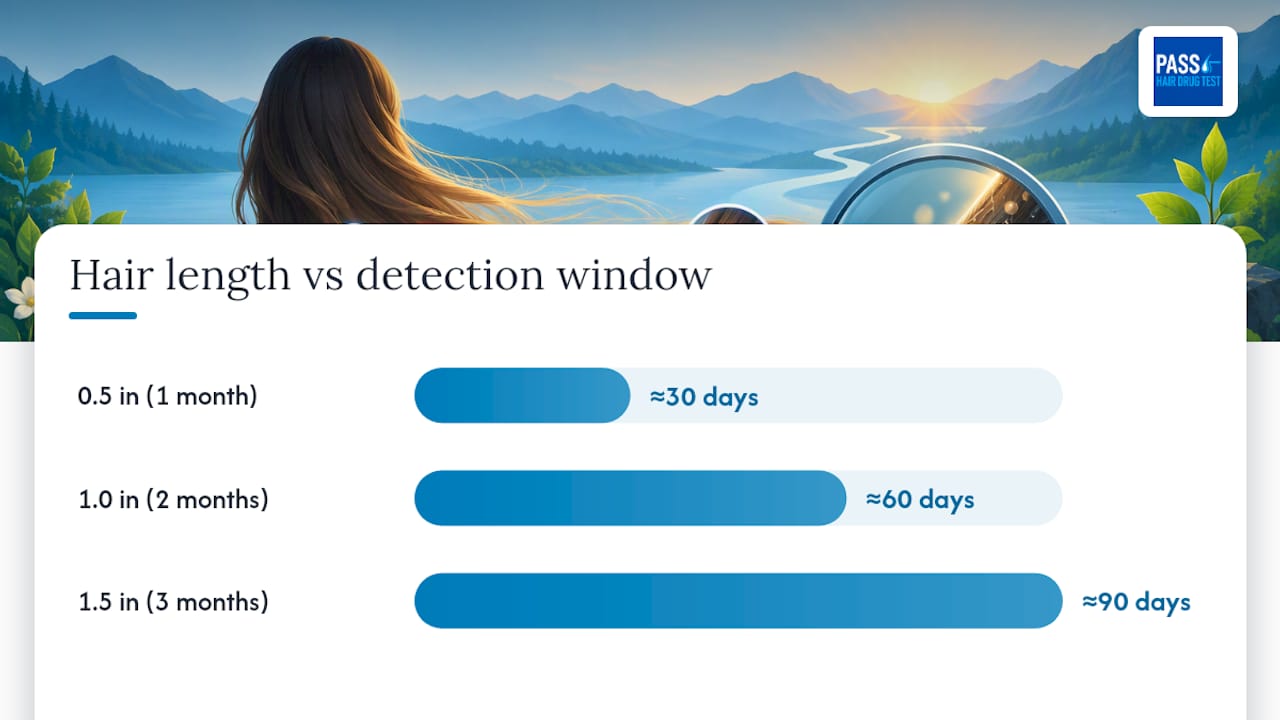
Labs typically collect a sample close to the scalp, usually the proximal 1.5 inches, because that segment represents the most recent growth. There’s a catch: hair does not emerge from the scalp instantly. It takes roughly 5 to 10 days for newly formed hair to reach the surface, so very recent use in that window may not show up yet even in a fresh sample.
Once the lab has a sample, testing happens in two stages:
- An initial immunoassay screens for the presence of opiates or their metabolites at a set cutoff.
- A positive screen moves to confirmatory testing, usually GC/MS or LC-MS/MS, which identifies the exact compound and concentration.
- Confirmatory results carry far more weight in disputes because mass spectrometry distinguishes parent drugs from metabolites and rules out cross-reactivity from other substances.
Several factors change how much drug ends up detectable. Darker, coarser hair tends to bind more drug residue than lighter or finer hair. Chemical treatments like bleaching or coloring can strip some of that residue, and external contamination (secondhand smoke, contact with a surface) can occasionally register, which is one reason labs distinguish between screening and confirmation rather than relying on the first result alone.
Opioid detection timelines in hair by drug type
The commonly cited “90-day window” is a practical guideline, not a hard rule. Opioid-specific research suggests the real picture is messier. A segmental-analysis study tracking codeine, morphine, and 6-MAM after people stopped using found that markers didn’t disappear on a fixed schedule. Some participants tested positive well past the two-month mark.
In a small cohort tracked after cessation, 27% still tested positive for 6-MAM at two months and 20% at four months, and samples only came back negative across the board after about six months. That’s a meaningfully longer runway than the standard 90-day figure implies, at least for some users in that study.
A few points matter when estimating your own timeline:
- Detection windows vary by the specific opioid: heroin’s unique metabolite 6-MAM behaves differently from morphine or codeine, which can also come from legitimate medications or even poppy seed exposure.
- Fentanyl and other synthetic opioids sit at far lower concentrations in hair, often at picogram-per-milligram levels, which means detection depends heavily on whether the testing lab’s assay is sensitive enough and whether that analyte is even included in the panel.
- Individual metabolism, dose, frequency of use, and hair growth rate all shift the timeline, so no single number applies to everyone.
None of this supports picking an exact “safe” date. The segmental data shows persistence is real and variable, which is the opposite of a guarantee that 90 days clears you.
What the research says about detox shampoos and DIY methods
Commercial detox shampoos and homemade recipes get discussed constantly, but the controlled research doesn’t back the idea that a wash or two erases a positive result. An early study on the shampoo Ultra Clean tested hair from known drug users before and after a single application. Every drug originally present was still detected afterward.
More recent work on homemade approaches found larger swings, though with caveats. A 2023 controlled study testing internet-sourced treatments, including baking soda washes, salicylic acid, and bleach-based protocols, measured substantial percentage decreases for some drugs under lab conditions.
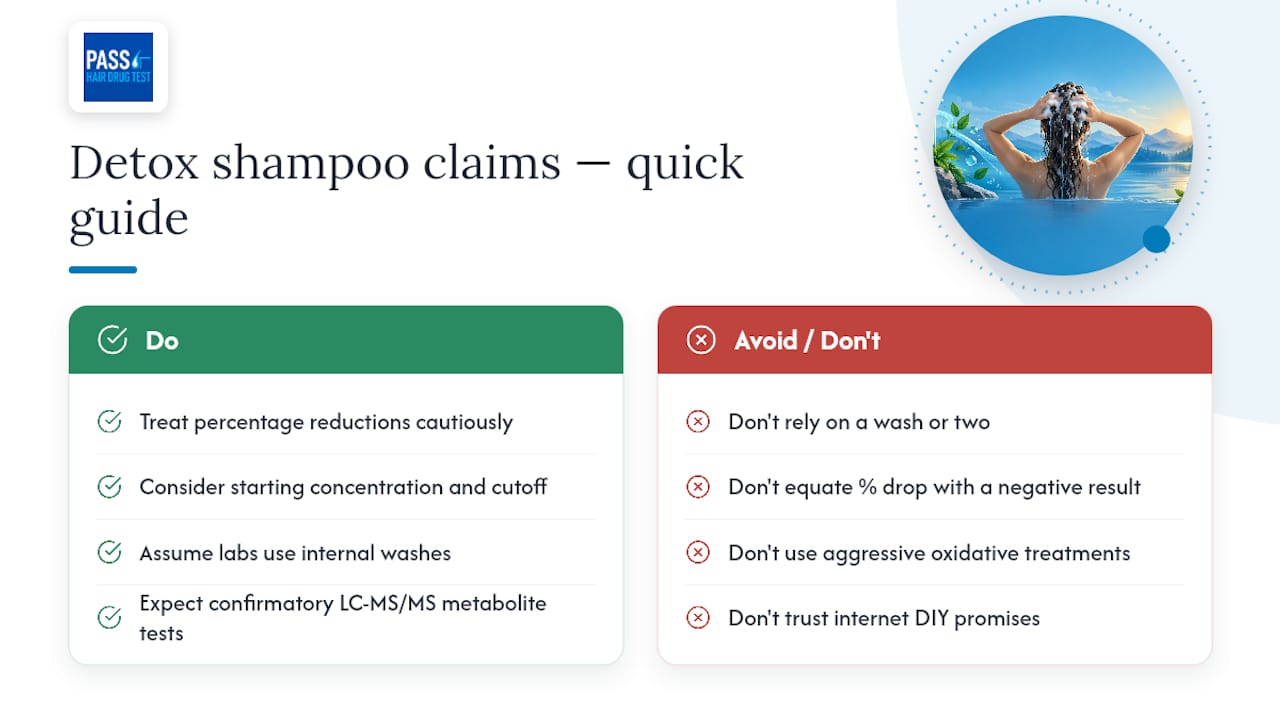
Those numbers sound dramatic, but a percentage reduction is not the same as a negative result. A lab cutoff is an absolute concentration, not a percentage. If the starting concentration is high enough, even a 77% drop can still leave the sample above the screening cutoff used for confirmatory opiate testing. The same 2023 research and a related forensic review both note that aggressive oxidative treatments cause visible and structural hair damage, and that labs aware of these methods can sometimes flag treated samples through altered metabolite ratios rather than accepting them at face value.
Pro Tip: Treat any claimed percentage reduction as a lab-condition result, not a promise: your starting concentration, hair type, and the specific test’s cutoff all determine whether that reduction is enough.
Labs have counters built in specifically because dilution and surface washing are common attempts to beat a test. Extended internal wash procedures during sample prep strip external contamination before testing even begins, and confirmatory LC-MS/MS looks for the parent drug and its metabolites rather than a single marker that a rinse might disrupt.
Practical steps that actually improve your odds
If you have weeks or months before a test, abstinence paired with new hair growth is the only approach with consistent support behind it. Hair grows roughly half an inch per month, so a 1.5-inch proximal sample represents about 90 days of history, meaning three clean months of growth is what you’re working toward, not three months from your last use date.
- Stop use as early as possible and track the date, since that’s your real countdown, not the test date.
- If a trim is an option, cutting length doesn’t erase drug incorporated into hair closer to the scalp, so don’t rely on a haircut alone.
- Keep hair care simple and consistent rather than starting an aggressive new routine right before testing, since sudden chemical treatments can look unusual to a lab and don’t reliably remove enough residue anyway.
- Consider an independent screening test before the real one, so you have an honest read on where you stand rather than a guess.
- If a screening result comes back positive, understand that a confirmatory retest will likely reach the same conclusion, since confirmation methods are built to be harder to fool than a first pass.
Pro Tip: A home or independent screening panel won’t guarantee the exact same cutoff as your employer’s lab, but it tells you whether you’re in the ballpark, which is more useful than assuming.
A few things are worth avoiding outright. Corrosive or high-concentration chemical mixtures applied directly to the scalp can cause burns and lasting damage, and the existing evidence doesn’t show they reliably beat a confirmatory test anyway. Misrepresenting a sample, substituting hair, or falsifying results carries legal and employment consequences well beyond the test itself. When in doubt, the safer path is verification and time, not improvisation.
How Passhairdrugtest approaches opiate hair test prep
Passhairdrugtest has spent more than 20 years in the drug-testing and detox product space, focusing on hair-cleansing products including Macujo Aloe Rid Shampoo, Zydot Ultra Clean Shampoo, and the multi-step Mike’s Macujo Method. The site’s position is that no single product replaces verification: pairing any preparation method with an independent screening test before the real one gives a clearer read than relying on a shampoo alone. Readers can review product pages and instructional guides, or reach the team directly for support before deciding on an approach.
The honest take on detox claims
Marketing around detox shampoos leans on the idea of a quick fix, but the research consistently shows partial, inconsistent results rather than a clean solution. The gap between what’s advertised and what studies actually measure is where most people get burned. Time and abstinence remain the most dependable variables, and verifying your status before the real test beats hoping a product did its job.
— MIchael
Where to find opiate hair test prep products
Passhairdrugtest carries hair drug testing products, including the multi-step kits and shampoos discussed above, for readers who want a structured approach rather than piecing one together from scratch. 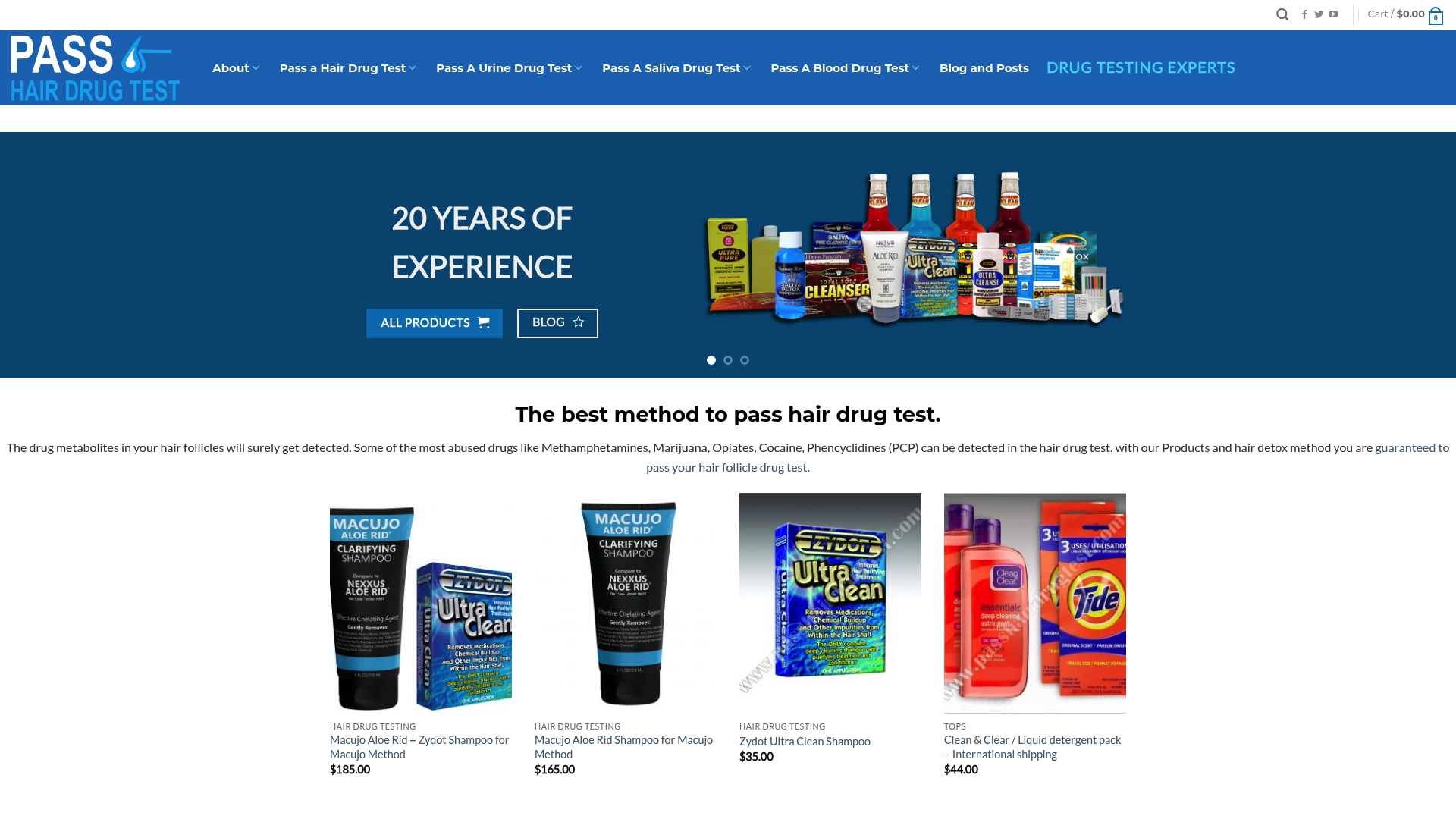
Pairing any product with an independent screening test remains the most reliable way to check where you actually stand before the real exam.
- Browse the hair follicle shampoo kit for the multi-step cleansing approach.
- Read how to pass a hair drug test for product-specific instructions.
- Check the hair drug test information page for background before you buy.
Start with a screening test, then decide which product fits your timeline and hair type.
Sources
- Hair analysis: Assessment of homemade hair treatment effects on drug concentrations in the keratin matrix
- Disappearance of codeine, morphine and 6-MAM in hair after cessation of abuse
- The influence of the special shampoo Ultra Clean on the results of hair analyses
- Drug metabolites and hair testing (SAMHSA guidance)
- Psychemedics Opiates HEIA – FDA review K201326
FAQ
Can you detox for a hair follicle test?
No product has been shown to reliably clear opiates from hair on demand. Studies on commercial shampoos and homemade treatments show partial, inconsistent reductions, and labs use confirmatory testing specifically to catch what a wash misses.
How long do opioids stay in a hair follicle test?
Opioids are typically detectable in the proximal hair segment for around 90 days, though a segmental study found some users still tested positive for 6-MAM at two and four months after stopping, with consistent negativity only after about six months in that cohort. Growth lag of 5 to 10 days also means the most recent use may not appear yet.
What is the best detox shampoo for a hair follicle drug test?
There isn’t a shampoo with peer-reviewed evidence of guaranteed success. Zydot Ultra Clean is one of the most studied commercial products, and a controlled test found a single wash still left every drug detectable, with only a modest reduction in concentration for some analytes like morphine.
How to pass a hair follicle test in 2026?
The most consistent approach remains abstinence combined with waiting for new hair growth, since hair grows roughly half an inch per month and a standard sample covers about three months of history. Verifying your status with an independent screening test before the real one gives a more honest read than relying on any single product.
Recommended
- Home Hair Detox: Realistic Protocol and Verification Guide
- Do Detox Shampoos Work for Hair Follicle Tests?
- How to Use Detox Shampoo for a Hair Drug Test
