Uncategorized
Bleach Lowers Amphetamine Hair Test Levels: Evidence and What to Do

Sep
Full, guaranteed amphetamine removal from hair is not something any method can promise: abstinence over time remains the only dependable path to clean hair, though certain oxidative treatments and multi-step cleansing routines reduce measured levels in many cases. Results vary widely by hair color, dose history, and the lab’s methods. This article walks through the evidence, a realistic prep protocol, and the medical and legal limits you need to know before your test.
TL;DR:
- Hair drug levels depend heavily on hair pigmentation, with darker hair tending to retain higher concentrations of amphetamines regardless of similar use.
- Oxidative treatments like bleaching can reduce measured drug levels but do not guarantee complete removal, especially if use was recent or heavy.
- A negative private test before your appointment is useful for assessment but should not be relied on blindly, as test sensitivity varies and new growth may still contain traces.
- Strict abstinence remains the only reliable way to truly clear hair of amphetamines over time, as current methods only reduce, not eliminate, detectable levels.
- Prescription stimulant use can be documented to help distinguish it from illicit use, but positive results still require proper disclosure and legal procedures.
Table of Contents
Table of Contents
- How hair follicle tests detect amphetamines in your system
- Detection window and what changes how much shows up
- What the research actually shows about detox methods
- A realistic pre-test protocol if you have limited time
- Medical, safety, and legal limits you need to know
- If you take prescription stimulants like Adderall or Vyvanse
- Verifying your results before the official test
- Why this article leans on evidence over shortcuts
- Where PassHairDrugTest.com products fit into this plan
- Sources
- FAQ
How hair follicle tests detect amphetamines in your system
Amphetamines enter hair through the bloodstream while a strand is in its active growth phase, called anagen. As blood flows through the hair follicle, trace amounts of the drug and its metabolites bind into the growing keratin structure, locking a chemical record into the strand as it lengthens. This is fundamentally different from urine or saliva testing, which catch a drug only while it circulates in body fluids for a matter of days.
Labs typically start with an immunoassay screen, then confirm any positive result with liquid chromatography tandem mass spectrometry, or LC-MS/MS, which identifies and quantifies the exact compounds present. Controlled dosing research has shown that methamphetamine and amphetamine incorporate into hair in a dose-related pattern, with concentrations often exceeding the Society of Hair Testing’s 0.2 ng/mg cutoff for at least two weeks after a single dose.
A few technical points shape how results get interpreted:
- Screening tests flag possible positives; confirmatory LC-MS/MS testing verifies the specific drug and quantity.
- Labs may also test for amphetamine’s parent compound and its metabolites to build a fuller exposure picture.
- The Society of Hair Testing recommends segmenting hair into roughly 3-centimeter sections, each representing about 90 days of growth, which lets a lab estimate roughly when exposure occurred.
Detection window and what changes how much shows up
The standard hair test looks at the 1.5 inches of hair closest to the scalp, which corresponds to roughly the most recent 90 days of growth. That figure is a convention built around average hair growth rates, not a hard biological limit: growth speed varies by person, and segmental analysis can narrow or extend the window depending on how much hair is available and how it’s cut.
Melanin content strongly predicts how much drug shows up in hair. Controlled studies found that hair pigment correlates with amphetamine concentration at levels as high as an R-squared of 0.90 in some analyses, meaning darker, more pigmented hair tends to bind and retain more drug than lighter hair exposed to the same dose. That single fact explains a lot of the frustration people feel when they hear conflicting stories about who tested positive and who didn’t after similar use.
Several other variables move the number a lab reports:
- Higher or more frequent doses generally produce higher concentrations, though individual metabolism varies.
- External contamination from sweat, smoke, or handling drug residue can deposit trace amounts on hair without any ingestion at all.
- Cosmetic treatments including bleach, dye, and repeated washing can lower measured concentrations, which is why forensic labs use pre-wash decontamination steps to strip surface contamination before testing the hair itself.
What the research actually shows about detox methods
The internet is full of confident claims about “detox shampoos” and home remedies, but the actual evidence is narrower and more conditional than most of that advice suggests. Peer-reviewed and forensic studies do support some approaches, with real limits.
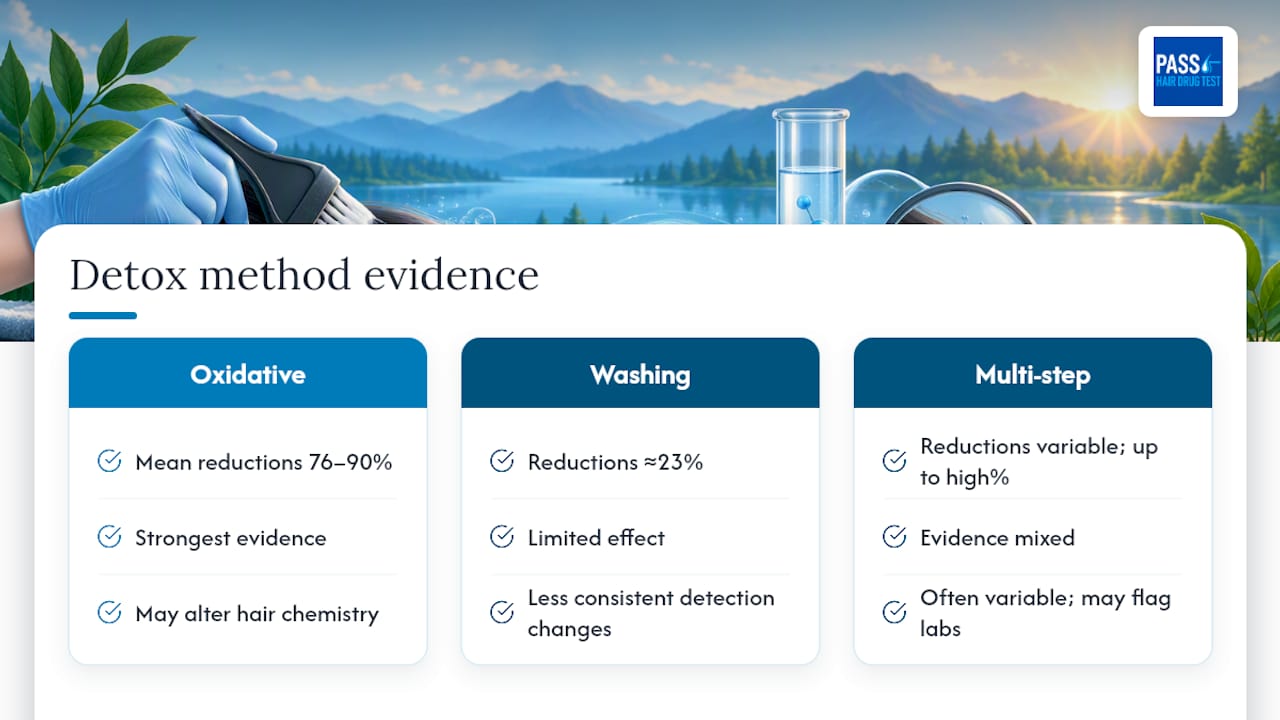
Oxidative treatments have the strongest evidence behind them. Laboratory experiments on hair samples found that bleaching and bleach-plus-dye cycles can substantially lower measured drug concentrations, with some experiments reporting mean reductions in the 76% to 90% range for various drugs depending on the treatment used, though amphetamine-specific reductions varied more than for other substances. A separate forensic study comparing repeated washing against a single dye treatment found that repeated washing lowered methamphetamine and amphetamine levels by about 23%, while a single dyeing session lowered them by a substantial percentage in that sample set.
Multi-step cleansing protocols, including the salicylic-acid-and-baking-soda-style routines popularized by Macujo-method guides, sit in a murkier evidentiary spot. More recent experimental work on decontamination procedures found that common wash cycles and multi-step treatments lower analyte levels but rarely eliminate them completely, with reported decreases up to a high percentage for some drugs and more variable results for amphetamines specifically. The same research noted that treated hair can look visually normal while still showing measurable chemical changes that a lab may flag as evidence of tampering.
Forensic and experimental studies demonstrate that a range of consumer hair cleansing procedures can lower analyte levels, but results vary and treated hair often shows changes that labs may flag.
That gap between what a shampoo bottle promises and what a controlled experiment measures is the single biggest source of confusion in this space. In vitro lab conditions don’t perfectly mirror a real collection, and a reduction that looks impressive on a treated hair swatch in a study doesn’t guarantee the same percentage drop on your own hair, at your own dose history, under your own lab’s cutoff.
A realistic pre-test protocol if you have limited time
If you have a hair test scheduled and any recent amphetamine exposure, the sequence below reflects what the evidence actually supports, not what marketing copy promises.
- Stop use immediately. Every day of continued exposure adds fresh drug to new hair growth closest to the scalp, which is exactly the segment labs test first.
- Understand the timeline honestly. Full biological clearance from hair isn’t fast: heavier or longer-term use means more accumulated drug in existing growth, and no shampoo reverses that instantly.
- Start a clarifying shampoo routine to strip surface oils and buildup, ideally daily in the days leading up to the test.
- If using a multi-step cleansing kit, follow the labeled frequency exactly. Products like Macujo Aloe Rid Shampoo and Zydot Ultra Clean Shampoo are built around specific wash sequences and timing, and skipping steps undercuts whatever partial effect the routine has.
- Consider bleaching only through a professional salon, and only as a last resort. Bleach has the strongest evidence for lowering concentrations, but it also visibly damages hair and can itself raise questions at collection.
- Order a private hair test before your official appointment to check where you stand while there’s still time to adjust your plan.
Pro Tip: A negative home test taken too soon after use can be a false reassurance because newly grown hair near the scalp may not yet reflect a full week or two of incorporation.
If a private test comes back positive, your realistic options are limited to more abstinence time, a documented medical explanation if one applies, or accepting the outcome. There is no reliable method that erases a strong recent exposure overnight.
Medical, safety, and legal limits you need to know
Stopping amphetamine use, especially after heavy or prolonged use, carries real withdrawal risk that no shampoo protocol addresses. A systematic review of pharmacological treatments for methamphetamine withdrawal found no medication consistently effective for rapid detoxification, noting that withdrawal symptoms typically peak in the first week and the withdrawal phase can last two to four weeks, with a longer extinction period sometimes stretching into months.
A few points matter beyond the physical risk:
- Withdrawal management is supportive, not a quick fix. Medical guidance if you’re stopping heavy use is worth seeking, not something to skip for the sake of a test date.
- Federal workplace testing guidelines permit stereoisomer, or D/L, analysis to help distinguish prescription amphetamine use from illicit use, and allow split-specimen testing as a safeguard.
- Labs and collectors are trained to spot signs of tampering, including unusual hair texture or damage, and a flagged sample can carry more serious consequences than a straightforward positive result.
If you take prescription stimulants like Adderall or Vyvanse
A legitimate prescription for Adderall, Vyvanse, or a similar stimulant does not automatically clear you at collection, but it gives you documentation that matters. Bring your prescription bottle or a pharmacy printout to the collection site, and be ready to disclose the medication when asked.
- Tell the collector and, if possible, the Medical Review Officer about your prescription before or immediately after the test.
- Understand that labs can run stereoisomer testing to help distinguish prescription dextroamphetamine from illicitly manufactured methamphetamine, since the federal testing framework specifically allows this analysis for exactly this kind of reconciliation.
- Contact your prescriber ahead of a scheduled test if you anticipate questions, since a letter confirming your diagnosis and dosage is the kind of documentation an MRO typically wants to see.
The MRO’s job is to reconcile a positive result with legitimate medical use, and having your paperwork ready before you’re asked for it keeps the process quick and prevents an accurate prescription from getting mistaken for illicit use.
Verifying your results before the official test
A private hair test taken a few days before your scheduled appointment gives you a preview, though a negative or low-positive reading should be read cautiously since lab cutoffs and methods vary.
- Order a home or private lab hair test with enough lead time to act on the result if it comes back positive.
- Remember that labs collect hair close to the scalp specifically because that segment reflects the most recent detection window, so a distant cut or body hair sample changes the timeframe being measured.
- Expect the collection technician to check for unnatural hair damage, uneven cutting, or signs of recent chemical treatment, all of which can trigger closer scrutiny or a request for an alternate specimen.
Why this article leans on evidence over shortcuts
Most advice on this topic overpromises. My approach here has been to separate what controlled studies and forensic literature actually measured from what detox marketing claims, because the gap between the two is where people get blindsided at collection. Every recommendation above traces back to a specific study or regulatory source, not to a forum anecdote. Results still vary person to person, and nothing here substitutes for medical or legal advice specific to your situation.
— MIchael
Where PassHairDrugTest.com products fit into this plan
If you’ve decided a cosmetic cleansing routine is part of your plan, Passhairdrugtest sells the specific products referenced throughout the evidence above rather than generic alternatives you’d have to guess about.
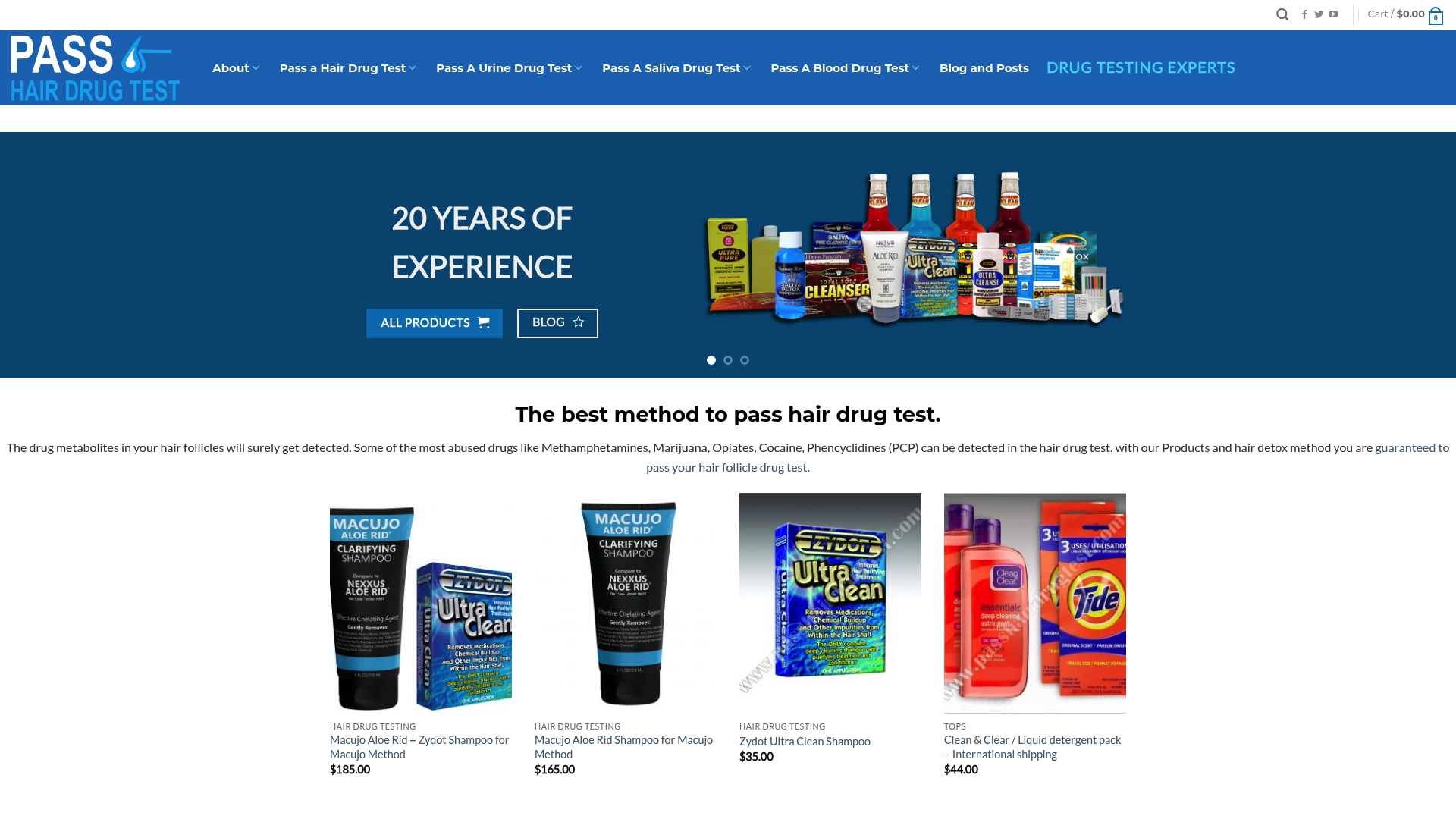
The product range breaks down into a few practical categories:
- Detox shampoos, including Macujo Aloe Rid Shampoo and Zydot Ultra Clean Shampoo, designed for the wash sequences described in the protocol section above.
- Multi-step cleansing kits built around Mike’s Macujo Method, which pairs a specific product sequence with detailed timing instructions.
- Home hair test kits for the verification step, letting you check your status before the appointment that actually counts.
The company states it has extensive experience in the drug testing and detox product industry, with detailed instructions and support included with its kits. As the evidence above makes clear, these products may reduce concentrations in some cases but nothing guarantees a pass, which is exactly why the verification step matters as much as the shampoo itself. Browse the full product lineup to match a kit to your timeline, or start with the step-by-step usage guide if you’re not sure which option fits your situation.
Sources
- Incorporation of methamphetamine and amphetamine in human hair following controlled oral methamphetamine administration
- Detox shampoos for EtG and FAEE in hair – Results from in vitro experiments
- Mandatory Guidelines for Federal Workplace Drug Testing Programs
FAQ
How long do amphetamines stay detectable in hair?
Standard hair tests examine the 1.5 inches closest to the scalp, representing roughly the most recent 90 days of growth, though segmental analysis can extend that window when more hair is available. Controlled dosing research found detectable methamphetamine and amphetamine levels exceeding standard cutoffs for at least two weeks after a single dose, with longer detection likely after repeated use.
Can you detox for a hair follicle test?
Full removal isn’t something any method guarantees: time and abstinence are the only dependable way to clear hair of amphetamines. Oxidative treatments like bleaching have shown meaningful reductions in controlled experiments, but results vary by hair type, dose history, and the specific lab’s testing methods.
What is the best detox shampoo for a hair follicle drug test?
Macujo Aloe Rid Shampoo and Zydot Ultra Clean Shampoo are the two most established products for this purpose, often used together as part of a multi-step routine like Mike’s Macujo Method. No shampoo has been shown to guarantee a negative result, so pairing any routine with a private verification test is the more reliable approach.
Will I pass a hair follicle test if I take Adderall?
A legitimate Adderall prescription will still typically produce a positive screen, but federal testing guidelines allow labs to run stereoisomer analysis that helps a Medical Review Officer distinguish prescribed dextroamphetamine from illicit methamphetamine. Bringing your prescription documentation to the collection site is the most direct way to protect an accurate result from being misread.
Recommended
- Bleach Lowers Lab Numbers but Doesn’t Guarantee a Negative Drug Test
- Facing a Hair Test: Can Relaxers Reduce Drug Levels to 5–67%?
- How Can I Pass a Hair Drug Test?
- African American Hair Drug Test: A Practical Prep Plan
