Uncategorized
Vaseline Won’t Mask a Hair Drug Test: Labs Wash Samples
Oct
Applying Vaseline will not reliably keep a hair drug test from detecting drug use. Drugs are built into the hair shaft from the inside, and labs following Society of Hair Testing (SoHT) guidance wash samples and confirm results with LC-MS/MS. Surface products do not change that. Abstain, follow the collector’s instructions, and skip the petroleum jelly.
TL;DR:
- Labs use validated solvent and water washes, examine wash residue, and confirm positive screens with mass spectrometry; metabolites help distinguish ingestion from contamination.
- Abstinence is the most useful preparation because hair records exposure during growth; hair length and growth rate limit the period a sample can reflect.
- Bleaching and perming may lower measured drug levels unpredictably, and chemical damage can complicate sampling; document treatments rather than adding new ones.
- Arrive with clean hair, disclose medications and treatments on collector forms, and ask whether an alternate authorized specimen and Medical Review Officer review are available.
Table of Contents
Table of Contents
- How hair follicle drug tests work and how far back they look
- Can Vaseline or oils mask drugs in the hair?
- What labs do: wash steps, wash-residue analysis, and metabolite testing
- Cosmetic treatments: bleaching, dyeing, perming, and why results vary
- Realistic, evidence-based steps to prepare before a scheduled hair drug test
- What the Macujo Method is and how Vaseline fits into it
- Macujo Aloe Rid and Zydot Ultra Clean compared with Vaseline use
- What the science says about Vaseline and hair drug test results
- Possible side effects and hair damage from putting Vaseline on before a test
- Step-by-step timeline for products before a hair drug test
- A note on our own perspective
- FAQ
- Sources
How hair follicle drug tests work and how far back they look
A hair test does not look for drugs sitting on the surface of your hair. It looks for drugs and their breakdown products that your body delivered into the growing hair. Researchers describe several routes: diffusion from the bloodstream into the growing follicle, deposition through sweat and sebum, and exposure from the environment. A review on toxicology testing in hair notes that incorporation is complex and shaped by many factors, which is also why labs are careful about how they interpret a result.
Collectors usually cut a small sample from the back of the head, close to the scalp. The lab can then analyze the segment nearest the scalp, which reflects the most recent growth. The period reflected by head hair depends on how fast your hair grows and how much length is cut.
Here is what you should know about what gets tested:
- Drug classes: the usual panel covers THC (cannabis), cocaine, opiates, and amphetamines, as described in SoHT’s consensus guidelines.
- Parent drugs versus metabolites: a parent drug is the substance itself. A metabolite is what the body turns it into. Metabolites matter because they form inside the body, not on a surface.
- Interpretation: results depend on more than a number. Hair color, growth rate, cosmetic treatment, and outside contamination all play a role, which is why a three-stage interpretation approach is recommended.
- Where we fit in: our hair drug test information page walks through what a collection event looks like.
Put together, a test measures what was incorporated during hair growth. A coating applied afterward does not rewrite that record.
Can Vaseline or oils mask drugs in the hair?
Petroleum jelly is a surface coating. It sits on the outside of the hair, while the drug you are worried about is already inside the cortex. Because the incorporation pathways described above run through blood and sweat, a layer of grease on top addresses none of them.
A few things make the Vaseline idea weak in practice:
- It does not remove anything. Nothing about petroleum jelly pulls compounds out of the hair shaft.
- It does not seal anything. The drug is already inside the hair, so there is nothing to block.
- It can look suspicious. Visible buildup on a sample can raise questions at collection and invite closer scrutiny.
- Labs wash anyway. Standard decontamination uses organic solvents and aqueous washes designed to strip product residue before analysis.
There is a related finding worth knowing. One study reported that some ethnic hair-care products can increase contamination susceptibility compared with petroleum-based products. That is a point about contamination risk from products, not a path to a clean result. It does not suggest petroleum jelly helps anyone who has used.
Pro Tip: If you use any styling product, write down what it was and when you used it. Documentation helps far more than trying to hide a sample.
What labs do: wash steps, wash-residue analysis, and metabolite testing
Modern labs have several tools that work against surface masking.
- Decontamination washes. The SoHT 2022 consensus details validated wash protocols and recommends pre-analytical steps meant to reduce the influence of surface contaminants. It also covers storing the washings.
- Wash-residue analysis. Labs can test what came off in the wash. Researchers explain that labs distinguish contamination from consumption by comparing parent drug to metabolites and by testing wash residue. A hair concentration well above the wash residue, or the presence of metabolites, supports ingestion.
- Metabolite checks. Metabolites are formed in the body, so finding them points to use. We explain this further in our article on how labs use phase II metabolites.
- Newer analytical methods. NIJ-supported toxicologists have proposed focusing on conjugated metabolites in hair to address external contamination concerns, and that approach could change how hair results are interpreted.
- International guidance. The UNODC laboratory manual covers sampling, decontamination, and extraction, and calls for chromatographic methods paired with mass spectrometry plus validated wash protocols.
A screening result is not the end of the story. A 2017 review warned that inappropriate interpretation of hair analysis has caused serious consequences and that immunoassays alone are unreliable, so confirmation with GC-MS or LC-MS is essential. In other words, the system has multiple checkpoints, and each one makes a topical product less likely to matter.
Cosmetic treatments: bleaching, dyeing, perming, and why results vary
People often ask whether harsh cosmetic treatments change the outcome. The honest answer is that they sometimes lower measured levels, but unpredictably.
- Inconsistent effects. Research indicates that bleaching and perming can reduce drug concentrations inconsistently, and that laboratories have become more sensitive with LC-MS/MS. A treatment that lowered a number years ago may no longer produce a clean result.
- Wide variation. Outcomes differ by drug, hair type, and how heavily the hair was treated. A recent review of manipulation strategies, including forced washing and chemical treatment, describes inconsistent results across studies.
- Detectable signs. The same review describes biomarkers and analytical methods being developed to detect manipulation, though no routine objective screen for extensive washing exists yet. Treated hair can draw extra attention.
- Hair damage. Treatments that weaken hair can leave it brittle and harder to sample cleanly.
For a closer look at this topic, see our article on how bleach and dye change hair drug tests.
The practical takeaway: a treatment may or may not lower a result, you cannot predict which, and visible damage can complicate interpretation. That is a poor bet to make with a job or a legal matter on the line.
Realistic, evidence-based steps to prepare before a scheduled hair drug test
Here is what holds up against how testing actually works.
- Stop using as early as you can. Because hair records drug exposure during growth, the length of abstinence matters more than anything you put on your hair. Your hair length and growth rate set the real limits, as the review literature and the SoHT consensus both describe.
- Avoid new chemical treatments. A fresh bleach or perm adds uncertainty and can look like manipulation.
- Document what you have done. Keep dates and receipts for any cosmetic services or products. Our hair follicle drug testing page offers more background on preparing.
- Avoid heavy secondhand smoke. Environmental exposure is a recognized contamination route.
- Be honest on collector forms. Disclose medications and treatments. Inconsistencies cause more trouble than candor does.
- Ask about alternative specimens. Federal guidance on workplace programs emphasizes collecting an alternate authorized specimen and review by a Medical Review Officer (MRO) to account for the limits of hair testing.
- Know what happens after a positive. Expect confirmatory mass-spectrometry testing, possible split-sample retesting, and MRO review. If you believe contamination explains a result, consider talking to a legal professional.
Pro Tip: If you have had significant cosmetic work recently, gather the dates and receipts before test day so you can show them to the MRO or testing facility.
What the Macujo Method is and how Vaseline fits into it
The Macujo Method is a multi-step hair cleansing routine, and the version we sell is called Mike’s Macujo Method. It centers on a series of washes with Macujo Aloe Rid Shampoo and related steps. We describe the method as a structured shampooing process, not a coating.
Vaseline is not a step in that process. The two work from opposite directions. A cleansing routine aims to remove surface residue and wash the hair, while petroleum jelly adds a layer of residue to the outside. Adding a greasy coating is the opposite of what a cleansing routine is trying to do, and labs wash samples with solvents regardless.
We want to be clear about the limits here. SoHT’s consensus notes there is no validated laboratory-approved method for removing drugs from hair with consumer cleansing products, and results depend on the individual. If you are researching a cleansing routine, our how to use detox shampoo guide explains the washing steps without any petroleum products involved.
Macujo Aloe Rid and Zydot Ultra Clean compared with Vaseline use
These products and Vaseline do different jobs, so they are not really competing options.
Macujo Aloe Rid Shampoo is a detox shampoo used as part of the multi-step Macujo routine. It is a wash product, meant to be rinsed out.
Zydot Ultra Clean Shampoo is another cleansing shampoo we carry. It is also a wash-and-rinse product designed for hair cleansing before a test.
Vaseline is a leave-on occlusive. It stays on the hair, adds residue, and can show up as visible buildup at collection.
The practical difference is direction. Shampoos aim to leave the hair clean of surface product. Petroleum jelly leaves something behind. If your goal is clean-looking, residue-free hair at collection, a leave-on grease works against you.
The lab measures what is inside the hair. For help choosing between shampoo types, see our detox versus clarifying shampoo comparison, or browse our hair testing products.
What the science says about Vaseline and hair drug test results
No study we are aware of shows that petroleum jelly protects a hair sample from detection. What the literature does show points the other way.
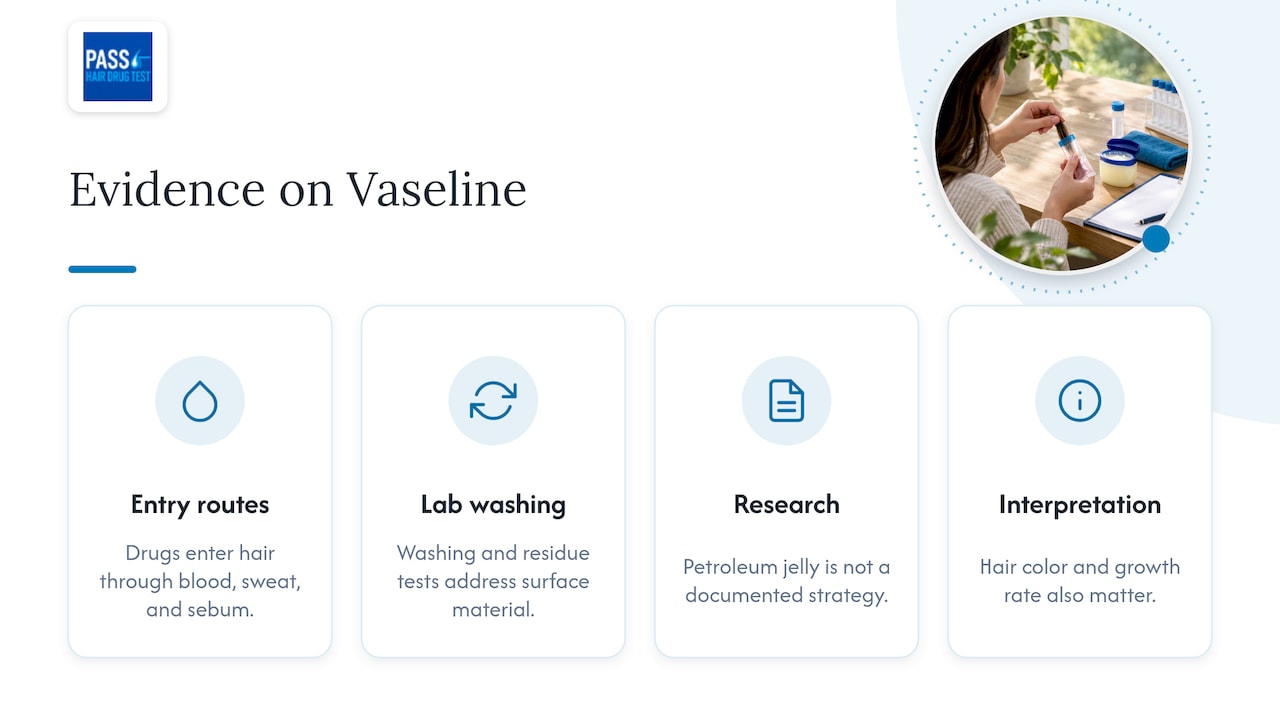
The mechanism research describes drug entering hair through blood, sweat, and sebum, none of which a surface coating blocks. Laboratory guidance covers washing and wash-residue testing specifically to handle surface material. And the contamination literature that mentions petroleum products, such as the study on ethnic hair-care products, treats them as a comparison point for contamination susceptibility, not as a protective shield.
Reviews of sample manipulation, including recent forensic toxicology work, focus on forced washing and chemical treatment. Petroleum jelly is not a documented strategy in them.
Be wary of anyone who claims a study proves Vaseline works. Absence of evidence is not proof of safety, and the mechanism gives you every reason to doubt it. Interpretation also depends on factors such as hair color and growth rate, so one anecdote tells you very little.
Possible side effects and hair damage from putting Vaseline on before a test
Even if the strategy did not fail at the lab, it can cause practical problems for you.
- Residue and buildup. Petroleum jelly is hard to rinse out. It can leave hair greasy, flat, and visibly coated.
- Scalp irritation. Heavy occlusive products on the scalp can trap sweat and oil. Some people get clogged pores or flaking.
- Collection problems. A sample that is coated may be harder to cut and handle, and visible product can prompt questions from the collector.
- Repeated washing. To remove the grease, many people shampoo repeatedly. Frequent harsh washing can dry out hair and make it brittle.
If you have had a skin or scalp reaction, stop using the product and consider speaking with a dermatologist. None of this adds up to a benefit. You would be accepting hair and scalp trouble in exchange for a method with no evidence behind it.
Step-by-step timeline for products before a hair drug test
Because nothing topical changes what is inside your hair, the best timeline is a simple one. Here is how to schedule your preparation.
- Weeks before: Decide to abstain and stay with it. This is the step that matters most, since hair reflects drug exposure during growth.
- Before the test: Stop adding new chemical treatments. Keep a log of any cosmetic services and the products you use.
- Before the test: Use your usual shampoo. Avoid heavy leave-on products, including petroleum jelly, waxes, and thick oils. If you are following a cleansing shampoo routine, our detox shampoo guide lays out the washing steps.
- Before the test: Wash your hair normally and rinse thoroughly so no product is left behind.
- Test day: Arrive with clean hair, bring your documentation, and answer the collector’s questions honestly. Ask whether an alternate specimen is an option.
Notice that Vaseline appears nowhere in this timeline. Residue-free hair and honest documentation are the only product-related choices that cannot hurt you.
A note on our own perspective
We built this site for people who are about to face a hair test and want straight answers. From our experience in this industry, our view is simple: the evidence supports abstinence and honest, documented preparation, and it does not support grease-on-the-hair shortcuts. We would rather tell you that plainly than sell you a myth.
If you want procedural details, our hair test information pages explain collection and what to expect. If you decide a commercially available preparation route is right for you, our team can point you to the shampoos and kits in our product range. You make the call, and we will give you the facts to make it well.
— MIchael
FAQ
Can you use hair for a drug test?
Yes. Labs analyze head hair, and sometimes body hair, for drugs and their metabolites. The period of exposure reflected by head hair depends on length and growth rate.
How do you clean your hair for a hair test?
Wash with your normal shampoo, rinse thoroughly, and avoid leave-on products such as petroleum jelly or heavy oils. Labs also wash samples with validated solvent and water steps, as described in the SoHT consensus, so cleaning cannot remove what is inside the hair.
What would make you fail a hair follicle test?
A test is positive when a lab confirms drugs or their metabolites in the hair, usually with mass spectrometry. Surface contamination alone is checked against wash residue and metabolites, so real use is what shows up.
How long do I need to be clean to pass a hair follicle test?
Hair reflects drug exposure during growth, so a longer clean period is better. Your hair length and growth rate set the real limits, and no product replaces time without use.
Sources
- Pubmed
- Soht
- Advances in testing for sample manipulation in clinical and forensic toxicology—part B: hair samples – PMC
- Detecting Drugs in Hair: Is it Drug Use or Environmental Contamination? | National Institute of Justice
- Consensus_v7_FINAL Version 27NOV22
Recommended
- How Can I Pass a Hair Drug Test?
- How to Pass a Drug Test on Hair Follicles?
- Body Hair vs Head Hair: What Drug Test Labs Really Use
- Long Hair Drug Test: What Labs Actually Measure
