No products in the cart.
Uncategorized
Keratin Treatment and a Hair Drug Test: What Changes
26
Nov
A keratin treatment is not a hair-test cleanse. Research shows that chemical and heat treatments can shift THC levels in hair, but they do it unevenly and you cannot predict by how much. If you have a hair follicle test coming and want a planned result, you need a purpose-built, multi-step cleansing routine, not a salon service chosen for smoothness. We built our Macujo-based hair cleansing products for that job, and this guide explains where keratin fits and where it does not.
Table of Contents
TL;DR
- Federal testing guidelines say hair treatments such as straightening and relaxing can change drug concentrations in hair, in ways that depend on the drug and the person.
- Heat from a flat iron can lower THC in some samples and raise it in others, and it increases cannabinol (CBN), a THC breakdown product.
- Keratin smoothing treatments can release formaldehyde, so they are a health decision first and never a test strategy.
- A hair test looks back about 90 days, so one salon visit does not rewrite that window.
- A structured cleansing routine, such as Mike’s Macujo Method, is built for the test itself.
Table of Contents
- What a hair test actually looks for
- Does a keratin treatment change a hair test result?
- Why one salon visit does not decide a 90-day window
- Keratin treatment, keratin mask and test shampoo: three different things
- The health side of keratin smoothing
- A cleaner way to prepare
- Our perspective
- Where to start
- FAQ
- Sources
What a hair test actually looks for
A standard hair test does not look for THC the way a blood test does. Hair labs look for THC-COOH, a metabolite (a substance your body makes when it breaks down THC). It reaches hair mainly through sweat and sebum that bathe the hair, not through the bloodstream. That is why it ends up spread through the hair shaft instead of sitting at one neat spot.
The amounts are tiny. Labs measure in picograms per milligram, using mass spectrometry. SAMHSA-suggested cutoffs for marijuana metabolite are 1.0 pg/mg for screening and 0.05 pg/mg for confirmation. A standard 1.5-inch scalp sample covers roughly 90 days, using an average growth rate of 1 cm per month.
Two things follow from this:
- Anything that touches the hair’s outer layers, such as chemicals, heat or repeated washing, can change what the lab measures.
- Because the window is about three months, a single product used once rarely accounts for the whole picture.
For a deeper look at how long THC can stay in hair, see our guide on THC in hair for U.S. cannabis users.
Does a keratin treatment change a hair test result?
The honest answer is that it can, and nobody can tell you in which direction for your head of hair.
The 2020 federal Mandatory Guidelines for workplace testing say that bleaching, straightening, relaxing, frequent washing and vigorous brushing may affect drug and metabolite concentrations. They add that the effect depends on the drug and the profile, and that treated hair can be more open to environmental contamination. The 2021 consensus of the Society of Hair Testing says the type of hair treatment should be documented at collection and considered when the result is interpreted. Labs know treatments matter.
Keratin smoothing combines two things that research has looked at separately: chemicals and heat.
The heat part
Smoothing treatments are sealed in with a flat iron, often at 200 °C or more. A 2016 study put THC-positive hair samples through a 200 °C straightener. THC fell in 11 of 17 samples but rose in 6, and CBN was higher in every sample. The authors explain that heat converts some THC into CBN, which changes the ratio of compounds the lab sees.
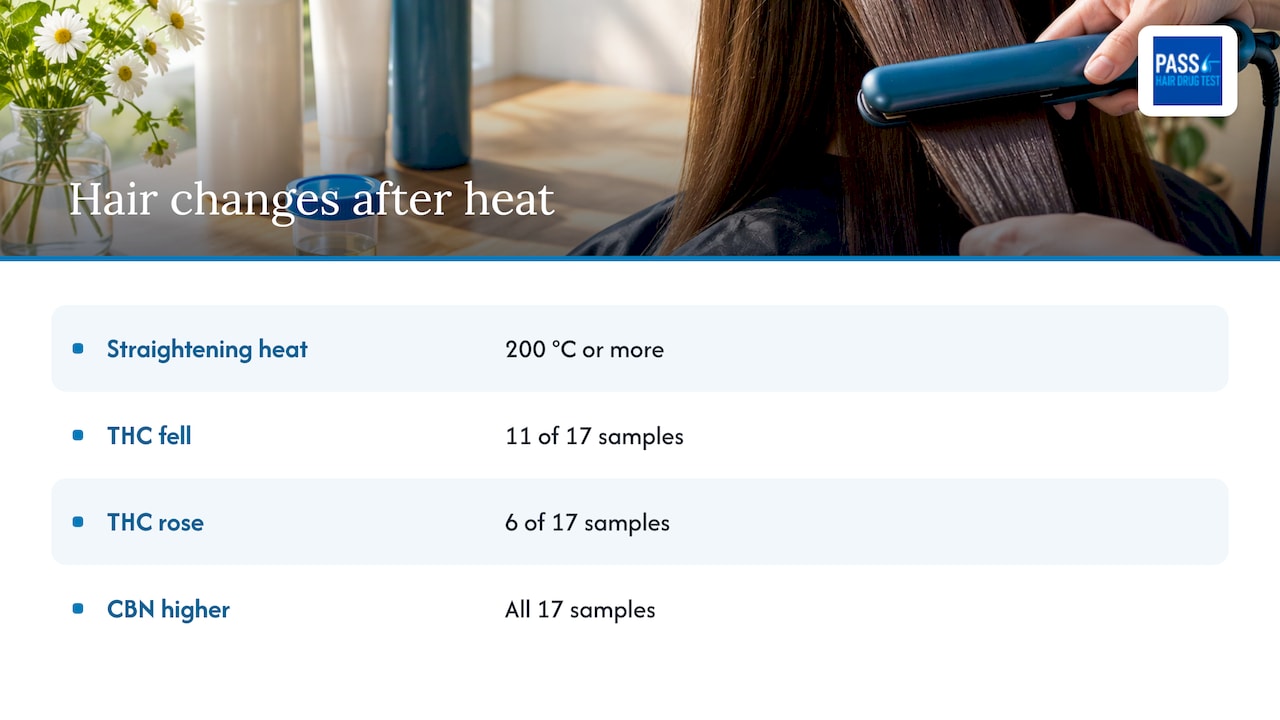
A 2025 review of hair toxicology reaches a similar conclusion: thermal damage increases CBN, and THC can go up or down depending on hair color. If you are curious about the heat side alone, we cover it in Does Heat Styling Change a Hair Drug Test Result?
The chemical part
A 2023 review reports that harsh alkaline relaxers significantly reduced drug concentrations, while thermal straightening caused variable changes. The same review found perming clearly lowered cannabinoids, and permanent dye lowered them only slightly.
Keep one distinction in mind. Most of that work covers relaxers, perms, bleach and dye, which are not the same as a keratin smoothing treatment. We found no study that tests a commercial keratin smoothing service on THC hair concentrations specifically, so any specific promise about it would be a guess. What the evidence supports is the general principle: chemical and thermal treatments change hair, and the change is not uniform.
What this means for you
A table makes the range of outcomes plain.
| Treatment | What research reports for THC in hair | How predictable |
|---|---|---|
| Thermal straightening (200 °C) | THC down in 11 of 17 samples, up in 6; CBN higher in all | Low |
| Alkaline chemical relaxer | Significant drop in drug concentrations | Moderate, harsh on hair |
| Perming | Clear drop in THC, THC-COOH, CBN and CBD | Moderate |
| Permanent dye | Slight drop in cannabinoids | Low effect |
| Bleach plus dye | Mean 60% drop in four samples, range 32% to 100% | Wide range |
Sources are the studies linked above and the 2023 Drug Testing and Analysis study on homemade and bleaching treatments. Those authors also note that treated hair looked the same as untreated hair, so you cannot judge the result by eye.
The range in that last row, from 32% to 100%, is the point. A treatment that does something is not a plan. A plan means knowing what you did, in what order, and how many times.
If bleach and dye are what you are weighing, read how bleach and dye change hair drug tests.
Why one salon visit does not decide a 90-day window
Three reasons keep a keratin appointment from being a reliable answer.
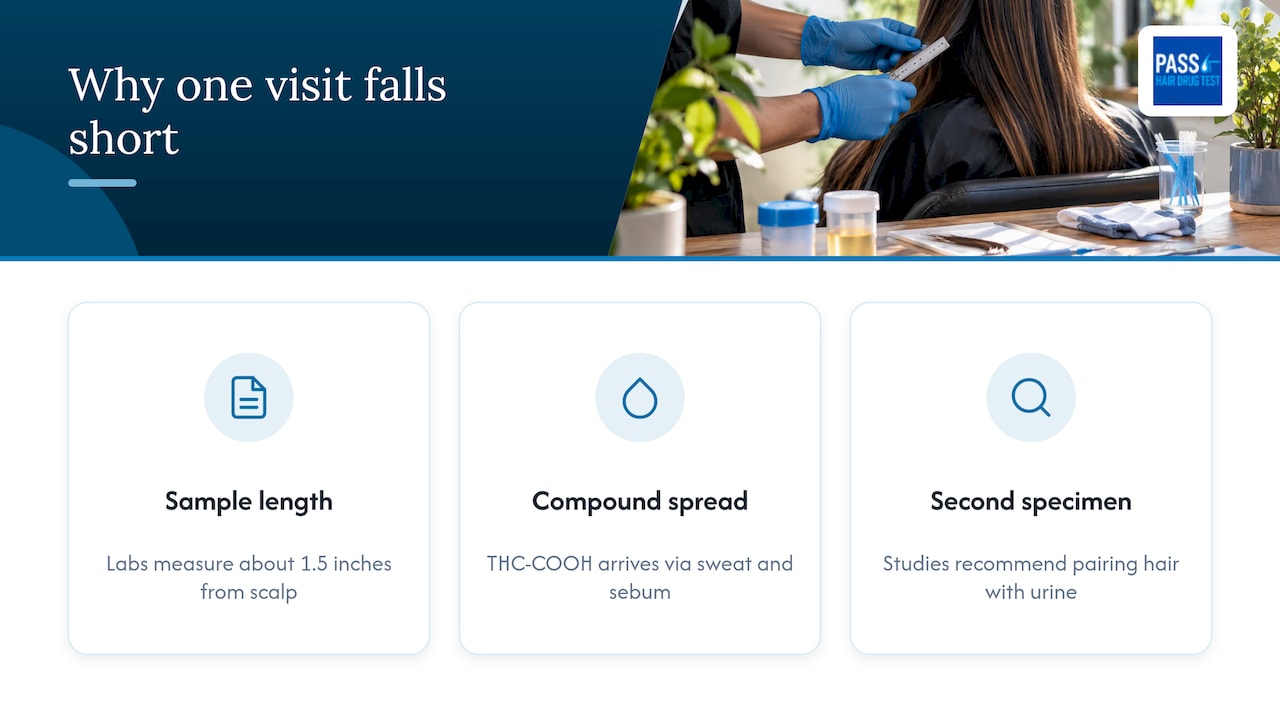
The sample is long. The lab typically measures about 1.5 inches of hair from the scalp. New growth after your appointment is untreated, and the roots are the part nearest your most recent use.
THC-COOH is spread through the hair. Because it arrives via sweat and sebum, it is not locked into one segment. The 2025 review notes this is why segment-by-segment timelines are hard to read. Treating only part of the length will not touch everything.
Labs are watching for this. The 2020 proposed federal guidelines asked for comment on how treatments and hygiene affect interpretation and proposed collecting an alternate specimen alongside hair. Researchers who studied everyday hair products also recommend pairing hair results with urine analysis, because a person can test negative in hair and still test positive in urine. Comparing the two is covered in our hair test vs urine guide.
So if the employer’s process includes a second specimen, hair is only half the picture.
Keratin treatment, keratin mask and test shampoo: three different things
People searching this topic often mix up three products.
- Salon keratin smoothing treatment. A professional service. A stylist applies a smoothing solution, then seals it with high heat. Its purpose is frizz control and straighter hair.
- Keratin hair mask. A conditioning product you use at home. It is applied and rinsed like any other mask and does not involve a sealing iron. Its purpose is softness.
- Hair-test cleansing shampoo. A product made for people preparing for a hair test. Its purpose is the test, and it comes with instructions about how to use it.
Of the three, only the last is designed with the test in mind. If your goal is a hair test, a styling product’s cosmetic results are beside the point.
The health side of keratin smoothing
This is the part worth knowing even if you never take a test. Some keratin smoothing products release formaldehyde, a chemical that is a known human carcinogen. The New York State Department of Health warns that exposure can irritate eyes, nose, throat and skin, that people with asthma may be more sensitive, and that products labeled “formaldehyde-free” or “natural” were still found to contain it when tested.
An Oregon OSHA investigation of one popular product, described in an advocacy group’s petition to the FDA, found formaldehyde at more than 50 times the recommended limit, with reports of eye irritation, nosebleeds and breathing difficulty. If you have asthma or are pregnant, talk to your doctor before booking any smoothing service.
That is a good reason not to pick a smoothing treatment as a hair-test move. You would be taking on a chemical exposure for an outcome that studies say is unpredictable.
Also worth knowing: Heat and harsh chemistry can leave hair dry and brittle, and over-processed hair is hard to treat gently afterward. A hair test also does not rely on color or texture alone: the lab can still grind and analyze what is there.
A cleaner way to prepare
If you need to cleanse your hair for a hair follicle test, the useful question is not “which salon service might do something?” It is “what routine is designed for this, with instructions I can follow?”
Our store is built around that. Our hair-cleansing line is centered on Macujo Aloe Rid Shampoo, Zydot Ultra Clean Shampoo and the multi-step Mike’s Macujo Method. Each step has a defined role and a written order, so you are not improvising with products designed for styling.
In the 2022 German study of commercial products, a Zydot shampoo lowered THC by a mean of 52% in the tested samples, and 14 of the 54 samples fell below the reporting threshold the researchers considered. That is a finding about one of our products, in lab conditions on treated samples, and it shows why a purpose-built shampoo belongs in the conversation.
What we can say about how we work: we have more than 20 years in the drug-testing and detox-product industry, and our site offers unlimited phone support so you can ask questions before your test date. The product pages explain each step: Macujo Aloe Rid Shampoo, Zydot Ultra Clean instructions and how long Zydot lasts.
Our perspective
Most people who write to us about keratin are trying to solve two problems with one appointment: they want smoother hair and a cleaner test. The two goals do not belong together. A salon treatment is designed around how hair looks. A cleansing routine is designed around the test.
We built our approach around Mike’s Macujo Method because a hair test is not a single moment. It is a roughly 90-day record, and the best way to prepare is a defined sequence with clear steps, not a guess about what a stylist’s product might do. That is why we put the instructions, the shampoos and the support in one place, with more than 20 years of experience behind how we explain it.
If you are choosing between a salon service and a structured routine, choose the routine, and leave the hair-smoothing for after your test.
MIchael
Where to start
If your test is coming up, begin with the routine rather than the salon. Our hair follicle test page explains the process, and our products page lists the shampoos and kits, including the Macujo Aloe Rid and Zydot combination for the Macujo Method.
If you have questions about timing, hair length or how many days you need, call us. Support is part of what we offer.
FAQ
Will a keratin treatment make me pass a hair drug test?
No treatment can be counted on to do that. Federal guidelines say straightening and similar treatments may change drug concentrations, but the effect depends on the drug and the person. Studies on heat alone show THC going down in some samples and up in others.
Does the heat from a flat iron change THC in hair?
It can. In a 2016 study at 200 °C, THC fell in most samples but rose in several, and CBN increased in all of them, because heat converts some THC into CBN. We look at it further in our heat styling article.
Is a keratin hair mask the same as a keratin treatment?
No. A mask is a home conditioning product that rinses out. A salon smoothing treatment uses a smoothing solution sealed with high heat, and some of those products release formaldehyde. Neither is made for hair-test preparation.
How far back does a hair test look?
A standard 1.5-inch scalp sample reflects roughly 90 days, with an average growth of about 1 cm per month. Use in the last several days may not yet show above the scalp. Our hair drug test information page covers the timeline.
Should I get a keratin treatment if I’m pregnant or have asthma?
Talk to your doctor first. Health authorities warn that formaldehyde from some smoothing products can irritate the eyes, nose and throat, and people with asthma may be more sensitive.
Sources
- Mandatory Guidelines for Federal Workplace Drug Testing Programs, Federal Register 2020
- 2021 SoHT Consensus on Drugs of Abuse Testing in Hair
- Review on Toxicology Testing in Hair, Journal of Applied Laboratory Medicine
- Hair as a Biological Indicator of Drug Use, SAGE
- Influence of thermal hair straightening on cannabis and cocaine, PubMed
- Advances in testing for sample manipulation in clinical and forensic toxicology, PMC
- Hair analysis: Assessment of homemade hair treatments, Drug Testing and Analysis
- Manipulation of THC Hair Concentrations by Commercially Available Products, PMC
- Consumer Health Alert: Hair Straightening Products and Formaldehyde, New York State Department of Health
- FDA petition on keratin straighteners and formaldehyde, EWG
Recommended
- Hair Drug Test Information
- Hair Follicle Drug Test Information
- How Can I Pass a Hair Drug Test?
- 40–90% Reductions: How Bleach and Dye Change Hair Drug Tests
