No products in the cart.
Uncategorized
Hair Test Frequency: How Often You’re Tested and What Use Shows
11
Nov
Nov
A hair drug test is usually a one-time event, not a routine one. A standard sample covers about 90 days of history, so employers use it mostly for pre-employment screening and some random programs. Frequency also matters in a second way: how often you used a substance changes whether a hair test can pick it up. This guide covers both meanings, with sources, so you know what to expect before a collection.
Table of Contents
TL;DR
- A standard hair test looks back about 90 days, based on a 1.5-inch (3.9 cm) sample of head hair cut close to the scalp.
- Because the window is so long, hair testing is used for pre-employment and random programs. It is a poor fit for frequent repeat testing or testing right after an incident.
- Heavier and more regular use is more likely to show. Cannabis is harder to detect in hair than some other drugs, especially with occasional use.
- Hair takes about 5 to 10 days to grow out to the surface, so very recent use is typically not captured.
- Hair length, color and cosmetic treatments can all influence what a lab finds.
Table of Contents
- What “hair test frequency” really covers
- How far back one hair test looks
- The 5 to 10 day lag
- How often employers actually run hair tests
- How your frequency of use affects the result
- Why hair length and growth rate change the picture
- Hair color, treatments and other variables
- What to expect on collection day
- Our perspective
- Getting ready for a hair test
- FAQ
- Sources
What “hair test frequency” really covers
People type this phrase into search for three different reasons:
- How often hair tests are given. Employers, not the test itself, set the schedule.
- How often you can be tested. Hair grows slowly, so repeat tests overlap heavily.
- How your frequency of use affects the result. Daily, weekly and one-time use leave different traces.
We take each in turn. If you also want the broader picture of how hair compares with other specimens, our page on hair drug tests versus urine lays out which test detects use when.
How far back one hair test looks
The 90-day figure comes from simple arithmetic. According to Labcorp’s hair testing FAQ, head hair grows about half an inch per month, so a 1.5-inch sample covers roughly 90 days before the test. Quest Diagnostics gives the same numbers in its 2021 hair testing FAQ: about 1.3 cm (½ inch) of growth per month, and a standard 3.9 cm segment that reflects a pattern of repeated use over about three months.
Here is how that compares with other specimens, using Labcorp’s published ranges:
| Specimen | Typical detection window |
|---|---|
| Oral fluid | About 5 to 48 hours |
| Urine | Generally 1 to 7 days, longer in chronic users |
| Head hair (1.5 inches) | About 90 days |
The window is measured backward from the day of collection. It is not a countdown that starts when you stop using. A 1.5-inch sample taken today represents roughly the last three months, whatever happened before that.
Some sources say hair can reflect use even further back with a longer sample, though Quest’s FAQ for employers sticks to the standard segment. If you have long hair and wonder what a lab does with it, read what labs actually measure in a long hair drug test.
The 5 to 10 day lag
Hair does not record yesterday. Quest notes that hair containing drugs takes about 5 to 10 days to reach the scalp surface where it can be collected. SAMHSA’s Clinical Drug Testing in Primary Care describes the hair detection timeframe as starting 7 to 10 days after use and extending to the time needed to grow the length of hair sampled.
Two practical points follow:
- Use from the past week or so generally sits below the surface and falls outside what a standard cut sample captures.
- A review by Palamar and Salomone in a 2023 paper on hair testing challenges says the same: hair typically does not detect use within the first one to two weeks after exposure, even though it covers a much wider window afterward.
The same lag logic applies to other substances. We explain it for one class in our opioid hair detection time guide.
How often employers actually run hair tests
No law sets a universal frequency for private-sector hair testing. The schedule comes from the employer’s drug-testing policy, and the test type is chosen to fit the program.
Quest explains that hair is best for evaluating long-term patterns of use. It says hair is not appropriate for post-accident or reasonable-suspicion testing, because those situations call for detecting a drug as close as possible to the incident. It fits better with random testing and pre-employment screening, where a longer history is the point.
SAMHSA makes a related point: the long detection period is not useful when frequent testing, such as weekly or monthly, is desired. Many labs analyze about a 3-month hair segment. If an employer wants to check someone every few weeks, hair would keep showing the same stretch of history, so urine or oral fluid tends to be used instead.
What this means for you in practice:
- Pre-employment: expect one collection tied to a job offer.
- Random programs: a hair test can be used on a rolling basis, but two tests a month apart would mostly overlap.
- After an incident: other specimens usually do this job.
If you are facing a specific screen, ask the employer or the collection site what specimen is being collected and the sample length. Our overview of hair follicle drug testing walks through the full process.
How your frequency of use affects the result
This is where the keyword gets personal. SAMHSA states that detection windows vary with the frequency and amount of use, the test’s sensitivity and cutoff, and individual and specimen factors, including metabolism, health, diet, weight and fluid intake.
The research on hair adds detail by drug:
| Pattern of use | What research indicates |
|---|---|
| Single dose | Most often not enough for a positive hair result |
| Weekly use | May be needed for cocaine and amphetamine to show |
| Cannabis, a few times a week | Can be hardly detectable |
| Cannabis, daily | Positivity is not guaranteed, even then |
Those findings come from an academic review of biological samples in epidemiological research. The 2023 paper cited above agrees that hair is less sensitive for sporadic cannabis use than for some other substances, and that infrequent use can be difficult to detect.
Two cautions keep this in perspective:
- The amount of a drug in hair does not track closely with the dose taken. A 2025 review in the Journal of Applied Laboratory Medicine notes the weak correlation, and the 2021 SoHT consensus says concentration cannot be used to determine how much someone consumed.
- Because of that, labs compare results with set concentration thresholds. Our page on hair test cutoff levels explains what those numbers mean.
Can a hair test detect one-time use?
Usually a single use is not enough to produce a positive hair result, according to the same review. Single cocaine use may sometimes be detected for several months, which shows that outcomes depend on the substance. For cannabis, a one-time event is the least likely to register.
Light, moderate and heavy use
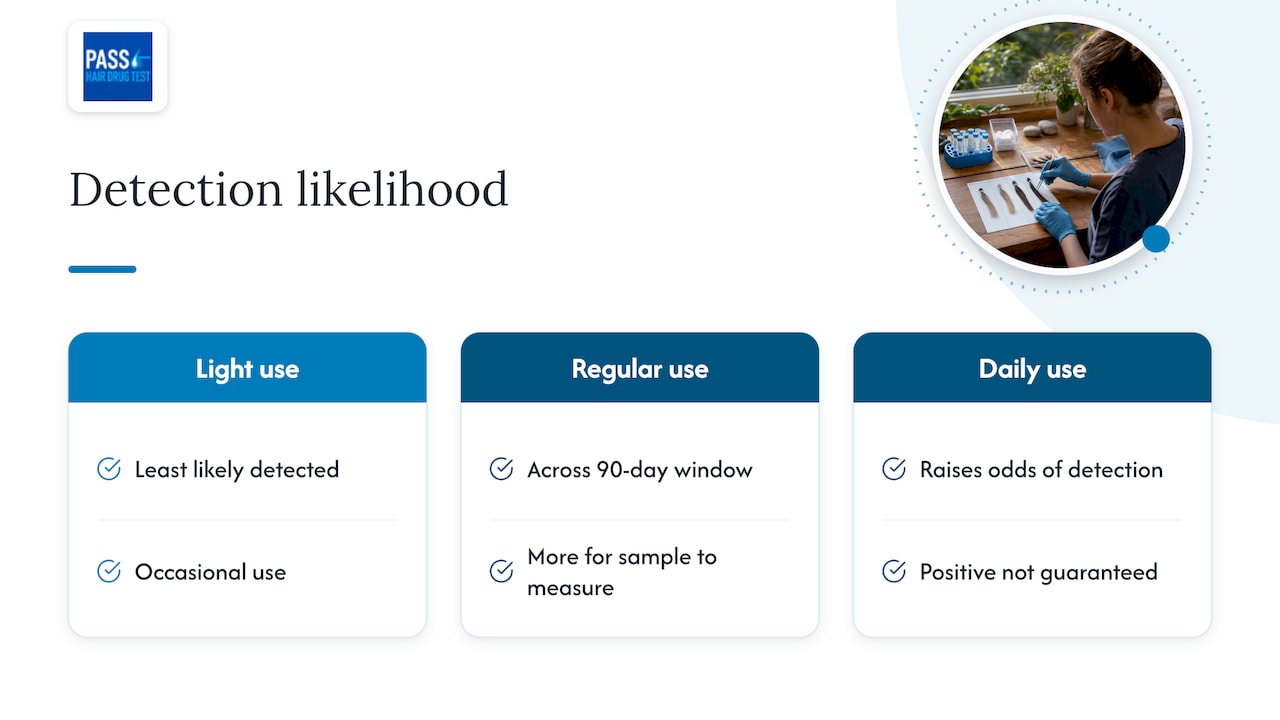
Putting the research together, a rough picture emerges. Light and occasional cannabis use is the least likely to be detected. Regular use over the whole 90-day window gives the sample more to measure. Daily use raises the odds but, per the research, does not guarantee a positive. Nobody can promise an outcome from frequency alone, because hair type and lab cutoffs also play a part.
Why hair length and growth rate change the picture
The lab does not test all your hair. Quest says the collector cuts a small amount close to the scalp, and only the hair above the scalp is tested. Standard lab testing uses the first 3.9 cm from the root end.
That has a few consequences:
- Growth speed varies. The half-inch-per-month figure is an average. Faster or slower growth changes the time a 1.5-inch segment represents.
- Short hair. If your hair is shorter than the standard length, the segment covers less time. Labs often have alternatives, such as body hair, when head hair is too short.
- Segmenting. The SoHT consensus notes that segmental analysis can show a person’s consumption pattern over time, which is how a lab can separate older use from newer.
Hair color, treatments and other variables
The SoHT consensus document says drug incorporation can be influenced by natural hair color. It also says concentrations can be affected by chemical and physical treatments such as bleaching, dyeing, perming, straightening and UV exposure.
In plain terms, two people with identical use habits can end up with different results, because hair is a biological material and not a uniform one. This is one reason we do not treat any single number or rule of thumb as a promise. If you color or treat your hair, mention it to us when you ask about preparation.
What to expect on collection day
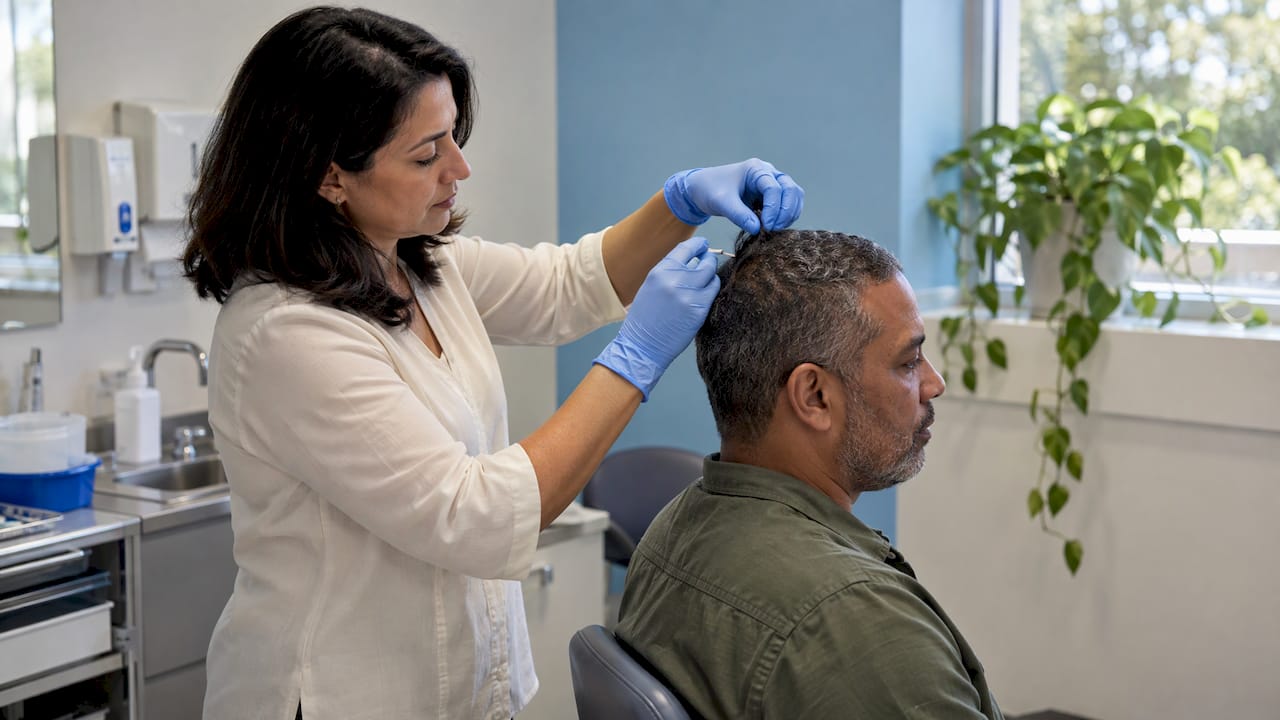
Collection is quick and directly observed. According to Healthline’s hair strand test overview, a collector takes a small amount of hair, and the lab washes it and assesses it for environmental contamination. Quest’s FAQ says every collection is directly observed, which is part of how it limits tampering at the collection step.
Bring photo ID, follow the instructions you were given for the site, and ask the collector any question about the sample length before the cut.
Our perspective
After more than 20 years in the drug-testing and detox-product industry, the question we hear most is not “how long is the window?” It is “what does my own pattern of use mean for this one test?” Those are different questions, and the second is the one that matters.
Here is how we see it. A hair test is a one-shot snapshot of roughly 90 days. You cannot retest your way out of it, and you cannot count on a short break from use to change the history already sitting in the hair shaft. That is why we think preparation has to be deliberate and has to start before the collection date, not the night before.
This is the reason we built our approach around a multi-step routine rather than a single wash. Our Mike’s Macujo Method pairs Macujo Aloe Rid Shampoo with a step-by-step process, and our team believes it is the strongest route for people with a hair test coming, whether they are light users or heavy users. We stand behind it with a pass guarantee and unlimited phone support, so you are not guessing alone on the schedule or the steps.
If you are unsure where you stand, start with the facts on this page, then talk to us about your timeline, your hair length and any treatments in your hair.
MIchael
Getting ready for a hair test
Once you know the test looks back about 90 days and is a single collection, the useful question is what you do with the time you have. Our guide to passing a hair follicle drug test covers the planning side for cannabis users, and our hair shampoo guide explains how the routine fits together.
We sell hair-cleansing products built around Macujo Aloe Rid Shampoo, Zydot Ultra Clean Shampoo and the multi-step Mike’s Macujo Method, with detailed instructions and unlimited phone support. Our store also carries urine, saliva and blood products and home test kits, so you can match what you buy to the specimen your employer names. You can browse everything on our products page.
If your test date is close, call us before you order so we can go over timing for your hair length.
FAQ
How long is a hair follicle test accurate for?
A standard hair test reflects about 90 days of use before collection. That figure assumes a 1.5-inch head-hair sample and average growth of about half an inch a month, per Labcorp and Quest. Accuracy for any single drug also depends on the lab’s cutoff and the pattern of use.
How far down do hair follicles go?
The lab does not test the follicle itself. The collector cuts hair close to the scalp, and the lab tests the hair shaft above the scalp, usually the first 1.5 inches from the root end. Drugs enter growing hair from the bloodstream, which is why the shaft holds a history.
Can a hair strand test detect one-time use?
Usually not. Research indicates a single dose is most often insufficient for a positive hair result. Some substances, such as cocaine, may occasionally show for months after one use, but cannabis is much less likely to be detected from occasional use.
How often can an employer give a hair test?
There is no fixed rule in the test itself. The employer’s policy decides. Because each sample covers about 90 days, repeat tests within weeks look at largely the same stretch of history, so employers who want frequent checks often choose urine or oral fluid.
Does recent use show up in a hair test?
Typically not within the first week or two. Hair needs about 5 to 10 days to reach the surface where it can be cut, so very recent use is generally outside what a standard sample captures.
Sources
- Labcorp: Hair Drugs of Abuse Testing FAQ
- Quest Diagnostics: Hair Testing FAQ (2021)
- SAMHSA: Clinical Drug Testing in Primary Care
- Palamar and Salomone (2023): challenges of hair testing
- Using biological samples in epidemiological research on drug use
- Review on Toxicology Testing in Hair, Journal of Applied Laboratory Medicine
- 2021 SoHT Consensus on Drugs of Abuse Testing in Hair
- Healthline: Hair Strand Drug Test
Recommended
- Why the 5–14 Day Lag Makes Hair Tests Miss One Time Use
- Hair Drug Test Information
- Hair Drug Test vs Urine: Which Detects Use When
- Hair Follicle Drug Test Information
