No products in the cart.
Uncategorized
How to Pre-Test Your Hair at Home Before a Drug Test
29
Oct
Oct
A home hair pre-test is a mail-in kit. You cut a small hair sample, seal it in foil and an envelope, and send it to a laboratory, which reports whether drugs or their metabolites show up. It is the closest thing you can do at home to see what an employer’s test might find. It will not tell you how a specific employer’s lab will read your hair, and it cannot change the result. This guide covers how the kits work, how to collect a sample correctly, what the results mean, and what to do with the answer.
Table of Contents
TL;DR
- At-home hair kits are collection kits: you cut the sample at home, then a laboratory analyzes it. Testing.com describes them this way.
- A standard 1.5-inch scalp sample covers roughly 90 days, and THC generally begins to show about 7 to 10 days after use.
- Cut the sample close to the scalp, about as thick as a pencil, and keep the root ends aligned on the foil.
- Home tests are generally less sensitive than formal lab collections, so a clean pre-test is encouraging, not a guarantee.
- If you are preparing for a real test, start with the timeline, then read how hair-cleansing products are supported by research before you spend money.
Table of Contents
- What a home hair pre-test actually does
- How far back hair shows THC
- How to collect a hair sample for a mail-in test
- What your pre-test result means
- Can hair treatments change a hair test?
- Perspective: how we think about pre-testing
- Planning your timeline before a real test
- What to expect at a formal hair test, and if a result is disputed
- Where our products fit
- FAQ
- Sources
What a home hair pre-test actually does
Most people searching for this want one thing: to know what the hair will show before somebody else finds out. A pre-test answers that question in a limited way.
Hair tests look for drugs or drug metabolites in hair, which grows at about one-half inch each month, according to Testing.com’s overview of hair follicle testing. Substances you take get incorporated into the growing strand, so the part of the hair closest to the scalp reflects the most recent weeks, and the part further out reflects earlier ones. The same page notes that at-home collection kits let you collect hair and mail it to a laboratory.
That is the key difference from the instant urine or saliva cups sold at drugstores. You do not get a line on a cassette in five minutes. You get a lab report days later, and the quality of that report depends heavily on how well you collected the sample.
Home pre-test versus a formal employer test
| Home pre-test | Formal employer or lab collection | |
|---|---|---|
| Who collects | You | A trained collector, in view, with chain of custody |
| Sample | Hair you cut yourself | Hair cut at the scalp and sealed in foil by the collector |
| Purpose | Information for you | A result the employer can act on |
| Sensitivity | Variable, generally lower | Laboratory standard |
| Result use | Private | Reported to the employer or its review officer |
The Cleveland Clinic notes that at-home tests vary in accuracy and are generally less sensitive than formal laboratory-based collections. That is the main reason to treat a clean home result as a good sign, not as permission to relax.
For comparison, a commercial lab that runs employer programs describes its collector taking about 100 milligrams of hair, roughly 90 to 120 strands, cut at the scalp and sealed in foil with chain-of-custody paperwork, per Labcorp’s hair testing page. Your home sample is smaller and less controlled, which is one more reason a pre-test is an estimate.
How far back hair shows THC
The detection window is what most readers worry about, so get it straight.
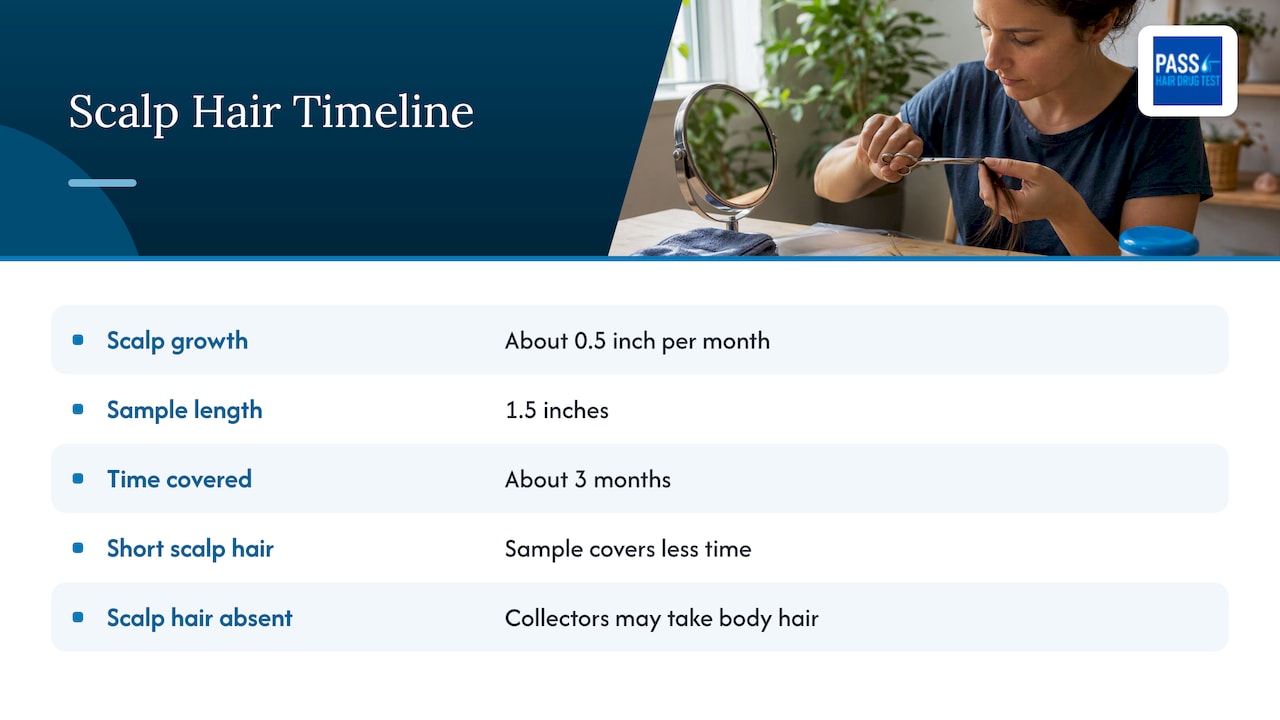
According to Testing.com, hair tests generally detect THC beginning about 7 to 10 days after use, and a standard 1.5-inch scalp sample covers approximately 90 days. Three things move that window:
- How much and how often you use. Heavier, more frequent use leaves more to find.
- Individual metabolism. Two people with the same habits can have different results.
- Which hair is sampled. Body hair grows more slowly, so it can reflect a longer period, up to about 12 months according to the same source.
The 7 to 10 day lag matters for planning. If you stopped using only a few days ago, the newest growth may not yet contain anything detectable, but the older part of the sample still reflects the prior weeks and months. A hair test does not forget because you stopped last week.
A simple way to read the timeline
If your hair grows about half an inch a month, a 1.5-inch sample from the scalp spans about three months. Use that arithmetic to judge what a given test is looking at. If you have had short hair cut recently, the sample covers less time, which is why collectors sometimes take body hair when scalp hair is too short or absent.
For a fuller explanation of how the 90-day window works, our hair follicle drug test guide goes through the timeline in more detail.
How to collect a hair sample for a mail-in test
A badly collected sample is the most common reason a home result is useless. The collection steps below follow the process published by a mail-in hair testing provider, HairConfirm, and match the general approach in most kits.
- Wash your hands and sterilize the scissors. Rubbing alcohol works for the blades.
- Pick the spot. The back of the head, near the crown, is the usual choice because a small cut is least visible there.
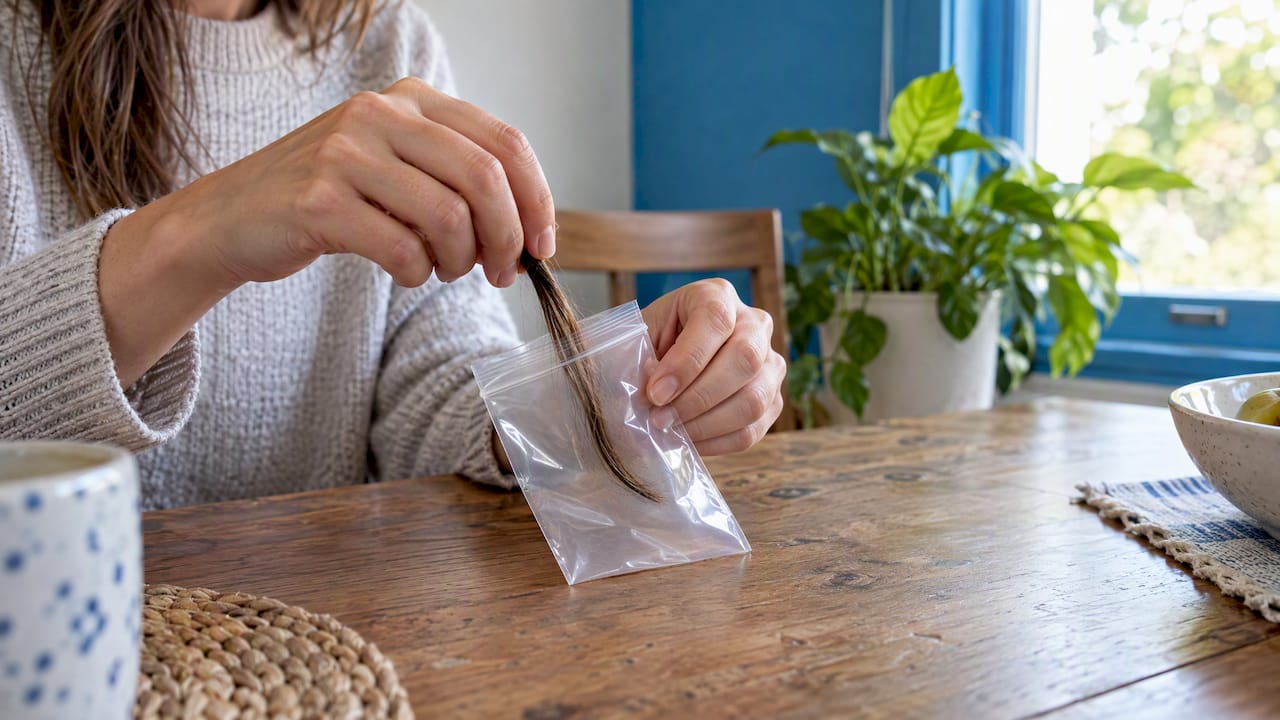
- Take enough hair. The strip should be about the diameter of a pencil or drinking straw. Too little hair is the most common reason a lab cannot run the test.
- Cut as close to the scalp as you can. The part nearest the scalp is the most recent growth, which is what you are trying to evaluate.
- Align the root ends. Lay the hair on the collection foil with all root ends pointing the same direction.
- Fold the foil, seal it in the specimen envelope, and mail it in the prepaid envelope that comes with the kit.
If your hair is short, there are collection methods for hair 1.5 inches or shorter, and some providers offer instructions for it. Follow your kit’s instructions over general advice, since the lab sets what it will accept.
Common collection mistakes
- Cutting from several scattered spots so strands are too thin to total enough sample
- Cutting far from the scalp, which tests older hair instead of recent growth
- Letting the root ends go in different directions
- Touching the strands with products, lotions or dirty hands before sealing
External contamination is a real concern in hair testing generally. The National Institute of Justice reports that it can be difficult to tell internal ingestion from external exposure, which is why labs wash samples and why you should keep your sample clean.
What your pre-test result means
Reports usually come as positive or negative for each drug class.
- Negative means no drug or metabolite was detected at the laboratory’s cutoff.
- Positive means a substance was found above the cutoff.
That description comes from Testing.com. Cutoffs matter because they decide where “detected” starts. For federal workplace programs, the Department of Health and Human Services evaluates recommended cutoff concentrations for drugs in hair, as discussed in the Federal Register’s mandatory guidelines. A private lab and an employer’s lab can use different thresholds, so the same hair can produce different answers.
A second point is screening versus confirmation. An initial screen is a first pass. Confirmatory testing such as gas or liquid chromatography gives more detailed results, and one at-home testing resource advises sending positive results to a lab for GC-MS confirmation, as Recovered.org explains. If your pre-test is a lab-analyzed kit, ask whether the report includes confirmation or is screening only.
What a negative home result does not prove
A negative pre-test means the lab did not find anything in the hair you sent. It does not mean the employer’s lab will agree, because their sample is bigger, collected under supervision, and run at their own cutoffs. Treat it as one data point.
Can hair treatments change a hair test?
People ask whether bleaching, dyeing or washing changes the answer. The research says it can, though not in a predictable way.
The proposed HHS guidelines name hair treatments as a factor that may affect hair-test results, and the agency sought scientific information on how treatments, color and contamination influence results, per the Federal Register notice. A 2023 academic review in PubMed Central says hair treatments can change drug concentrations, often lowering them, with effects that vary by drug and hair type.
The same review found that studies of household products and commercial detox shampoos showed they can reduce drug concentrations in hair, but results varied and were not consistent across all drugs. It also notes that no standardized routine workflow detects cleansing shampoos or extensive hair washing.
What that means for you:
- Treatments are not neutral. Bleaching or dyeing can alter what is in the strand, and it can also damage hair.
- Results are inconsistent, so nobody can honestly promise a specific outcome for your head of hair.
- If you pre-test after using a cleansing routine, the pre-test tells you something about your own hair after that routine, which is more useful than relying on a claim.
That last point is the practical use of a pre-test: test, treat, then test again if time allows, and compare. You are measuring your own hair rather than relying on a general claim.
Perspective: how we think about pre-testing
We have worked in the drug-testing and detox-product business for more than 20 years, and the question we hear most is some version of “will my hair pass?” Our honest view is that a pre-test is more valuable than most people realize and trusted less than it should be.
A pre-test turns a guess into information. If you have a job offer pending and a test date, knowing your hair’s status early gives you room to plan. You can see how long you have, whether your usage pattern is likely to matter, and whether you want to use a cleansing routine at all.
We also say plainly that no cleansing product can be promised to work for every person. The published research shows mixed effects. What we offer are hair shampoos and a multi-step routine, the Mike’s Macujo Method, along with instructions and phone support. We built the routine because people who ask us for help want a specific process they can follow and a person to call. Whether you use it or not, collect carefully, keep your sample clean, and read your result with its limits in mind.
If you want to compare approaches, our pages on whether detox shampoos work and on detox versus clarifying shampoo lay out what we know and what we do not.
— MIchael
Planning your timeline before a real test
Here is a workable order of operations when a test date is coming.
- Find out the test type. Ask the employer or collection site whether it is hair, urine, saliva or something else. Many job tests are urine, and a hair-focused plan is wasted if the test is a different type. Our product overview covers hair, urine, saliva and blood options.
- Count the days since last use. Remember the 7 to 10 day lag before THC reaches detectable hair, and the roughly 90 days a standard sample covers.
- Decide whether to pre-test. A mail-in kit takes time for shipping, lab processing and reporting, so start well before the test date. Labs vary, so check your kit’s stated turnaround.
- Hold off on guessing. Do not cut your hair off in a panic. Collectors can take body hair if scalp hair is not available, and that can reflect a longer period.
- If you plan a cleansing routine, follow the directions exactly and read how it is supposed to be used. We explain it in how to use detox shampoo for a hair drug test.
- Re-test if time permits to see whether anything changed in your own hair.
Hair health along the way
Cleansing routines and chemical treatments can strain hair. If you are weighing how much your hair can tolerate, our page on detox shampoo and hair damage discusses it, and a simple question on conditioner after detox shampoo comes up often too.
What to expect at a formal hair test, and if a result is disputed
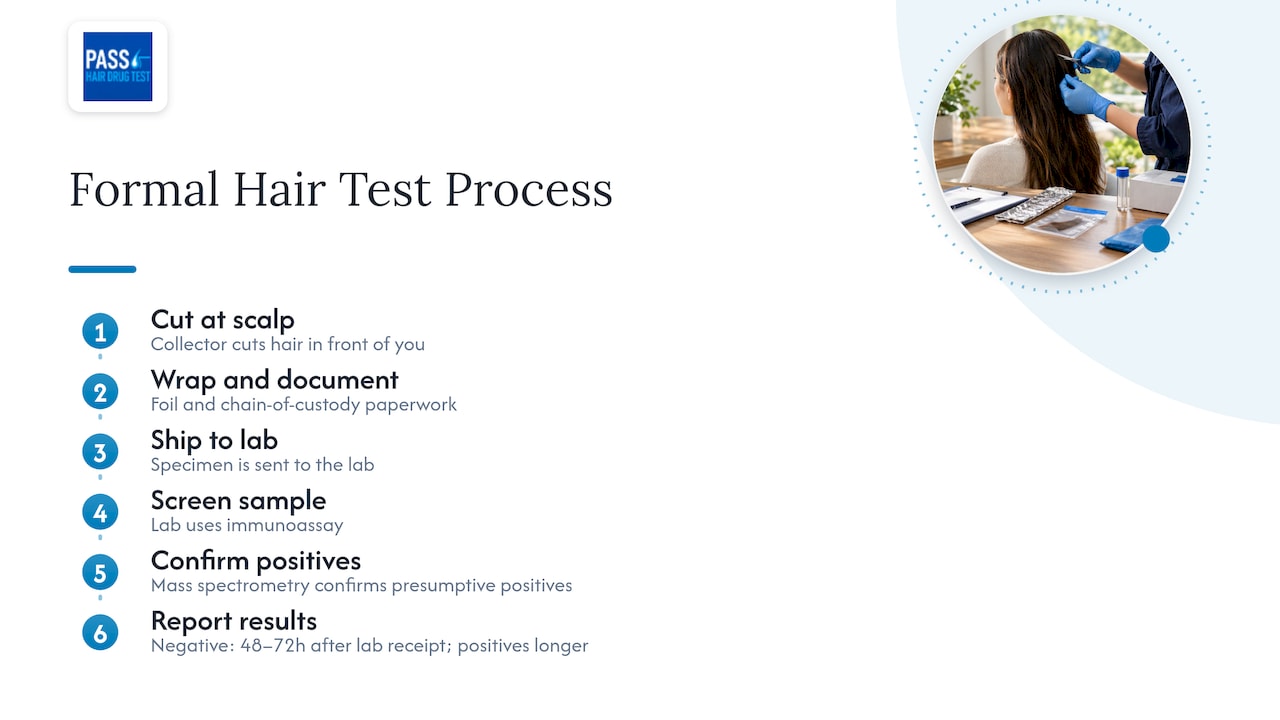
At a formal collection, a trained collector cuts the hair at the scalp in front of you, wraps it in foil and completes chain-of-custody paperwork, then ships it to the lab. Labcorp describes this process, including screening by immunoassay and confirmation of presumptive positives by mass spectrometry. Negative screens are generally reported within 48 to 72 hours of the lab receiving the specimen, and positives that need confirmation take longer.
If a result comes back positive and you believe it is wrong, act quickly and in writing. Ask the employer or the lab what the retest or review process is, since policies differ. Ask whether a medical review officer is involved, and whether any remaining sample can be retested. Keep your own pre-test report and any records of medications or other exposures. Because external contamination can complicate interpretation, as the National Institute of Justice article above explains, a documented history of your own testing can help you raise the question. For legal rights about employment testing, a state labor agency or an employment attorney is the right person to ask, since rules depend on your state and employer.
Where our products fit
If you are preparing for a hair follicle test, we sell the products and support materials for it. Our Hair Follicle Test Kit is the at-home collection option, and our hair follicle shampoo kit and Macujo and Zydot shampoos are the cleansing options. You can browse everything, including urine, saliva and blood test products, on our products page, and our team answers questions by phone if you are unsure which fits your situation.
FAQ
Are at-home hair tests as accurate as lab tests?
Generally not. The Cleveland Clinic says at-home tests vary in accuracy and are usually less sensitive than formal laboratory collections. Mail-in kits that use a laboratory do better than instant cups, but your collection and the lab’s cutoffs still shape the result.
How much hair do I need to cut?
About the diameter of a pencil or a drinking straw, cut as close to the scalp as possible, with root ends aligned on the foil. Always follow the instructions in your own kit, because the lab sets its minimum.
Does dyed or bleached hair change the result?
It can. Research reviews report that hair treatments can change drug concentrations, often lowering them, but the effect varies by drug and hair type. No one can reliably predict the result for a given head of hair.
How long does THC stay in hair?
A standard 1.5-inch scalp sample covers about 90 days, and THC generally starts to appear 7 to 10 days after use. Heavier use, metabolism and the type of hair sampled can all shift that.
Can I test my hair at home and get a result in minutes?
Not for a lab-quality hair result. Hair kits are collection kits that you mail to a laboratory, so expect to wait for the report.
Sources
- Hair Follicle Drug Test: How It Works and What It Detects, Testing.com
- How it works, HairConfirm
- Drug Test: What It Is, Purpose, Procedure & Types, Cleveland Clinic
- Detecting Drugs in Hair: Is It Drug Use or Environmental Contamination, National Institute of Justice
- Mandatory Guidelines for Federal Workplace Drug Testing Programs, Federal Register
- How Accurate Are At-Home Drug Tests, Recovered.org
- Advances in testing for sample manipulation in clinical and forensic toxicology, PubMed Central
- Hair Follicle Drug Testing: Process and Benefits, Labcorp
Recommended
- How to pass hair drug test
- How to Prepare for a Hair Test the Right Way
- Hair Detox Mistakes Before a Drug Test: 9 to Avoid
- Home Hair Detox: Realistic Protocol and Verification Guide
