No products in the cart.
Uncategorized
Heavy User Hair Test: What Labs See and How to Prepare
12
Nov
Nov
If you use THC heavily and face a hair test, the lab looks back about 90 days, and heavy use leaves the strongest trace in that window. The useful question is what you do with the weeks you have left. Our answer is a structured, multi-step cleansing routine, such as Mike’s Macujo Method, started early and followed exactly, because a single wash is rarely enough for a heavy user.
Table of Contents
TL;DR
- A standard hair test uses a 1.5-inch sample and looks back about 90 days, so heavy use during that period is what the lab is measuring.
- Heavy users test positive far more often than light users: one 2017 study found 77% of heavy users versus 39% of light users positive.
- Published research on commercial cleansing products shows mean THC reductions of 52% to 65%, and some samples fell to non-detectable levels.
- Hair length, dye or bleach, and body hair change the result, so plan around your own hair.
- Heavy users benefit most from a full multi-step routine with support, not a one-time rinse.
Table of Contents
- What a hair test actually measures
- How far back the test goes for a heavy user
- Your hair changes the picture
- What the research says about cleansing products
- A practical preparation timeline for a heavy user
- Why a heavy user should not rely on a single trick
- Hair test or other test: know which one you face
- Our offer for heavy users
- Our perspective
- Common mistakes heavy users make
- FAQ
- Sources
What a hair test actually measures
A hair test is not a snapshot of how you feel today. As hair grows, substances in your blood reach the hair bulb and are locked into the strand. A 2025 review reports that drugs can be incorporated into the hair bulb in as little as 30 minutes, and that they take up to 10 days to appear in hair above the scalp surface. That is why a hair test does not catch use from the last week or so, and why it is so good at catching a pattern.
For THC, labs usually look for the metabolite THC-COOH. SAMHSA notes that most hair testing targets the parent drug, with the major THC metabolite as the exception, and it flags external contamination as a major issue for the field.
The cutoffs are tiny. One large lab lists a marijuana metabolite screen cutoff of 1.0 pg/mg and a confirmation cutoff of 0.1 pg/mg. A picogram is a trillionth of a gram, so the test is built to find very small amounts. The 2021 Society of Hair Testing consensus says that finding THC-COOH strongly supports THC use, and that the concentration cannot tell anyone how much you consumed.
That last point matters to you. The lab reports positive or negative against a cutoff. It does not grade you as a light or heavy user from one number.
How far back the test goes for a heavy user
The standard answer is 90 days. Labcorp explains that a 1.5-inch head hair sample covers up to 90 days, based on head hair growing about half an inch per month.
Two things stretch that for heavy users in practice:
- Frequency fills the window. A light user may have one or two exposures spread across three months. A heavy user has THC entering the hair every day, so every centimeter of the sample carries it.
- Long-term use lingers. The Drug Policy Alliance notes that once-frequent marijuana users may continue to test positive after months of abstinence, while occasional users clear faster.
A heavy user who quits on the day the test is announced is still carrying about three months of history in the hair that is already out of the scalp. New growth is clean, but the sample is cut as close to the scalp as possible and the older length goes into the bottle.
The numbers back this up. A 2017 study summarized by Medical News Today found that 77% of heavy users and 39% of light users had positive hair tests, and no non-users did. Even among heavy users, not everyone tests positive, which tells you the outcome depends on hair, timing and what has been done to the hair, not only on how much you used.
Your hair changes the picture
Length and growth
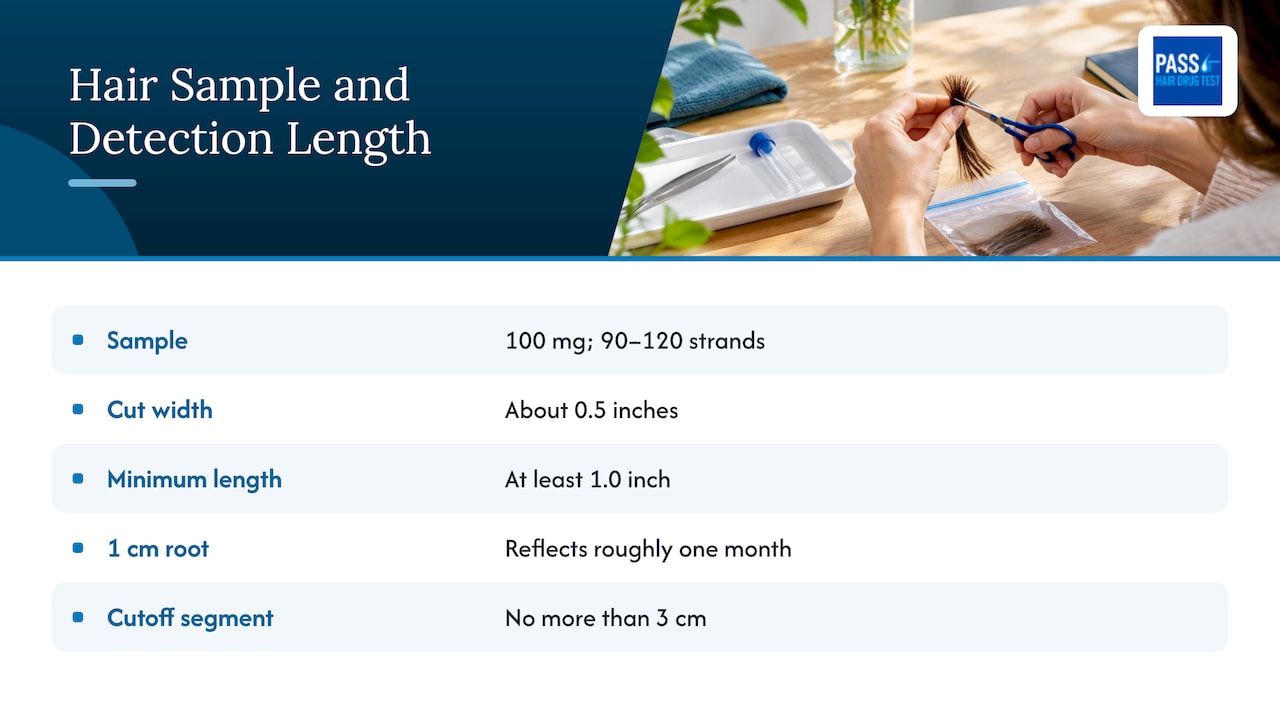
The sample is typically about 100 milligrams, which is 90 to 120 strands, cut at the scalp and sealed in foil with chain-of-custody paperwork. Under the HHS/SAMHSA proposed guidelines, the collector cuts a section about 0.5 inches wide and at least 1.0 inch long from the crown, as close to the scalp as possible.
A review in PMC explains that the window depends on strand length, and that a 1 cm root segment reflects THC use in roughly the last month. The SoHT consensus adds that cutoffs apply to segments of no more than 3 cm, and that longer segments dilute the concentration. If you want a deeper look at how length plays in, our page on what labs actually measure in long hair goes through it.
Short hair and body hair
Under the 2020 proposed guidelines, if the donor’s hair is shorter than half an inch, or the collector cannot get at least 100 mg from the back of the head, the collector moves to other options, typically body hair. Body hair grows more slowly, so the window widens: up to a year according to one consumer health reference. Shaving your head does not remove the question, it changes where the sample comes from.
Color, dye and bleach
The SoHT consensus states that bleaching, dyeing, perming, straightening and UV exposure can influence drug concentrations in hair, and that the lab should document the treatment at collection and consider it when interpreting results. The same review of the literature says pigmented hair binds more drugs than non-pigmented hair. Your natural hair color and your hair care history are part of your preparation, not an afterthought.
What the research says about cleansing products
This is the part heavy users care about most, so here is what peer-reviewed work found.
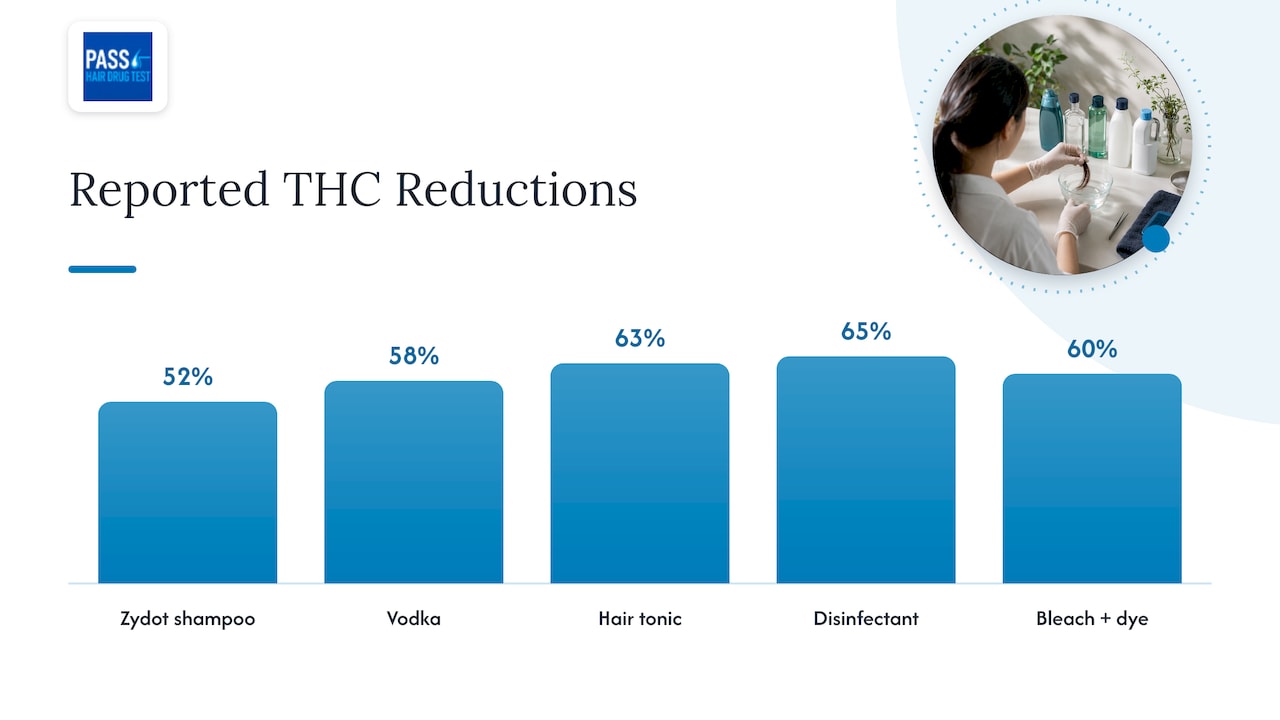
A 2022 German study analyzed 54 THC-positive hair samples treated with commercial products. It found mean reductions of 52% with Zydot shampoo, 58% with vodka, 63% with a hair tonic and 65% with a disinfectant, and in some samples the concentration fell below the detection limit. A 2023 Italian study found that a bleaching and dyeing treatment reduced THC by 60% without visible damage to the keratin matrix.
Two practical lessons follow for a heavy user:
- Results are a range, not a promise. Mean reductions of 52% to 65% mean some hair dropped more and some less. A heavy user starts from a higher concentration, so the starting level matters, and so does how thoroughly and how many times the hair is treated.
- Method matters more than a single product. Treating the hair repeatedly and in a defined order is what a multi-step routine is built to do.
There is also a detection angle. A 2023 review in PMC states that no standardized routine workflow exists to screen for cosmetic treatment or extensive hair washing, and that cleansing shampoos or extensive washing cannot be detected at all by current laboratory methods.
A practical preparation timeline for a heavy user
We cannot promise a lab result, and no one honestly can. We can lay out what a heavy user should be doing, step by step, and where each step usually goes wrong.
Step 1: Stop adding new THC now
Every day of use adds THC to the hair that will grow out before your test. New hair is the one part you can still control. Stopping today does not erase the past 90 days, but it keeps the root end clean, and it matters most if the lab takes a short sample.
Step 2: Work out your test timeline
Ask when the collection will happen, and plan from that date. Hair needs up to 10 days to show above the scalp, so anything you do in the final days affects only what is already out. Starting early means you can repeat treatments instead of cramming them.
Step 3: Know your hair
Note the length, whether it is dyed or bleached, and whether it is dark and dense. These change how you approach the routine and how many cycles are sensible. If you plan to color your hair, do it as part of your schedule, not in a panic the night before.
Step 4: Follow a complete routine, not a one-time wash
This is where heavy users most often go wrong. A single shampoo on test morning is a gamble when the research shows reductions are partial on average. Our multi-step Mike’s Macujo Method is designed for both light and heavy users and comes with detailed instructions. It is built around Macujo Aloe Rid Shampoo and Zydot Ultra Clean Shampoo, and you can read our step-by-step guide to the method before you order. Following the order and timing of each step is what the routine depends on.
Step 5: Do not stack random remedies
Vodka, tonics and disinfectants appear in studies, but mixing home remedies with a routine that has its own sequence is how people damage their hair and lose track of what worked. Pick one complete method and stick with it. If you have questions along the way, our team offers unlimited phone support.
Step 6: Arrive prepared for collection
Expect the collector to cut near the scalp and document everything with chain of custody. Do not skip the appointment or ask to postpone without a reason, because that creates its own problems with an employer. Head hair is the default, so plan for that.
Why a heavy user should not rely on a single trick
Heavy use is the scenario where shortcuts fail most often. The concentration to bring down is higher, the hair is saturated across the whole 1.5-inch sample, and the sample is taken right at the scalp. Because the typical mean reduction from a single treatment in research sits around half to two thirds, a heavy user needs the repeated, structured approach rather than hope.
It is also worth knowing how the test is judged. The lab compares a number to a cutoff, which for THC-COOH is as low as 0.1 pg/mg for confirmation. A heavy user’s concentration can be many times above that. Bringing it down is a matter of repeated treatment over the available time, which is exactly why starting early helps.
One more point. The 2025 Hubbard review notes that THC-COOH has been found in hair segments that do not match the period of intake, which suggests it can spread from sebum and sweat through the hair matrix. Heavy users produce more of it, which is another reason a cleansing routine addresses the whole length of the hair and not only the surface.
Hair test or other test: know which one you face
Not every employer uses hair. Under the 2020 proposed HHS guidelines, federal agencies would collect hair only for pre-employment and random testing. Confirm the test type before you act. If it is urine or saliva instead, the preparation is different, and we cover those on our pages for urine and saliva testing. If you want to compare how hair and urine detect use, see our guide to hair versus urine testing.
Our offer for heavy users
Our store is built for people in the United States who are facing a hair test. We carry Macujo Aloe Rid Shampoo, Zydot Ultra Clean Shampoo and the full Mike’s Macujo Method, and the company has more than 20 years of experience in the drug-testing and detox-product field. Detailed instructions and unlimited phone support come with the method, and our site describes the method as backed by a guarantee. You can see current options and pricing on our hair drug testing products page.
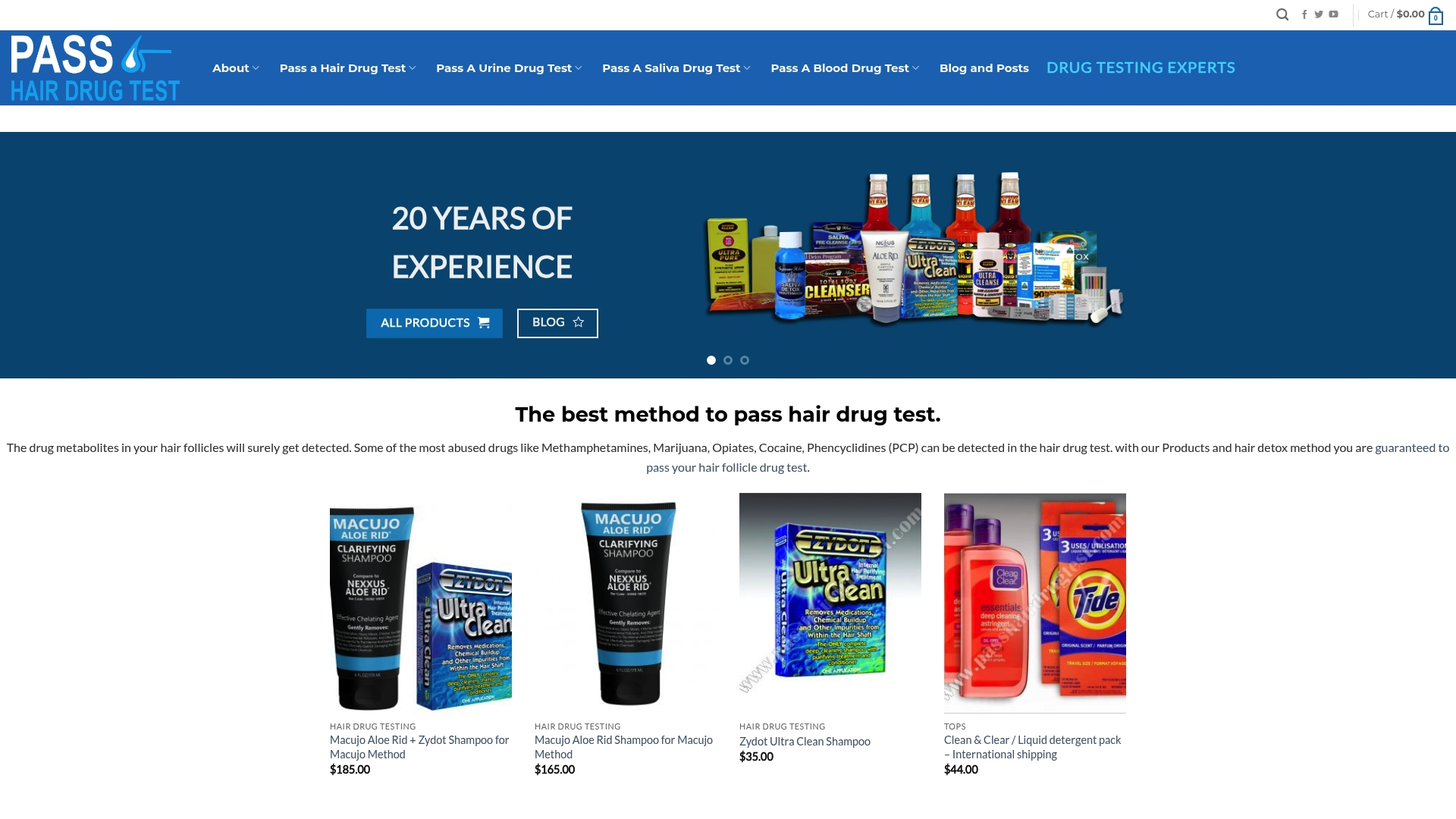
If you are not sure where to begin, start with our hair drug test information page and then browse all products.
Our perspective
After two decades in this field, the pattern we see in the questions people ask is simple: heavy users want one answer, and the honest answer has parts. The test looks back about three months, the sample is cut at the scalp, and the hair you have today is the hair that gets tested.
That is why we built our approach around a multi-step routine instead of a single shampoo. The published research shows that treatment reduces THC in hair by a large share on average. A heavy user starts higher, so the sensible plan is the complete method, followed in order, started with time to spare.
We also think people deserve clear instructions and a real person to call. That is why detailed guidance and phone support are part of how we work, and why we would rather you start early and follow every step than rush on the last night.
MIchael
Common mistakes heavy users make
- Waiting for the test date. Preparation needs repeated treatment cycles. Starting late removes your options.
- Treating the hair test like a urine test. Drinking water or fasting does nothing for a 90-day hair record.
- Changing hair color randomly. The SoHT consensus says labs document hair treatments, so keep your hair history straight and plan any change deliberately.
- Mixing methods. A routine with a set sequence works as a unit.
- Ignoring body hair rules. If your head hair is very short, the collector can go to body hair, and that carries a longer window.
FAQ
How long does THC stay in hair for a heavy user?
A standard sample covers about 90 days of head hair, and that is the usual window for heavy use. Frequent users can keep testing positive for months after they stop, because the already-grown hair keeps its record until it is cut. Body hair can extend the window to up to a year.
Can a hair test tell how much I used?
No. The SoHT consensus states that the concentration in hair cannot determine the quantity consumed. The lab reports a result against a cutoff, so the question it answers is whether THC use is detectable.
Can the lab tell if I used a cleansing shampoo?
A 2023 review found that no standardized routine method exists to screen for cosmetic treatment or extensive washing, and that cleansing shampoos cannot be detected by current laboratory methods. Labs do document visible treatments such as bleach or dye.
Does shaving my head avoid the test?
No. If scalp hair is too short, collectors move to body hair, which can show a longer window of up to a year. It is better to plan around your actual hair than to remove it.
When should I start preparing?
As soon as you know a hair test is coming. Because drugs take up to 10 days to appear above the scalp and the sample is taken at the root, more time lets you complete a full multi-step routine and repeat steps where needed.
Sources
- Labcorp: Hair Drugs of Abuse Testing FAQ
- Labcorp: Hair Follicle Drug Testing process
- Medical News Today: How long does THC stay in your system?
- Bertges et al. 2022: Manipulation of THC hair concentrations (PMC)
- Hubbard 2025: Review on Toxicology Testing in Hair
- SAMHSA: Drug Metabolites and Hair Testing
- Quest Diagnostics: Hair Testing Certifications and Cutoff Levels
- SoHT 2021 Consensus on Drugs of Abuse Testing in Hair
- Drug Policy Alliance: Marijuana Testing
- Shah et al. 2019: bioanalytical techniques review (PMC)
- HHS/SAMHSA 2020 proposed hair testing guidelines
- Drugs.com: How far back does a hair follicle test detect drugs?
- Mestria et al. 2023: homemade hair treatment assessment
- Wissenbach et al. 2023: testing for sample manipulation (PMC)
Recommended
- Body Hair vs Head Hair: What Drug Test Labs Really Use
- Thick Hair Drug Test: What Labs Collect and How to Prepare
- Heavy Smoker Hair Test: What Labs Find and Your Options
- How to Prepare for a Hair Test the Right Way
