Uncategorized
Your Last Week Before a Hair Test: What You Can Still Do
Oct
A week is not enough time to change what a hair test shows, because the sample reflects roughly the last 90 days, not the last few days. What the final week can do is smaller but real. You can avoid new contamination, protect the hair you have, line up documentation for any prescription, and walk into the collection knowing exactly what will happen.
This guide is for U.S. readers who have a hair test scheduled in about seven days and want straight answers on what matters now.
Table of Contents
TL;DR
- A standard hair test reads about 1.5 inches of hair, which covers roughly 90 days. One week of abstaining does not rewrite that history.
- Use in the last 5 to 10 days often has not reached the cut segment yet. That is a quirk of hair growth, not a loophole to plan around.
- In your final week, focus on what you control: no new exposure, no hair damage, prescription paperwork, and knowing the collection rules.
- No method is scientifically validated to erase metabolites from hair. Be skeptical of anyone promising certainty, including product pages.
- If you take a prescribed medication, tell the collector and the Medical Review Officer (MRO) on time.
Table of Contents
- What a hair test actually measures
- Why one week changes less than you hope
- A realistic seven-day plan
- External contamination and secondhand smoke
- What about shampoos and detox products?
- Our perspective: what we tell people with seven days left
- Where to start if you want a cleansing routine
- Prescriptions and the MRO
- Who is actually tested with hair
- Quick reference: myths versus facts
- FAQ
- Sources
What a hair test actually measures
People say “hair follicle test,” but labs test the hair shaft, not the follicle. The collector cuts about 1.5 inches from the scalp. Pulling the root from beneath the skin is rarely done because it is painful and invasive.
Head hair grows about half an inch a month, so a 1.5-inch piece represents about three months of exposure, according to Labcorp. Toxicologists describe hair testing as a tool for spotting a pattern of use rather than one event. A single exposure is a much weaker signal than regular use.
The lab process has two stages. An initial screen uses an immunoassay (ELISA). A positive is then confirmed by mass spectrometry (GC-MS or LC-MS), which identifies the specific substance and the amount. That second step is meant to rule out false positives.
Why one week changes less than you hope
There are two sides to the timing, and people tend to hear only the comfortable one.
The lag. Hair has to grow out of the follicle and above the scalp before it can be clipped. That produces a delay of about 5 to 10 days before very recent use appears in the sample. A hair test is therefore a poor tool for catching last week, and urine or saliva tests are better suited to that.
The window. Everything before that lag, back about three months, is still in the strand. If you have used regularly during that time, the next seven days will not remove it from the hair already grown. Abstaining now matters for future tests and for how your hair looks at the next one, not for this one.
There is also a practical point about the lag. Don’t treat it as a plan. Hair growth rates vary from person to person, and labs can’t pinpoint exact dates of use from a hair sample.
A realistic seven-day plan
This is a checklist for the things that can still be influenced. It is not a promise of an outcome.
Days 7 to 5: get the facts straight
- Confirm what you are being tested on. Ask the employer or the collection site which panel applies, which specimen is collected and who the lab is. A DOT-style five-panel and a private employer panel can differ.
- Check your hair length. If your head hair is too short for 1.5 inches, collectors can use body hair instead, and that reflects a longer window because body hair grows more slowly. Know this before you assume anything about timing.
- Gather prescription records. If you take Adderall or any other controlled medication, get the pharmacy printout or a letter from your prescriber now.
- Stop new exposure. That means no use, and also no extended time in places where others are smoking.
Days 4 to 2: protect the hair you have
- Leave your hair alone. Skip new bleaching, perming or relaxing. Cosmetic treatments can damage the shaft and may change metabolite concentrations, but experts warn the effect is inconsistent and deliberate manipulation can be flagged if the lab sees chemical degradation. Our own page on how bleach and dye change hair drug tests goes through the reported reductions and the risks.
- Wash gently and normally. Plain washing removes surface residue. Don’t overload your hair with gels, sprays or heavy serums that you would not normally use.
- Avoid contaminated environments. Smoke settles on hair and clothing. More on this below.
The day before and the day of
- Wash your hair as you normally would the morning of or the day before, as directed by your detox product’s instructions if you use one.
- Bring photo ID, the paperwork the employer gave you, and your prescription documentation.
- Tell the collector about any medication before the sample is taken. Do not wait for a positive result to bring it up.
- Do not try to cut or trim your own hair short to dodge the test. Collectors can switch to body hair, and a sudden shave tends to raise questions.
External contamination and secondhand smoke
One of the hardest problems for labs is separating drugs that were taken in from drugs that landed on the hair from the environment. Researchers at the National Institute of Justice describe this challenge, and labs try to handle it with a chemical wash before analysis.
For you, the lesson is practical. If you have been around smoke, wash your hair well and avoid repeating the exposure in the final week. We cover how long sealed-room exposure can matter in our article on the secondhand smoke hair test.
What about shampoos and detox products?
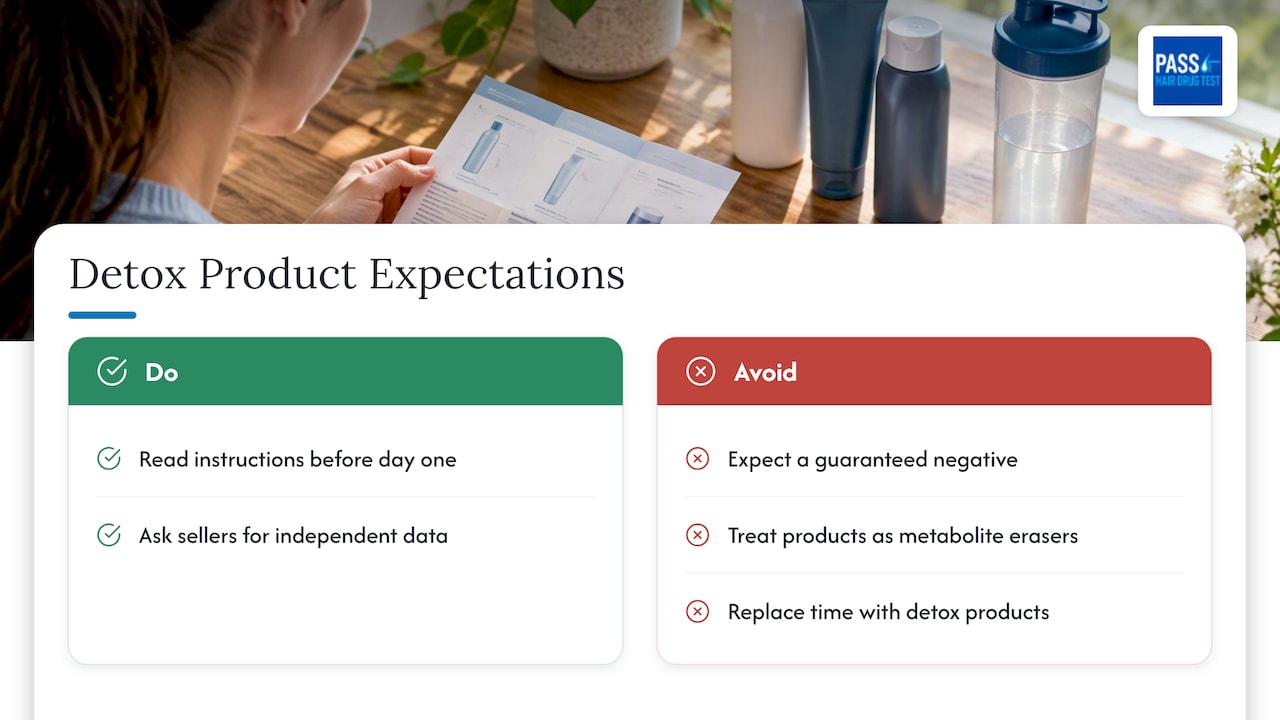
Here is the honest picture. A 2022 study of commercial products found that ordinary shampoos can sometimes lower measured THC concentrations, but they do not guarantee a negative result. The same research points out that no scientifically validated method exists to erase metabolites from hair, and labs are getting better at spotting tampering.
So set your expectations accordingly. A cleansing product may help remove surface residue and environmental contamination. It is not an eraser for three months of incorporated drug. If a seller tells you otherwise, ask for independent data.
A detox product is a tool for the final days, not a replacement for time. If you want to use one, read the instructions fully before day one, because most routines have steps that are timed.
Our perspective: what we tell people with seven days left
We have sold hair-cleansing products for years, and the question we hear most is some form of “is a week enough?” Our answer is that it depends on what you are asking the week to do.
If you want it to erase months of regular use from hair that has already grown, no honest seller can promise that, and the published research does not support it. If you want to reduce surface contamination, avoid hair damage that draws attention, and show up organized, a week is plenty.
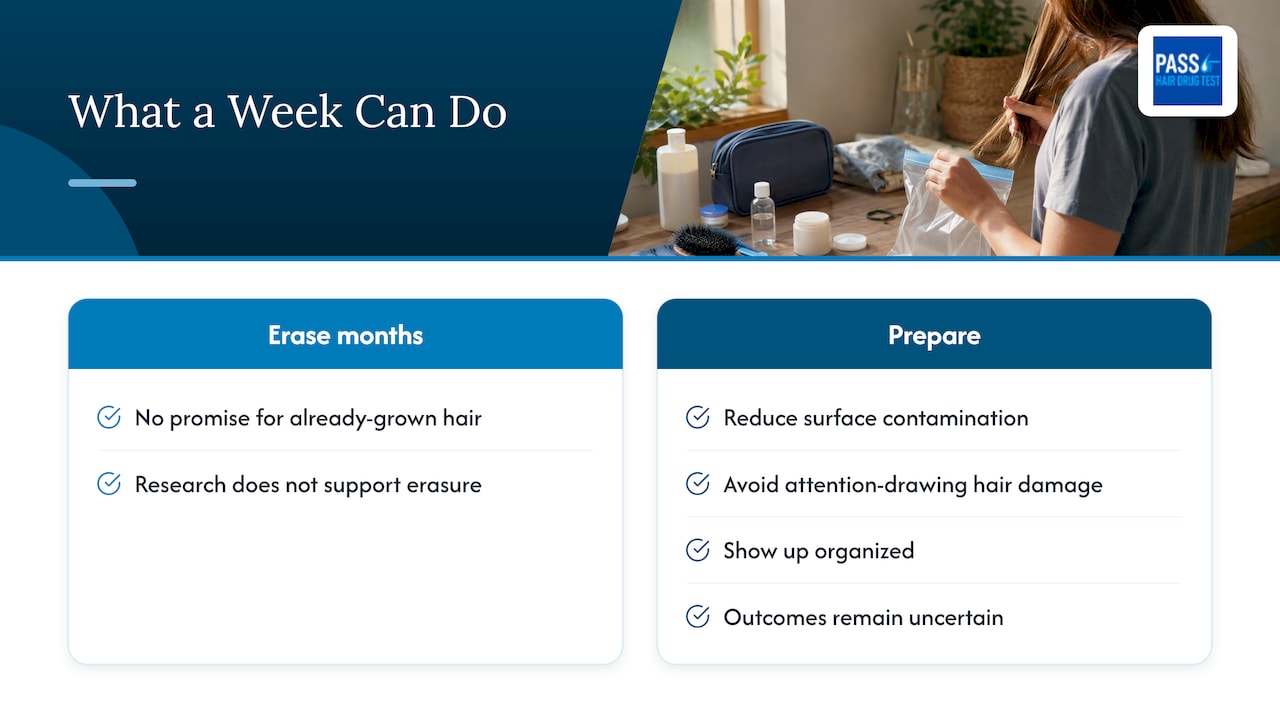
Our site is built around products such as Macujo Aloe Rid Shampoo, Zydot Ultra Clean Shampoo and the multi-step Mike’s Macujo Method. We describe them as options for people who are preparing, and we provide detailed instructions and phone support for using them. We also tell people to treat any outcome as uncertain, to start early next time, and to read our guide to preparing for a hair test before spending money on anything.
The best preparation is still time. If you know a test is coming, start well before the last week.
— MIchael
Where to start if you want a cleansing routine
If you decide a cleansing routine fits your situation, our hair follicle shampoo kit page shows what is in the kit and how the steps are laid out, and our full product catalog also covers urine, saliva and blood testing products if your employer may use another specimen. Read the instructions through before your first wash, and allow for the time each step takes.
Prescriptions and the MRO
If you take a prescribed controlled substance, the hair test is not your protection. The paperwork is. For tests that involve an MRO, a valid prescription may allow the MRO to verify a lab-positive as negative, but only if you disclose it in time.
What that means in your final week:
- Call the pharmacy for a dated printout, or ask your prescriber for a letter.
- Keep the medication in its labeled container if you are asked to show it.
- Disclose it at collection and when the MRO calls. Don’t ignore a call from an unfamiliar number during the days after your test.
This applies to prescriptions only. A prescription for one drug does not explain other substances. For the full process, see our guide on proving prescription meds to an MRO. If you have questions about your specific medication or a medical condition, talk to your prescriber or the MRO assigned to your test.
Who is actually tested with hair
Hair testing is most often used for pre-employment screening, where a longer lookback is useful. In the federal system, the Department of Health and Human Services proposed guidelines that would allow hair for pre-employment and random testing, with an alternate specimen available if someone cannot provide enough hair for medical or faith-based reasons. Private employers set their own policies, so ask yours what it uses and whether alternatives exist for you.
If you have a concern about hair type, a medical condition or a religious practice that affects collection, raise it with the employer or testing site before the appointment, not at the chair.
Quick reference: myths versus facts
| Belief | What the evidence says |
|---|---|
| One clean week fixes it | The sample covers about 90 days, so a week barely changes it |
| Recent use always shows up | Recent use may not have grown out yet, but that is not reliable |
| Dyeing or bleaching guarantees a pass | Effects are inconsistent and chemical damage can be flagged |
| Any shampoo erases metabolites | Some shampoos lower concentrations, none is proven to erase them |
| A prescription is automatically accepted | You must disclose it on time and document it |
FAQ
Can a week of abstinence help me pass a hair test?
Not for the hair already grown. The sample covers about three months, so one week is a small slice of it. A week does help you avoid adding new exposure and gives you time to prepare properly.
How long do I need to be clean to pass a hair follicle test?
To clear the standard window, you would need about 90 days of abstinence and enough new hair growth to be clipped. Because hair grows about half an inch a month, a 1.5-inch sample takes about three months to turn over. Individual growth rates vary.
Will one Adderall fail a hair test?
A prescribed medication can show up, and the right response is documentation, not hoping it is missed. With an MRO involved, a valid prescription may allow a positive result to be verified as negative if you disclose it in time. Bring records and tell the collector and MRO.
What can throw off a hair test?
Cosmetic treatments such as bleaching or perming can alter the hair, but the effect is inconsistent and labs can detect signs of chemical tampering. Environmental contamination is another factor, which is why labs wash samples first. Neither is a reliable way to change your result.
Sources
- Labcorp: Hair Drugs of Abuse Testing FAQ
- Quest Diagnostics: Hair testing FAQ
- Medical News Today: Hair follicle drug test
- National Institute of Justice: Detecting drugs in hair
- AlphaBiolabs: What affects a hair drug test result
- PMC: Manipulation of THC hair concentrations by commercially available products
- APCA: DOT 5-panel drug test
- Federal Register: Mandatory Guidelines for Federal Workplace Drug Testing Programs
Recommended
- 72, 48, 24 Hours: Last Minute Hair Detox Backed by Research
- How to Prepare for a Hair Test the Right Way
- How Can I Pass a Hair Drug Test?
- Start Three Weeks Out: Evidence Backed Hair Sample Collection Protocol
