Uncategorized
DOT Hair Testing for CDL Drivers: Why Part 40 Says No
Oct
No, under current DOT rules a hair specimen is not an authorized DOT drug test specimen. DOT-authorized tests use only urine or oral fluid, collected and processed under 49 CFR §40.210. Employers can still use hair testing under a separate non-DOT policy, but results from that testing are not reportable to the FMCSA Clearinghouse.
TL;DR:
- All six FMCSA testing events, including random, postaccident, return to duty, and follow up, require urine or oral fluid under Part 40 procedures.
- DOT compliance depends on the full chain: a qualified collector, required forms, a laboratory certified by HHS, and Medical Review Officer review before reporting.
- Keep company hair screening records and forms separate; positive results may trigger HR discipline but cannot be reported to the FMCSA Clearinghouse.
- HHS proposed federal hair testing guidelines in 2020, but they are not final and have no timeline; employers should keep hair screening outside DOT testing.
Table of Contents
Table of Contents
- 49 CFR Part 40: what the regulation requires and why hair is excluded
- How DOT testing events for FMCSA/CDL drivers map to authorized specimen types
- DOT tests versus non-DOT hair tests: Clearinghouse and reporting limits
- Practical steps for employers and drivers when hair testing is proposed or used
- Status of federal rulemaking on hair testing and what to watch next
- Compliance and non-DOT hair testing: an honest perspective
- Resources for non-DOT hair testing programs
- FAQ
- Sources
49 CFR Part 40: what the regulation requires and why hair is excluded
Part 40 governs every DOT-regulated drug and alcohol test, and it spells out exactly which specimens qualify. Under §40.210, DOT drug tests must use urine or oral fluid analyzed at an HHS-certified laboratory. Hair, point-of-collection devices, and instant tests are explicitly excluded, regardless of how sensitive or convenient they might seem.
No hair testing method, however accurate, satisfies DOT requirements unless the specimen itself is urine or oral fluid collected under Part 40 procedures.
The regulation exists because DOT testing depends on a tightly controlled chain of custody, not just a scientifically valid result. A compliant test requires:
- A qualified collector trained in Part 40 collection procedures
- A completed Custody and Control Form (CCF) or electronic equivalent for urine, or an Alcohol Testing Form for alcohol screening
- Specimen testing at an HHS-certified laboratory
- Review and verification by a Medical Review Officer (MRO) before any result is reported
Skip any one of these steps, or use a specimen type Part 40 does not list, and the result simply is not a DOT test, no matter how the collection was conducted or how reliable the lab appears.
How DOT testing events for FMCSA/CDL drivers map to authorized specimen types
Every FMCSA-regulated commercial driver is subject to the same set of required testing events, and each one must use a Part 40 authorized specimen. According to FMCSA implementation guidelines, these events are:
- Pre-employment: before a driver performs any safety-sensitive function.
- Random: unannounced testing drawn from a pool throughout the year.
- Reasonable suspicion: triggered by trained supervisor observation.
- Post-accident: required after certain qualifying crashes.
- Return-to-duty: completed after a driver violates drug and alcohol rules.
- Follow-up: ongoing testing tied to a return-to-duty plan.
Each of these situations calls for urine or oral fluid collection under direct Part 40 procedures, with direct observation required in specific circumstances such as return-to-duty and follow-up testing. Employers cannot substitute a hair specimen for any of these six events and still call the result a DOT test, and doing so would leave a safety-sensitive employee’s compliance status unresolved under federal rules.
DOT tests versus non-DOT hair tests: Clearinghouse and reporting limits
DOT and non-DOT testing programs must stay separate at every step. Part 40 requires employers to keep DOT-mandated tests distinct from any additional screening a company chooses to run on its own, and DOT testing always takes priority when a safety-sensitive event triggers a required test.
This separation matters most when it comes to the FMCSA Clearinghouse. The Clearinghouse accepts only DOT-covered violations and test refusals. A positive result from a company’s own non-DOT hair testing program is not reportable, even if the employer later takes disciplinary action based on that result.
- Keep DOT and non-DOT testing records in entirely separate files.
- Never use a DOT Custody and Control Form for a non-DOT hair collection.
- Write company policy language that clearly labels hair testing as a non-DOT program.
Pro Tip: Label every non-DOT hair test document and form distinctly so no one mistakes it for a DOT record during an audit.
Practical steps for employers and drivers when hair testing is proposed or used
Employers considering hair testing need a policy that keeps DOT obligations intact while adding a separate layer of screening.
- Write clear policy language stating that hair testing is a company-level, non-DOT program with its own consent form and consequences.
- Never substitute a hair result for a required DOT event; a driver due for random, post-accident, or return-to-duty testing still needs a Part 40 authorized specimen.
- Handle a positive non-DOT hair result through standard HR disciplinary procedures, not through DOT reporting channels, since it creates no Clearinghouse record.
- Preserve split-specimen rights and verification steps for any DOT test that runs alongside or after a non-DOT hair screen, so the employee’s due process rights under Part 40 remain intact.
Pro Tip: If a non-DOT hair test comes back positive, document the decision trail separately from any DOT paperwork so the two programs never get tangled during a compliance review.
Status of federal rulemaking on hair testing and what to watch next
Federal hair testing standards have been proposed but not finalized. HHS published draft Mandatory Guidelines for hair testing in 2020, outlining conditions under which hair could be used for pre-employment and random testing.
- The proposed guidelines would require collecting an alternate authorized specimen alongside hair in many cases.
- Adoption requires further interagency rulemaking, and no final timeline has been set.
- Until HHS and DOT finalize these guidelines, employers should continue treating hair testing strictly as a non-DOT tool, with no Clearinghouse reporting obligation attached to its results.
Compliance and non-DOT hair testing: an honest perspective
Having watched this space for years, I’d rather see employers over-separate their DOT and non-DOT programs than risk blending them. DOT-authorized testing always comes first for safety-sensitive events. When questions get specific to your operation, bring them to your Designated Employer Representative or check official FMCSA and DOT guidance directly.
— MIchael
Resources for non-DOT hair testing programs
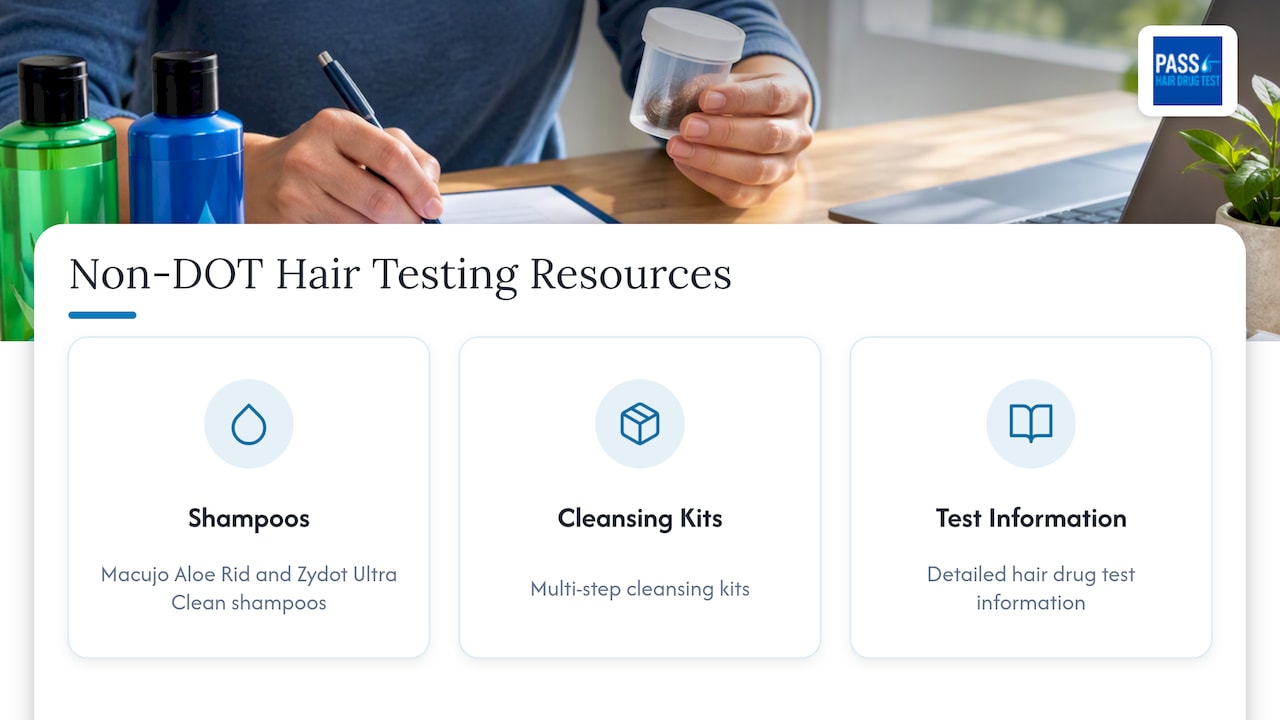
For employers or drivers building a non-DOT hair screening program, we offer hair cleansing shampoos, multi-step cleansing kits, and detailed hair drug test information built around products like Macujo Aloe Rid Shampoo and Zydot Ultra Clean Shampoo. None of these change DOT regulations or create a Clearinghouse entry; they exist strictly for company-level, non-DOT screening needs.
If you’re researching options for a non-DOT hair test, browse our hair drug testing products to see current kits and shampoos, or reach out with questions about how our multi-step method works for your situation.
This article is general information, not a substitute for advice from a qualified lawyer. Consult a qualified legal professional about your own circumstances before acting on anything here.
FAQ
What is a non-DOT hair drug test?
A non-DOT hair test is a screening an employer runs under its own company policy rather than under federal transportation testing rules. Results from this type of test are not reported to the FMCSA Clearinghouse and must be documented separately from any DOT-required test.
How to become a mobile drug tester?
Mobile collectors typically need training specific to the specimen type they collect, such as urine or oral fluid collector training that meets Part 40 standards for DOT work. Requirements and certification paths vary by training provider and by whether the work involves DOT-regulated or non-DOT collections.
Will fake pee pass a dot drug test?
DOT-regulated urine collections follow strict chain-of-custody and observation procedures designed to detect substituted or adulterated specimens, and a substituted specimen is itself a reportable refusal to test. Attempting to use a substitute specimen carries serious consequences for safety-sensitive employees under federal rules.
How to pass a hair follicle test in 2026?
Since DOT does not use hair specimens for required testing, this question typically applies to non-DOT hair screening set by an employer’s own policy. For that type of test, cleansing products and multi-step regimens like those detailed on our hair follicle drug testing page are built specifically for that use case.
Sources
- § 40.210 What kinds of drug tests are permitted under the regulations? | U.S. DOT
- FMCSA implementation guidelines — drug and alcohol testing
- FMCSA Drug & Alcohol Clearinghouse — Reporting FAQ
- Mandatory Guidelines for Federal Workplace Drug Testing Programs (HMG proposal) | Federal Register
Recommended
- How to Pass a DOT Hair Test: What the Law and Labs Say
- Hair Drug Test Information
- Hair Follicle Drug Test Information
- Trucking Hair Follicle Test: What Every Driver Must Know
