Uncategorized
Fail Hair Drug Test? What It Means and What to Do Next
Aug
A non-negative result on a hair follicle screen means the lab detected drug metabolites in your hair sample above its cutoff level. That is not the same as a confirmed positive. Labs only report a confirmed positive after a second, more precise test verifies the finding and a Medical Review Officer (MRO) reviews it for legitimate medical explanations.
Do these things in order, right now:
- Ask whether the result is a screening result or a lab-confirmed positive.
- Request the confirmatory test if it hasn’t already run.
- Pull together any prescriptions, pharmacy printouts, or medical records tied to the substance flagged.
- Prepare for a call from the MRO, and consider independent retesting or legal advice if the result still doesn’t make sense.
Keep the timeline in mind: a hair test typically reflects roughly 90 days of history from the first 1.5 inches of scalp hair, not a single recent use.
Table of Contents
Key Takeaways
A non-negative hair test result signals detectable metabolites within roughly a 90-day window and requires confirmatory GC-MS or LC-MS/MS testing plus MRO review before it counts as a confirmed positive.
| Point | Details |
|---|---|
| Screen versus confirmed | A screening flag is not final; only GC-MS or LC-MS/MS confirmation and MRO sign-off make a result official. |
| 90-day window applies to head hair | The 3.9 cm (1.5 in) standard segment reflects head hair growth; body hair timing is far less precise. |
| Accuracy varies by drug class | Concordance with self-reported use runs higher for cannabis and street opioids than for cocaine or prescribed opioids. |
| Documentation speed matters most | Prescriptions and pharmacy records submitted quickly to the MRO resolve many legitimate cases. |
| Shaving and shortcuts backfire | Shaving delays testing rather than erasing history, and inconsistent product use can raise red flags in lab checks. |
| Products support prep, not guarantees | Passhairdrugtest’s Macujo Method and detox shampoos are preparation tools; confirmatory testing and MRO documentation remain the real safeguards. |
Table of Contents
- What Does It Mean to Fail a Hair Drug Test?
- What Can Cause a Positive Hair Drug Test Result?
- How Far Back Does a Hair Test Really Go?
- How Accurate Is a Hair Follicle Drug Test?
- What Should You Do After a Non-Negative Result?
- Do Shaving or Detox Shampoos Actually Beat a Hair Test?
- Researching Your Options Before a Test
- Frequently Asked Questions
- Sources
What Does It Mean to Fail a Hair Drug Test?
Hair holds onto drug metabolites longer than urine or saliva because they get locked into the hair shaft as it grows, pulled in through tiny blood vessels at the follicle. That’s why a standard 1.5 inch (3.9 cm) segment of scalp hair gives labs roughly a 90-day window into someone’s history, instead of the day or two you’d get from a urine cup.
Collection isn’t complicated. A technician typically snips 90 to 120 strands close to the scalp, usually from the back of the head. If someone is bald or has closely shaved hair, technicians turn to body hair, which grows and rests in different cycles and doesn’t map cleanly onto the same 90-day timeline.
Behind the scenes, the lab runs two separate tests, not one. The first is an immunoassay screen, usually ELISA, which is fast and cheap but prone to flagging things that aren’t actually there. Anything that screens positive moves to a confirmatory test, either GC-MS or LC-MS/MS, which identifies the exact metabolite and measures it against a stricter cutoff.
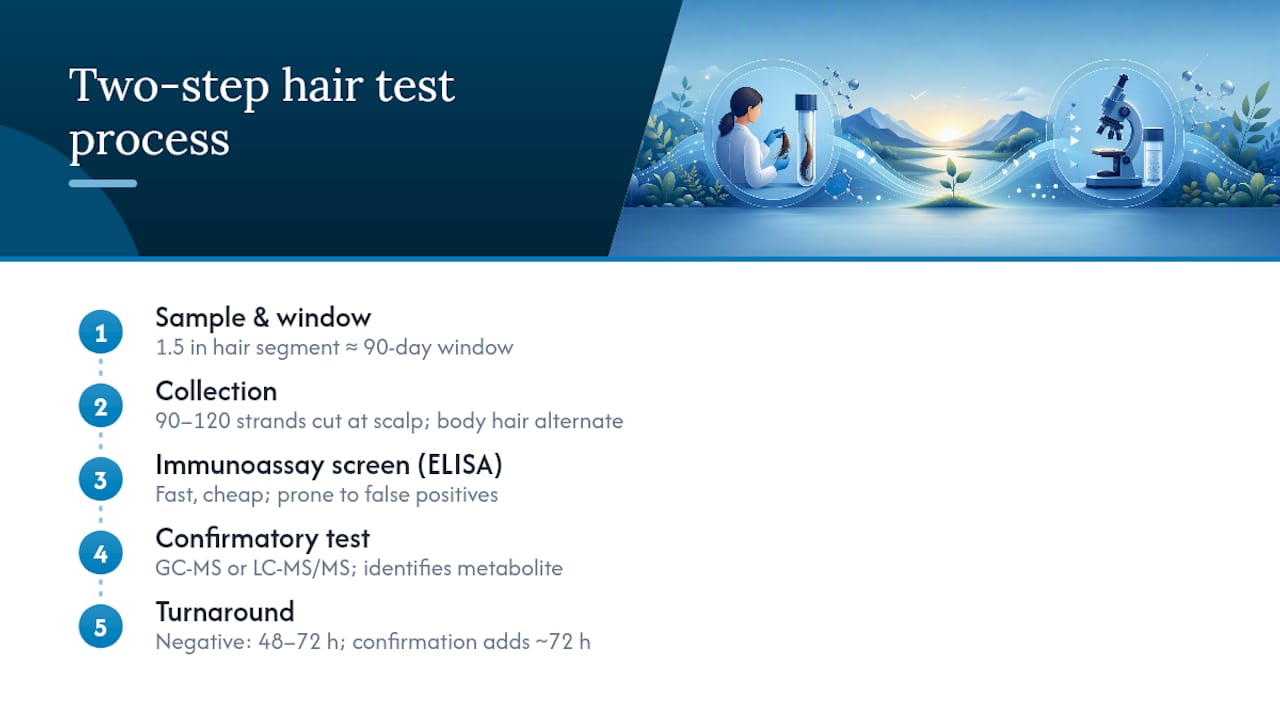
Turnaround matters if you’re waiting on a job offer. Negative screens are commonly reported within 48 to 72 hours of the lab receiving your sample. Confirmation testing on a non-negative screen typically adds another 72 hours or so.
What Can Cause a Positive Hair Drug Test Result?
The obvious cause is real use. Repeated or chronic exposure deposits metabolites into hair as it grows, and heavier or more frequent use generally leaves more of a trace than a single occasion. But “positive” and “used drugs” aren’t perfect synonyms, and a few other things can push a result the wrong direction.
- External contamination. Being around drug smoke or residue in close quarters can, in rare cases, leave trace amounts on the hair’s surface rather than inside it.
- Cross-reactive medications. Certain over-the-counter and prescription drugs share enough chemical structure with screened substances to trigger a false flag on the initial immunoassay.
- Cosmetic treatments. Bleaching, perming, and repeated coloring can degrade or alter metabolites already in the hair, which sometimes skews the ratios labs use to judge ingestion versus contamination.
- Individual biology. Darker, more melanin-rich hair binds certain drug metabolites more readily than lighter hair, and people metabolize substances at different rates, both of which affect what shows up.
Pro Tip: Start a folder today with every prescription, pharmacy receipt, and over-the-counter product you’ve used in the last few months. If the MRO calls, having dates and dosages ready is far more persuasive than explaining from memory.
How Far Back Does a Hair Test Really Go?
Hair grows at roughly 0.6 to 1.4 centimeters a month, which is why labs treat the first 3.9 centimeters, about 1.5 inches, as a stand-in for 90 days of exposure. That math only holds for head hair, though.
- Head hair: the standard sample; consistent growth rate makes the 90-day estimate reasonably reliable.
- Body hair: grows and rests in cycles that vary by body part, so it can reflect a much longer, blurrier timeframe instead of a clean 90 days.
If someone’s hair is too short, freshly shaved, or otherwise unavailable, labs may substitute body hair or decline the collection outright, and either move changes how confidently anyone can pin down when exposure happened.
How Accurate Is a Hair Follicle Drug Test?
Hair testing is a genuinely useful tool for spotting patterns of exposure over months, but it isn’t flawless, and treating a result as absolute certainty misreads what the science actually supports. Accuracy shifts by drug class: concordance with self-reported use tends to run higher for cannabis and street opioids, and noticeably lower for cocaine and prescribed opioids.
The two-step workflow exists specifically to catch errors. The ELISA screen is a wide net, cheap and fast but not precise. GC-MS or LC-MS/MS confirmation narrows that down to a specific, quantified metabolite, checked against a laboratory cutoff designed to filter out trace-level noise.
The Society of Hair Testing advises interpreting hair results as qualitative evidence of exposure, not a precise measure of dose or timing, because individual variation in hair chemistry and metabolism is simply too wide for that level of precision.
Labs also lean on wash procedures and metabolite-to-parent-drug ratios to tell contamination apart from actual ingestion. If a result shows only the parent drug with none of its expected metabolites, or a ratio that looks off, that’s a real reason to ask questions rather than accept the finding at face value.
What Should You Do After a Non-Negative Result?
Speed and documentation are your two biggest levers here, and both matter more than any home remedy you’ll find online.
- Confirm what stage the result is in. Ask outright whether this is a screening flag or an already-confirmed positive, since the response differs.
- Request or preserve a split sample. If a portion of your hair was retained, ask about independent retesting before it’s discarded; a fast request protects chain-of-custody integrity.
- Gather documentation immediately. Prescriptions, pharmacy records, and dates of any relevant medical treatment need to be in the MRO’s hands quickly.
- Respond to the MRO without delay. Prompt, well-documented responses resolve a surprising number of cases that have a legitimate medical explanation.
- Escalate if needed. Unusual metabolite ratios, suspected lab error, or an employer who won’t engage are all reasons to loop in HR, an employment attorney, or an independent toxicologist.
Pro Tip: Keep both digital and paper copies of every document you send. MRO response windows are often short, sometimes just a matter of days, so don’t wait until the last minute to start pulling records together.
Do Shaving or Detox Shampoos Actually Beat a Hair Test?
Shaving your head the week before a test doesn’t erase history, it just forces the lab to either use body hair or push back the appointment, and either outcome tends to draw more suspicion, not less. Body hair, as noted above, carries its own timing problems that can work against you as easily as for you.

Detox shampoos and specialty washes are a mixed bag. Reputable labs run wash procedures specifically designed to strip surface residue before testing, and they check metabolite ratios that flag inconsistent results. That doesn’t mean every product on the market is worthless, but it does mean lowering surface concentration inconsistently can raise red flags rather than produce a clean negative. Secondhand smoke exposure causing a positive is possible in extreme, prolonged scenarios, but standard lab wash steps and confirmatory testing are built to catch exactly that kind of contamination.
A Note From Michael
Nobody reads about MRO windows and lab cutoffs for fun. If you’re here, something’s on the line. The evidence points one direction: documentation and speed beat guesswork every time. Trust the confirmatory process, not internet shortcuts promising a clean result overnight.
Researching Your Options Before a Test
If you’re researching ways to prepare before a hair test, you’re not choosing between doing nothing and finding a miracle fix. Passhairdrugtest has built its hair follicle testing resources and product line, including Macujo Aloe Rid Shampoo, Zydot Ultra Clean, and the multi-step Macujo Method, around more than two decades of watching what people actually run into during testing season.
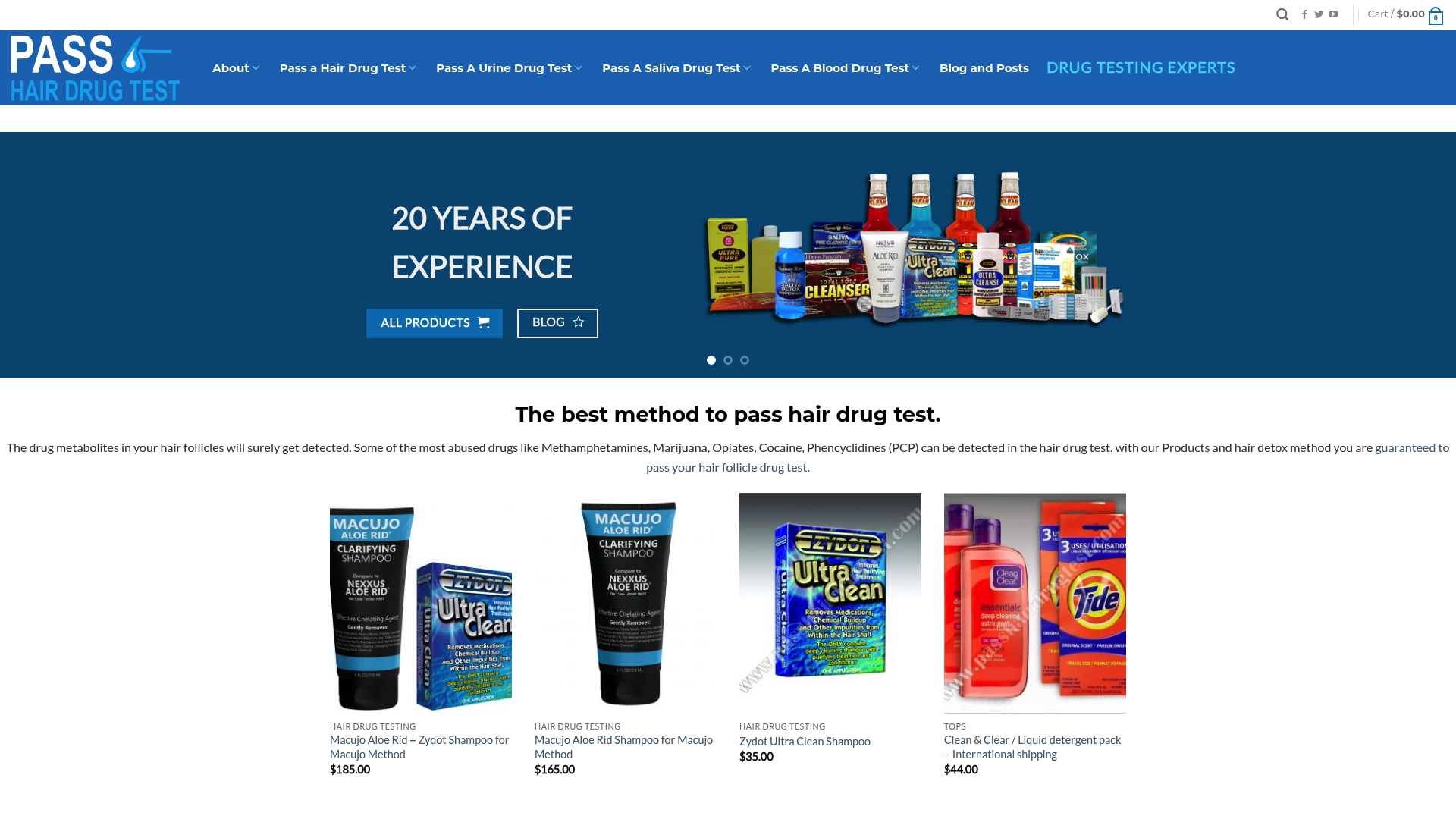
Be clear-eyed about what these products are: cleansing tools people use as part of their own preparation, not a guaranteed override of lab science. No shampoo or kit erases the fact that confirmatory testing and MRO documentation are the actual safeguards in this process, and those steps should always come first if you’re facing a non-negative result. If you’re still in the research phase and want to compare formulas and kits, the best hair detox shampoo page breaks down the differences between products, and the full product catalog covers kits built around the Macujo Method for people who want a structured, multi-step approach rather than guessing at a single shampoo.
Frequently Asked Questions
Can you fail a hair drug test from being around someone who smokes?
It’s possible in extreme, repeated exposure scenarios, but labs use wash procedures and metabolite-ratio checks specifically to separate surface contamination from actual ingestion, so casual secondhand exposure rarely produces a confirmed positive.
How long does a hair follicle test detect drug use?
The standard 1.5 inch (3.9 cm) segment of head hair typically covers about 90 days, though longer samples can extend that window further back.
Does shaving your head stop a hair drug test?
No. It doesn’t erase metabolites already deposited in hair that’s been cut, and it typically forces the lab to collect body hair or delay the test, which often looks worse than simply providing a sample.
What happens after a non-negative hair test screen?
The lab runs a confirmatory GC-MS or LC-MS/MS test, and if that comes back positive, an MRO reviews the case and may contact you for prescriptions or medical explanations before anything is finalized.
Are hair drug tests ever wrong?
They’re not infallible. Accuracy varies by drug class and can be affected by melanin content, cosmetic hair treatments, and individual metabolism, which is exactly why confirmatory testing and MRO review exist as safeguards.
This article is general information, not a substitute for advice from a qualified lawyer. Consult a qualified legal professional about your own circumstances before acting on anything here.
Sources
- PubMed Central article (PMC12272604)
- Hair follicle drug test: How it works, what to expect, and accuracy – Medical News Today
- Society of Hair Testing consensus on general recommendations for hair testing (DOI 10.1016/j.scijus.2026.101444)
- Hair Follicle Drug Testing: Process & Benefits | Labcorp
Recommended
- Pass hair Drug Test
- How Can I Pass a Hair Drug Test? – Pass Hair Drug Test
- Invalid Drug Test Result: What It Means for Hair Tests
- Hair Drug Test Information – Pass Hair Drug Test
