No products in the cart.
Uncategorized
Why Baking Soda Fails Many U.S. Hair Drug Tests Despite 60% Lab Drops
03
Sep
Sep
Baking soda alone will not reliably help you pass a hair follicle drug test. The only peer-reviewed evidence showing meaningful reductions in drug concentration came from a multi-step lab protocol that combined baking soda paste with salicylic acid and a brief bleach step, not baking soda by itself. Even that regimen produced inconsistent results across drugs and never guaranteed a negative result. If you have a hair test coming up, abstinence and validated risk-reduction strategies beat any DIY chemical experiment, especially one involving bleach near your scalp.
TL;DR:
- Baking soda alone cannot reliably reduce drug concentrations in hair to pass a drug test, as the only proven lab approach involves multiple chemicals and steps.
- A 2023 study found that aggressive, multi-step chemical treatments only moderately reduced THC levels and did not guarantee a negative test result, especially for frequent cannabis users.
- Hair drug metabolites are chemically locked within the cortex, making superficial cleaning or DIY remedies ineffective at removing internal drug residues.
- Realistic preparation requires stopping use well in advance, avoiding harsh chemicals, and understanding that lab results are based on controlled conditions, not in vivo hair on a person’s head.
- Any product or home remedy should be viewed as a risk reduction measure layered onto time and abstinence, not a guaranteed method to pass a drug test.
Table of Contents
Table of Contents
- Does Baking Soda Work for a Drug Test? What the Peer-Reviewed Research Found
- How Hair Follicle Drug Tests Actually Work
- Why Baking Soda’s Chemistry Falls Short
- Why Lab Percentages Don’t Guarantee a Real-World Pass
- What to Actually Do Before a Hair Follicle Test
- How Passhairdrugtest Approaches These Findings
- Where to Read the Original Research
- Baking Soda Home Remedies Deserve Skepticism, Not Dismissal
- Sources
Does Baking Soda Work for a Drug Test? What the Peer-Reviewed Research Found
The most-cited evidence on this topic comes from a 2023 study published in Drug Testing and Analysis, which tested whether household chemical treatments could meaningfully lower drug concentrations in hair. Researchers weren’t testing baking soda in isolation. They tested a three-part combination protocol, applied to hair strands already confirmed positive for specific drugs, then measured what happened to concentration levels afterward.
The protocol labeled Treatment 1 in the study broke down into three applications repeated twice daily for three days:
- A baking soda paste mixed at roughly three parts baking soda to one part water, left on for 10 minutes
- A salicylic acid moisturizer, left on for another 10 minutes
- A bleach application, left on for just 5 minutes
That’s six treatment cycles over three days, each one stacking an alkaline paste, an acid, and an oxidizer directly onto hair strands.
The results varied enormously by drug.
That gap matters more than the headline numbers. The drugs people most commonly get hair tested for in the United States, THC in particular, showed some of the weakest response to this aggressive combination treatment.
If someone used cannabis heavily and frequently, a 60% reduction can still leave a result well above the laboratory cutoff used in workplace testing. The study authors were explicit about this limitation: their lab findings do not translate into a guaranteed negative result on an actual employment or court-ordered test.
There’s also the small matter of sample size and setting. This was an ex vivo study, meaning researchers treated hair samples that had already grown and already tested positive, in a controlled lab environment. Sample sizes for some analytes were small, and the strands weren’t attached to a living scalp undergoing normal oil production, sweat exposure, and new growth. That’s a very different scenario from someone in their bathroom mixing a paste before a Monday morning test.
The study’s other major finding gets less attention than the percentage table, but it’s arguably more important: oxidative bleaching under alkaline conditions was the most effective piece of the whole protocol. Treated strands often looked visually indistinguishable from untreated hair. That means damage isn’t always visible to the naked eye, which cuts both ways. It’s part of why forensic labs have started developing chemical markers instead of relying on visual inspection alone.
How Hair Follicle Drug Tests Actually Work
To understand why baking soda struggles to do much on its own, you need to know where drug metabolites actually end up inside a hair strand.
Hair has two relevant layers for this discussion. The cuticle is the outer layer, made of overlapping scale-like cells that protect the strand. The cortex sits underneath, and it’s where drug metabolites get bound into the keratin structure as hair grows through the follicle. Once a metabolite is incorporated into the cortex, it’s not sitting on the surface waiting to be rinsed away. It’s chemically locked into the same protein matrix that gives hair its structure.
This is why hair follicle testing has such a long detection window compared to urine or saliva. A standard test typically examines hair segments detecting drug use going back roughly 90 days, using the portion of hair closest to the scalp, since that segment represents the most recent growth.
Before any hair sample reaches an actual drug screen, forensic and commercial laboratories run it through a decontamination wash. This isn’t a courtesy rinse. It’s a documented, multi-step process using organic solvents followed by aqueous buffers, designed specifically to strip away external contamination such as secondhand smoke residue or environmental exposure before the internal analysis even begins.
- Labs run both pre-wash and post-wash extracts and compare them.
- If a drug metabolite shows up mainly in the post-wash extract, it means the substance is incorporated into the hair itself, not sitting on the surface.
- Surface-level cleaning, no matter how thorough, cannot remove what a lab’s own solvent wash has already accounted for.
This is the core reason surface remedies underperform. A household wash, even an aggressive one, is trying to solve a problem the lab already solves for you before analysis starts. You’re not hiding metabolites from the test. You’re duplicating a step the lab already performs, then hoping your version somehow reaches deeper than theirs.
Labs are also getting better at spotting tampering that goes beyond a simple wash. Researchers have proposed biomarkers such as PTeCA and untargeted metabolomic screening specifically to flag hair that’s been cosmetically or chemically altered, even when it looks completely normal.
Pro Tip: If you’re worried about environmental exposure showing up in a test rather than personal use, ask the testing facility whether they follow standard decontamination protocols. It’s a fair question, and any accredited lab should be running one regardless.
Why Baking Soda’s Chemistry Falls Short
Sodium bicarbonate is a mild alkaline compound. When mixed into a paste and applied to hair, it can cause the cuticle to swell slightly, opening up the outer scale layer a bit more than usual. That’s genuinely useful for something like clarifying buildup or lifting surface residue.
It’s a much weaker tool for reaching metabolites bound inside the cortex. The lab study that showed real reductions didn’t rely on baking soda’s mild alkalinity to do the heavy lifting. It relied on bleach, an oxidizer that breaks down chemical bonds far more aggressively than a baking soda paste ever could on its own. Baking soda’s role in that protocol was more of a supporting player, helping open the cuticle so the bleach and salicylic acid could penetrate further, not the active ingredient doing the real damage to metabolite structures.
That distinction gets lost when people see “baking soda” in a study headline and skip past the “plus salicylic acid plus bleach” part.
Trying to replicate lab-grade oxidative reduction at home carries real risk:
- Scalp irritation and chemical burns from concentrated bleach or repeated alkaline exposure
- Hair breakage and visible damage from repeated stripping over just a few days
- Increased scrutiny from lab examiners if hair looks chemically altered, brittle, or unusually porous
- Uneven results depending on hair thickness, porosity, and how recently the person used the tested substance
And as the study data showed, even when the full aggressive protocol was followed correctly, THC and methadone still resisted reduction more than other analytes. If you’re worried about a THC-specific hair test, baking soda’s weakest performance in the entire study happens to be for the drug most people are actually being tested for.
Why Lab Percentages Don’t Guarantee a Real-World Pass
Here’s where the gap between a research paper and your actual test appointment gets wide. The 2023 study was conducted ex vivo, meaning researchers treated hair strands that had already grown, already tested positive, and were no longer attached to a living scalp. That’s fundamentally different from in vivo conditions, where hair is still growing, still receiving new metabolite deposits from ongoing exposure, and still subject to natural oils and sebum that can affect how any topical treatment penetrates.
A strand sitting in a lab dish doesn’t behave exactly like hair on your head the morning of a scheduled test.
Several variables separate a study’s percentage reduction from a real pass/fail outcome:
- Cutoff levels. Workplace hair tests use specific cutoff concentrations, and a 60% reduction from a very high starting point can still land above that threshold, while the same reduction from a lower starting point might not. The Mandatory Guidelines for Federal Workplace Drug Testing Programs define exactly how those cutoffs and confirmatory procedures work.
- Confirmatory testing. A screening result near the cutoff typically triggers confirmatory LC-MS/MS analysis, a highly sensitive method capable of detecting residues that a simple immunoassay might miss.
- Hair characteristics. Color, texture, porosity, and cosmetic history (previous dyeing, perming, or bleaching) all affect how metabolites bind and how any treatment interacts with the strand.
- Usage patterns. Heavy, frequent, recent use leaves a much higher starting concentration than occasional use, which changes how much a percentage reduction actually matters.
- Sample amount. Labs typically require a minimum amount of hair, and the segment closest to the scalp carries the most recent, most relevant window.
But “mean reduction” describes an average across a small sample set, not a guarantee for any individual person’s hair, usage history, or the specific cutoff their employer’s testing panel applies.
What to Actually Do Before a Hair Follicle Test
If a hair test is on your calendar, here’s the realistic order of operations, starting with the one method that actually has zero uncertainty attached to it.
- Stop use and let time do the work. Abstinence is the only approach with no variability, no chemistry experiment, and no risk of scalp damage. Since hair testing typically looks back roughly 90 days, the earlier you stop, the more of that window shows clean growth.
- Understand what commercial detox shampoos can realistically do. Products designed for this purpose, used consistently over multiple days and paired with a day-of finishing formula, are generally used as part of a broader risk-reduction regimen rather than a standalone fix. No shampoo, including anything sold anywhere, can promise a guaranteed result on its own.
- Control recontamination sources. Pillowcases, hats, secondhand smoke, and shared hair tools can reintroduce environmental exposure even after a cleaning regimen. Wash bedding and avoid environments with heavy smoke exposure in the days leading up to your test.
- Skip the caustic DIY chemistry. Avoid laundry detergent, full-strength household bleach applied directly to the scalp, or repeated harsh pH swings. If you try any topical product, patch test a small area first and stop immediately if you notice burning or irritation.
- Know your options if the stakes are high. If a positive result carries serious consequences, ask about your employer’s or testing service’s retest policy, and consider talking to an occupational health professional or legal advisor about your specific situation before the test date.
Pro Tip: Write down the actual date of your test and count backward. Knowing exactly how many days of abstinence you’re working with tells you far more about your realistic risk than any percentage from a lab study ever will.
How Passhairdrugtest Approaches These Findings
The experience in the drug-testing and detox-product space shapes a specific view on studies like this one: lab data is useful context, not a shortcut. The products the company offers, including multi-step cleansing shampoos and kits, are built around the idea that a responsible plan combines multiple layers, abstinence where possible, recontamination control, and a structured product regimen, rather than a single miracle ingredient pulled from a research paper.
No product sold anywhere, including here, can promise a guaranteed passed test. What a measured approach can offer is a reduction in avoidable risk, applied correctly and combined with realistic expectations about timing and usage history.
Where to Read the Original Research
The full findings on baking soda, salicylic acid, and bleach treatments appear in the peer-reviewed Drug Testing and Analysis study from 2023, with the complete methodology available via its DOI record. For the regulatory side of how workplace results get interpreted, the Mandatory Guidelines for Federal Workplace Drug Testing Programs lay out cutoff levels and confirmatory testing rules. Lab decontamination methodology is documented in forensic toxicology literature on hair washing protocols.
Baking Soda Home Remedies Deserve Skepticism, Not Dismissal
The conventional internet advice on this topic tends to swing to extremes. Either baking soda is dismissed as a total myth with zero basis, or it’s oversold as a proven method because one study exists. Neither read is honest. The 2023 research is real, peer-reviewed, and shows genuine reductions under specific lab conditions, and pretending otherwise does readers a disservice.
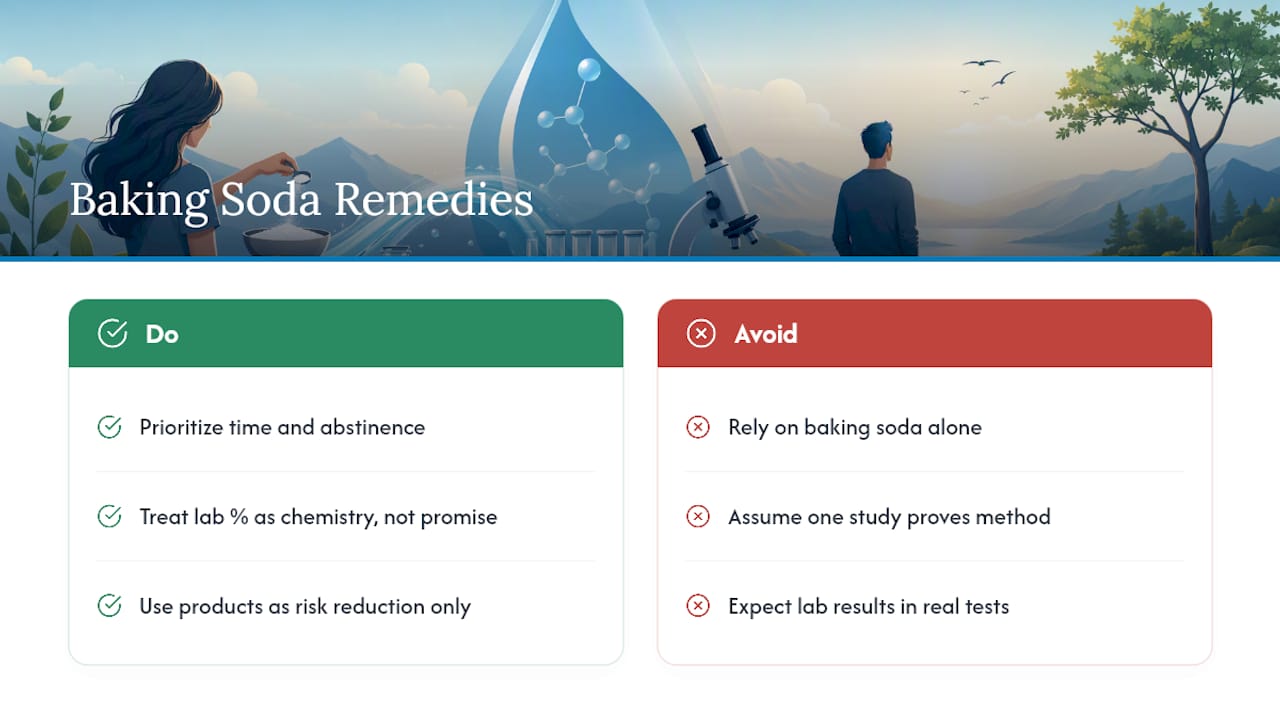
What gets lost is the fine print: those results came from a three-chemical combination applied six times over three days, not a baking soda paste alone, and even that aggressive regimen barely touched methadone and only modestly reduced THC. If you’re being tested for cannabis, the drug most commonly screened for in the US, you’re relying on the weakest result in the entire dataset.
My take: treat lab percentages as a description of chemistry, not a promise about your test outcome. Prioritize time and abstinence first, since it’s the only variable you fully control. If you use a product-based regimen, treat it as risk reduction layered on top of that time, never as a replacement for it.
— MIchael
Sources
- Hair analysis: Assessment of homemade hair treatment effects on drug concentrations in the keratin matrix (Drug Testing and Analysis, 2023)
- Hair analysis: Assessment of homemade hair treatment effects on drug concentrations in the keratin matrix (DOI)
- Mandatory Guidelines for Federal Workplace Drug Testing Programs (Federal Register)
- Forensic toxicology literature on hair decontamination washes (PubMed reference)
Recommended
- How to pass hair drug test
- How to Pass a Drug Test on Hair Follicles? – Pass Hair Drug Test
- Bentonite Clay and Hair Drug Tests: What the Evidence Shows
- Bleach Lowers Lab Numbers but Doesn’t Guarantee a Negative Drug Test
