No products in the cart.
Uncategorized
Topical THC and Hair Drug Tests: What Actually Shows Up
13
Nov
Nov
A THC cream or balm rubbed on a sore knee is a much smaller risk for a hair follicle test than smoking, vaping or eating cannabis. The published research on skin-applied THC found no THC in blood or urine after heavy use. The risks that are better documented are different: cannabis residue that gets onto hair from hands or smoke, and CBD or hemp products that carry trace THC. If a hair test is coming, the practical move is to prepare your hair for the 90-day window the lab will read. That is what our hair-cleansing products are made for.
Table of Contents
TL;DR
- In a 2017 study, volunteers who applied two THC salves to their skin several times a day for 3 days showed no THC or THC metabolites in blood or urine. That study did not test hair.
- Hair labs look mainly for THC-COOH, a metabolite your body makes, and use cutoffs measured in picograms per milligram of hair.
- Trace THC in CBD and hemp products, including topicals, is a documented cause of positive tests in workplace settings.
- A standard hair sample covers about 90 days, so what you used in that window matters more than the form it took.
- Preparing your hair before the collection date is the part you can control.
Table of Contents
- What a hair test actually looks for
- What the research says about THC creams and balms
- Where topical products can still cause trouble
- How labs separate contamination from use
- Why the 90-day window decides everything
- What to do if you have a hair test coming
- Our cleansing routine for hair tests
- Our view on topicals and hair tests
- FAQ
- Sources
What a hair test actually looks for
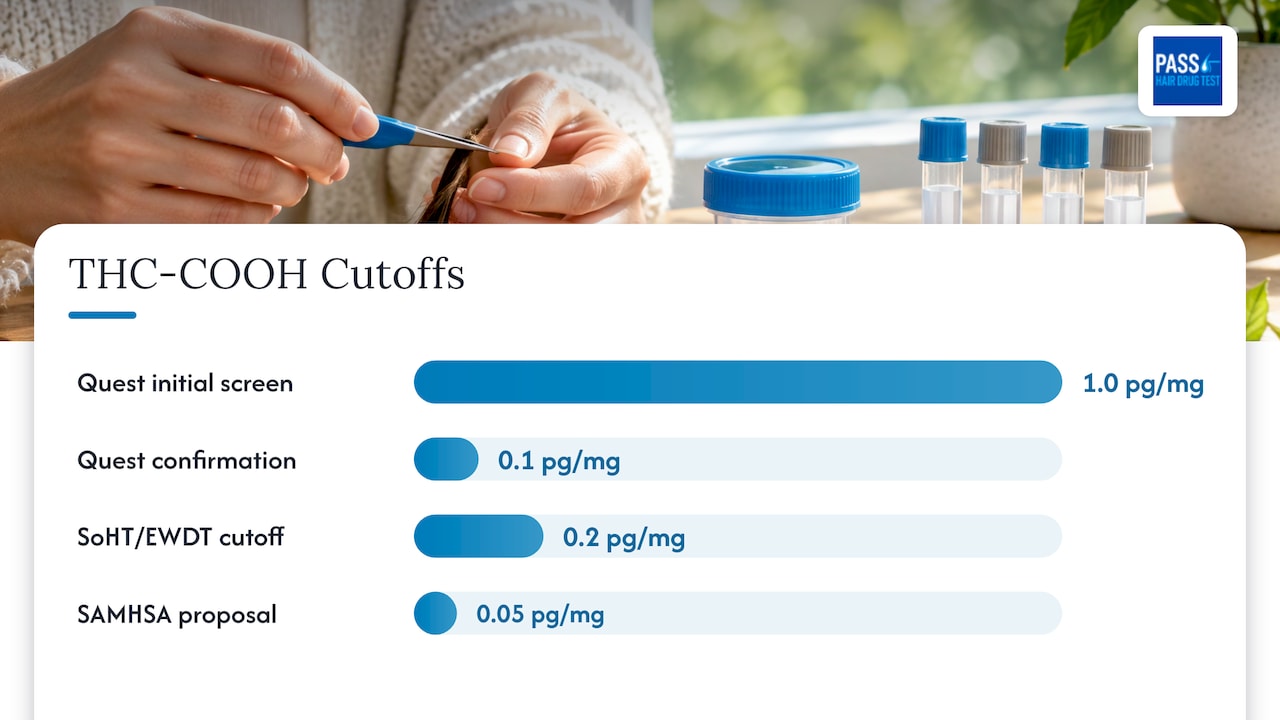
A hair follicle test does not scan for the high. A lab cuts roughly 1.5 inches of hair from close to the scalp, washes it, breaks it down and measures what is inside. For cannabis, the key target is THC-COOH, a metabolite your body produces after it processes THC. Quest Diagnostics reports marijuana-metabolite cutoffs of 1.0 pg/mg for the initial screen and 0.1 pg/mg for confirmation. A picogram is a trillionth of a gram, so these are tiny amounts.
The Society of Hair Testing (SoHT), a professional body for hair-testing laboratories, states in its 2021 consensus that finding THC-COOH strongly supports THC use. That matters for you because a metabolite is made inside the body. It is the finding labs treat as the strongest sign of intake, and it is why the form of the product (smoked, eaten, rubbed on) is less important than whether THC reached your bloodstream or your hair.
Other cutoff numbers exist too. SoHT and the European Workplace Drug Testing Society recommend 0.2 pg/mg of THC-COOH, while U.S. SAMHSA, the federal agency that sets workplace testing standards, proposes 0.05 pg/mg, according to a 2019 Forensic Science International paper. Which cutoff applies to you depends on the lab and your employer’s policy. Our guide to hair test cutoff levels explains how to read the numbers.
What the research says about THC creams and balms
The cleanest study on this question is a 2017 paper in Forensic Science International by Hess, Krämer and Madea, indexed on PubMed. Three volunteers applied two commercial THC salves, containing 1.7 ng and 102 ng of THC per milligram, to 50 to 100 cm² of skin every 2 to 4 hours for 3 days. The researchers collected 10 blood and 10 urine samples from each person. They found no THC, no 11-hydroxy-THC and no THC-COOH in any of them, and concluded that exclusive topical use did not produce cannabinoid findings in blood or urine.
Two points about that result:
- It is a small study. Three people is a pilot, not a guarantee. It supports the idea that skin application alone rarely moves THC into the bloodstream, but it does not cover every product.
- It measured blood and urine, not hair. Hair testing has its own pathways, covered below.
The product type also matters. Ordinary salves and lotions are not designed to cross the skin. Transdermal products, such as patches, are. The U.S. Navy treats the two alike for its own purposes: its hemp-product prohibition covers topical hemp products and products designed to penetrate the skin, because the FDA does not certify the THC concentration of commercially available hemp products. If you are tested under a strict policy, that logic is worth knowing.
Where topical products can still cause trouble
Products that contain more THC than the label suggests
The stronger evidence for a positive result from a topical comes from product content, not from skin absorption itself. A U.S. Coast Guard administrative decision (the Cook case) found that a mariner’s positive urine test, with THCA at 51 ng/mL, very plausibly came from a CBD ointment he applied to his knee. The ointment was labeled as containing 100 mg CBD and 10 mg THC. That is a urine case, not a hair case, but it shows a topical with real THC in it can matter.
SAMHSA’s July 2019 memo on hemp products points the same way. It says the FDA does not certify THC levels in CBD products, that in one study 69% of 84 tested CBD products did not match their label for CBD content, and that some contained unlabeled THC of up to 6.4 mg/mL. U.S. Customs and Border Protection states plainly that CBD use, topically or by ingestion, can cause a positive test because of THC and that it does not treat that as a false positive.
Our article on trace THC in CBD and hair tests goes deeper for workers in tested jobs.
Hemp oil on the scalp
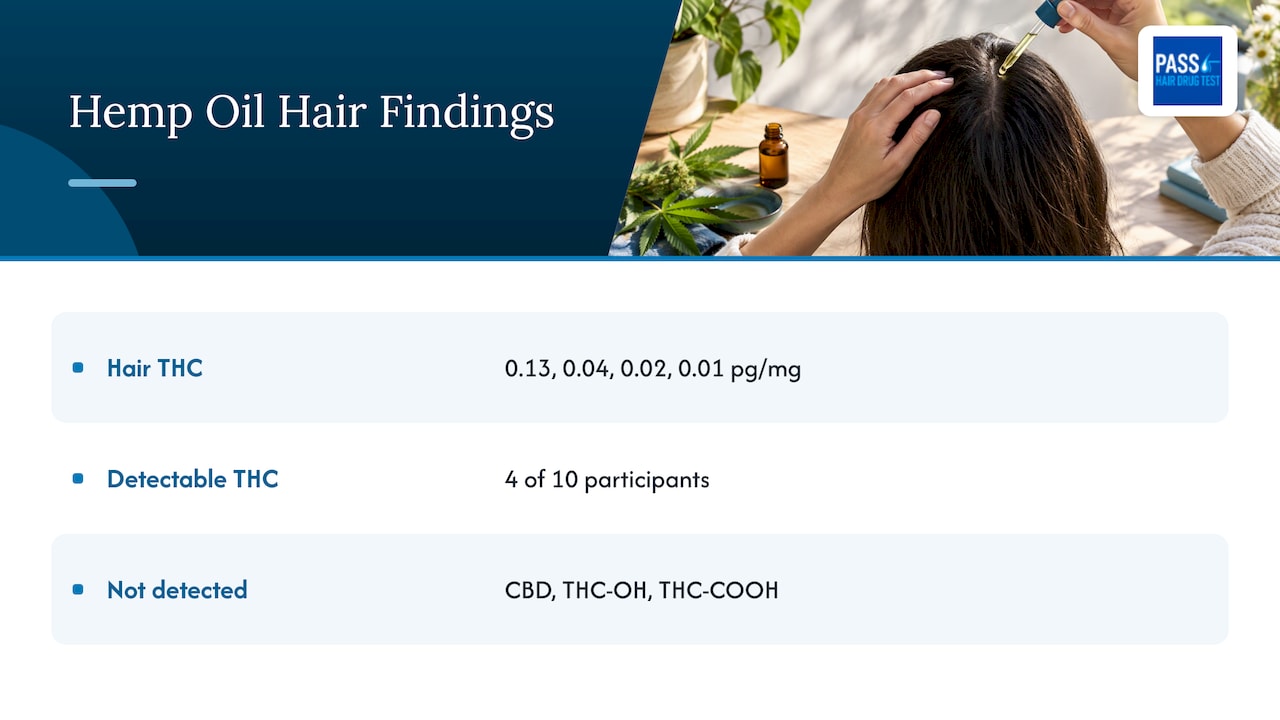
Hair is the one place where a topical lands directly on the material being tested. A 2026 systematic review by Ovat and colleagues, published in PMC, summarizes a UK study in which 10 people applied hemp oil to their heads for six weeks. THC turned up in the hair of four of them, at 0.13, 0.04, 0.02 and 0.01 pg/mg, while CBD, THC-OH and THC-COOH were not detected. The review concludes that regulated CBD and hemp oils are unlikely to produce positives under typical use, but that unregulated products, prolonged use and hair as a matrix carry a measurable risk of borderline or ambiguous results.
If you use a hemp-based hair or scalp product, that is the one to think about before a test.
Residue from hands, sweat and smoke
External contact is a separate route. A 2015 Scientific Reports study by Moosmann, Roth and Auwärter, available from Nature, found that THC, THCA-A and THC-COOH can be present in the hair of people who do not consume cannabis, through transfer from hands, sebum or sweat, or cannabis smoke. The same work found that THC itself is incorporated into hair from the bloodstream at very low rates. In their controlled study, two volunteers took oral THC (2.5 mg three times a day for 30 days) and no THC was detected in any head, beard or body hair sample at a 1 pg/mg detection limit.
For a cannabis user, the lesson is that what sits on and in the hair is shaped by more than what you swallow or inhale. Touching cannabis flower, concentrates or a salve and then your hair or scalp is a plausible way to add residue. Our pages on secondhand smoke and hair tests and concentrates and hair tests cover those routes.
How labs separate contamination from use
Labs know about external contamination, and their procedures account for it. SoHT’s 2021 consensus says that analysis of the wash solutions can help identify external contamination, and that chemical or physical hair treatments such as bleaching, dyeing, perming, straightening and UV exposure can change drug concentrations and should be documented when the sample is collected. The same document says THC-COOH is the finding that most strongly supports actual intake.
What this means in practice:
- A positive that rests on THC alone, without the metabolite, is read more cautiously than one with THC-COOH.
- Your hair history (dye, bleach, straightening) is part of how the sample is interpreted. Our guides on hair dye and bleach and heat styling explain how these treatments relate to results.
- Concentration in hair cannot tell anyone how much you used. SoHT states that the amount in hair cannot be used to work out the quantity consumed.
Why the 90-day window decides everything
The commonly quoted detection window comes from hair growth. Quest states that head hair grows about 1.3 cm (half an inch) a month, that the standard test length is the first 1.5 inches from the root, and that this segment represents roughly 90 days. It also notes a delay of about 5 to 10 days before hair that has taken up a drug reaches the scalp surface where it can be cut. A 2025 review in the Journal of Applied Laboratory Medicine describes the same lag: drugs enter the hair bulb within as little as 30 minutes, but they are not detectable in shafts above the scalp for at least a couple of days, and the process can take up to 10 days.
So a balm you used last week is unlikely to be what a lab sees as a 90-day pattern, but anything on the hair when it is cut is in the sample. That is why the preparation period matters and why a short, quick fix on the morning of the collection is a weaker plan than a routine you start early. Our page on THC in hair lays out the timeline in more detail.
What to do if you have a hair test coming
If you have used a THC topical, a CBD lotion or a hemp scalp product in the last few months, treat it like any other exposure in the window and plan accordingly.
- Find out the test type and the date. Ask the employer or the testing site what is being collected (head hair is standard) and when. Do not guess.
- Stop adding exposure. Put cannabis products, hemp scalp products and CBD products with any THC away from your hair and hands. Wash hands after handling any of them.
- Do not rely on a single wash. Ordinary shampoo is not a plan. A 2022 study by Bertges and colleagues, published in PMC, tested 54 THC-positive hair samples against everyday and specialty products. Zydot shampoo, Seborin hair tonic, Head and Shoulders shampoo, vodka and Desderman disinfectant lowered mean THC concentrations by 52% to 65%, and some samples fell below detectability. The authors noted that hair-care products affect results, which is why preparation is worth taking seriously.
- Follow a defined routine, not improvisation. A multi-step routine used on a schedule is easier to repeat correctly than a set of one-off treatments.
- Leave time for it. Start well before the collection date so that you can complete every step as directed.
Our cleansing routine for hair tests
We sell hair-cleansing products for people facing a hair follicle test, built around Macujo Aloe Rid Shampoo, Zydot Ultra Clean Shampoo and the multi-step Mike’s Macujo Method. We have more than 20 years of experience in the drug-testing and detox-product industry, and our site offers detailed instructions and phone support for customers.
Start with our how-to-pass guide for hair tests, read the Macujo Aloe Rid Shampoo guide, or go straight to the Macujo Aloe Rid and Zydot shampoo set. The full range is on our products page.
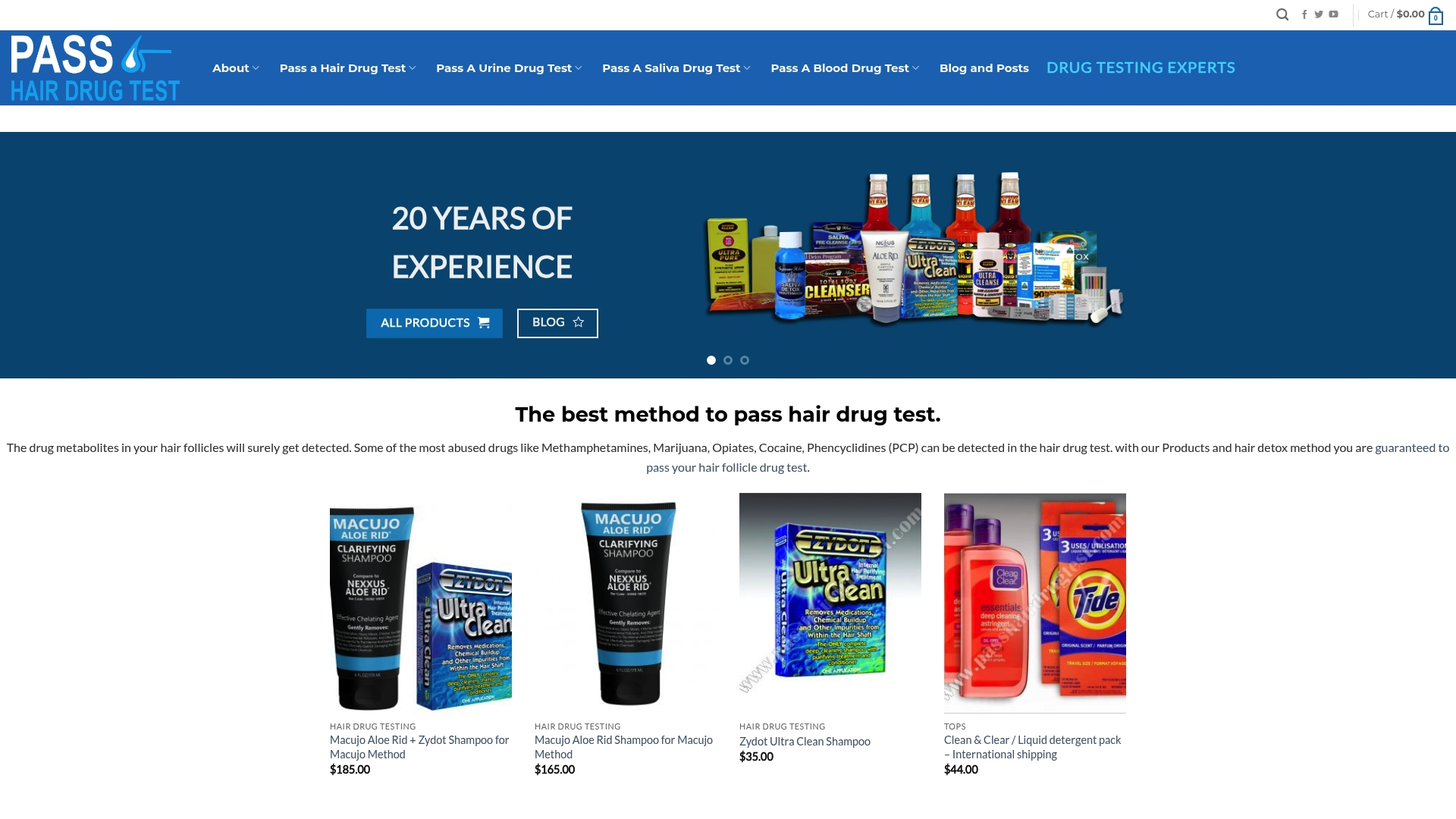
If you are also facing a urine, saliva or blood screen, we carry products for those as well, and you can see them on the same products page.
Our view on topicals and hair tests
Most people who write to us about a THC balm or a CBD lotion are worried about the wrong thing. The research on skin-applied THC is reassuring for blood and urine, and hair is a slower, longer record that picks up what happens over about three months.
That is why we look at the whole window rather than at one product. Cannabis use, residue on the hands, hemp products and even hair-care habits all end up in the same 1.5 inches of hair.
Our approach is to treat preparation as a routine. Mike’s Macujo Method is a multi-step process, and our Macujo Aloe Rid and Zydot shampoos are the core of it. We built our instructions so that a first-timer can follow them, and our team is available by phone if a step is unclear.
If you have a test date, start early, follow the steps in order and keep your hair free of new exposure until the sample is taken.
MIchael
FAQ
Can a THC cream make me fail a hair follicle test?
A plain THC cream used on skin is not well supported as a cause of positive blood or urine results. In the 2017 study, none of the three volunteers had detectable cannabinoids after 3 days of heavy use. Hair was not tested, though, and residue from hands or a high-THC product could still end up on hair, so avoid touching your hair after applying it.
Does CBD lotion show up on a hair test?
CBD itself is not the usual target, but CBD products can carry unlabeled THC. SAMHSA’s 2019 memo reports some products with unlabeled THC of up to 6.4 mg/mL. If you are in a tested job, treat a CBD product as a possible source of THC until you can show otherwise.
How far back does a hair test look?
A standard head-hair test covers about 90 days, based on 1.5 inches of hair and growth of about half an inch per month. There is also a delay of roughly 5 to 10 days before newly affected hair reaches the surface. Body hair windows cannot be reliably determined, according to Quest.
Can regular shampoo clear THC from hair?
Everyday shampoos can lower THC levels in hair, but the effect varies. The 2022 study found reductions of 52% to 65% on average across several products, with some samples dropping below detection. A defined multi-step routine is more consistent than a single wash, and we explain ours in our hair-test guides.
Sources
- Topical application of THC containing products (Hess, Krämer, Madea, 2017)
- U.S. Coast Guard decision, Cook case
- U.S. Navy hemp products prohibition
- Quest Diagnostics hair testing FAQ
- SoHT 2021 consensus on drugs of abuse testing in hair
- 11-OH-THC in hair as marker of active cannabis consumption (2019)
- U.S. Customs and Border Protection: CBD, know the facts
- SAMHSA memo on hemp products, July 24, 2019
- Impact of CBD and hemp oil use on drug test results (Ovat et al.)
- Finding cannabinoids in hair does not prove cannabis consumption (Moosmann et al., 2015)
- Review on Toxicology Testing in Hair (Hubbard, 2025)
- Manipulation of THC Hair Concentrations by Commercially Available Products (Bertges et al., 2022)
Recommended
- THC in Hair: What U.S. Cannabis Users Need to Know
- Concentrates and Hair Drug Tests: What Labs Can Detect
- Microdosing THC and Hair Tests: What Labs Can Detect
- Trace THC in CBD Can Trigger a Positive Hair Drug Test for Workers
