No products in the cart.
Uncategorized
Vitamins and Hair Drug Tests: What Supplements Can and Can’t Do
23
Oct
Oct
Vitamins do not cause a positive hair drug test for THC, and they do not hide one either. Biotin, vitamin B complexes, multivitamins and the “hair, skin and nails” gummies sit on your shelf without any known chemical link to the lab methods used to screen hair for drugs. The things that can change your result are different: how heavily you used, how long ago, your hair color, how your hair has been treated, and, in rare cases, contamination or specific foods.
This guide separates the myths from what is documented, so you can stop worrying about the wrong things and focus on the right ones.
Table of Contents
TL;DR
- Ordinary vitamins, including high-dose biotin, are not known to produce false positives or false negatives on standard hair follicle drug panels.
- Biotin does interfere with some blood immunoassays, which is where the warning comes from. The FDA’s notice on biotin interference concerns blood tests such as troponin, not hair drug screens.
- Vitamins will not flush THC out of your hair. Drug metabolites are locked into the hair shaft as it grows, so supplements cannot remove them.
- What actually moves results: usage frequency, melanin (hair color), cosmetic treatments, and external contamination.
- If you have a test coming, tell the collector about prescriptions, and look at the hair-care side of preparation rather than the vitamin aisle.
Table of Contents
- Why people ask about vitamins in the first place
- What a hair drug test actually measures
- Biotin: the one vitamin with a real testing warning
- Can vitamins help clear THC from hair? No
- What can actually throw off a hair test
- Our perspective: look at the hair, not the vitamin aisle
- If you have a hair test coming: a practical checklist
- Where our hair-cleansing products fit
- FAQ
- Sources
Why people ask about vitamins in the first place
The question usually comes from one of three places.
First, you take a supplement for hair growth and wonder if the lab will see it. Second, you have read that biotin “ruins” lab tests and assume that includes drug tests. Third, you hope a vitamin regimen could help your hair “clear” a drug faster.
All three assumptions get the mechanism wrong. A hair test does not look for nutrients, and it does not measure how clean your body is today. It looks for specific drug molecules, or their breakdown products, that were deposited in the hair as it grew.
What a hair drug test actually measures
A standard collection takes about 100 mg of hair, roughly 90 to 120 strands, cut close to the scalp. The lab typically runs an initial immunoassay screen, then confirms any non-negative result with mass spectrometry. For THC, the screening cutoff is typically 1 pg/mg and the confirmation cutoff 0.1 pg/mg.
The usual sample is the 1.5 inches of hair closest to the scalp, which represents about 90 days of growth. A sample that length gives approximately a 90-day lookback, with a delay of about a week or so between use and detectability, because hair has to grow out of the follicle before it can be cut. That is why someone who used yesterday will usually not show it on this test.
None of that involves vitamins. Mass spectrometry identifies molecules by their mass and structure. A B vitamin has a completely different structure from THC-COOH, the metabolite labs look for to show that cannabis was ingested.
Biotin: the one vitamin with a real testing warning
Biotin (vitamin B7) is the source of most of the confusion, so it deserves a closer look.
The FDA has warned that biotin in supplements can significantly interfere with certain lab tests, including troponin assays used for heart attack diagnosis. The cause is a specific technology: some immunoassays use biotin and streptavidin to capture and detect their target. Extra biotin in a blood sample can distort that reaction.
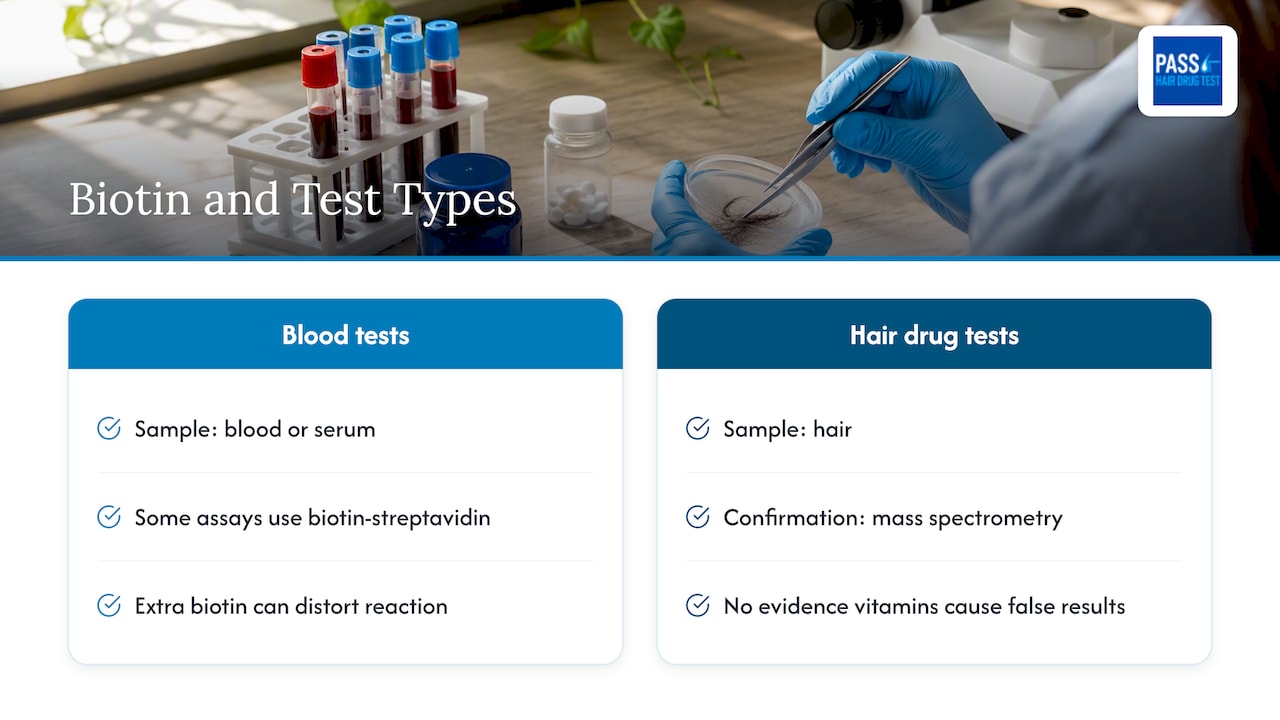
Hair drug testing is a different setup. The sample is hair, not blood or serum, and the confirmation step relies on mass spectrometry, not a biotin-streptavidin reaction. We have found no evidence that biotin or other common vitamins cause false positives or negatives on standard workplace hair panels. If your doctor ever orders blood work, though, tell them you take biotin and ask whether to pause it first. That is a real issue, just not for a hair drug test.
Vitamins people commonly take, and what to expect
| Supplement | Effect on a hair THC test | Notes |
|---|---|---|
| Biotin (B7) | None known | Affects some blood immunoassays, not hair drug screening |
| B-complex, multivitamin | None known | Not structurally related to THC metabolites |
| Vitamin C | None known | Does not remove drugs already in the hair shaft |
| Vitamin D, zinc, iron | None known | Sometimes taken for hair shedding |
| Collagen, “hair gummies” | None known | Check labels for anything beyond vitamins |
The last row matters. Some beauty products and herbal blends include extra ingredients. If you take anything unusual, read the full label and keep the bottle handy in case you are asked about it.
Can vitamins help clear THC from hair? No
This is the claim worth being blunt about. THC metabolites bind into the hair as it forms. Eating or swallowing anything does not reach back into hair that has already grown and pull them out. Vitamins support healthy growth of new hair, which is exactly what you will not be sending to the lab: the test looks at the oldest 1.5 inches, not the new growth at the root that has not yet been captured.
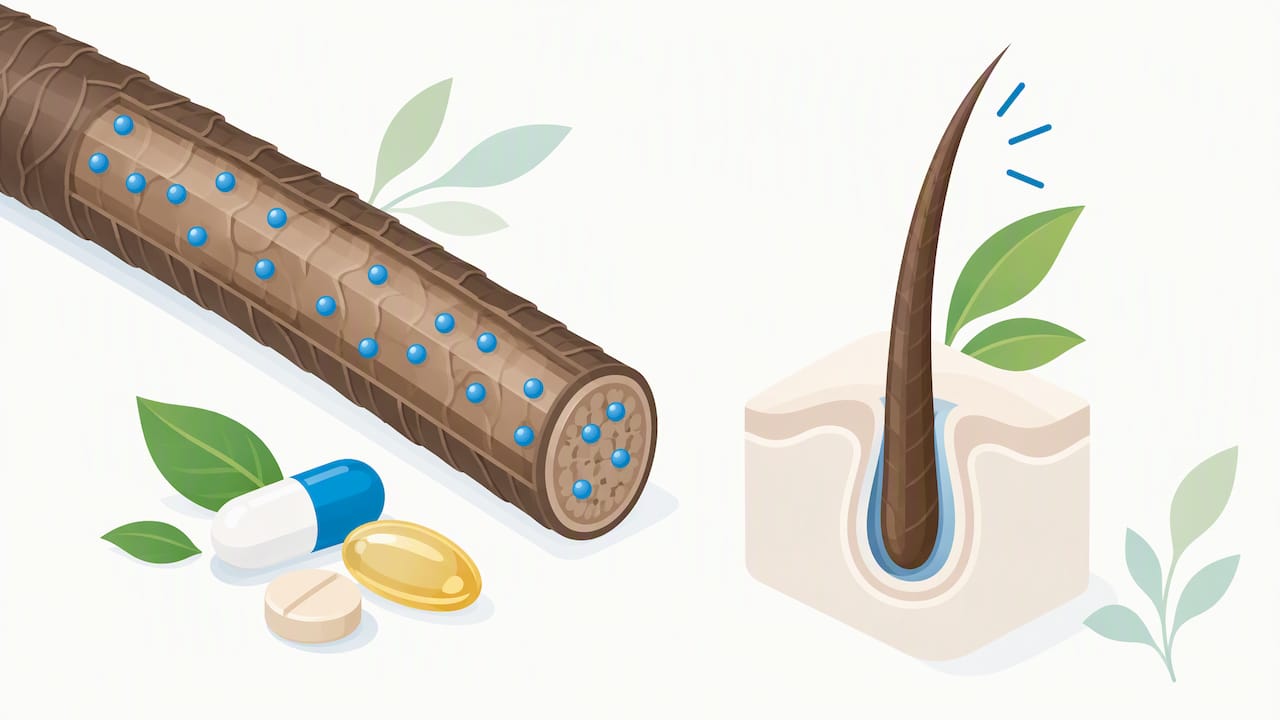
The only things documented to change concentrations in hair already grown are things applied to the hair itself. A peer-reviewed study of commercially available products examined how products can alter THC levels in hair, and found that routine treatments such as bleaching, dyeing and even ordinary shampoo can reduce drug concentrations in hair, with reductions in the range of 30% to 65% reported. That is a topical effect on the shaft, not something a pill does.
What can actually throw off a hair test
How much and how often you use
The low confirmation cutoff makes hair testing very sensitive to repeated use, but it is not good at catching occasional use. Sources on detection windows note that light or weekend users often fall short of the threshold, while daily users are far more likely to be detected. Your pattern matters far more than any supplement.
Hair color and melanin
Darker hair has more melanin, and melanin binds drugs such as THC metabolites more strongly. Two people with identical use can get different results based on hair color. It is a known fairness problem with hair testing, and it is one reason results are not as clean as they sound.
Bleach, dye and other cosmetic treatments
Chemical treatments degrade drug molecules inside the shaft. Labs often cannot tell a deliberately treated sample from one that was just cosmetically maintained, as the same research notes. If you want the details, our page on how bleach and dye change hair drug test results walks through the reported reductions.
External contamination
Smoke can deposit THC on the surface of hair. Labs wash samples and look for metabolites like THC-COOH, which show the drug was processed by the body. A peer-reviewed review of contamination notes that washing can reduce but not always completely remove external contamination. Forensic toxicology literature on manipulation testing describes casual presence in a room with cannabis as unlikely to trigger a positive, while heavy direct smoke exposure can leave detectable levels on the surface.
Foods and medications for other drug classes
If your panel covers opiates, food matters more than vitamins do. Poppy seed consumption may cause opiate positives in urine and hair tests, according to a laboratory supplier’s summary of the studies. Prescription medications can also matter. Tell the collection site and the medical review officer, if there is one, about anything you take under a doctor’s care.
Our perspective: look at the hair, not the vitamin aisle
We have worked in the drug-testing and detox-product space for more than 20 years, and the vitamin question is one we hear regularly. The honest answer is the least exciting one: your vitamins are not the problem, and they are not the solution.
People who come to us fall into two groups. Some are worried a supplement will hurt them, and we can tell them to relax about that. Others hope a supplement will help, and that is where we think people waste time and money in the weeks they have left.
What we tell customers is to think about the hair itself. The test reads a 1.5-inch segment, and what is in that segment is already fixed. Preparation, if you choose to do it, is about what you do to the hair shaft. That is why our products are hair-cleansing shampoos and a multi-step method rather than anything you swallow. We also tell people plainly that no hair test is an absolute, and no shampoo can promise the same result for every head of hair. Hair color, use history and how your hair has been treated all change the picture.
Two practical habits help. Keep a list of every supplement and medication you take, so you can answer questions at collection without guessing. And if the test is for a job, ask the employer which specimen types and panel they use. Many people assume hair is the only test, when some employers use urine, saliva or hair.
— MIchael
If you have a hair test coming: a practical checklist
- Find out the test type. Ask HR or the collection site whether it is hair, urine or oral fluid. Hair follicle testing is not part of federal SAMHSA or DOT workplace programs, but private employers use it. Each specimen type has different detection windows, and our comparison of a hair drug test versus urine explains them.
- Do the math on timing. Hair covers roughly 90 days, and recent use will not show yet because of the growth lag. Our guide to THC in hair explains what that means for users in the U.S.
- Keep taking vitamins that your doctor recommended. Stopping a supplement will not change a hair drug result. Do not change medication without talking to your prescriber.
- Do not add random products to your hair. Harsh treatments can damage hair and, if your hair is later judged to be treated, it may prompt questions or a request for a different specimen.
- Be ready for a retest or a second specimen. Researchers recommend corroborating hair results with urine or oral fluid before significant action is taken, and a disputed result is a reasonable thing to raise.
- Know your rights as an applicant or employee. Rules differ by state and employer. If you believe a result is wrong, ask for the lab’s confirmation method and the appeal process in writing, and speak with an employment attorney if the stakes are high.
For a broader view of how reliable these tests are, see our page on hair drug test accuracy.
Where our hair-cleansing products fit
If your concern is the hair itself, that is the part we sell. Our range centers on Macujo Aloe Rid Shampoo, Zydot Ultra Clean Shampoo and the multi-step Mike’s Macujo Method, and we pair them with instructions and phone support. You can browse the hair shampoo kits or the full products catalog, which also includes urine, saliva and blood testing items if your employer uses a different specimen. If you want to read first, start with our hair follicle drug test guide.
FAQ
Can vitamins affect a drug test?
For standard hair, urine and oral fluid drug panels, ordinary vitamins are not known to cause positives or negatives. The documented biotin problem involves certain blood immunoassays, not drug screening. If a medication or an unusual herbal supplement is involved, tell the collector.
Does biotin cause a false positive on a hair follicle test?
No evidence suggests it does. Biotin interferes with tests built on biotin-streptavidin chemistry, which the FDA has flagged for troponin and similar assays. Hair drug screens use immunoassay screening and mass spectrometry confirmation, which do not rely on that pathway.
What can cause a false positive hair drug test?
The main documented causes are external contamination, such as heavy direct exposure to cannabis smoke, and, for opiates, poppy seed consumption. Labs wash samples and look for metabolites to reduce this risk, but the process is not perfect. A confirmed result you dispute can be checked against another specimen type.
Can I take vitamins before a hair drug test?
Yes. Continue any supplement or medication your doctor recommends, and list them if asked. Stopping vitamins will not change what is already in the 1.5 inches of hair the lab will analyze.
Do vitamins help my hair “detox”?
No. Supplements support new growth, but the sample is the older hair nearest the scalp, and drug metabolites inside it are not removed by anything you swallow. Changes to results come from what is applied to the hair shaft, such as dye, bleach or washing.
Sources
- FDA: Biotin interference with troponin lab tests
- Weed Hair Follicle Test: 90-Day Detection Window
- Hair drug testing: 90-day lookback and limits
- THC Detection Windows: Occasional vs Daily User
- Manipulation of THC Hair Concentrations by Commercially Available Products (PMC)
- Advances in testing for sample manipulation: hair samples (PMC)
- Urine and Hair Analysis for Opiates after Poppy Seed Consumption
Recommended
- Vaseline Won’t Mask a Hair Drug Test: Labs Wash Samples
- Do Detox Shampoos Work for Hair Follicle Tests?
- How to Prepare for a Hair Test the Right Way
- Body Hair vs Head Hair: What Drug Test Labs Really Use
