Uncategorized
Concentrates and Hair Drug Tests: What Labs Can Detect
Oct
Yes, cannabis concentrates can show up on a hair drug test. Dabs, wax, shatter, rosin, live resin and vape cartridges all deliver THC, and the lab looks for THC’s metabolites in your hair, not for the product you used. The form of cannabis matters less than how often you used it, how much, and how long ago. Below we cover what the lab actually measures, why heavy concentrate use can matter, what changes a result, and what to do if a test is scheduled.
Table of Contents
TL;DR
- A hair test does not care whether THC came from flower, edibles or concentrates. It looks for cannabinoids and metabolites in a hair sample covering roughly the last 90 days.
- Concentrates are far more potent than flower, so frequent dabbing can mean a larger dose per session. We found no study that ranks concentrates against flower in hair results, so treat that as a reasonable concern, not a measured fact.
- Hair is cut close to the scalp under supervision, about 100 to 120 strands from the crown, and the first 1.5 inches of length is analyzed.
- Bleaching, age, hair color and external exposure can all shift results, which is why no one can honestly predict a result from your habits alone.
- If a test is coming, start with the facts about your own hair length and use history, then decide on a plan.
Table of Contents
- What a hair test looks for, whatever form of cannabis you use
- How THC gets into hair
- Can vapor and dab smoke contaminate hair?
- What the collector actually takes
- What changes a result besides your use
- What a lab says about trying to beat the test
- Our perspective
- A realistic plan if a test is coming
- Shop our hair-cleansing range
- Other substances and the same 90-day logic
- FAQ
- Sources
What a hair test looks for, whatever form of cannabis you use
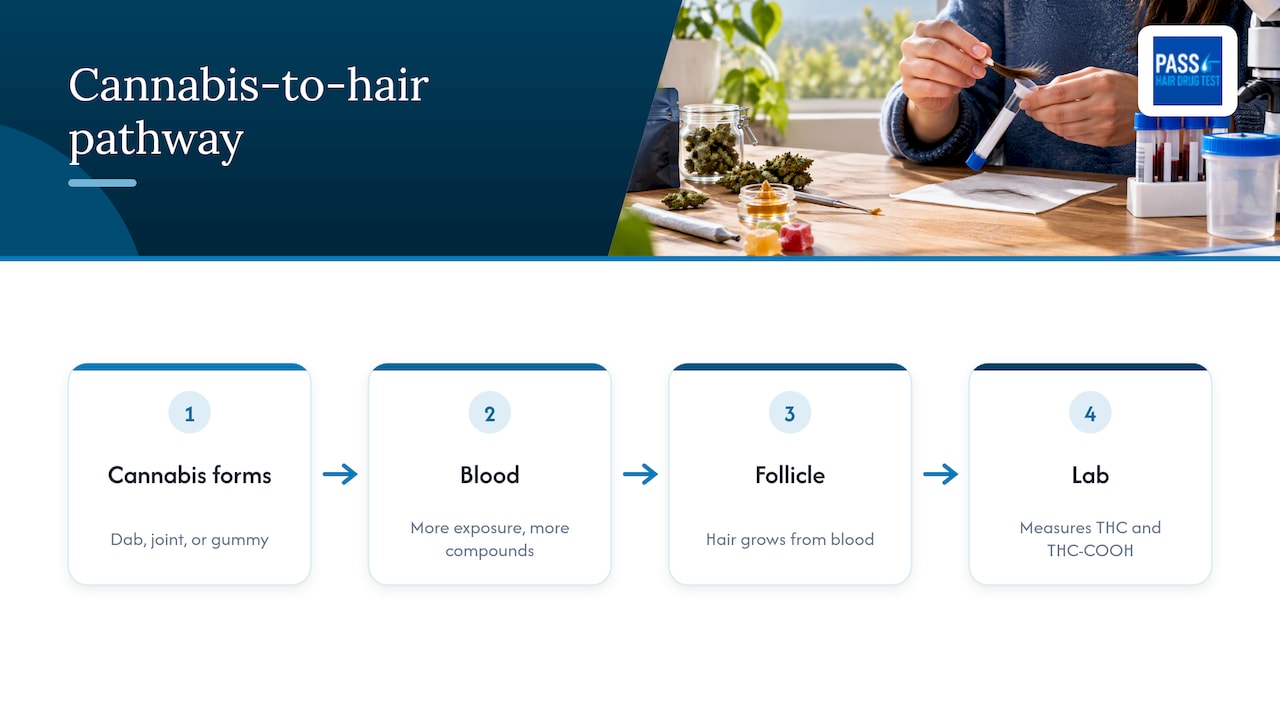
A hair drug test is not a search for a product. The lab extracts compounds from your hair and measures them. For cannabis, the targets are THC and its metabolite, THC-COOH, which the body forms only after THC has been processed. The 2023 paper on THC and THC-COOH hair concentrations describes hair analysis as the most widely adopted approach for investigating repeated or chronic exposure.
That is why a dab, a joint and a gummy are the same thing to the instrument. What differs is the dose and the pattern. Concentrates commonly run much stronger than flower, so a person who dabs daily may be taking in considerably more THC than someone who smokes a joint on weekends. More exposure generally means more compound reaching the blood, and hair grows from blood-fed follicles. Still, the published research we reviewed does not isolate concentrates as a category, so we will not hand you a number for them.
For the broader picture, see our guide to THC in hair for U.S. cannabis users.
How THC gets into hair
Cannabinoids travel through the bloodstream to the hair follicle, and the growing hair shaft takes up some of what is circulating. Quest Diagnostics notes that hair testing is designed to detect a pattern of repetitive use over about 90 days, and that metabolites take roughly 5 to 10 days to reach the hair shaft after ingestion.
Two practical consequences follow:
- A single dab last week is unlikely to be the issue. The federal mandatory guidelines notice explains that hair is not appropriate for detecting very recent use, because analytes do not appear in hair for 5 to 7 days after use.
- Repeated use across weeks is what the test is built to find. If you dab several times a week for months, that pattern is the target.
An important caveat from toxicology research: a study in Scientific Reports, Finding cannabinoids in hair does not prove cannabis consumption, reported that THC-COOH was also found in older hair segments that grew before the oral dose in the experiment, and in sebum and sweat samples. The authors argue that cannabinoids can also reach hair through contact with sweat, sebum or smoke. Hair biology is messier than the simple blood-to-hair story suggests.
Can vapor and dab smoke contaminate hair?
This matters for concentrate users because dabbing and vaping produce aerosol. An in vitro study on external hair contamination from cannabis and light cannabis delivered by smoking and vaping examined whether hair exposed to smoke and side-stream vapor takes up cannabinoids. Its premise is that external contamination requires careful evaluation in forensic toxicology, particularly as e-cigarettes become common.
A separate 2019 study of hemp oil applied to hair found that daily cosmetic application for six weeks led to cannabinoid incorporation in 89% of the 10 volunteers. That is about a product on the hair, not vapor, but it shows external exposure can leave a signal.
What this means for you:
- Labs know about external contamination, and their procedures are built around it. We would not count on it as an explanation for a positive result.
- If you live with a heavy dabber or vape in closed spaces, it is worth knowing the issue exists, and worth telling a medical review officer if a result comes back positive and you did not use.
- Hair products containing hemp or CBD can add cannabinoids. Read our note on trace THC in CBD and hair tests if you use them.
What the collector actually takes
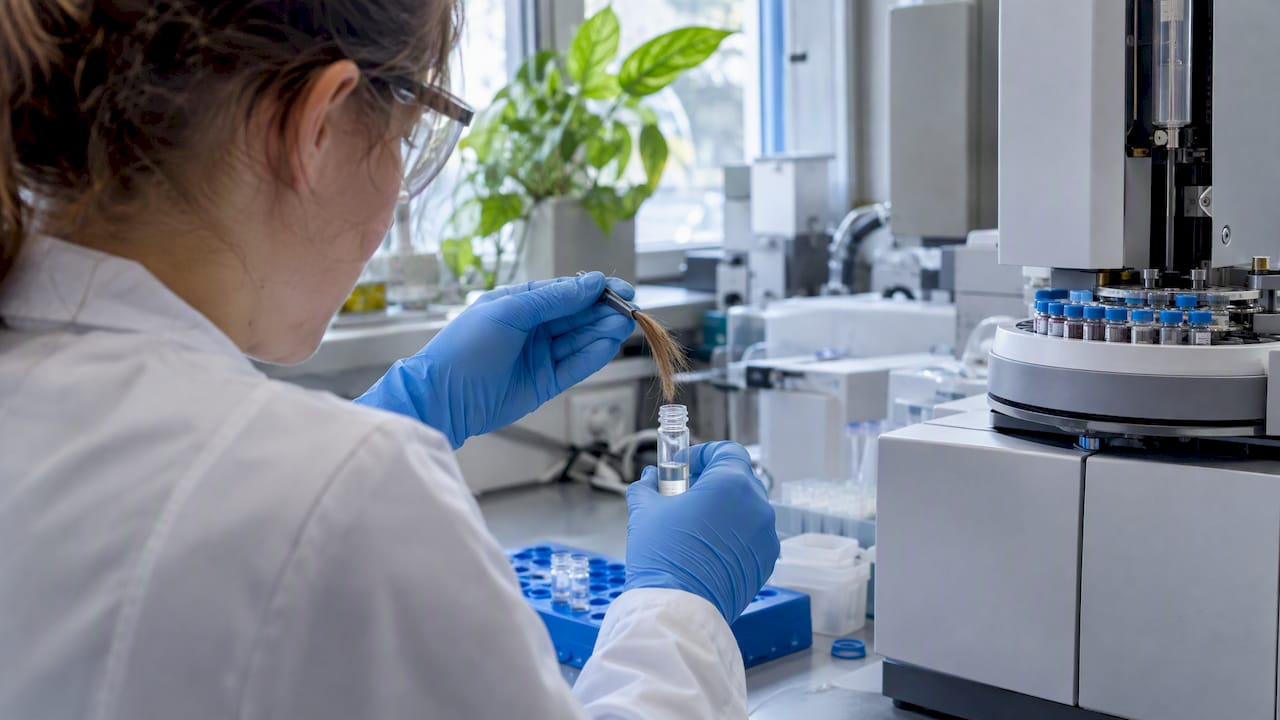
The name “hair follicle test” is a bit misleading. Nobody plucks follicles. According to Quest’s collection guidance, the collector cuts approximately 100 to 120 strands from the crown under direct supervision. The sample is about 100 mg, and the 1.5 inches closest to the scalp represent roughly 90 days, based on average growth of about half an inch a month, per the Quest hair testing FAQ.
Three details people overlook:
- The sample cannot come from a brush. It is cut from your head while the collector watches.
- No head hair means body hair. The same FAQ says collectors move to chest, underarm, leg or facial hair in that order, and cannot mix body hair with head hair in one sample.
- Length matters. Longer hair does not mean a longer window, because only the section nearest the scalp is analyzed. We break this down in what labs actually measure on long hair.
What changes a result besides your use
Two people with identical dabbing habits can get different results. The 2023 THC and THC-COOH hair study looked at several factors:
| Factor | What the research found |
|---|---|
| Age | Cannabinoid levels tended to be lower in subjects older than 40 |
| Hair color | Melanin content, which varies with natural color, plays a role in how drugs bind to hair |
| Cosmetic treatment | Bleaching produced a statistically significant drop in THC and THC-COOH |
| Consumption habits | Frequency and amount were evaluated alongside the other factors |
Older research agrees on direction. A 1997 study on cosmetic treatment of hair found that strongly alkaline treatments damage hair and change drug concentrations, and a 2019 paper on bleaching, perming and permanent coloring looked at the same question for cannabinoids. In older datasets, differences between treated and untreated hair often fell in the 40% to 60% range for some substances, including THC-COOH.
Two cautions. Damaging your hair is not a plan, and labs are aware of it. The same research shows treatment effects are variable, so nobody can promise what bleaching would do to your sample.
What a lab says about trying to beat the test
In fairness to you, here is the other side. Quest says in its FAQ that it has not found any chemical adulterants that successfully beat a hair drug test, and points out that observed collection leaves little room for tampering. That is the position of a testing lab, and you should know it before you spend money on anything.
Our experience is different in emphasis. We have sold hair-cleansing products for more than 20 years, and people research them because they are facing a test and want to reduce what is on and in the hair shaft. Cleansing products are aimed at the hair surface and the hair itself. Whether they change the result for you depends on your use history, your hair and your lab, and no honest seller can see those from here.
Our perspective
We talk to people every week who use concentrates and have a hair test on the calendar. Here is what we tell them.
First, be honest about your pattern. Daily dabbing over three months is a very different situation from a few sessions at a party. The first is what a hair test is built to catch. The second may not register at all.
Second, count your calendar. The lab sees 90 days in 1.5 inches. Hair that has grown since your last use is clean hair. If you stopped weeks ago and your hair grows at the average rate, the newest growth near the scalp helps you, but the older segment is still in the sample. A buzz cut does not erase this, because collectors can take body hair instead.
Third, do not rely on folk fixes. Salt, baking soda, vinegar and similar kitchen tricks float around forums. They can dry and damage hair, and we would rather you not experiment on the one head of hair you have.
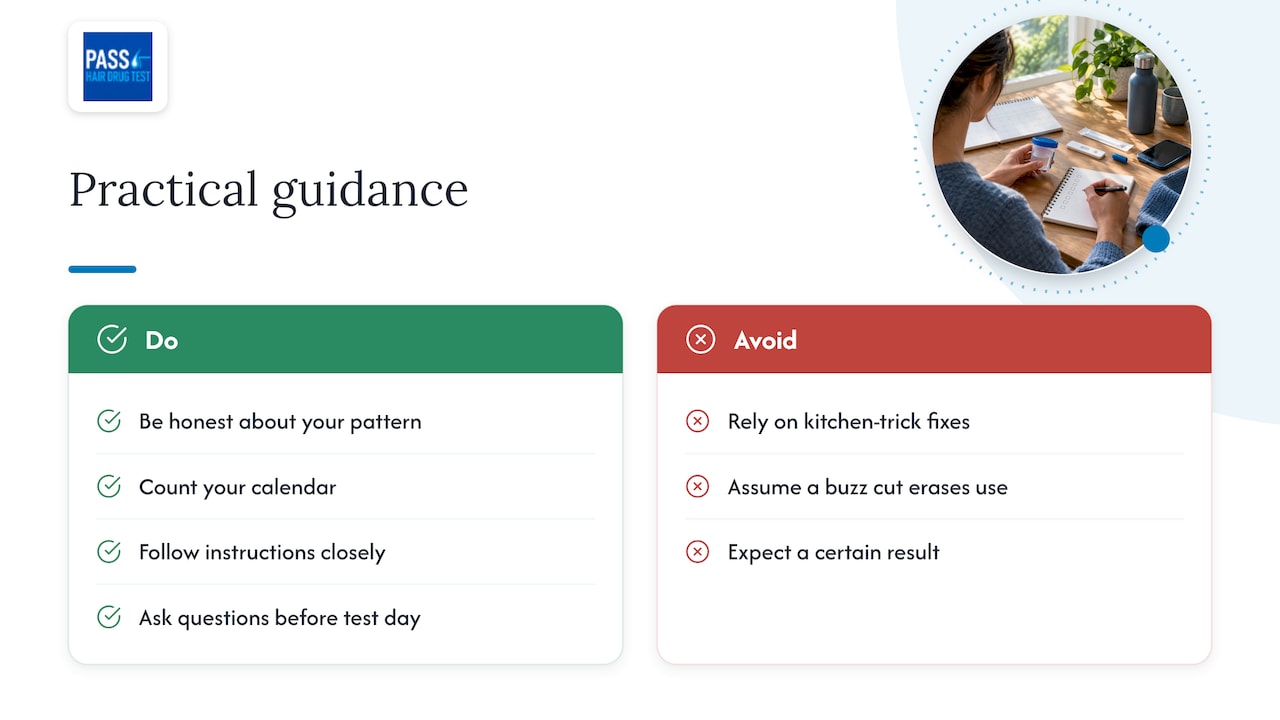
Fourth, use a structured approach if you decide to. Our hair-cleansing range is built around Macujo Aloe Rid Shampoo, Zydot Ultra Clean Shampoo and the multi-step Mike’s Macujo Method. We built our guidance around following the instructions closely, because skipped steps are the most common reason people tell us a routine did not go as hoped. We also offer phone support so you can ask questions before test day.
We will not tell you a result is certain. Hair, history and lab all vary, and anyone claiming otherwise is selling, not helping.
— MIchael
A realistic plan if a test is coming
- Find out the test type and date. Ask the employer or the collection site whether it is hair, urine or oral fluid. Hair tests are common in some pre-employment settings, and they are a different animal from urine tests. Our comparison of hair versus urine testing shows what each detects and when.
- Check your hair situation. Length at the crown, any bleaching or coloring, and whether you have body hair as a fallback.
- Stop use now. New use becomes new hair content within 5 to 10 days, so every additional session extends the signal.
- Avoid products with hemp or cannabinoid ingredients on your hair and scalp.
- Decide on a cleansing routine early. Multi-step routines take time. Starting a week out leaves little room for mistakes.
- Keep your paperwork. If a result is positive, ask about the review process and bring information on any prescribed medication or exposure.
If you want the full breakdown of how hair tests work, read our hair drug test information page and our hair follicle drug test guide.
Shop our hair-cleansing range
If you have decided to prepare, you can see the shampoos, the multi-step kit and our other drug testing products on our products page, and read how our routine works on the hair drug test shampoo page. Prices and availability are listed at checkout, and our support line is there if you are unsure which option fits your hair and your timeline.
Other substances and the same 90-day logic
The window and lag apply to other drugs too, which is useful if you are trying to understand a panel. We have separate guides on the opioid detection window and the 5 to 10 day lag, fentanyl sensitivity in hair and Adderall in hair. The general rule holds across all of them: hair reflects a pattern over months, not a single recent event.
FAQ
Do dabs and wax show up on a hair drug test?
They can. The lab measures THC and THC-COOH in your hair, not the form you used. Frequent concentrate use delivers a lot of THC, so heavy, regular use over the past 90 days is the scenario a hair test is designed to detect.
Is vaping a cannabis cartridge safer than smoking for a hair test?
Not in any way we could support. Vaping still delivers THC into your blood, and hair incorporates what circulates. Side-stream vapor can also reach hair from outside, according to research on external contamination from smoking and vaping.
How long after my last dab can a hair test detect it?
Metabolites need about 5 to 10 days to reach the hair shaft, per Quest. Once present, it stays in that section of hair, and a standard 1.5-inch sample represents about 90 days of history.
Does bleaching or dyeing hair change a hair test result?
Research shows bleaching can significantly reduce THC and THC-COOH concentrations, as in the 2023 observational study. The effect varies with treatment intensity and the individual, and it is not a reliable way to control an outcome.
Can body hair be tested instead of head hair?
Yes. If you have no head hair, collectors take body hair in a set order of preference, and the two types are not combined in one sample.
Sources
- Quest Diagnostics, Hair Testing FAQ (2021)
- Quest Diagnostics, Hair Specimen Collections
- Federal Register, Mandatory Guidelines for Federal Workplace Drug Testing Programs (2020)
- THC and THC-COOH hair concentrations: influence of age, gender, consumption habits, cosmetics treatment, and hair features (2023)
- Influence of the cosmetic treatment of hair on drug testing
- Influence of cosmetic hair treatments on cannabinoids in hair: bleaching, perming and permanent coloring
- Detection of cannabinoids in hair after cosmetic application of hemp oil, Scientific Reports (2019)
- Finding cannabinoids in hair does not prove cannabis consumption, Scientific Reports
- External hair contamination from cannabis and light cannabis delivered by smoking and vaping: an in vitro study (2023)
Recommended
- Body Hair vs Head Hair: What Drug Test Labs Really Use
- Hair Drug Test vs Urine: Which Detects Use When
- How Labs Use Phase II Metabolites to Confirm Drug Use in Hair
- Which Labs U.S. Employers Use for Hair Follicle Drug Tests
