Uncategorized
Long Hair Drug Test: What Labs Actually Measure
Aug
No — having long hair does not extend the lab’s standard detection window. When you walk into a collection site, the technician cuts a proximal segment from the root end of your hair, typically the first 1.5 inches (3.9 cm) closest to your scalp. That segment represents approximately 90 days of history, regardless of whether your hair hangs to your shoulders or your waist. The extra length beyond that 1.5-inch mark is simply not analyzed in a standard workplace screen.
Two numbers matter most going in:
- 1.5 inches (3.9 cm): the proximal segment labs use to establish the standard ~90-day window
- Sample mass: Most labs require about 100 mg of hair for a standard screen, though some higher-panel tests may request up to 150 mg.
If your head hair is too short, collectors move to body hair, which introduces a less predictable window. That substitution matters more than your total hair length ever will.
Table of Contents
Table of Contents
- How a long hair drug test actually works
- Does total hair length change the detection window?
- Specimen collection: how much hair labs want and where they cut it
- Body hair versus head hair: how substitutions change things
- What can alter a hair test result?
- Timelines and hair growth: what “1.5 inches = 90 days” really means
- If you have long hair: what to expect at collection
- Common detox methods and what the evidence actually shows
- If you have very short hair or no head hair: what labs do next
- Key Takeaways
- The myth that keeps tripping people up
- Preparing for your test: hair-cleansing options worth knowing
How a long hair drug test actually works
Understanding the biology makes the rest of this article click. When you use a substance, it enters your bloodstream. Each hair follicle has a blood supply feeding its growth cells, so drug metabolites bind into the hair shaft as it forms. That hair then grows upward at roughly 1.3 cm (about half an inch) per month.
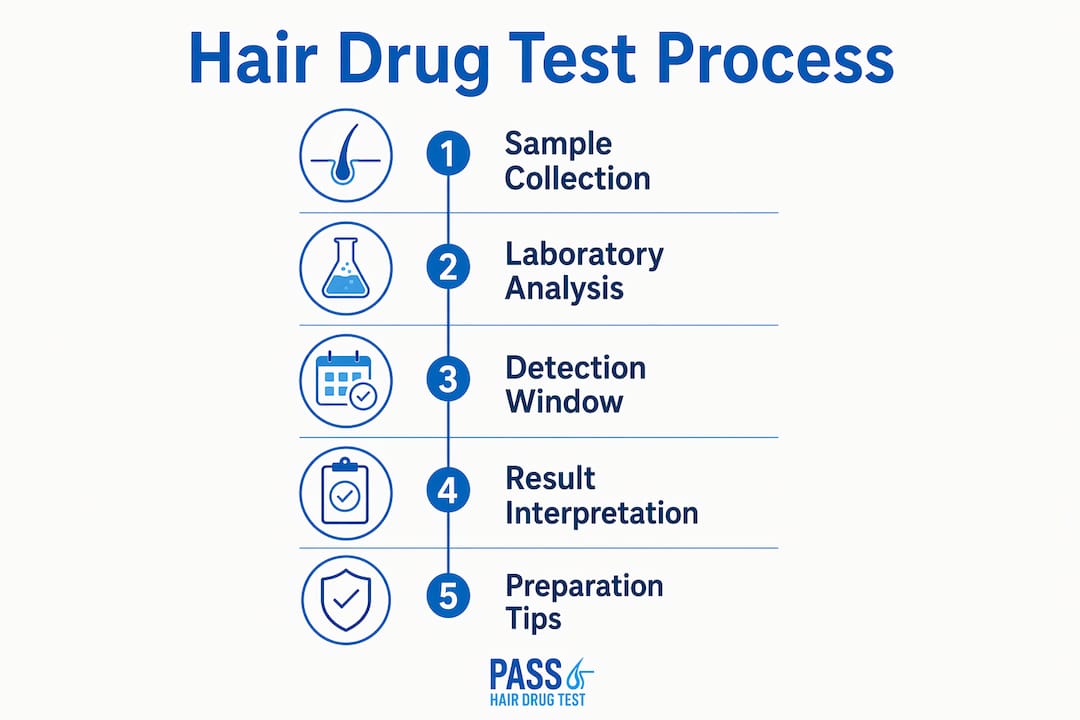
Here is the basic sequence labs rely on:
- Ingestion: the substance enters the bloodstream
- Incorporation: metabolites bind into the hair matrix at the follicle
- Emergence: the drug-containing hair grows above the scalp surface, typically after 5–10 days
- Collection: a trained collector cuts the proximal segment at the crown/vertex of the head, as close to the scalp as possible
- Lab analysis: the proximal 1.5 inches are isolated, washed, and tested; the rest is stored
Because the 5–10 day lag before drug-containing hair clears the scalp, hair tests cannot detect use from the past week or so. That is a feature, not a flaw — the test is designed to reveal patterns over months, not last weekend.
Pro Tip: Hair testing is a lifestyle screen. If an employer or court needs to know about use in the last 24–72 hours, urine or oral fluid is the right tool. Hair is built for the 90-day picture.
Does total hair length change the detection window?
No, and a Psychemedics whitepaper on hair-testing myths addresses this directly: standardization of the test segment, not total hair length, controls the reported window. Labs read only what they cut, and standard workplace screens cut only the proximal 1.5 inches.
A few practical points that clarify why:
- Distal hair is not reported by default. The extra inches beyond the root segment are stored by the lab but not included in the standard result.
- Segmental analysis exists but is not routine. A lab can test longer segments if a client specifically requests it (for example, to map a six-month history), but that is a separate, non-standard order.
- Chain of custody drives standardization. Using a fixed proximal length means the same sample can be retested for confirmation without ambiguity about which portion was analyzed.
- Long hair changes collection logistics, not science. With longer hair, the collector has more material to work with, but the cut still happens at the root end.
Pro Tip: If you have very long hair and worry about what the lab keeps, ask the collector to document what was retained. Labs store distal hair separately, and that material is only tested if a follow-up order is placed.
Specimen collection: how much hair labs want and where they cut it
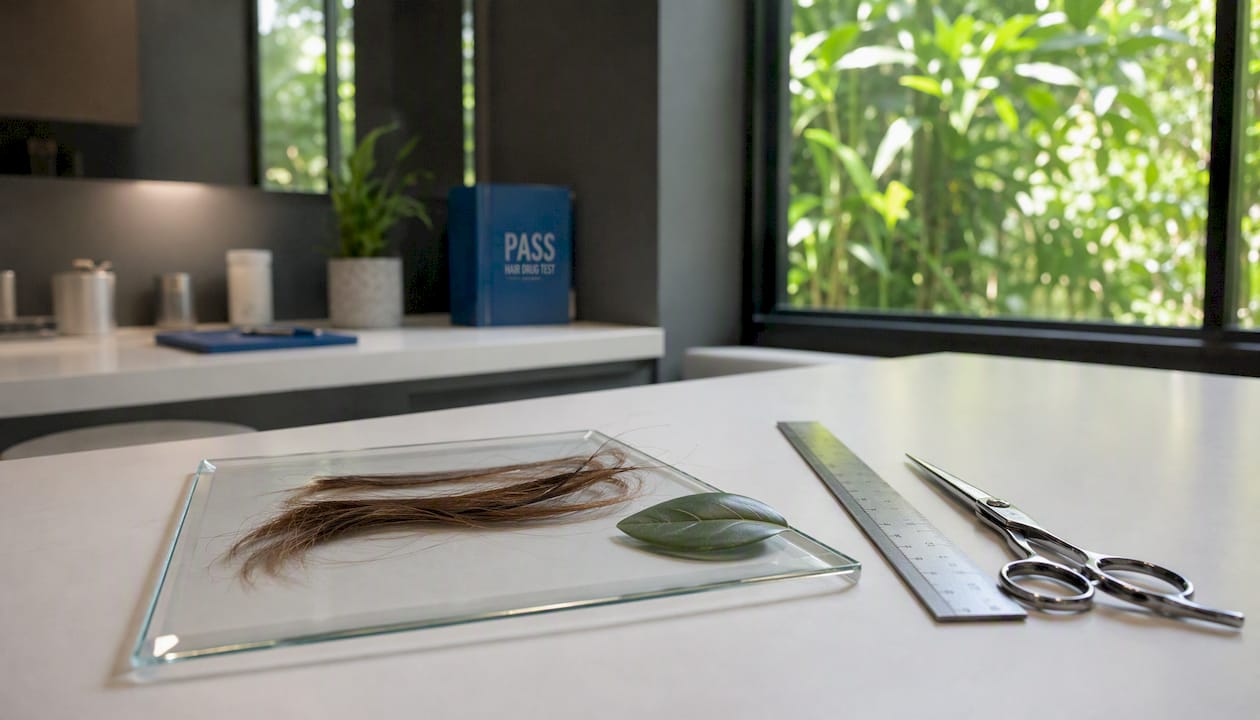
Most labs request approximately 100 mg of hair composed of the first 1–1.5 inches from the root end. Higher-panel tests may ask for up to 150 mg. Since collectors rarely carry a scale to the collection site, they use visual proxies instead.
| Measurement | Standard value | Notes |
|---|---|---|
| Sample length | 1–1.5 inches (3.9 cm) | Proximal segment from root end |
| Sample mass | 100 mg | Up to 150 mg for expanded panels |
| Bundle width (straight hair) | Circumference of a pencil | Visual proxy at collection |
| Bundle size (curly hair) | Small cotton-ball size | Accounts for lower density per strand |
| Preferred collection site | Crown/vertex of the head | Most consistent growth rate |
A few things collectors are trained to do:
- Cut as close to the scalp as possible to maximize root-proximal material
- Align root ends before packaging so the lab can orient the segment correctly
- Document the collection site, especially if body hair is used
- Reject hair from brushes, floors, or other non-donor sources — hair must come directly from the donor under supervised collection
Root alignment is not a formality. If the root ends are scrambled, the lab cannot reliably assign which part of the segment corresponds to which time period.
Body hair versus head hair: how substitutions change things
When head hair is shorter than about half an inch, collectors move to body hair. The substitution protocol follows a rough priority order:
- Chest hair — most commonly used first substitute
- Underarm hair — second choice
- Leg hair — third
- Facial hair — used when other sources are insufficient
Body hair grows in longer resting (telogen) phases than head hair, which means the growth rate is slower and less consistent across individuals. A body-hair sample that looks like 1.5 inches of head hair may actually represent a much longer period, sometimes well beyond 90 days, though the exact window is harder to pin down. Collectors document the source on the chain-of-custody form so the lab can note the limitation in its interpretation.
Pro Tip: Shaving your head before a test does not eliminate detection risk. Collectors are trained to request body hair when head hair is insufficient, and body hair often produces a longer, less defined detection window than head hair would have.
For a deeper look at how body-hair collection differs from standard head-hair protocols, Passhairdrugtest has a dedicated guide on body hair drug testing worth reading before your appointment.
What can alter a hair test result?
Labs are not naive about the variables. Several factors can shift analyte levels up or down, and accredited labs build procedures around the most common ones.
- Bleaching, perming, and dyeing can reduce measurable drug levels in the hair shaft. Chemical treatments lower detectable analyte concentrations, which is why labs document cosmetic history and interpret results accordingly.
- Environmental contamination is addressed through wash protocols. Labs wash samples before analysis to strip external residue, so claiming passive exposure is harder to sustain than people assume.
- Collection errors invalidate tests. Hair from a brush, misaligned root ends, insufficient mass, or a broken chain of custody can all lead to an invalid or rejected specimen.
- Frequency of use matters more than recency. Hair tests are built to detect repeated or sustained use, not a single instance. Someone who used once three months ago may or may not show a positive, while someone with consistent use almost certainly will.
A key distinction accredited labs make: incorporated metabolites (from blood) versus external contamination (from environment). Wash procedures separate the two, and confirmatory testing via GC/MS or LC/MS/MS is used on any non-negative screen.
Timelines and hair growth: what “1.5 inches = 90 days” really means
Labs convert length to time using a single average: head hair grows about 1.3 cm (~0.5 inch) per month. At that rate, 3.9 cm (1.5 inches) covers roughly 90 days.
| Variable | Value | Practical note |
|---|---|---|
| Average head-hair growth rate | About 1.3 cm (approximately half an inch) per month | Individual variation exists |
| Standard proximal segment | 3.9 cm (1.5 in) | Covers ~90-day window |
| Time for drug to appear above scalp | Between several days to about ten days post-use | Tests miss very recent use |
| Approximate detection window | About three months | Based on proximal segment only |
Individual growth rates vary with age, genetics, health status, and ethnicity. Labs account for this by treating the 90-day figure as an approximation, not a hard cutoff. Someone whose hair grows faster than average may have a slightly shorter window in the same 1.5-inch segment; someone with slower growth may have a slightly longer one. The difference is usually measured in days, not weeks.
If you have long hair: what to expect at collection
Long hair does not complicate the science, but it does change the collection experience slightly. Here is what to expect and how to prepare:
- Remove all hair accessories before the appointment. Clips, ties, and extensions can interfere with the collector’s access to the crown area.
- Avoid last-minute chemical treatments. Bleaching or dyeing in the days before a test does not reliably remove incorporated metabolites and may flag the sample for additional scrutiny.
- Expect the collector to work at the crown. They will gather a small bundle, align the root ends, and cut close to the scalp. The visible change to your hair is minimal.
- Distal hair may be stored. If you provide more than the required amount, the lab keeps the extra material for potential confirmatory testing.
- Bring valid ID and be ready to sign consent forms. Supervised collection is standard, and chain of custody begins at the moment of collection.
Pro Tip: If you recently bleached or dyed your hair, tell the collector before they cut. Labs note cosmetic treatments on the report and factor them into interpretation. Disclosing upfront is always better than having a result flagged for unexplained low analyte levels.
You can find more detail on the full collection process at Passhairdrugtest’s hair follicle drug test information page.
Common detox methods and what the evidence actually shows
The short version: most at-home approaches are anecdotal. Here is how the main methods stack up:
- Cosmetic bleaching alone. Reduces detectable levels but does not reliably eliminate them. Labs document bleached hair and adjust interpretation; a bleached positive is still a positive.
- Multi-step wash routines (e.g., Macujo-style protocols). These combine chemical and clarifying treatments to target the hair shaft. Anecdotal reports are widespread; lab-validated guarantees are not.
- Commercial detox shampoos. Designed for hair-shaft decontamination. Effectiveness varies by product, frequency of use, and the substance being tested for.
- Shaving the head. Triggers body-hair collection, which often produces a longer and less predictable window. This approach typically makes things worse, not better.
- Waiting (abstinence). The only method with a clear biological basis. New growth from the root end will be clean; the question is whether enough clean growth has replaced the positive segment before the test date.
Pro Tip: If you use a consumer cleansing product, choose one specifically formulated for hair-shaft decontamination, follow the manufacturer’s instructions precisely, and disclose the treatment to the collector. No product carries a guaranteed pass, and labs are trained to recognize treated hair.
If you have very short hair or no head hair: what labs do next
When head hair is too short or absent, the process shifts in predictable ways:
- Collectors move to body hair in the priority order described earlier (chest, underarm, leg, facial). They document the source on the chain-of-custody form.
- The detection window becomes less precise. Body hair’s variable growth cycles mean the reported window may extend well beyond 90 days, with less certainty about timing.
- Alternative specimen types may be offered. Where the testing program allows, urine, oral fluid, or blood can substitute. Each serves a different detection need: urine and oral fluid catch recent use (hours to a few days); blood is used in specific clinical or forensic contexts.
- Intentional shaving is noted. Collectors are trained to recognize when head hair has been recently shaved, and that observation goes into the collection record.
If you are in this situation, Passhairdrugtest’s guide on body hair drug testing covers the substitution protocols in detail.
Key Takeaways
Labs standardize the proximal 1.5-inch segment to produce a consistent detection window of about three months, so total hair length does not extend the detection period in a standard workplace screen.
| Point | Details |
|---|---|
| Standard detection window | Labs use the proximal 1.5 inches (3.9 cm) to cover approximately three months, regardless of total hair length. |
| Sample mass required | Most labs require approximately 100 mg of hair for a standard screen, while some higher-panel tests may request up to 150 mg. |
| Body hair substitution | When head hair is very short, collectors use body hair, which yields a less precise and often longer window. |
| Cosmetic treatments | Bleaching and dyeing can lower analyte levels but do not guarantee a negative result; labs document and adjust for treatments. |
| Passhairdrugtest | Offers specialized detox shampoos and multi-step kits for hair-shaft cleansing protocols, with guidance on preparation and disclosure. |
The myth that keeps tripping people up
The assumption that longer hair means a longer detection window is one of the most persistent misunderstandings in this space, and it leads people to make decisions that backfire. Someone shaves their head thinking they have eliminated the evidence, only to find a collector requesting chest hair that reflects an even longer, murkier window. Someone else bleaches their hair the night before a test, hoping to scrub the result, and instead flags the sample for low analyte levels that prompt a second look.
What actually matters is the proximal segment, the 1.5 inches of hair sitting closest to your scalp right now. That is the record. Everything else, the length, the color, the texture, is context. Labs are not fooled by cosmetic changes, and collectors are trained to document anything unusual. The donors who navigate this most cleanly are the ones who understand the biology, follow the collection rules, and disclose treatments honestly rather than trying to outmaneuver a process that has been refined over decades.
If recent use is the concern, hair testing is genuinely the wrong tool. Urine or oral fluid will give a faster, more relevant answer for anything in the last few days. Hair is the right test when the question is about patterns over the past three months.
Preparing for your test: hair-cleansing options worth knowing
If you are facing a hair follicle test and want to explore every preparation option, Passhairdrugtest carries the products most commonly used in hair-shaft cleansing protocols, including Zydot Ultra Clean Shampoo and the Macujo Aloe Rid Shampoo, along with complete multi-step kits built around Mike’s Macujo Method.
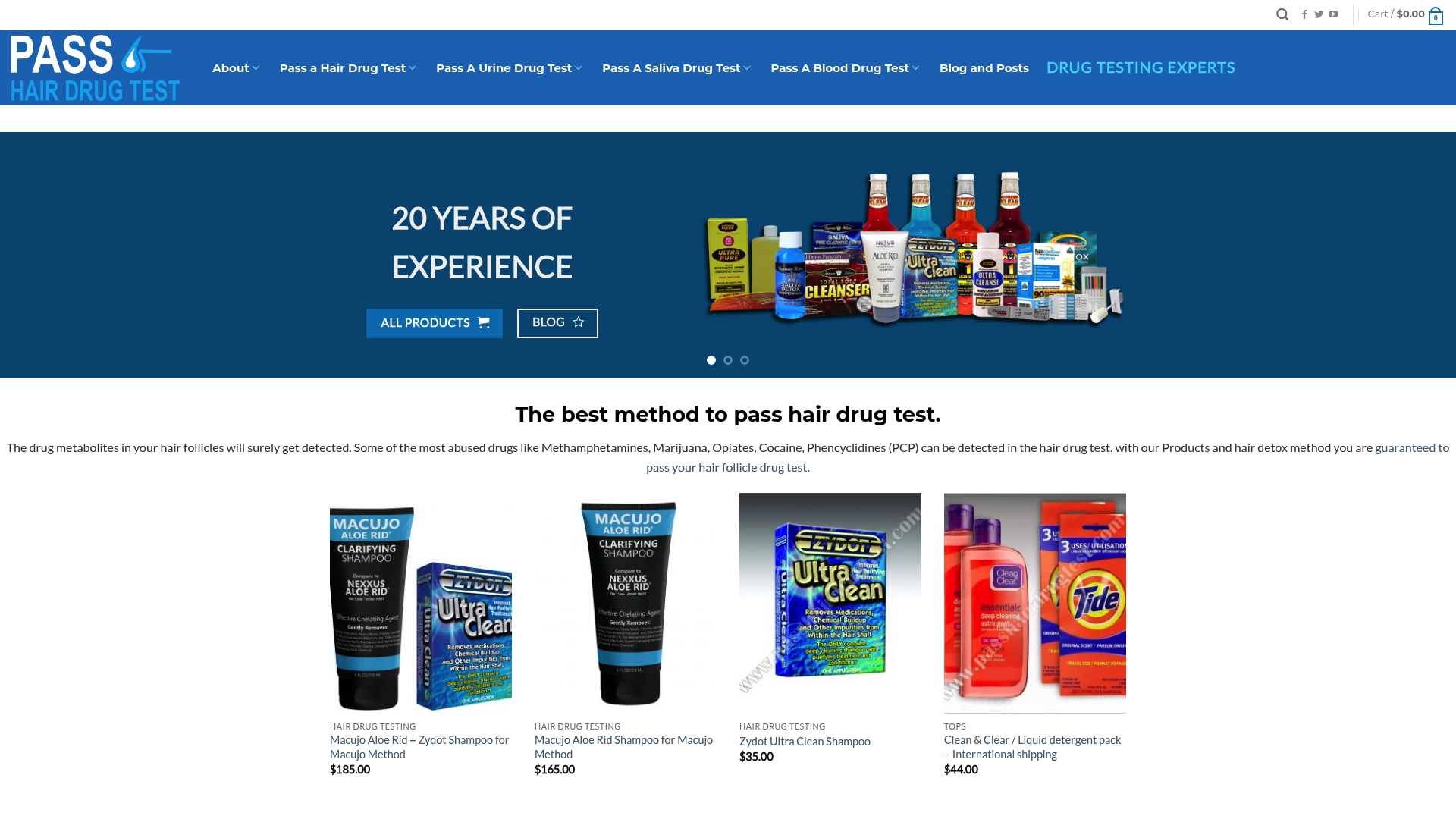
These products are designed for hair-shaft decontamination, not as guaranteed pass solutions. Using them correctly, following manufacturer instructions, and disclosing any treatments to your collector gives you the most defensible position going into the test. Passhairdrugtest has more than 20 years of experience in this space and provides detailed guidance alongside every product.
Browse the full range of hair testing shampoo kits or read the step-by-step preparation guide at Passhairdrugtest to find the option that fits your timeline and situation.
This article is general information, not medical or legal advice. Confirm current testing protocols with your collector, testing lab, or a qualified professional before your appointment.
Recommended
- Hair Drug Test Information – Pass Hair Drug Test
- Hair Follicle Drug Test – Best guaide for hair drug test – Pass Hair Drug Test
- Pass hair Drug Test
- How to pass hair drug test
