No products in the cart.

Uncategorized
90 Day Window Explained: Opioid Hair Detection Time and the 5–10 Day Lag

12
Sep
Sep
A standard hair follicle test covers roughly 90 days of history, because labs analyze the 1.5 inches of hair closest to the scalp, and that segment grows in about that span of time. But opioids don’t show up immediately. There’s usually a 5 to 10 day lag between use and detectability, and the actual window shifts depending on dose, hair type, and which lab method gets used.
TL;DR:
- Hair testing for opioids generally detects drug use up to 90 days, but the detection window varies with dose, hair type, and laboratory sensitivity.
- A delay of 5 to 10 days exists between opioid use and when the drug appears in hair, due to hair growth and deposition processes.
- Longer hair allows for segmental analysis, which can identify recent, occasional, or continuous use more precisely.
- Detection is influenced by factors like hair color, cosmetic treatments, and individual growth rates, which can lead to variability in results.
- Standard panels may miss synthetic opioids like fentanyl unless specialized, highly sensitive tests targeting these newer drugs are used.
Table of Contents
Table of Contents
- Opioids Hair Detection Time: What the 90-Day Window Really Means
- How Opioids Get Into Hair in the First Place
- What Changes the Detection Window From Person to Person
- Which Opioids and Metabolites Labs Actually Test For
- Screening, Confirmation, and What Cutoffs Actually Mean
- Reading a Result: What It Confirms and Where It Can Mislead
- Real-World Timelines: Single Use vs. Occasional vs. Chronic
- What the Research Still Hasn’t Settled
- Preparing for a Hair Test: What Passhairdrugtest Actually Offers
- Sources
- FAQ
Opioids Hair Detection Time: What the 90-Day Window Really Means
The 90-day figure isn’t arbitrary. It comes directly from how fast scalp hair grows and how much of it a lab needs to run a valid test.
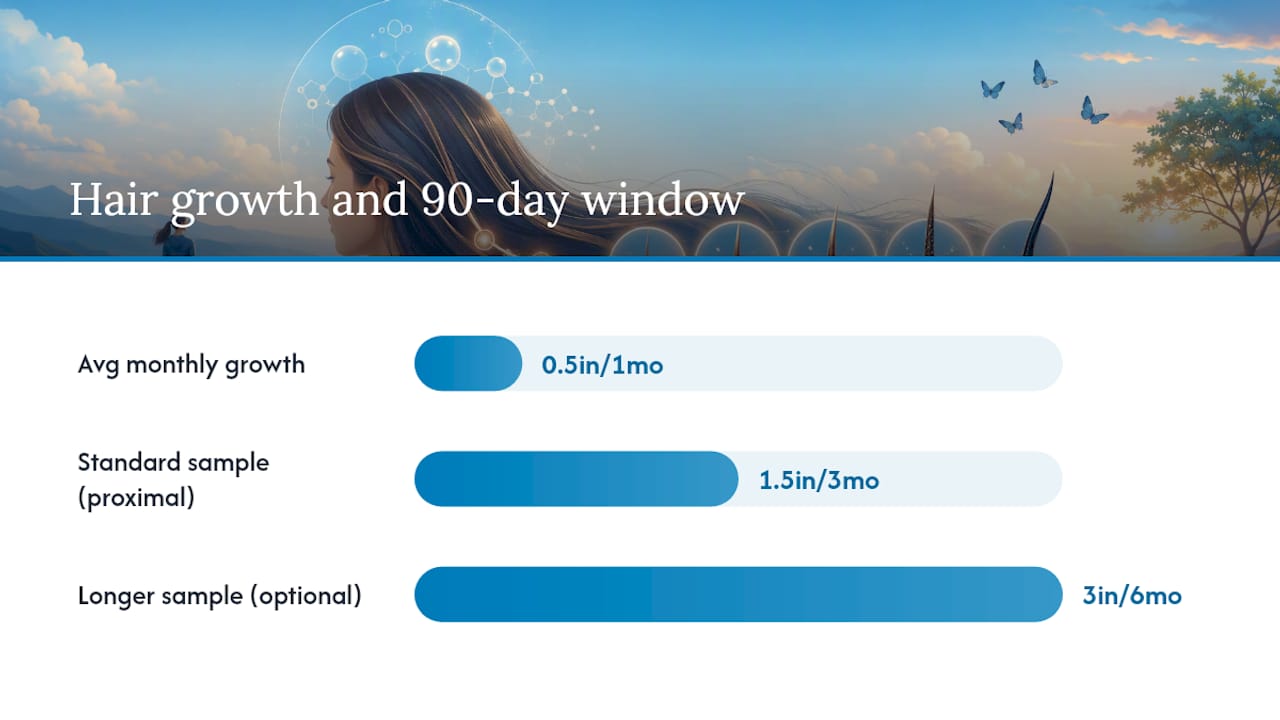
Scalp hair grows at an average rate of about half an inch per month. Take the standard 1.5-inch segment collected closest to the scalp, and you get a window of roughly three months, which is why Quest Diagnostics and other major labs anchor their standard test around that specific length. LabCorp’s testing guidance confirms the same baseline: drugs in hair are typically detectable for approximately 90 days, though the exact figure moves with dose, sensitivity of the assay, and how often someone used.
Collection specifics matter more than most people realize. Labs need about 100 milligrams of hair, which usually means 90 to 120 strands cut as close to the scalp as possible. If the sample gets taken from a spot further down the shaft, or if there isn’t enough hair to meet that threshold, the result can be unreliable or the test may need to be rerun using body hair instead.
Segmental analysis takes this a step further. Instead of testing the whole 1.5-inch piece as one lump, a lab can slice it into smaller sections, each representing a few weeks of growth, and test them individually.
- A single dark band appearing in only one 0.5-inch segment suggests a narrower window of use rather than months of continuous exposure.
- Detecting the drug across every segment points toward regular or chronic use throughout the full 90-day period.
- Segmental testing is more common in forensic and legal contexts than in routine employment screening, where a single combined result is standard.
This is also where hair length changes the math. A 3-inch sample doesn’t just double the detection window to six months automatically. Labs typically still test the proximal 1.5 inches for a standard result unless a longer window is specifically requested, which is why longer hair mainly opens the door to extended segmental testing rather than changing the default 90-day rule on its own.
How Opioids Get Into Hair in the First Place
Opioids don’t get deposited into hair the moment someone takes a pill. The process runs through the bloodstream, and understanding it explains both why detection takes time and why results occasionally get disputed.
- Bloodstream deposition during hair formation. As hair follicles build new hair, they draw on nutrients and compounds circulating in the blood, including opioid metabolites, which get bound into the hair’s protein structure (keratin) as it forms.
- Sweat and sebum contribution. Once hair emerges from the follicle, sweat and oil from the scalp can continue depositing trace amounts of drug residue onto the hair shaft, adding a secondary route beyond the original bloodstream incorporation.
- Growth to the surface. The newly formed hair, now carrying trapped compounds, has to grow up through the follicle and past the scalp line before it can physically be cut and tested.
- Possible external contamination. Hair can also pick up drug residue from the environment, secondhand smoke, or contact with contaminated surfaces, which is precisely why labs run a decontamination wash before analysis.
That third step is the reason hair testing has a built-in blind spot. New hair growth takes time to surface, so most labs and researchers put the lag between actual use and hair-detectable levels at roughly 5 to 10 days. Use opioids today, and a hair test collected tomorrow will likely miss it entirely, not because the drug isn’t in your system, but because the hair carrying that evidence hasn’t grown far enough to be cut and analyzed yet.
Labs address the contamination question with a specific pre-analytic protocol. Before any hair sample gets extracted and run through mass spectrometry, it typically goes through a wash step, often isopropanol combined with a phosphate buffer, meant to strip surface residue while leaving internally incorporated drug metabolites intact. The Society of Hair Testing’s consensus guidance lays out these steps in detail, and the choice of wash solvent, extraction heat, and pulverization method all affect how sensitive the final result turns out to be.
What Changes the Detection Window From Person to Person
Two people who used the same opioid on the same day can get different hair test results. That’s not a lab error. Several variables stack on top of each other to determine whether a substance shows up strongly, faintly, or not at all.
- Dose and frequency. A single low dose deposits far less drug into hair than daily use over weeks, and chronic users tend to show detectable levels across more segments and at higher concentrations.
- Route of administration. Injected or smoked opioids can reach the bloodstream faster and in higher peak concentrations than oral doses, which can influence how much gets incorporated into growing hair.
- Drug chemistry. Some opioids bind to hair protein more readily than others; morphine and codeine are well studied, while newer synthetic analogs behave less predictably.
- Hair color and melanin content. Darker, more heavily pigmented hair tends to bind and retain basic drugs, opioids included, more strongly than lighter or gray hair, which can produce a skewed result between individuals of different hair colors even at identical doses.
- Cosmetic treatments. Bleaching, perming, and repeated dyeing can strip a meaningful portion of drug residue out of the hair shaft, sometimes enough to push a borderline result toward a false negative.
- Individual growth rate. Not everyone’s hair grows at the textbook half-inch-per-month pace, so the same 1.5-inch segment might represent a slightly shorter or longer real-world window depending on the person.
Pro Tip: If you’ve recently bleached, permed, or double-processed your hair, understand that this can lower detectable drug concentrations, but it does not reliably eliminate them. Labs are aware of this pattern, and a low result on chemically treated hair isn’t automatically read as a clean one.
Chronic, heavy use adds another wrinkle: it doesn’t just raise the concentration. Research on opioid clearance from hair after someone stops using suggests that for some analytes, it can take up to six months from cessation to reach total negativity in hair segments, well beyond the standard 90-day window most people assume applies universally.
Which Opioids and Metabolites Labs Actually Test For
A hair opioid panel doesn’t test for one generic substance. Labs target a specific list of parent drugs and their metabolites, and which ones show up carries real interpretive weight.
- Codeine and morphine are the two most commonly targeted opioids, both because of their prevalence and because they’re chemically well characterized in hair matrices.
- 6-acetylmorphine (6-MAM) is heroin’s signature metabolite. Its presence is considered strong evidence of heroin use specifically, since 6-MAM doesn’t come from codeine or prescription morphine.
- Oxycodone and hydrocodone cover the two most widely prescribed opioid painkillers, along with their active metabolite, hydromorphone.
- Tramadol, methadone, and buprenorphine get included in broader panels, often relevant in treatment monitoring or pain management contexts rather than standard pre-employment screens.
- Fentanyl and fentanyl analogs represent the newest and hardest challenge for hair testing labs, given how potent and structurally varied these synthetic opioids can be.
Metabolites matter as much as the parent drugs, sometimes more. Glucuronide conjugates like morphine-3-glucuronide form specifically when the body metabolizes an opioid internally, which means their presence in hair is much harder to explain away as environmental contamination. Peer-reviewed LC-MS/MS validation work confirms labs can now quantify these glucuronide metabolites at trace concentrations, typically in the low picogram-per-milligram range, giving toxicologists a more defensible way to distinguish true ingestion from surface exposure.
Fentanyl poses a distinct problem. Because it’s active at such low doses, the amount that ends up incorporated into hair can sit near the floor of what even sensitive LC-MS/MS instruments can reliably measure. Studies analyzing real hair samples have detected fentanyl and furanyl-fentanyl at concentrations in the low picogram-per-milligram range, alongside 4-ANPP, a marker that can indicate exposure to fentanyl analogs even when fentanyl itself falls below the cutoff. A negative fentanyl result on a standard panel doesn’t necessarily rule out exposure. It may simply mean the assay used wasn’t built to catch it.
Screening, Confirmation, and What Cutoffs Actually Mean
A positive hair result rarely comes from a single test. Most labs run a two-stage process, and skipping straight to “positive” or “negative” misses how much analytical work happens in between.
The first stage, where labs use one assay, is a broader screening assay designed to flag samples that might contain an opioid above a general threshold. Anything that flags moves to the second stage: confirmatory testing by LC-MS/MS, the gold standard for both sensitivity and specificity in forensic and workplace drug testing. This step doesn’t just say “opioid detected,” it identifies the exact compound and quantifies it against a validated lower limit of quantification (LLOQ).
- Published literature and consensus guidance often reference cutoffs around 200 picograms per milligram for parent opioid compounds like morphine or codeine in hair.
- Glucuronide metabolite cutoffs tend to run lower than the parent compound cutoffs, reflecting their typically smaller concentrations relative to the parent drug.
- A result sitting just below the cutoff doesn’t necessarily mean zero exposure, it means the concentration didn’t clear the threshold the lab set for a confirmed positive.
- Sample extraction amount also affects sensitivity; some methods use as little as 10 milligrams of hair for high-concentration samples versus 25 milligrams when finer sensitivity is needed.
Labs report results in picograms per milligram (pg/mg) rather than simple positive/negative flags, precisely because concentration data lets toxicologists and reviewing physicians judge how strong or borderline a result actually is. Differences between labs, in wash protocols, extraction solvents, and instrument calibration, mean the same hair sample tested at two different facilities could theoretically produce slightly different pg/mg values, even while both agree on the qualitative outcome. That’s part of why validated methodology and consistent lab accreditation matter more than people assume.
Reading a Result: What It Confirms and Where It Can Mislead
A hair test result carries more nuance than a simple pass or fail. Knowing what strengthens a result, and what commonly undermines one, changes how it should be interpreted.
- Metabolite confirmation strengthens the case for ingestion. When a lab detects a glucuronide metabolite alongside the parent opioid, it’s much harder to argue the result came from touching a contaminated surface rather than actually consuming the drug.
- Contamination remains a real risk, especially for low-level positives. Secondhand exposure, contact with a partner’s residue, or even certain occupational settings can deposit trace amounts on hair without any ingestion at all, which is exactly why the pre-test wash step exists.
- Cosmetic treatments can create false negatives. Heavily bleached or chemically treated hair may show a concentration below the cutoff even when actual use occurred, simply because the treatment stripped part of the drug residue.
- Some synthetic analogs need a purpose-built panel. A standard opioid screen may not be calibrated to catch newer fentanyl variants, so a clean result on a generic panel isn’t the same as a clean result on a fentanyl-specific assay.
- Recent use calls for a different test entirely. Because of the 5 to 10 day incorporation lag, urine or oral fluid testing is the better tool for catching use within the past few days, while hair testing is built for spotting patterns of use over weeks or months, not last night’s decision.
Real-World Timelines: Single Use vs. Occasional vs. Chronic
Numbers on paper are one thing. Here’s how the detection window tends to play out in practice, based on usage patterns.
- Single use: Likely to be missed entirely if hair is collected within the first several days, since incorporation hasn’t caught up yet; detection becomes more plausible starting around 7 to 14 days out, depending on growth rate and how sensitive the lab’s assay is.
- Intermittent or occasional use: Tends to show up in whichever 1.5-inch (or smaller, if segmented) portion of hair corresponds to the timeframe of use, with segmental analysis able to pinpoint roughly which weeks the exposure occurred in.
- Chronic, regular use: Produces a stronger, more consistent signal across multiple segments, often with higher pg/mg concentrations throughout, and that signal persists until the affected hair is eventually cut, sometimes taking months beyond cessation to fully clear a standard test.
What the Research Still Hasn’t Settled
The 1.5-inch, 90-day rule is a solid working baseline, but it’s a baseline, not a guarantee. Individual growth rate, hair color, dose, and which lab ran the confirmatory analysis all pull that number in different directions, sometimes by weeks.
Metabolite confirmation, particularly glucuronide detection, is doing more of the interpretive work than it used to, because it separates genuine ingestion from surface contamination far better than testing the parent compound alone. Synthetic opioids are the real wildcard. Fentanyl and its analogs sit at concentrations low enough that older panels, built around morphine and codeine, can simply miss them. Expect labs to keep pushing toward lower detection limits and broader synthetic-opioid panels in the coming years, since hair testing’s core strength has always been long-term pattern detection, not catching last week’s use, and that strength only holds if the assay list keeps pace with what’s actually circulating.
— MIchael
Preparing for a Hair Test: What Passhairdrugtest Actually Offers
If you’re staring down a hair follicle test and wondering what your options actually are, some companies sell products built specifically for this scenario, rather than generic detox products repurposed for hair. The core lineup centers on Macujo Aloe Rid Shampoo and Zydot Ultra Clean Shampoo, used individually or together as part of the multi-step Mike’s Macujo Method, alongside complete shampoo kits for people who want the full process in one order.

No product on the market, from Passhairdrugtest or anywhere else, guarantees a negative result, and treat any site that claims otherwise with skepticism. What actually helps is starting early rather than the night before your appointment, reading the step-by-step application instructions closely, and understanding exactly how detox shampoo differs from a clarifying shampoo before you buy anything. If you want the full breakdown of how the Macujo Method works and which product fits your hair type, the hair follicle drug test guide walks through the process in detail, and you can browse the complete shampoo kit lineup to compare options before checkout.
Sources
- Hair testing — FAQ (Quest Diagnostics)
- Hair Drug Testing (LabCorp)
- Detection and quantification of opioid glucuronides in human hair by LC–MS-MS (Journal of Analytical Toxicology)
- Disappearance of codeine, morphine and 6‑MAM in hair after cessation of abuse (Forensic Science International)
- SoHT consensus document — Drugs of Abuse (2021)
FAQ
How long do opiates stay detectable in hair?
Standard hair follicle tests cover roughly 90 days, based on testing 1.5 inches of hair closest to the scalp, though chronic heavy use can sometimes require several months longer to fully clear.
Can a hair follicle test detect one-time use of alcohol?
Hair testing for alcohol typically relies on a different marker, ethyl glucuronide (EtG), rather than the opioid analytes discussed here, and a single, isolated drinking episode is far less likely to produce a detectable EtG level than sustained or heavy use.
Why can’t hair tests detect opioid use from yesterday?
New hair carrying trapped drug metabolites has to grow up through the follicle and reach a length where it can be cut, a process that takes about 5 to 10 days before it becomes detectable at the scalp surface.
Does hair color affect opioid detection results?
Yes. Darker, more heavily pigmented hair tends to bind and retain opioids more strongly than lighter hair, which means two people with identical use patterns can sometimes produce different concentration readings.
Is fentanyl harder to detect in hair than other opioids?
Fentanyl is active at such low doses that it can incorporate into hair at concentrations near the sensitivity floor of standard assays, so labs increasingly rely on targeted, high-sensitivity panels built specifically to catch it and related analogs.
Recommended
- How Long Does Meth Stay Detectable in Hair?
- LSD Hair Test: Forensic Reliability and Interpretive Limits
- Hair Drug Test vs Urine: Which Detects Use When
- Hair Drug Test Information
